How to Prepare for an Interview: A Plan From One Week Out
by Larbi SahliLast Updated
How to prepare for an interview: a one-week timeline, five stories that answer most questions, format-specific practice, and a night-before checklist.
On this page
To prepare for an interview, read the job posting and list what it will test, research the company and the people interviewing you, match five stories from your own experience to the likely questions, practice out loud in the format you'll face, and settle logistics the night before. Start a week out. Most of the work is matching your stories to their questions, and that part can't be crammed.
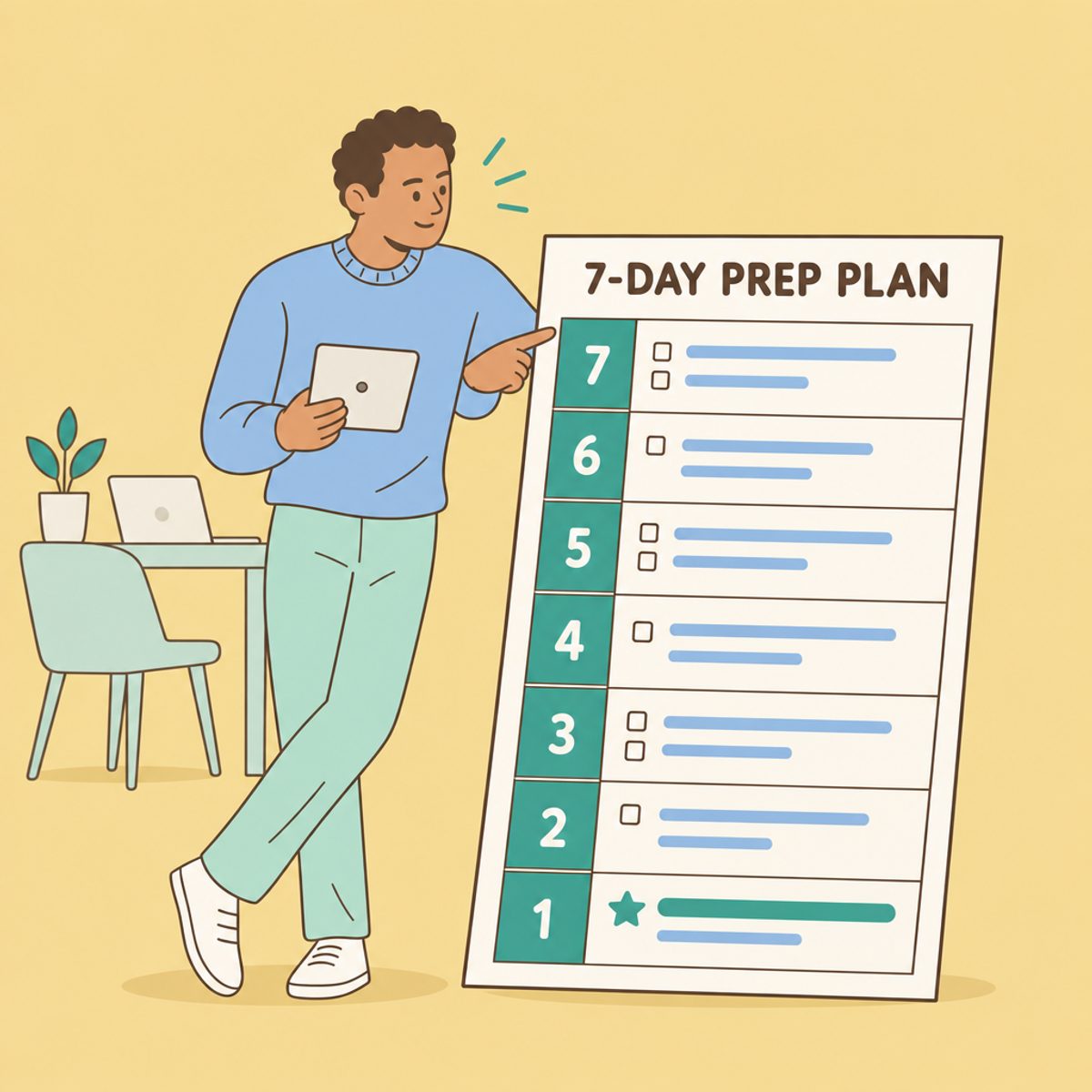
The one-week plan at a glance
Interview preparation fails in a predictable way: people spend the week collecting company trivia and the night before trying to memorize answers. The candidates who do well flip that. They spend the week figuring out what the interviewer needs to verify, attach a real story from their own history to each of those things, and rehearse the delivery out loud. Trivia takes an hour. Stories take days to get right.
Here is the timeline this article walks through, step by step.
| When | What to do |
|---|---|
| 7 days out | Read the posting twice. List the six to eight things the interviewer will test. Book time on your calendar for practice. |
| 5 to 6 days out | Research the company, the team, and your interviewers. Write down why you want this job in one honest sentence. |
| 4 to 5 days out | Pick your five stories and outline each one in four lines. Draft your two-minute introduction. |
| 2 to 3 days out | Practice out loud, in the format of the actual interview: phone, video, panel, or technical. Prepare your questions for them. |
| The night before | Logistics, outfit, tech check, one read-through of your story outlines. Then sleep. |
| The morning of | Re-read the posting for ten minutes. Warm up your voice. Arrive or log in early. |
| Within 24 hours after | Write your notes while they're fresh, then send the thank-you email. |
A week out: read the posting and list what the interviewer will test
The job posting is the interview's blueprint. Every requirement line will show up again as a question, usually a behavioral one. "Manages competing priorities" becomes "Tell me about a time you had to juggle deadlines." "Works cross-functionally" becomes "Tell me about a time you had to get another team to do something." The interviewer didn't invent their question list from scratch; they built it from the same document you're holding.
So read the posting twice. On the second pass, write down every requirement, then translate each one into the question it implies. You'll end up with six to eight items, and that list is your syllabus for the week. Everything else you prepare should map back to it.
Pay attention to what's repeated. If "stakeholder" appears three times, expect half the interview to be about influence and communication, and weight your practice accordingly. If the posting is thin, pull two or three similar postings from the same company or competitors and build the list from those.
Research the company, the team, and your interviewers
The goal of research is not to recite the founding year. It's to answer two questions convincingly: why this company, and why this role. Interviewers can tell within a minute whether your interest is specific or copy-pasted, and it changes how they read everything else you say.
| What you need to know | Where to find it |
|---|---|
| What the company sells and to whom | The homepage, product pages, and pricing page. If you can't explain the product in one sentence, keep reading. |
| How the business is doing | For public companies, the latest earnings coverage. For startups, funding announcements and what the CEO has said publicly about direction. |
| What the team you'd join actually ships | The company blog, engineering or product blog, case studies, and job postings from the same team. |
| Who is interviewing you | Their LinkedIn profiles: how long they've been there, what they did before, what they post about. Ask the recruiter for names if you weren't given them. |
| What current and former employees say | Employee review sites, read for patterns rather than individual complaints. |
| Recent news | A quick news search plus the company's LinkedIn page for the last three months. |
Interviewer research pays off twice. It tells you what kind of questions to expect, since a hiring manager probes depth while a peer probes collaboration, and it gives you material for the conversation. Noticing that your interviewer moved from a big company to this startup two years ago is a better closing question than anything generic.
Out of this research, write one sentence: the specific reason you want this job at this company. Not a flattering one, a true one. That sentence is the spine of your answer to "why do you want to work here?", and it will leak, usefully, into every other answer you give.
Five stories that answer most interview questions
You cannot prepare for every question, and you don't need to. Behavioral interviews recycle a small set of themes, so five well-chosen stories from your own experience will cover the large majority of what you're asked. Prepare the stories, not the questions.
- A win you drove, with a number attached. Covers "greatest accomplishment," "a project you're proud of," and most "tell me about a time you succeeded" variants.
- A disagreement or conflict you worked through. Covers conflict, difficult colleagues, pushing back on a decision, and handling feedback you didn't like.
- A failure or mistake, and what you changed afterward. Covers "tell me about a failure," "biggest weakness" in its honest form, and "a time you were wrong."
- A time you influenced people you had no authority over. Covers leadership, cross-team work, and persuasion questions at every level.
- A time you learned something hard, fast, or worked through real ambiguity. Covers "a time you were out of your depth," adaptability, and most curveballs.
Structure each story with the STAR method: situation, task, action, result, with most of your airtime on action and result. Write each story as a four-line outline, not a script. Scripts collapse under follow-up questions; outlines flex.
What the five stories look like at each career stage
Student or recent graduate. Your stories come from coursework, part-time jobs, clubs, and volunteering, and that's fine, because the interviewer is testing reliability, learning speed, and communication rather than a track record. The win: the capstone or group project where you carried a deliverable to the finish. The conflict: the group member who wasn't pulling weight and what you did about it. The failure: the exam, application, or project that went badly and what you changed. Influence: recruiting people for a club event or getting a professor to approve an unusual project. Learning fast: picking up a tool or skill under deadline for a class or a shift job.
Mid-career hire. The bar rises to independent scope. The win should carry a metric: the process you changed and what it saved, the launch and what it moved. The conflict story should involve a peer or a stakeholder, not a subordinate. The failure should show judgment maturing, a call you'd make differently and the checkpoint you've added since. Influence: the time you got a resistant team to adopt your approach. Learning: the domain or system you had to master mid-project.
Career changer. Your stories come from the old field, deliberately. The interviewer's real question is whether your experience transfers, so pick stories where the skill is visible under the different job title: managing competing demands, handling difficult people, delivering under pressure. Then close each story with one explicit sentence connecting it to the new role. If this is you, the framing work starts well before the interview; the career change guide covers how to position the whole move.
Senior candidate. Scope is the story. The win should be organizational: a team you built, a turnaround you led, a bet you made with real money behind it. The conflict story should be a hard one, a peer executive or a board-level disagreement, because interviewers at this level distrust candidates whose conflicts all sound small. The failure should be expensive and honestly told; senior interviews die on defensiveness faster than on the failure itself. Influence and learning stories should show you operating through others, not doing the work yourself.
The hard part is the mapping: seeing which of your experiences answers which question. If you're staring at your own history and drawing a blank, Roleframe does this mapping from your resume. Remi, its career copilot, reads what's actually on the document, builds the questions an interviewer is likely to ask about your specific experience, then runs a practice round: one question at a time, you answer, and it tells you where the answer was thin. The questions come from your real history, so the practice produces your true stories rather than a generic list to memorize.
Two or three days out: practice out loud, for the format
Answers that read well on paper fall apart when spoken. The only fix is saying them out loud, several times, until the outline comes out naturally in slightly different words each run. Record yourself once on your phone. It's uncomfortable and it will show you exactly what to fix: the answer that runs three minutes when it needs one, the filler words, the mumbled result at the end of a good story.
Start with your introduction, because "tell me about yourself" opens almost every interview and sets the tone for the rest. Use a present-past-future shape, keep it under two minutes, and land it on why this role. There's a full walkthrough in how to answer "tell me about yourself".
Then adapt your practice to the format you're actually facing, because each one punishes different weaknesses.
Phone interview
A phone screen is usually a recruiter checking basics: interest, communication, logistics, and salary. Your voice carries everything, so stand up or sit forward, and smile while you talk; it's audible. Take the call somewhere quiet with your resume and your story outlines in front of you, one advantage of the phone format worth using. Expect the compensation question here and have a researched range ready; how to answer the salary expectations question covers the exact wording. Keep answers shorter than you would in person, since silence on a phone line reads as rambling faster.
Video or virtual interview
Test everything two days before, not two minutes before: the platform, your camera, your microphone, your link. Put the camera at eye level and light your face from the front, since a window behind you turns you into a silhouette. Look at the camera, not the screen, when you deliver your key points; it reads as eye contact. Close every other app, silence notifications, and have a fallback ready, meaning your phone charged with the same app installed, in case the laptop fails. A sticky note beside the camera with your five story titles is legitimate; reading full answers off a second screen is obvious and costs you credibility.
Panel interview
Get the panelists' names and roles from the recruiter beforehand, and spend ten minutes on each person's background. In the room, answer the person who asked, then bring your eyes to the others as you finish; ignoring the quiet panelist is the most common panel mistake. Expect faster follow-ups, since one panelist's probe often triggers another's, and don't be thrown when they take notes at odd moments; panels are usually scoring against a rubric. Prepare one closing question that fits each role on the panel: depth for the hiring manager, day-to-day reality for the peer.
Technical test or case interview
Practice under real conditions. If it's a live coding round, practice in a bare editor with someone watching, not alone in your own setup. If it's a case, practice structuring a problem out loud with a friend playing interviewer. In both formats, thinking out loud is most of the score: the interviewer wants your reasoning, and a wrong answer reasoned well often beats a right answer produced silently. Ask clarifying questions before you start solving; jumping straight in is graded as a mistake in itself.
Prepare your questions for them
Bring three to five questions, and make them ones you actually want answered. Strong options: "What does great look like in this role after six months?", "What's the hardest part of this job that isn't in the posting?", and "What made the last person who succeeded on this team succeed?" Skip questions about salary and vacation in early rounds, and skip anything the website answers, since that just proves you didn't look.
Preparing with no experience, after a gap, or with short jobs to explain
No experience
Interviewers hiring for entry-level roles are not expecting a work history; they're testing whether you show up prepared, communicate clearly, and learn fast. That means preparation itself is your differentiator, and it's the one thing fully in your control. Build your five stories from school, part-time work, volunteering, sports, and personal projects, and don't apologize for the sources. A story about calming an angry customer during a weekend retail shift answers the conflict question as well as any office anecdote, because the skill is identical. Prepare one extra answer: "why this field?", since career-start interviews almost always probe motivation.
After an employment gap
Decide your one-sentence explanation before the interview, deliver it in a flat, unapologetic tone, and move immediately to the present: what you did during the gap that's relevant, and why you're ready now. Rehearsed once out loud, the gap question takes ten seconds; unrehearsed, it becomes a three-minute apology that colors the whole interview. The framing advice in how to explain an employment gap without apologizing applies word for word to the spoken version.
Several short jobs
If your resume shows three roles in four years, the interviewer will ask, so prepare the pattern answer rather than three separate defenses. One honest through-line, "I was chasing scope and kept outgrowing the role, and this position has the scope I've been looking for," beats three excuses. Never blame each employer in turn; a candidate with three bad-boss stories reads as the common factor. Then redirect to evidence of commitment: what you shipped in each role despite the short tenure.
The night before and the morning of
The night before an interview is for logistics and rest, not for learning anything new. Cramming trades sleep for information you won't retain, and a tired candidate underperforms a slightly less prepared one every time. Run this checklist, then stop.
- Confirm the time, and the timezone if the interview is remote. This is the single most avoidable interview disaster.
- Confirm the place: the address and parking for in-person, or the meeting link and platform for virtual. Open the link once to make sure it works.
- Write your interviewers' names on your notes page, spelled correctly.
- Prepare your one-page notes: the five story titles in one line each, your one-sentence "why this company," and your three questions for them.
- Print two copies of your resume for an in-person interview, and keep the PDF on your phone as backup.
- Lay out your outfit. One step more formal than the company's daily dress code is the safe default.
- Charge your phone and laptop. For a video interview, do the final tech check now, not in the morning.
- Set two alarms. Go to bed at your normal time.
The morning of: re-read the posting and your story outlines for ten minutes, no more. Talk to someone, or read a paragraph aloud, so the interview isn't the first time you've used your voice that day. Arrive ten to fifteen minutes early in person, which means arriving in the area thirty minutes early and waiting nearby. For a virtual interview, join three to five minutes before the start.
Preparation mistakes that cost offers
Some preparation actively hurts. These are the patterns I've seen sink otherwise strong candidates.
- Memorizing scripts. A word-for-word answer sounds recited, and the first follow-up question derails it completely. Outline the story, then say it differently each practice run.
- Researching trivia instead of the job. Knowing the founding year impresses no one. Knowing what the team shipped last quarter changes the conversation.
- Winging the introduction. "Tell me about yourself" opens nearly every interview, and an unprepared answer rambles through your resume in chronological order for four minutes. Prepare it first.
- Preparing zero questions. "No, I think you covered everything" reads as low interest, and low interest loses close decisions.
- Ignoring the format. A great in-person candidate can bomb a panel by talking to one person, or a video call by reading off a second screen. Practice the format you'll actually face.
- Trash-talking a former employer. Even when justified, it transfers the negativity to you. Keep past-job answers factual and forward-looking.
- Dodging the salary question. "I'm flexible" costs money and looks unprepared. Research a range and say it.
- Cramming past midnight. Sleep beats one more rehearsal, without exception.
After the interview: notes first, then the thank-you
Within an hour of walking out, write your notes: every question they asked, which of your answers felt thin, each interviewer's name and what they seemed to care about, the stated next steps, and your own honest read on the role. These notes make round two dramatically easier, and if you're interviewing at several companies, they're the only way the processes don't blur together.
Send the thank-you email within 24 hours. Keep it short, reference one specific moment from the conversation, and restate your interest in a single sentence; there are six ready-to-adapt versions in thank you email after an interview. If the stated decision date passes with silence, one polite follow-up is fine. Then keep applying elsewhere; the best cure for post-interview anxiety is the next interview on the calendar.
Frequently asked questions
- What are 5 things you should do before an interview?
Read the job posting and list what it will test. Research the company and your interviewers. Prepare five stories from your own experience that cover the likely behavioral questions. Practice out loud in the format of the interview, whether phone, video, panel, or technical. Settle logistics the night before: time, place or link, outfit, and copies of your resume.
- What are the 10 most common interview questions?
Tell me about yourself. Why do you want to work here? Why should we hire you? What are your strengths? What's your biggest weakness? Tell me about a challenge or conflict you handled. Tell me about a failure. What accomplishment are you proudest of? What are your salary expectations? And finally, do you have questions for us? Notice that the five stories described above cover most of the middle of that list.
- What are the 5 C's of interviewing?
The 5 C's is a coaching mnemonic, and the exact list varies by who's teaching it. A common version is competence, confidence, communication, character, and curiosity: prove you can do the job, deliver answers without hedging, speak clearly and concisely, show integrity in how you talk about past employers, and ask real questions. Treat it as a checklist for how you come across, not something to recite. The stories and practice do the actual work.
- How do I introduce myself in an interview?
Use a present-past-future shape in under two minutes: who you are professionally now, the one or two past experiences most relevant to this role, and why this job is the logical next step. Lead with your current role and a concrete result, not your birthplace or your degree from a decade ago. Practice it out loud until it flows without sounding memorized, because it's almost always the first question and it sets the tone for everything after.
- How long should I spend preparing for an interview?
Spread five to eight focused hours across the week before, rather than one long session the night before. Spaced practice is how the stories become natural instead of recited, and out-loud rehearsal needs at least two separate sessions to show improvement. For a short recruiter phone screen, a focused evening covering the posting, your introduction, and the salary question is enough.
- How do I prepare for an interview the night before, if that's all the time I have?
Triage. Spend twenty minutes on the posting and translate its requirements into likely questions. Pick three stories, a win, a conflict, and a failure, and outline each in four lines. Practice "tell me about yourself" out loud three times. Write down two questions to ask them, confirm the time and the link or address, lay out your clothes, and go to bed. Skip company deep-research beyond the product and the latest news; a rested candidate with three solid stories beats an exhausted one with fifteen facts.

Ready to start your new resume?
Writing a resume takes time, and even a polished one can miss what a hiring manager is looking for. Roleframe helps you build a clear, ATS-safe resume in minutes and tailor it to the job you want.


