Questions to Ask During an Interview (and Three to Avoid)
Ten questions to ask during an interview, what each answer reveals, what a bad reply sounds like, and the three questions that quietly cost people offers.


On this page
You get maybe ten minutes at the end of an interview to ask your own questions, and interviewers weigh those minutes heavily. A candidate who asks nothing looks uninterested. A candidate who asks "what's the culture like?" looks like every other candidate. The ones who get remembered ask questions that show they thought about this specific job, and then actually listen to the answer.
That last part is where most advice falls short. Every list of questions to ask during an interview gives you the questions; almost none tells you how to read the reply. "Why is this role open?" is a fine question, but its value lives in what the hesitation, the vagueness, or the straight answer tells you about the job you're about to take. So every question below comes paired with what a good answer sounds like and what a bad one sounds like.
One rule before the list. An interview is a two-way evaluation, and your questions are the only instrument you have on your side of the table. Spend them on things you can't learn from the company's website, and never on things the recruiter already told you.
The ten questions worth asking, and what each one tells you
You won't get through all ten in one conversation, and you shouldn't try. Pick the four or five that match what you most need to know, and save the rest for later rounds. The last one on this list is the exception; ask it every time.
1. "Why is this role open?"
The highest-yield opener, because every honest answer teaches you something. Growth is the good version, and it sounds specific. "We closed a new enterprise segment and need a second account executive for the East Coast" tells you the role is funded and attached to revenue. A backfill is neutral until you hear why the person left; promotion is a good sign, and a resignation deserves one polite follow-up. "It didn't work out" is a yellow flag, and "it didn't work out" twice in a row for the same seat is a red one.
A bad answer is vague or defensive. If the interviewer can't say why the role exists, the role is probably not well defined, and poorly defined roles are where new hires fail through no fault of their own.
2. "What would you need to see from me in the first six months to call this hire a success?"
This tests whether success has been defined before you arrive. A good answer names two or three concrete outcomes, like "own the on-call rotation solo" or "get the migration shipped by Q3." You now know exactly what to say yes to.
The bad answer is "get up to speed and see where you can add value." Nobody has thought about it, which means you'll be measured against a target that moves after you start. A different bad answer lists outcomes that describe three separate jobs; the headcount was approved for a title, and the plan is you.
3. "What's the hardest part of this job that isn't in the posting?"
Job postings are marketing. This question asks for the disclosure document. A good answer is specific and slightly uncomfortable. "Our biggest client calls the project manager directly and expects same-day answers" is a gift, because now you know what you'd be signing up for and can decide with your eyes open.
"Honestly, nothing comes to mind" is the answer to worry about. Either the interviewer doesn't know the job well enough to be interviewing for it, or they've decided you can't handle the truth. Both are information.
4. "When the team disagrees on something that matters, how does it get resolved?"
Culture questions get you slogans; this gets you culture in operation. A good answer names a mechanism, ideally with an example. Maybe decisions go to a written doc, maybe a design review settles it, maybe one named person breaks ties and everyone knows who.
The bad answer is "we're all pretty aligned." Every functioning team disagrees. A team that claims otherwise either avoids conflict until it explodes or has one person deciding everything, and the interviewer just told you which without realizing it.
5. "Who will I work with most outside the team, and where does that relationship get hard?"
The org chart never shows friction. This question does, and friction with a partner team shapes your daily experience more than almost anything else you can ask about. A good answer admits a real tension, like "sales commits to dates before engineering has scoped the work, and this role sits in the middle of that."
"Everyone here is collaborative" is the answer that should worry you, for the same reason as the no-disagreements answer above. Universally smooth cross-team relationships do not exist, so someone is choosing to describe them anyway.
6. "What separates someone who's been great in this role from someone who was just fine?"
This surfaces the actual evaluation criteria, which often differ from the job description. A good answer is behavioral and specific. "The great ones flag risks before I have to ask" or "they built relationships with the support team before they needed them" tells you what to demonstrate in your remaining rounds and what to do in your first month.
A bad answer recites the posting back at you. That means the posting is the sum total of the thinking anyone has done about this role, and you'll be discovering the real criteria by tripping over them.
7. "What's the one thing this team has to get right this year?"
You're checking whether the role attaches to a funded priority or floats at the edge of one. A good answer arrives without hesitation, and you can hear how your seat connects to it. Roles tied to the priority get resources, visibility, and patience; roles that aren't tied to anything get reorganized.
Bad answers come in two flavors. The interviewer can't name one thing, which suggests the team lacks direction, or names five, which suggests it lacks focus and you'd inherit the ambiguity.
8. "How do you like to stay informed about work in progress?" (hiring manager only)
You are interviewing your future manager's style before you've signed anything, which is the only time you can do it cheaply. A good answer is a concrete cadence, like a weekly one-on-one plus async updates, or "bring me problems early, I hate surprises more than bad news."
Watch for two failure modes. "I'm very hands-off" with nothing behind it often means absent until something breaks, then suddenly present. And an answer that implies daily oversight of a senior hire tells you the autonomy in the posting is decorative.
9. "Tell me about the last person promoted from this team. What did they do to get there?"
Every company claims a growth path. This question asks for evidence, and evidence sounds like a story about a specific person. "Maria came in as a coordinator, took over vendor management when we lost a lead, and got promoted last spring" is the answer you want, because it proves the path has been walked.
A long pause followed by "we're rolling out a new career framework" means promotions from this seat are theoretical. That's survivable if you're joining for other reasons, but you should know it going in rather than discover it at your second annual review.
10. "What are the remaining steps, and when will I hear from you?"
Ask this every time, and ask it last. Hiring processes have gotten longer and rounds have multiplied, so pin down how many stages remain, who is in them, and a date by which you'll hear something. You're allowed to be direct here; logistics questions signal professionalism, never desperation.
The answer doubles as a diagnostic. An interviewer who lays out the next steps crisply usually works inside a process that runs crisply. One who can't tell you what happens next is describing, without meaning to, what the next month of your candidacy will feel like.
Match the question to the person in the room
A great question aimed at the wrong person gets a useless answer. Recruiters can't tell you about the codebase, and engineers can't tell you about the compensation band. Sort your questions by audience before the loop starts, because each stage gives you access to different information.
| Who you're talking to | What they actually know | Spend your questions on | Don't waste them on |
|---|---|---|---|
| Recruiter / HR screen | Process, timeline, salary band, logistics, how the company hires | Salary range, remaining stages, who you'll meet, scheduling and start-date flexibility | Team dynamics, technical detail, what the day-to-day feels like |
| Hiring manager | The job itself, success criteria, team health, their own management style | Questions 1 through 9 above, especially success criteria and how they manage | Salary specifics, benefits fine print, PTO policy |
| Future teammates / panel | What the work actually feels like, unwritten norms, whether the manager's story checks out | "What does a normal Tuesday look like?" and "What would you change about how the team works?" | Anything that sounds like you're auditing their boss |
| Executive / skip-level (final round) | Strategy, funding, where the team sits in company priorities | How the company decides what to invest in, and where this team fits this year | Tactical details they're too far from to answer well |
Teammates are your verification layer, and that's worth planning for. If the manager said the team ships weekly and a teammate winces when you ask what a normal week looks like, believe the wince. People rarely contradict their manager out loud, but body language and careful phrasing leak the truth constantly.
What to ask when you think the team is in trouble
Sometimes you walk in with a suspicion. The role has been reposted, your interviewer looked exhausted, or the reviews mention a reorg every third paragraph. You can't ask "is this team a mess?" directly, so you triangulate with questions that are individually innocent.
- "How many people have joined or left the team in the past year?" A team that lost a third of its people in twelve months has a story, and you need to hear that story before you join it.
- "How long has this role been open, and has anyone held it recently?" A seat that's been empty for many months, or filled twice in two years, points at either the role's design or the manager.
- "What's changed on the team in the last six months?" Listen for a reorg, a new manager, or a cancelled project. One change is normal. Three at once is turbulence.
- "How is this team's work viewed by the rest of the company?" Squirming here suggests the team is under pressure, under-resourced, or under threat.
Listen for candor rather than for perfect answers. A manager who says "we lost two strong people to a competitor, and I've changed how I run one-on-ones because of it" is telling the truth and learning from it, which is about the best you can ask of anyone. Deflection is the real warning sign, along with nervous humor and answers that blame every departure entirely on the departed. Trouble disclosed is manageable. Trouble concealed is what makes you quit in month four.
Scope, headcount, and budget questions for senior roles
Past a certain level, the interview stops being about whether you can do the work and becomes about whether the company will let you. Titles are cheap. Scope is what you're actually negotiating, and it's far easier to pin down before an offer than after you've started.
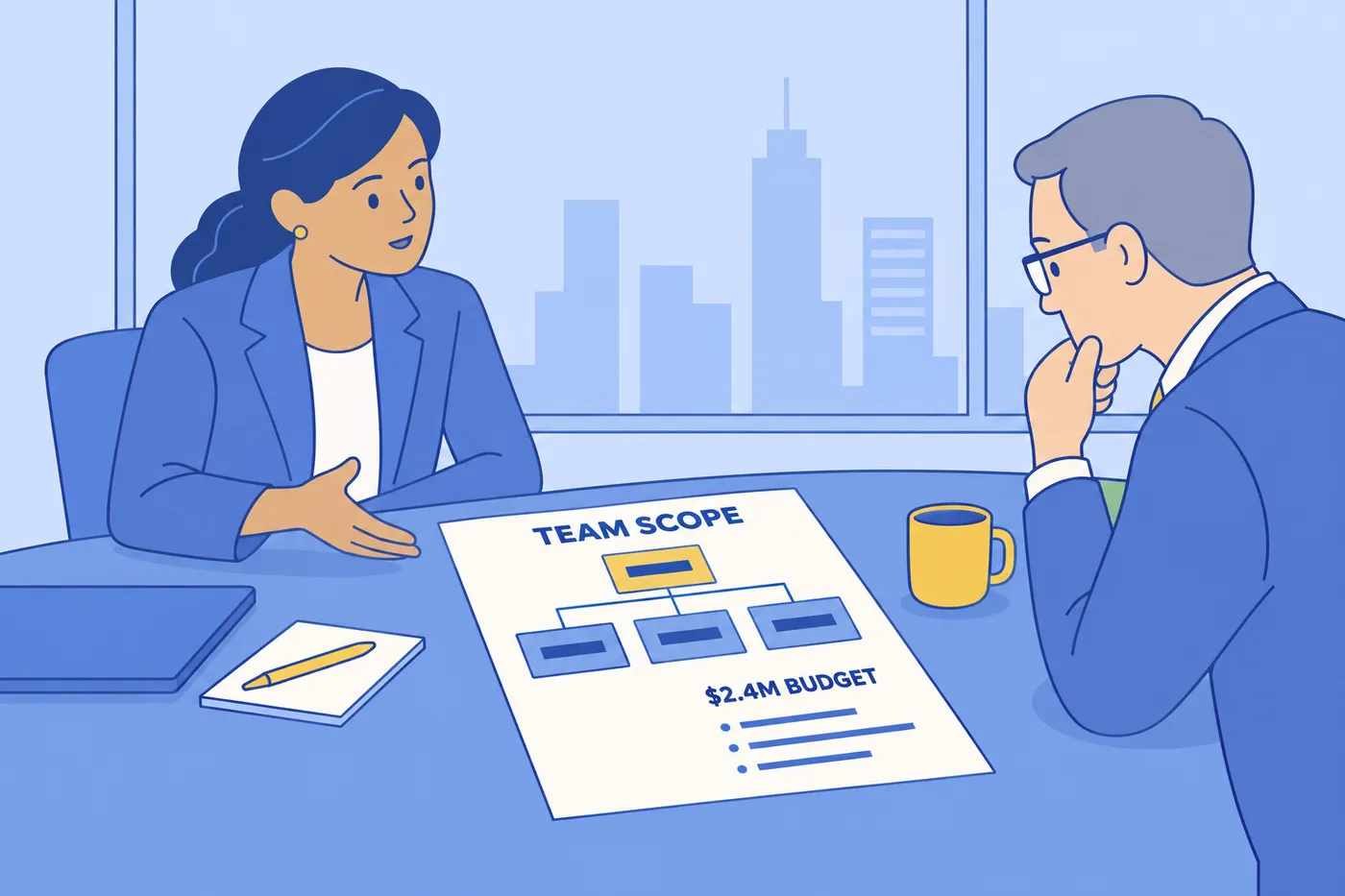
- "Is the headcount plan for this team approved, or aspirational?" Plenty of senior hires join to "build a team" that finance never signed off on. Approved requisitions come with numbers and dates. Aspirations come with adjectives.
- "What budget does this role own, and who approved it last year?" You don't need the figure in a first conversation. You need to confirm a budget exists and learn who actually controls it.
- "What decisions can this role make without escalation?" If the answer is a long pause, the role is execution work wearing a leadership title.
- "Who did this role report to a year ago?" A reporting line that moved twice in eighteen months means the organization hasn't decided what this function is for, and you'd be the next person to absorb that indecision.
- "Who is the executive sponsor for this work, and how involved are they?" Senior roles die quietly when their sponsor leaves or loses interest, so find out how much of the mandate rests on one person.
The pattern in bad answers here is deferral. "We'll figure that out together" sounds collaborative, and for a junior role it genuinely can be. For a director-level hire it usually means the company wants senior output without granting senior authority, which is a common reason executives walk inside their first year. Get the scope in writing where you can, and treat a refusal to be specific as an answer in itself.
Asking about salary, and when in the process to do it
Ask the recruiter, on the first call, plainly. Something like "Can you share the budgeted range for this role, so we can confirm we're aligned before going further?" works because it frames the question as protecting everyone's time, which it does. A growing number of postings now include a range, sometimes because local law requires one; when the range is posted, confirm it's current and ask where in it the team typically lands for someone with your background.
What costs people offers is timing more than the topic itself. Raising compensation with the hiring manager in the middle of a panel round signals that you don't understand who owns what. The recruiter owns money and process, while the hiring manager owns the job. Respect those lanes and nobody flinches. If you're the one asked to name a number first, that's a different conversation with its own playbook; we've covered how to answer the salary expectations question separately.
At the final round, salary comes back to the table, and by then it's fine to talk specifics with whoever is closing you. You'll have maximum information and they'll have already decided they want you, which is exactly the order you want those two things to happen in.
Three questions that cost people offers
Interviewers rarely tell you a question hurt you. It just shows up later as a lukewarm scorecard and a polite rejection. These three come up constantly, and each one has a safer version that gets you the same information.
1. Anything the website already answers
"So what does the company actually do?" ends interviews. So does asking about a product the company launched to headlines, or a funding round announced last month. The interviewer reads it as ten minutes of preparation you chose not to do, and preparation is the cheapest interest signal there is.
The fix is to push one layer past the public information. Instead of asking what the company does, try "the site describes X as the big focus this year; what does that translate to for this team's roadmap?" You get real depth and credit for the homework in the same breath.
2. "How fast can I get promoted?" in a first interview
Ambition is fine. What stings is asking about your exit from a job before anyone has offered you the job. "How quickly could I move into management?" and "when could I transfer to another team?" both tell the hiring manager you see this role as a waiting room, and no manager staffs a waiting room enthusiastically.
The safe version is question nine from the list above. Asking about the last real promotion off the team gets you the honest growth picture, grounded in evidence, without announcing that you're halfway out a door you haven't walked through yet.
3. Anything that sounds like "what can I get away with?"
"How strictly do you track hours?" "Is the return-to-office policy actually enforced?" "How closely is remote work monitored?" Each of these is a legitimate concern wrapped in the worst possible framing, because what the interviewer hears is a compliance problem shopping for loopholes before day one.
Flexibility questions belong with the recruiter, stated as requirements rather than probes. "I do my best work with some schedule flexibility; how does the team handle that?" is direct, adult, and answerable. If the answer matters enough to change your decision, it matters enough to ask straight.
What to ask on a final round that you couldn't ask earlier
The final round has two properties earlier rounds don't. You're talking to people with real authority, and the company has already invested enough in you that hard questions read as seriousness rather than presumption. Use both.
- "What would my first two weeks look like?" It assumes the close, which is fine at this stage, and the answer tells you whether an onboarding plan exists or you'd be inventing your own job.
- "How will the final decision be made, and by whom?" Structured processes have a ready answer. "We'll huddle and go with our gut" is worth knowing before you spend two weeks waiting on a verdict.
- "What's the company's biggest bet this year, and how does this team contribute?" Executives enjoy this question, and the answer tells you whether your team is core to the plan or peripheral to it.
- "Is there anything in my background giving you hesitation that I could speak to?" The concerns question, on which reasonable coaches disagree. My take is below.
The concerns question is worth asking, with one condition. You have to be able to hear the answer without arguing. Asked well, it surfaces an objection while you can still address it, instead of after the rejection email when you can't. If the interviewer names a gap, respond with evidence, briefly, then let it go; two sentences of specifics beat five minutes of defense every time. The best insurance is walking in with proof ready, and the STAR method gives you a structure for building those stories in advance. If you know you can't resist litigating a criticism, skip the question. A defensive final impression costs more than an unaddressed doubt.
Taking notes without looking like a stenographer
Taking notes in an interview is a good look, in moderation. It signals you treat the conversation as information you plan to act on. The failure mode is the stenographer, head down, transcribing every word, no eye contact, and interviewers read that posture as absence.
Ask once at the start. "Do you mind if I jot a few things down?" Nobody says no, and asking marks you as considerate. In person, paper beats a laptop, since a screen between you and the interviewer is a wall and typing sounds like typing. On a video call, mention that you're taking notes so your glances down aren't misread as reading from a script.
Then keep it to keywords. Three or four words per answer, written while holding eye contact as much as you can, the way you'd take notes in a meeting with your own boss. The full write-up happens in the ten minutes after you leave, while the details are still warm. Those notes earn their keep again the same evening, because a thank-you email that references something specific the interviewer said beats a template every time, and you can't reference what you didn't write down.
One more preparation habit worth building. If you keep a tailored resume for each job in Roleframe, you can ask Remi, its career copilot, to run interview practice built from what's actually on your resume and the posting attached to that version. It asks one question at a time, you answer, and it tells you where the answer was thin. Rehearsing your side of the table frees up attention for reading theirs, which is what everything above depends on.
Frequently asked questions
- What are the 5 best questions to ask an interviewer?
If you're picking five, take these. Why is this role open? What would you need to see from me in the first six months to call this hire a success? What's the hardest part of this job that isn't in the posting? What separates someone great in this role from someone who was just fine? And what are the remaining steps and when will I hear from you? Together they cover the role's origin, its success criteria, its real difficulty, the evaluation bar, and the process, which is most of what you need to make a good decision.
- What are three good questions to ask in a job interview?
When time is short, ask why the role is open, what success looks like at six months, and what the next steps and timeline are. The first tells you the role's history, the second tells you whether success has been defined, and the third protects you from weeks of silence. Three well-chosen questions with real listening beat ten fired off a list.
- How many questions should I prepare for an interview?
Prepare eight to ten and expect to ask three to five. Interviews answer some of your questions along the way, and asking something that was already covered is worse than asking nothing. Having a deep bench means you can drop the answered ones and still finish strong, including the next-steps question, which you should ask every single time.
- Is it OK to ask about salary in the first interview?
With a recruiter, yes, and you should. "Can you share the budgeted range for this role?" on the first screen saves everyone from a mismatch three rounds later, and recruiters expect it. What hurts you is raising compensation with the hiring manager mid-panel, because pay belongs to the recruiter's lane and the job belongs to the manager's. Save the detailed negotiation for the final round or the offer stage.
- Is it bad if I don't ask any questions in an interview?
Yes. "No questions" reads as low interest or low preparation, even when you're simply tired at the end of a long final-round day. If everything you cared about was genuinely answered, say so, name one answer that stood out, and then ask about next steps and the decision timeline. That takes thirty seconds and leaves the impression of someone who was paying attention.
- Can I ask how my interview will be evaluated?
You can, and with a recruiter it's a smart question. Asking about the format, who you'll meet, and how the team evaluates candidates signals that you take the process seriously, and companies with structured interviews will answer readily. If the process includes an automated or AI-driven screening step, it's reasonable to ask how human review fits in. A company that can't describe its own evaluation process is telling you something about how decisions get made there.


Ready to start your new resume?
Writing a resume takes time, and even a polished one can miss what a hiring manager is looking for. Roleframe helps you build a clear, ATS-safe resume in minutes and tailor it to the job you want.


