Analytical Skills: Examples, Practice Tasks and Resume Proof
What analytical skills are, examples with observable actions, a worked scenario, a practice drill, and how to prove analytical skills on your resume.


On this page
Analytical skills help you break a problem into parts, find patterns in evidence and explain what those patterns mean for a decision. In the World Economic Forum’s Future of Jobs Report 2025, about seven in ten surveyed employers identified analytical thinking as a core skill.
Most pages on this topic hand you a list of adjectives: critical thinker, detail-oriented, logical. None of that is checkable, and a recruiter can't act on it. This guide does something different. For each example you get the task, the observable action, the artifact you could show someone, and the follow-up question an interviewer would ask. Then a worked scenario, a self-assessment, a practice drill, and the resume bullets that turn "analytical" from a claim into evidence.
What analytical skills are (and what they are not)
Analytical skills combine gathering information, evaluating what the evidence supports and drawing a conclusion you can defend. Frame the question, check the data, choose a method, interpret the result and explain its implications.
Analytical skill is not the same as tool proficiency. SQL and Excel can help you work with data. Deciding whether repeat contacts or ticket volume is the more useful measure requires reasoning about the question. Both the tool and that reasoning may matter for a role.
Analysis does not always require advanced mathematics. The workplace examples below use arithmetic and judgment: rates, comparisons, outliers and alternative explanations. Some specialist roles do require advanced statistical or mathematical methods.
Checking an AI-generated analysis is another useful application. Compare its calculations and conclusions with the original data instead of assuming a fluent summary is accurate.
Analytical skills examples: task, action, artifact, follow-up
A skill you can't observe is a skill you can't prove. The matrix below maps six common analytical tasks to what someone would actually see you do, the artifact that work leaves behind, and the question an interviewer would ask about it. Use it in two directions: to recognize analysis you've already done, and to know what evidence to collect next time.
Use work records only with permission. Redact confidential details or describe the example instead of sharing the original artifact.
| Task | Observable action | Shareable artifact | Likely interview follow-up |
|---|---|---|---|
| Trend comparison | Pull the same metric for two periods, compute the change, check whether a definition changed between them | A two-column comparison sheet with the change annotated | "What else could explain the difference besides real change?" |
| Root-cause investigation | Trace one bad outcome backward through each step until you find where the process first went wrong | A short write-up: symptom, steps checked, cause found, fix proposed | "How did you rule out the other candidate causes?" |
| Categorization | Sort messy records into defined groups, write down the rule for each group, flag items that fit none | A labeled dataset plus the one-paragraph rules that produced it | "What did you do with the items that fit two categories?" |
| Variance analysis | Compare actual figures to the plan line by line and separate price effects from volume effects | A variance table with a one-line explanation per material gap | "Which variance would you investigate first, and why?" |
| Reconciliation | Match two sources record by record, list every mismatch, classify each as timing, error, or definition | An exceptions list with a cause assigned to each item | "Which exceptions were real errors versus timing noise?" |
| Explaining a finding to a nontechnical colleague | Translate the result into one decision-relevant sentence, state the confidence level, name the limitation | A three-sentence summary a manager forwarded without edits | "What did you leave out of the summary, and why?" |
Notice what every row has in common: a verb a colleague could watch, and a document that outlives the conversation. "Strong analytical skills" produces neither. Early-career readers can run every one of these tasks on class projects, club budgets, or personal data; the artifact counts the same.
A worked example: what a defensible conclusion looks like
Here is the whole process on one small table. The scenario, the company, and every number below are fictional, written for illustration only. Imagine you support a help desk and your manager asks: "Where should we focus next month?"
Each case in the table is counted once. The repeat-contact column counts cases with at least one follow-up, rather than counting every follow-up message.
| Category (fictional data) | Cases this month | Cases needing a repeat contact | Median resolution time |
|---|---|---|---|
| Login problems | 300 | 15 | 0.4 days |
| Billing questions | 120 | 30 | 2.1 days |
| Shipping issues | 90 | 40 | 3.5 days |
The lazy read stops at volume: login has 300 cases, so focus there. The analytical read separates the three signals. Compute the repeat-contact rate and the picture flips: login is 5% (15 of 300), billing is 25% (30 of 120), shipping is 44% (40 of 90). Login cases are frequent, but fewer require repeat contact and their median resolution time is shorter. Shipping issues are the smallest pile, yet nearly half of those customers had to come back, and the median resolution time is three and a half days.
The defensible conclusion: "Shipping is the priority. It has the lowest volume but the highest repeat rate and the slowest resolution, which suggests we should investigate why customers need repeat contact."
The stated limitation: "This is one month of data, and repeat contacts might reflect carrier delays rather than our answer quality. I'd pull a second month and read ten shipping threads before committing staff to it."
That pairing, a conclusion plus the honest limit on it, is what separates analysis from opinion. Anyone can point at the biggest number. The analytical move was choosing a better measure (repeat rate over raw volume), showing the arithmetic, and naming what could make the conclusion wrong.
A quick self-assessment you can run this week
Skip the personality-quiz version of this question. Assess yourself on outputs someone else could inspect. For each of the five dimensions below, answer with a specific recent example or an honest "no example yet." Three or more blanks tells you where the practice drill in the next section should start.
- Problem framing. In the last month, did you rewrite a vague request ("look into the numbers") as a precise question ("did repeat contacts rise after the pricing change?") before starting work? The output is the question itself, written down.
- Data checking. Before your last analysis, did you check for duplicates, missing values, or a changed definition? The output is a note of what you checked and what you found, even if the answer was "clean."
- Method choice. Can you say why you compared rates instead of totals, or medians instead of averages, in plain words? The output is one sentence of justification you could say out loud.
- Interpretation. Did your last finding include at least one alternative explanation you considered and set aside? The output is the sentence that names it.
- Explanation. Did a nontechnical colleague act on your summary without asking you to re-explain it? The output is the summary they used. If explaining is your weak dimension, it overlaps heavily with communication skills, and the fix is the same: shorter sentences, the implication first.
How to improve: one repeatable drill
Analytical skill improves the way any skill does, through short, repeated practice with feedback. The drill below takes about thirty minutes and exercises all five dimensions at once.
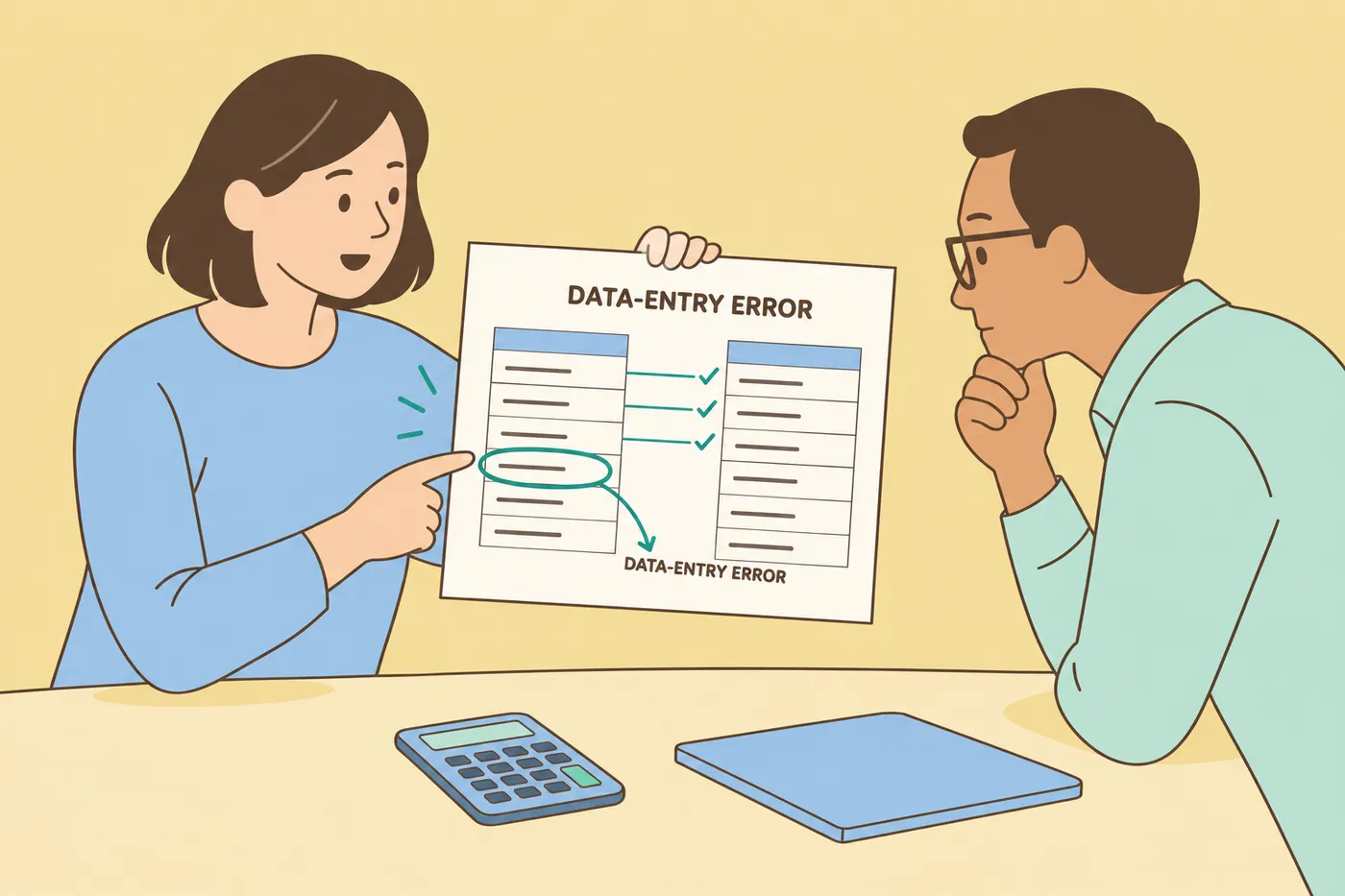
- Find two small tables that should agree: a bank statement against your own expense log, a club's member list against its dues record, an export from one system against a report built from it. Ten to fifty rows is plenty.
- Reconcile them record by record. List every mismatch, then classify each one: timing difference, data-entry error, or definition difference.
- Pick the one exception that matters most and investigate it until you can name a cause, not just a symptom.
- Write a three-sentence finding: what you compared, what you found, what you recommend. Then add a fourth sentence naming one alternative explanation you cannot yet rule out.
- Show the finding to someone who knows the data and ask two questions: "Is my conclusion fair?" and "What did I miss?" Their answer is the feedback loop; without it you're practicing in the dark.
Repeat the drill with a different pair of tables and compare your checks over several weeks. Keep the write-ups so you can see whether your explanations become clearer and your review catches different errors.
You can also run the drill on AI output. Ask a tool to summarize nonsensitive data you already understand, then verify each calculation and conclusion against the source. Follow your organization’s rules before uploading any work data.
How to show analytical skills on a resume
The phrase "analytical skills" in a skills section proves nothing, because every applicant can type it. The proof lives in experience bullets that follow an action-context-evidence pattern: what you did, on what, with what checkable outcome. Build them from the four artifacts your analytical work actually produces.
- From an analysis workbook: "Built a spreadsheet comparing [metric] across [number] regions over [period]; flagged the outlier that led [team] to [specific decision]."
- From a query: "Wrote SQL joining [number] tables to separate first-time from repeat contacts; the [X]% repeat rate shifted staffing toward [area]."
- From a quality check: "Reconciled [system A] against [system B] monthly; caught [number] mismatched records per cycle before reports reached [audience]."
- From a recommendation memo: "Summarized findings in a one-page memo recommending [action]; adopted by [team], reducing [metric] by [X]%."
Every bracket is a fact only you can supply. Fill each one from your own records, and if you don't have the number, write the bullet without it rather than inventing one. A figure you can't defend in the interview is worse than no figure.

A weak-to-strong rewrite
Weak: "Responsible for data analysis and reporting. Strong analytical and problem-solving skills."
Strong: "Analyzed [number] months of support tickets by category and repeat-contact rate; identified shipping as the highest-friction queue despite lowest volume, and the resulting process change cut repeat contacts by [X]%."
In Roleframe’s resume editor, live checks can flag wording to review while you edit. Signed-in accounts have a limited free allowance for AI features. If you ask Remi for a rewrite, supply the facts and review the proposed changes before applying them; keep only claims you can support.
Keep the skills section for concrete, searchable terms (SQL, Excel, variance analysis, reconciliation) and let the bullets carry the proof. For how to structure that split, see resume skills section examples, and for a full analytical resume worked end to end, the data analyst resume example shows the pattern across a whole document. Choose tools and methods relevant to the actual role, and keep an example ready for every item you list.
Proving analytical skills in an interview
Interviewers test analytical skills by asking for a story and then pulling its threads. Build one answer around a real situation using three beats: the situation and the precise question you framed, the actions you personally took (compared, reconciled, queried, tested, ruled out), and a verifiable result or an honest learning. The STAR method gives you the scaffolding; the analytical content is what fills it.
A fictional example answer showing the structure; replace it with your own true experience:
"Our refund costs rose and the assumption was fraud. I framed it narrower: was the rise concentrated anywhere? I broke refunds down by product line and found one line carried most of the increase. I reconciled its refund records against shipping data and the pattern matched delayed deliveries, not fraud. I wrote a three-sentence memo recommending we fix the carrier handoff first, and flagged that two months of data couldn't rule out seasonality. Refunds on that line came down the next quarter."
Three boundaries keep an answer like this credible. Claim only what you did: "I reconciled" when you reconciled, "our team found" when it was shared. Name the limitation before the interviewer does; it signals you check your own work. And if your conclusion turned out wrong, say so and finish with what you changed, because a corrected mistake demonstrates the process better than a tidy win.
One placement rule ties the resume and the interview together: evidence belongs in an experience bullet, not the skills list. The bullet is what the interviewer reads aloud and asks you to expand on, so every analytical bullet on the page should have a two-minute story behind it. If it doesn't, cut the bullet before the interview does it for you. For the question formats to expect, behavioral interview questions covers the standard prompts.
Frequently asked questions
- What are analytical skills?
Analytical skills are the ability to gather, break down, evaluate, and interpret information to solve a problem or make a reasoned decision. The process is what defines them: frame the question, check the data, choose a method, interpret the result, and explain the implication with its limitations. They are distinct from proficiency with any single tool, though employers usually want both together.
- What are examples of analytical skills?
Concrete examples include trend comparison, root-cause investigation, categorization, variance analysis, reconciliation, forecasting, troubleshooting, and translating a finding for a nontechnical audience. Broader families include critical thinking, research, data analysis, logical reasoning, and pattern recognition. The useful test for any of them: could a colleague observe you doing it, and did it leave an artifact like a workbook, an exceptions list, or a memo?
- What are the top 5 analytical skills?
A useful practice set is critical thinking, data analysis, problem-solving, research and decision-making. There is no universal ranking: the mix depends on the role. Communication supports all five because a finding needs a clear explanation and an honest account of its limitations.
- Can I demonstrate analytical skills without advanced maths?
Yes. Compare the same business metric across two periods, check for a definition change, calculate a rate and write down an alternative explanation. For example, a rise in returned orders could reflect a larger sales volume rather than a higher return rate. Show the denominator before drawing a conclusion.
- Are analytical skills a hard skill or a soft skill?
They sit in between, which is why proving them takes both kinds of evidence. The reasoning process is a transferable capability like a soft skill, while the methods it runs on, SQL queries, variance tables, reconciliations, are checkable like hard skills. On a resume, name the hard components in your skills section and prove the reasoning in your bullets; hard skills vs. soft skills on a resume walks through that split in detail.
- Should I write "analytical skills" in my resume skills section?
Include the phrase if it is relevant to the posting and supported by your experience. Also name specific methods or tools you know, such as reconciliation, forecasting, SQL or Excel. An experience bullet explaining what you compared, what you found and how it informed a decision provides the evidence.
- How do I improve analytical skills quickly?
Use a short weekly drill: reconcile two small tables, classify the mismatches, investigate one exception and write a finding with an alternative explanation. Ask someone familiar with the data to review it. Track what improves over repeated attempts rather than expecting a guaranteed result after a fixed number of sessions.



Turn your skills into proof.
A skills section helps most when your experience backs it up. In the editor, write each skill into a bullet about real work, then check the page against the posting before you send it.


