Behavioral Interview Questions and How to Answer Them
The 20 behavioral interview questions that cover almost every interview, and how four prepared stories answer fifteen of them. STAR structure included.


On this page
Behavioral interview questions come from a short list. Companies phrase them differently, but almost every "tell me about a time" prompt you will face maps to one of about twenty underlying questions, and those twenty map to a handful of competencies the interviewer has been told to probe. That makes prep far more manageable than it looks.
Here is the part that saves you a week of work. You do not need twenty rehearsed answers. Four well-built stories, prepared properly, cover fifteen of the twenty questions below. Prepare the stories once, learn which question each one flexes to, and you walk into any behavioral interview with your material already loaded.
The 20 questions that cover almost every behavioral interview
Interviewers rarely improvise. Most pull from a company question bank organized by competency, and those banks overlap heavily from one employer to the next. The list below is numbered because the rest of this article refers back to it.
- Tell me about a time you had to work with someone difficult.
- Describe a time you disagreed with a coworker.
- Tell me about a time you disagreed with your manager.
- Describe a time you failed.
- Tell me about a mistake you made and how you handled it.
- Describe a time you received tough feedback.
- Tell me about a time you led a project or a team.
- Describe a time you influenced someone without formal authority.
- Tell me about a time you took initiative.
- Describe a time you went beyond what was asked of you.
- Tell me about a tight deadline you had to hit.
- Describe a time you juggled competing priorities.
- Tell me about a time you worked under real pressure.
- Describe a time you had to adapt to a significant change.
- Tell me about a decision you made with incomplete information.
- Describe the hardest problem you have solved at work.
- Tell me about a time you had to learn something quickly.
- Describe a time you persuaded someone to see things your way.
- Tell me about a goal you set and how you reached it.
- What is your proudest professional accomplishment?
Phrasing varies by company. Amazon's version of #9 asks about taking ownership beyond your role. A hospital asks the #13 pressure question as "tell me about a short-staffed shift." A consulting firm dresses #15 up as a client scenario. The skin changes; the skeleton underneath does not. Learn the twenty skeletons and the variants stop mattering.
Why interviewers ask for a past example instead of an opinion
Opinions are free. Anyone can say they handle conflict well or stay calm under pressure, and every candidate does. A specific account of a real conflict, with the stakes named and an outcome the interviewer can probe, is much harder to fake. That is the entire logic of behavioral interviewing, and it is why the question always asks for a time something happened rather than how you would handle it.
Structured interviews take this further. Many companies now score each answer against a defined competency and a rubric, which means the interviewer is listening for evidence they can write down. When you drift into "what I would do" or "what we usually do," they steer you back to "what did you do," because the rubric has no row for hypotheticals.
Two practical consequences follow. First, a specific mediocre story beats a polished generality every time, because the generality scores zero. Second, say "I," not "we." The interviewer is grading you, and a story where your personal actions are invisible reads as a story about someone else's work.
STAR, and the part of it people skip
STAR stands for Situation, Task, Action, Result, and it exists because unstructured answers ramble. Used well, it keeps a story under two minutes and puts the weight where the interviewer's rubric puts it. Here is the shape, with rough timing.
- Situation. One or two sentences of context. Where you were, what was at stake. Twenty seconds, no more.
- Task. What you, specifically, were responsible for. One sentence.
- Action. What you did, step by step, in the first person. This is most of your answer.
- Result. What changed, with a number where you have one, plus one sentence on what you learned or do differently now.
The part people skip is the Result. Listen to real candidates and you hear ninety seconds of scene-setting, thirty of action, and a trailing "and it worked out pretty well." That ending is where the interviewer's pen was waiting. A result needs to be concrete enough to probe, so give the number, the shipped date, the retained client, or the specific thing that changed because of you.
Add one more sentence after the result, the learning line. Interviewers increasingly want to hear what a setback or a win taught you, because it separates people who accumulate experience from people who repeat a year of it ten times. If you want the full framework with worked answers, read our guide to the STAR method in interviewing.
Building four stories that answer fifteen questions
Preparing twenty separate answers is how people burn a week and still freeze in the room, because twenty scripts are impossible to hold in your head under pressure. Four stories are not. Each story below anchors a different competency, and each one answers three to five of the numbered questions depending on which part of it you lead with. Pick your stories from different jobs or projects where you can, so a forty-five minute interview does not spend all its time inside one quarter of your career.
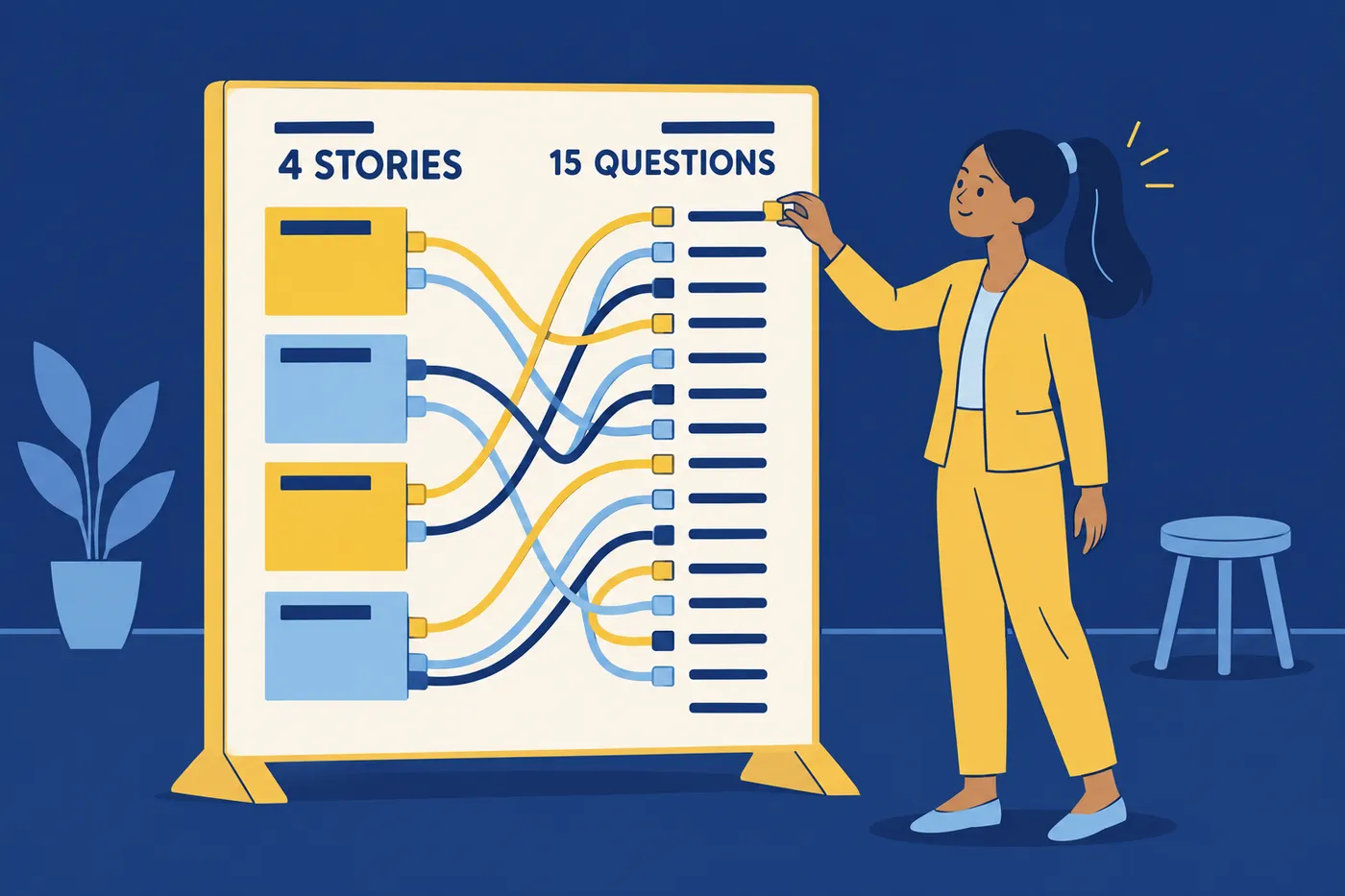
| Story | Core competency | Questions it answers |
|---|---|---|
| The ownership story | Initiative and delivery | 7, 9, 16, 19 |
| The disagreement story | Influence and collaboration | 1, 2, 8, 18 |
| The failure story | Accountability and learning | 4, 5, 6 |
| The crunch story | Judgment under pressure | 11, 12, 13, 15 |
Story 1: something you drove end to end
Pick a project or problem where the outcome was yours to own. It needs four ingredients. A gap you spotted or a goal you were handed. Decisions that were genuinely yours to make. At least one obstacle that forced a change of approach. A measurable result at the end.
How it flexes depends on your opening sentence. For #7, lead with the people you coordinated and how you kept them moving. For #9, lead with the moment you spotted the gap before anyone asked. For #16, lead with why the problem was hard and how you broke it down. For #19, lead with the target and the distance you closed. Same events, four different front doors.
Story 2: a disagreement you worked through
Choose a peer-level disagreement about the work itself, a technical approach, a launch decision, a resourcing call. The strongest versions have legitimate positions on both sides, which is exactly what makes them credible. Cover what you did to understand the other view before pushing your own, the evidence or reframing that actually moved the conversation, and an ending where both the work and the relationship survived.
This one story handles the difficult-person question (#1), the coworker disagreement (#2), influence without authority (#8), and persuasion (#18). For #8 and #18, put your weight on how you built the case rather than on the friction itself.
Story 3: a failure you recovered from
You need one real failure, prepared cold, because #4, #5, and #6 are where improvised answers do the most damage. This story has its own rules, so it gets a full section below. The short version is that the failure must be genuine, the ownership must be total, and most of the airtime belongs to what you changed afterward.
Story 4: a crunch with a real trade-off
Find a moment when time, scope, and resources collided and you had to choose. The ingredients that matter are a constraint you could not negotiate away, an explicit trade-off you made rather than absorbed, communication upward before the deadline arrived, and the outcome of the call. Interviewers asking #11 through #13 are really asking whether pressure degrades your judgment, so the decision is the center of the story, not the stress. For #15, lead with what you did not know when you had to decide, and how you decided anyway.
The five questions the stories don't cover
That leaves #3, #10, #14, #17, and #20, and none of them requires a fifth full story. Question #3, the manager conflict, gets dedicated prep below because the safe version has extra rules. Your proudest accomplishment (#20) is almost always your ownership story told with more scope and more feeling, so practice that retelling rather than building something new. For going beyond what was asked (#10), adapting to change (#14), and learning fast (#17), check each against your four stories first. One of them usually contains the needed angle, and only if none does should you sketch a short fifth example.
Answering a failure question without damaging yourself
Candidates fail this question in two opposite directions. Some offer a fake failure, the "I care too much about quality" answer, which experienced interviewers read as evasion and mark down accordingly. Others over-share, picking a failure so large or so recent that the interviewer spends the rest of the hour quietly re-evaluating everything else you said.
Pick a failure with real stakes that is clearly behind you. It should have cost something, a deadline, a client's patience, rework for a team, and it should end with a change you made that visibly stuck. Avoid two categories entirely. Never pick anything touching integrity, and be careful with failures in the exact core skill of the job you are interviewing for, unless the story is old enough that your growth since is obvious.
Structure matters more here than anywhere else. Name the failure in one plain sentence with no excuses attached, because a ledger of mitigating circumstances reads as blame-shifting even when every item is true. Then move fast to the recovery. A strong shape sounds like this: you missed a migration deadline because you did not validate a dependency early, you said so in front of the team the day you knew, you renegotiated scope and shipped two weeks late, and you added a dependency check to your kickoff process that has caught problems on every project since. The mistake takes one sentence. The system you built afterward takes four, and that ratio is the answer.
Conflict questions when the conflict was your manager
Question #3 is a trap with a clean exit. The person across the table is usually a future manager, and they are listening for how you will one day describe disagreeing with them. Any story where your old boss is the villain fails, even when the boss genuinely was one. Grievances, however justified, do not belong in an interview.
The exit is to pick a disagreement about the work rather than about the person. You thought the deadline was unrealistic, the priority was wrong, the technical approach carried risk they had not seen. Show three things in order. You made the effort to understand their constraint, because managers usually have context you lack. You raised your concern privately, with evidence rather than volume. You then committed fully to whatever was decided.
Both endings work. If you turned out to be right, tell it with humility and let the facts carry it. If your manager turned out to be right, say so plainly and name what it taught you about the context you were missing. That second ending is often the stronger answer, because it proves you can disagree, commit, and update, which is precisely the behavior the interviewer is buying.
Questions about leading, when you have never had reports
Leadership questions do not require a title. Interviewers asking #7 or #8 of an individual contributor define leading as owning an outcome that needed other people, and most careers contain more of that than the person living them notices. Training the new hire on your team counts. So does coordinating a launch across three teams, running the retro nobody wanted to run, taking point during an incident, pushing a process change through peers who preferred the old way, or mentoring an intern to a shipped project.
Handle the mismatch head-on rather than hoping it goes unnoticed. Open with one honest sentence, something like "I haven't had direct reports yet, so I'll tell you about the closest I've come to leading," and then tell the story with full confidence. Interviewers respect the framing, and it converts a perceived gap into evidence of self-awareness. If you want the same experience to read as leadership on paper too, our guide to management skills at every career stage shows how to write those bullets before you ever had the title.
Pulling your examples straight off your own resume
Your interviewer preps from your resume. Most behavioral interviews open with the interviewer scanning it and picking bullets to probe, which means the smartest move you can make is to put your four stories on the page as bullets and let the interviewer walk straight into your prepared material. A bullet that reads "led migration of billing system, shipped with zero downtime" is an invitation to ask question #7, and you wrote the invitation.
Run the audit in both directions. Go bullet by bullet and mark which of your four stories each one feeds; any bullet you could not speak about for two minutes is a liability, so cut it or learn it. Then check the reverse. If one of your four stories is nowhere on the resume, add a line for it, because a story with a paper trail lands harder than one that appears from nowhere. Numbers must match exactly, since a resume that says 30% while your mouth says "roughly half" plants a doubt that outlasts the answer.
Rehearse out loud, from bullets rather than scripts. A memorized script collapses at the first follow-up question; five bullet points per story, spoken aloud twice, bends to whatever variant you are asked. This is also where Roleframe earns a mention. Remi, its career copilot, builds interview practice from what is actually on your resume, asks you one question at a time, and scores your answers against your own experience, telling you where an answer ran thin. On a resume version tailored to a specific job, the questions draw on that posting too, so you rehearse against the interview you are actually about to have.
The one-evening prep plan
- Pick your four stories, from different jobs or projects where possible, and check them against the mapping table above.
- Write a five-bullet skeleton for each in STAR order, ending with the result and a one-line learning.
- Read the twenty questions and say, for each, which story you would use and which part you would lead with.
- Speak every story aloud twice, timed. Anything over two minutes gets its situation cut, not its result.
- Audit your resume against the stories. Match every number, and add a bullet for any story that is missing from the page.
Frequently asked questions
- What are the 10 most common behavioral interview questions?
From the list above, the ten that come up most often are conflict with a difficult coworker (#1), a failure (#4), a mistake and how you handled it (#5), tough feedback (#6), leading a project (#7), influencing without authority (#8), a tight deadline (#11), competing priorities (#12), working under pressure (#13), and a decision with incomplete information (#15). Notice that the four-story method covers all ten of these, which is exactly why it works.
- What are the 5 hardest behavioral interview questions?
The hardest are the ones that require criticizing yourself without sinking yourself. In practice that means the failure question, the mistake question, disagreeing with your manager, a time you were wrong and had to admit it, and a time you committed to a decision you disagreed with. They are hard improvised and manageable prepared, so build your failure story and your manager-conflict story cold before any interview.
- What is the biggest red flag an interviewer listens for?
Blame. A candidate whose every story features a problem caused by someone else, a bad manager, a lazy teammate, an unreasonable client, is telling the interviewer how they will describe this company in two years. Close behind are answers built entirely on "we" with no visible personal action, and stories that trail off with no result the interviewer can verify or probe.
- How long should a behavioral answer be?
Ninety seconds to two minutes. Keep the situation to about twenty seconds, spend most of the time on your actions, and land on a concrete result plus one learning sentence. If there is more depth, close with "happy to go deeper on any part of that" and let the interviewer choose, which reads far better than a five-minute monologue.
- Can I use the same story for two questions in one interview?
Once, yes, if you flag it and shift the angle. Say "this is the same project I mentioned earlier, but a different part of it," then lead with the element the new question asks about. Reusing a story twice without acknowledging it, or leaning on one story three times, signals a thin bank of experience even when that is not true.
- How do I answer behavioral questions with no work experience?
Draw from coursework, a capstone project, a part-time or service job, a club, or volunteering. Interviewers asking behavioral questions of entry-level candidates expect exactly these sources. A shift at a busy register produces genuine pressure and conflict stories, and a group project that nearly fell apart is a legitimate leadership story. What matters is the same STAR structure and a specific, first-person account, not the prestige of the setting.
- Is "tell me about yourself" a behavioral question?
No. It is an opener that sets the frame for the interview rather than a request for a past example, and it needs a different structure, roughly your present, the relevant past, and why this role. It deserves its own prep; our guide on how to answer "tell me about yourself" covers the shape that avoids rambling.


Ready to start your new resume?
Writing a resume takes time, and even a polished one can miss what a hiring manager is looking for. Roleframe helps you build a clear, ATS-safe resume in minutes and tailor it to the job you want.


