Medical Student CV: A Full Example for Residency and Research
by Larbi SahliPublished
A complete medical student CV example plus section-by-section guidance: research entries, publication status labels, ERAS consistency, and what early-year students list.
Users have landed jobs at
- 1Password
- OpenAI
- Notion
- justworks
On this page
Your CV is the master record every other medical application pulls from. The residency application, the away rotation form, the research program, the scholarship, the email you send a letter writer: each one asks for a slice of the same facts, and each one has to agree with the others. Build the CV once, keep it accurate, and the rest becomes copying rather than remembering.
In medicine, CV stands for curriculum vitae, Latin for course of life. It is the detailed record of your education, clinical training, research, publications and presentations, teaching, service, honors and certifications. A resume is shorter and aimed at one job; a CV grows with you and stays complete. The AAMC treats the CV as separate from the structured residency application and publishes a "Create My CV" resource for students building one, which tells you something useful: the CV is not the application, it is the source material behind it.
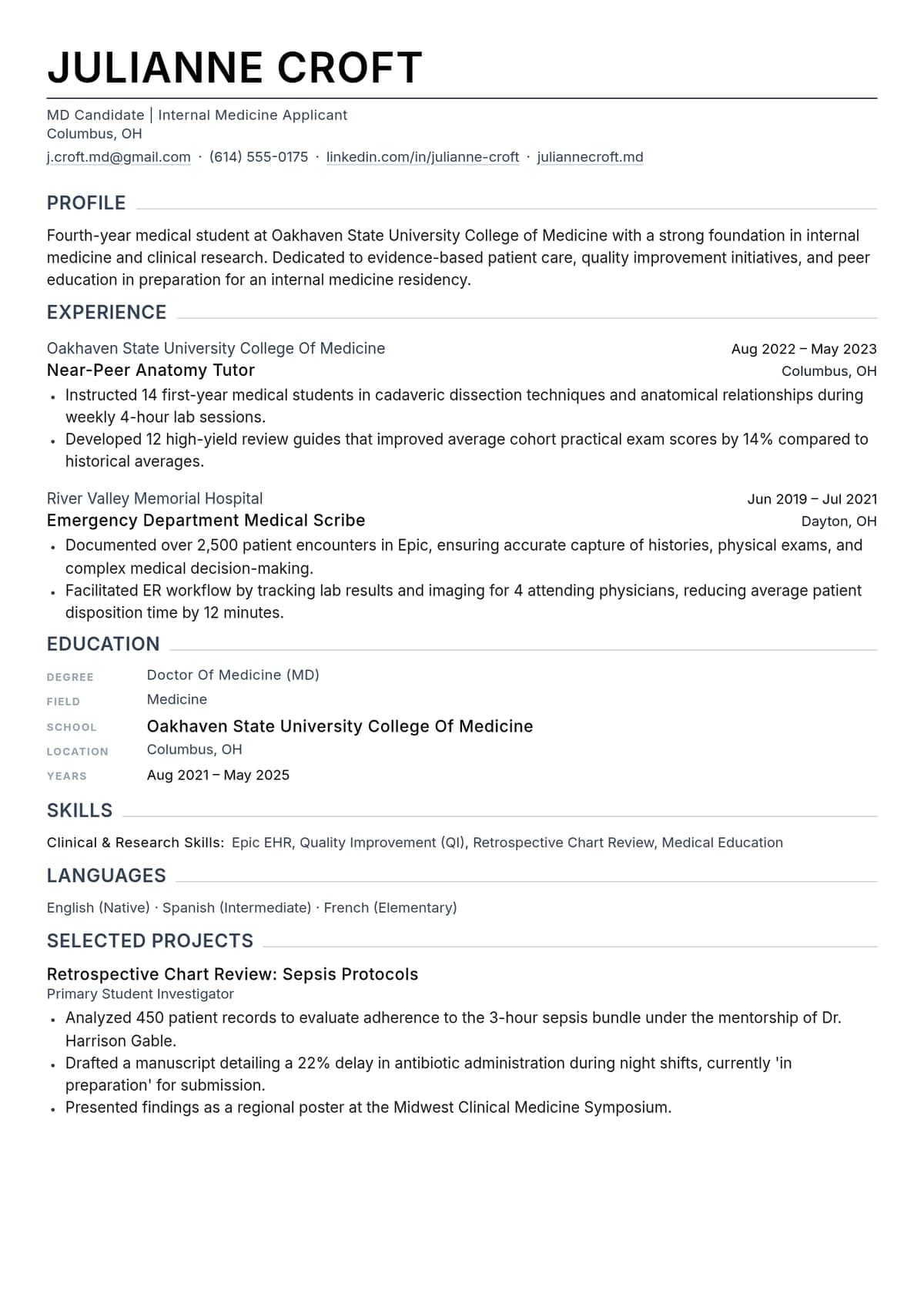
Below is a complete example for a fourth year student applying to internal medicine, then the reasoning behind each section, what changes for a first or second year student with a thin record, and how to keep every line consistent with what your program sees.
A complete medical student CV example
This is a fourth year MD student in the fall of application season. Read it for three things: education sits first and everything after it is in reverse chronological order, every research entry names a mentor and the student's own part in the work, and the publication statuses are labeled honestly rather than inflated.
Illustrative example. The student, the medical school, the mentors, the hospitals, the journal and the meeting above are fictional, and the numbers are plausible placeholders rather than real results. Copy the structure and the way each entry is phrased. Never copy a line of content.
What to include in a CV as a medical student
Academic medical CV guidance, including guidance published by the Wright State University Boonshoft School of Medicine, separates education and training, appointments, certifications and licensure, publications, grants, teaching, clinical activities, service, and honors and awards. A student version uses the same spine with the sections you have actually filled. Here is the order that works for a student, with what earns a place in each.
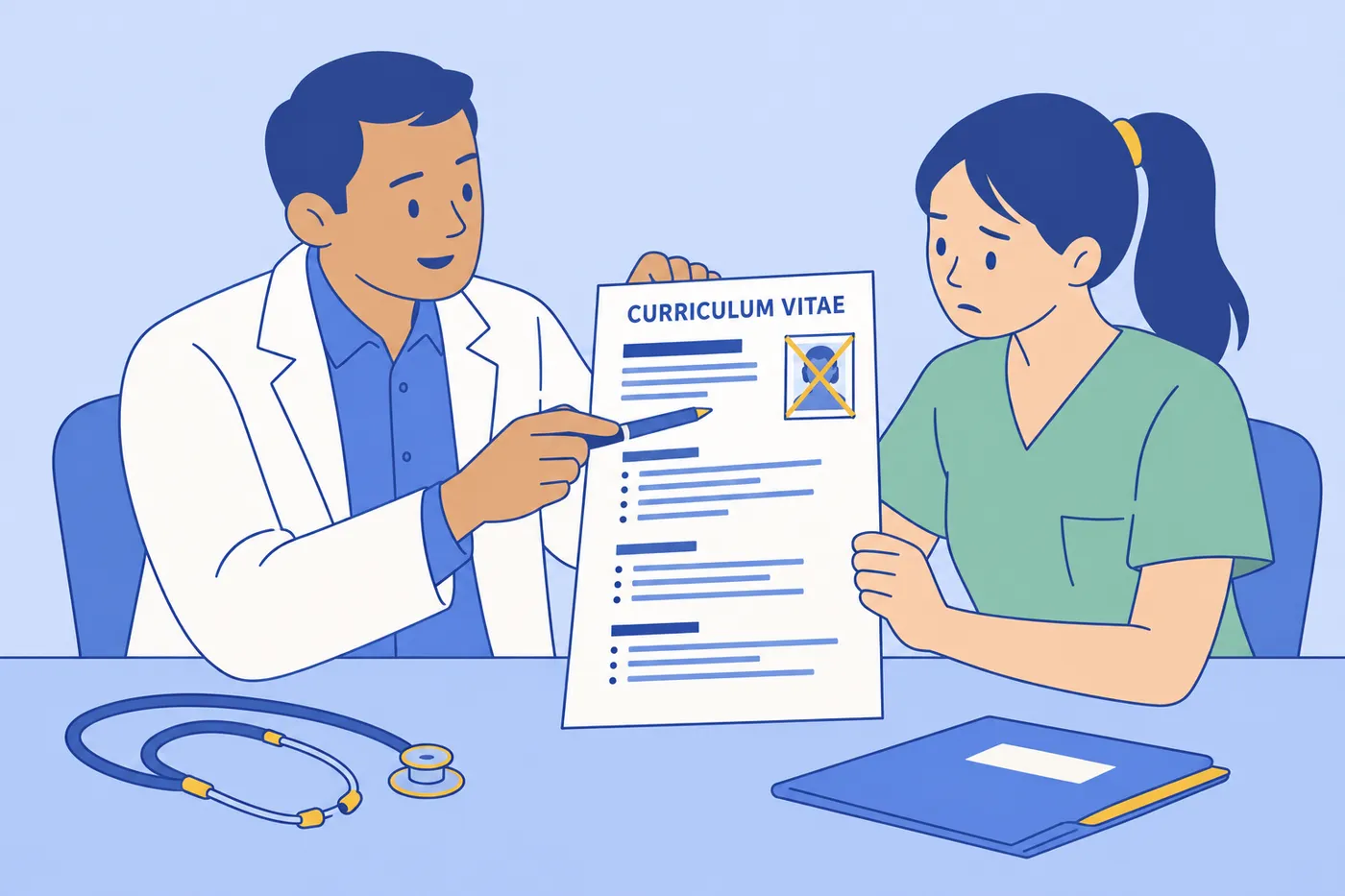
- Contact details. Name, one phone number, one professional email address, city and state. No photo, no date of birth, no marital status on a US CV.
- Education. Your MD or DO program first with the expected graduation month and year, then your bachelor's degree with its completion date. Add an honors thesis title if you wrote one.
- Honors and awards. Clerkship honors, school and departmental awards, scholarships and national recognitions, each with the awarding body and the year.
- Research experience. Every project you contributed to, with the mentor, the department, the question the project asked, and what you personally did.
- Publications and presentations. Peer-reviewed articles, abstracts, posters, oral presentations and case reports, each under its own subheading with an honest status label.
- Leadership. Elected and appointed roles in student organizations, interest groups, free clinics and committees, with the dates and the scope you actually held.
- Teaching. Near-peer tutoring, anatomy or small group teaching assistant roles, standardized patient training, workshops you ran, with hours or session counts where you know them.
- Service and volunteer work. Ongoing commitments with dates and rough frequency. One line each.
- Work experience. Paid jobs, including work before medical school: scribe, medical assistant, research technician, barista, anything with dates and a title.
- Certifications and licensure. BLS, ACLS, PALS and similar, with the issuing body and current expiration. New graduates add medical council or board registration exactly as issued.
- Languages and interests. Language with an honest proficiency level, then a single short interests line that gives an interviewer something human to open with.
Formatting rules that apply to every section
Reverse chronological order inside each section, newest first. Dates on one side, aligned, in one format for the whole document ("Aug 2023 – May 2024" everywhere, not "08/2023" in one place and "August 2023" in another). Keep one font and one heading style, because a reader scanning twelve CVs notices inconsistency before they notice content.
Write a degree you have not received yet as expected: "Doctor of Medicine, expected May 2027." Change it the day it is conferred, not before. DO students follow the same structure with their own degree and their own exam series. Exam lines belong on the CV only when your school's template or a specific program asks for them, and you list what they ask for, nothing more.
Save and send it as a PDF so the spacing, alignment and page breaks survive the trip. A file that reflows on someone else's machine is the one that arrives with a section heading stranded at the bottom of a page.
The CV example for a medical student early in training
A first or second year student has a short record, and short is fine. What is not fine is a CV that looks half-built. A strong early CV reads as complete because every section it keeps is filled properly, and the sections you have nothing for simply do not appear.
Take a first year applying for a summer research program. The pre-med record carries forward and does the heavy lifting: a year as a medical assistant at a family practice, a year as a research technician in a university lab, hospice volunteering through college. Those are real jobs with real dates and real duties, so they get full entries, the same as any other work experience. The first year additions go on top: an interest group role, shifts at the student-run free clinic, and a research project that has just started.
The project with no results yet is the entry students get wrong. Write it by its question and your role, and stop there:
- Mentor and department, so the reader knows who can vouch for you.
- The question the project asks, in one plain sentence.
- What you are doing on it: screening charts, building the REDCap form, running the literature search, consenting participants.
- Dates, with "present" as the end date. No invented outcome, no "results pending publication" unless something has actually been submitted.
Pre-med students can use this same structure for letter writers and interviews. Send it to a professor with your ask and it saves them an hour of guessing. The medical school application itself is a different animal: in the US, MD programs use AMCAS and DO programs use AACOMAS, and each has its own experiences section with its own fields and limits. Check each service's own pages for the current format rather than assuming your CV sections map onto it.
Illustrative example. Any school, employer, lab or mentor described here is fictional.
Research and publications, entry by entry
Research entries are where medical CVs separate. Most students write a duty. Strong students write a question, a role and a status. The academic guidance is consistent on this point: clarify your own role in grants, publications and initiatives rather than letting a project's prestige stand in for your contribution.
Write every research entry with five parts: mentor, department, the question, what you did, and where it ended up.

One entry, weak and strong
Weak: "Research Assistant, Department of Medicine. Assisted with a retrospective study on heart failure readmissions. Attended lab meetings and helped with data collection."
Strong: "Student Investigator, Division of Hospital Medicine. Mentor: Dr. A. Ferris. Retrospective chart review of 412 heart failure admissions asking whether a pharmacist-led discharge call was associated with lower 30-day readmission. Built the data dictionary, abstracted 180 charts, ran the descriptive analysis, drafted the methods section. Manuscript in preparation."
The strong version is not longer for its own sake. It gives an interviewer four things to ask about, and every one of them is something the student can defend for ten minutes. The weak version gives them nothing, so they move on.
Citations, headings and status labels
Pick one medical citation style, AMA style is the usual choice, and use it for every reference on the document. Put your own name in bold so a reader finds your position in the author list without counting. Keep the author order exactly as it appears on the work.
Separate peer-reviewed publications from everything else, with its own subheading for each type: peer-reviewed articles, case reports, published abstracts, poster presentations, oral presentations. A reader who has to work out whether your third item is a paper or a poster has already discounted it.
Status labels are a professionalism test. Use exactly four, and mean them:
- Published: it is out, with a citation.
- Accepted or in press: the journal has accepted it. You can show the acceptance email.
- Submitted: it has actually been submitted to a named journal, on a date you can state.
- In preparation: the manuscript exists and is being written. Not "an idea my mentor mentioned."
A long list is not automatically stronger. The guidance points the other way: accurate role clarification and clean separation of publication types matter more than volume. Three entries you can discuss in depth beat nine you have to apologize for.
How the CV feeds your residency application
The CV is the master record; the residency application is a selection from it. For the 2026 ERAS season, the AAMC says applicants may select and describe up to 10 experiences, and may designate up to three of those as most meaningful. Each selected experience asks for a position title, organization, approximate start and end dates, participation frequency, location and setting, plus up to 750 characters describing your activities, responsibilities and context. Each most-meaningful experience gets an additional 300 characters on why it mattered and how it influenced you. There is also an impactful-experiences section where applicants may describe major obstacles encountered before or during medical school.
Two practical consequences follow. First, the structured fields are exactly the fields a well-built CV entry already contains, which is why a CV kept current turns the application into transcription. Second, 10 slots means choosing, so the CV needs to hold everything while the application holds the best of it.
A useful correction here: experiences do not have to come from medical school, and they do not have to be specialty-related. The AAMC's current guidance states that experiences may come from any point in an applicant's life. The scribe job, the college lab year, the two years teaching high school science: all eligible, all legitimate, all worth keeping on the CV.
Everything has to agree. Your CV, your application entries, your MSPE and your letters are read side by side, and a title that shifts between documents or a date that moves by six months reads as carelessness at best. Before you submit, check every date, every title and every publication status against the same source. The AAMC recommends keeping a system for updating CV materials rather than rebuilding the document each season, and following your institution's own guidelines for internal academic CVs; both are good advice precisely because it keeps the versions from drifting.
Check the AAMC's ERAS and Careers in Medicine pages for current formats, field definitions and timelines before each season, since the application changes. One example of how quickly the surrounding context moves: Public Health and General Preventive Medicine residencies used the official NRMP Match for the first time in 2025, which changed the application timeline for applicants in that field. If you are applying outside the US, follow your medical school's guidance and your national application system; the structure on this page transfers, the fields and deadlines do not.
Does a medical student CV need an objective?
For US residency applications, no. The personal statement does the work an objective would do, at length and with far more room, so an objective line at the top of your CV repeats the weakest version of what the reader is about to read in full. Start with education and use the space.
An objective earns its place in three situations: an MBBS graduate applying for a junior resident or medical officer post, a student applying for a dedicated research year, and a CV sent for a non-clinical job where the reader cannot tell what you are asking for. In all three, one or two lines that name the post, the department and one concrete strength. Fictional examples to adapt:
- "MBBS graduate with twelve months of internship across internal medicine, surgery and emergency, applying for the Junior Resident post in General Medicine at Harbourview Hospital. Comfortable managing an acute medical ward overnight with on-call senior support."
- "Third year MD student applying for a one-year dedicated research fellowship in cardiovascular outcomes. Two years of chart review experience and an abstract accepted at a regional student research meeting."
- "Final year medical student applying for the Clinical Data Analyst role at Northgate Health. Built and ran the analysis for a 412-chart retrospective review and work daily in R and SQL."
New doctors: list your medical council or board registration exactly as it is issued, with the registering body and the registration number if that is how it is normally quoted in your country. Registration rules and what must appear differ by council and change, so check the council's own site rather than copying a format from a template.
Mistakes that sink medical CVs
These are the ones that cost students credibility with people who read hundreds of these documents a season.
- The padded shadowing list. Eleven specialties at four hours each is not clinical experience, it is a weekend. Group pre-medical shadowing into one brief line, or drop it once you have clerkships.
- Inflated authorship or presentation roles. Listing yourself as a presenter when your mentor presented, or as an author when you were acknowledged, is the kind of thing a program director checks and a co-author contradicts.
- Status labels that overstate a paper. "Submitted" means submitted. If an interviewer asks which journal and when, you need an answer.
- Dates that differ from the application. The most common cause is a CV updated in March and an application filled in September from memory. Update the CV first, always.
- Unexplained gaps or leaves. A research year, a leave of absence, a repeated year: give it a line with dates and a neutral description. Silence invites a worse interpretation than the truth.
- An unprofessional email address. Use your school address or a plain name-based one.
- Typos in mentors' and co-authors' names. Misspelling the attending who is writing your letter is a small error that lands badly. Check every proper noun against the source.
Can ChatGPT write your CV?
It can help with wording and layout, and it is genuinely useful for tightening a clumsy entry or suggesting a stronger verb. It should not be the author. A language model will happily produce a publication that does not exist, an award with the wrong year, or a date it inferred from context, and on a medical CV those are not typos, they are integrity problems that surface during an interview or a background check. Check every line against your own records: your transcript, your award letters, your submission emails.
The other rule is absolute: never paste patient details, chart data, or anything identifiable into a chatbot. Describe your project by its question and your role, which is what belongs on the CV anyway.
Generic output is the smaller risk, but it is real. Entries that sound like everyone else's are a known pattern with AI drafts, and why ChatGPT drafts end up sounding the same explains what makes them interchangeable and how to put your own specifics back in.
When you need a resume instead of a CV
Some applications ask a medical student for a resume, and they mean it. A summer job, a non-clinical internship, a campus position, a tutoring company: those readers want one page, tailored to the role, not your full academic record. In that case use the shorter format in our student resume examples, which covers short resumes for jobs and internships from high school through final year.
If you are applying for a clinical job before medical school or between application cycles, the medical assistant resume example shows how to write clinical duties for an employer rather than for an academic committee. Faculty and physician CVs follow their own institution's required format, which is a different document again, and your department will hand you the template.
If you want the general version of the distinction, what a CV is and when you need one covers it, and the academic CV example shows the longer form a researcher uses.
Build it once, then keep it current
The single habit that matters: add the entry the week it happens. A poster accepted in February, logged in February, with the meeting name and the full author list, is a line you never have to reconstruct in September when you are writing your personal statement and your application at the same time. Students who rebuild the CV from memory each season are the ones whose dates stop matching.
Set a recurring reminder at the end of each block or rotation and spend ten minutes on it. Honors, new projects, new teaching sessions, status changes on papers. Then every residency form, research application and letter-writer email is a copy job.
Frequently asked questions
- What does CV mean in medical?
CV means curriculum vitae, Latin for "course of life." In medicine it is the detailed, continually updated record of a student's or physician's education, clinical training, research, publications, presentations, teaching, service, honors, certifications and professional memberships. It is not an abbreviation for anything medical-specific; the same term is used across academia.
- Is a CV the same as a resume?
No. A CV presents a fuller, continually updated account of your academic and professional record, while a resume is shorter and tailored to one specific job. The terms overlap differently by country and institution, so the program or employer's instructions decide which one they expect. If an application says "CV" and you are a medical student, send the full academic document; if it says "resume" for a summer or non-clinical job, send one tailored page.
- What should a medical doctor's CV look like?
Clear, accurate, consistently formatted and organized in reverse chronological order. Typical sections are contact information, education, licensure and board certification, postgraduate training, academic or professional appointments, clinical experience, research, publications and presentations, teaching, leadership and service, honors, and professional memberships. The emphasis shifts with the purpose: a clinical employment CV leads with training and licensure, an academic promotion CV leads with publications, grants and teaching.
- What does a student CV stand for?
The same thing: student curriculum vitae. It summarizes a student's education and developing academic record, including research, clinical or work experience, volunteering, leadership, presentations, publications, awards and skills. Which sections you include depends on your field and what the application asks for, and sections you have nothing for are left out rather than listed empty.
- How long should a medical student CV be?
As long as your accurate record, and no longer. A first year student with a pre-med work history might fill one page; a fourth year with research, teaching and leadership roles will run longer, and that is normal for a CV. Length is never the goal. Padding with shadowing hours and one-off attendance at conferences is more visible than a short, well-built document.
- Should I put my USMLE or COMLEX scores on my CV?
Only if your school's required template or the specific program asks for them. Exam results reach residency programs through the application itself, so adding them to the CV is usually redundant. When a form does ask, list exactly what it asks for and nothing more.
- Do I need a different CV for research applications and residency?
You need one master CV and a selection from it. Keep every entry in the master document, then adjust emphasis for the audience: a research program wants your projects, methods, posters and manuscripts near the top, while a clinical post wants training, certifications and clinical roles. Never change a fact between versions, only the order and the depth of detail.
- Can I use a CV template from Word or Google Docs?
Yes, as long as the output is clean and consistent. Avoid templates built on text boxes, tables with hidden borders or heavy graphics, since those reflow unpredictably and parse badly when a system reads the file. Whatever you draft in, export and send a PDF so spacing, alignment and page breaks look the same on the reader's screen as on yours.

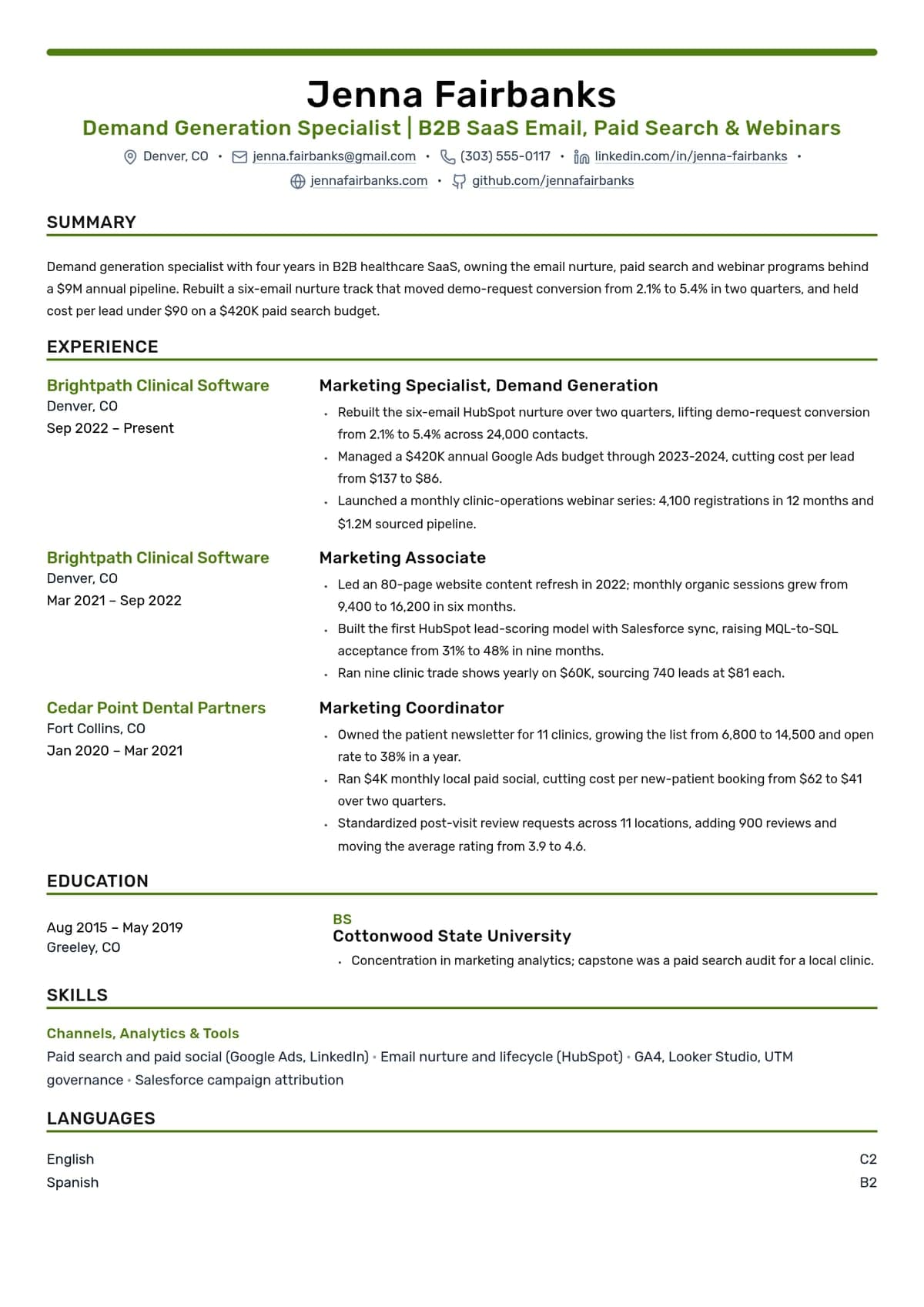
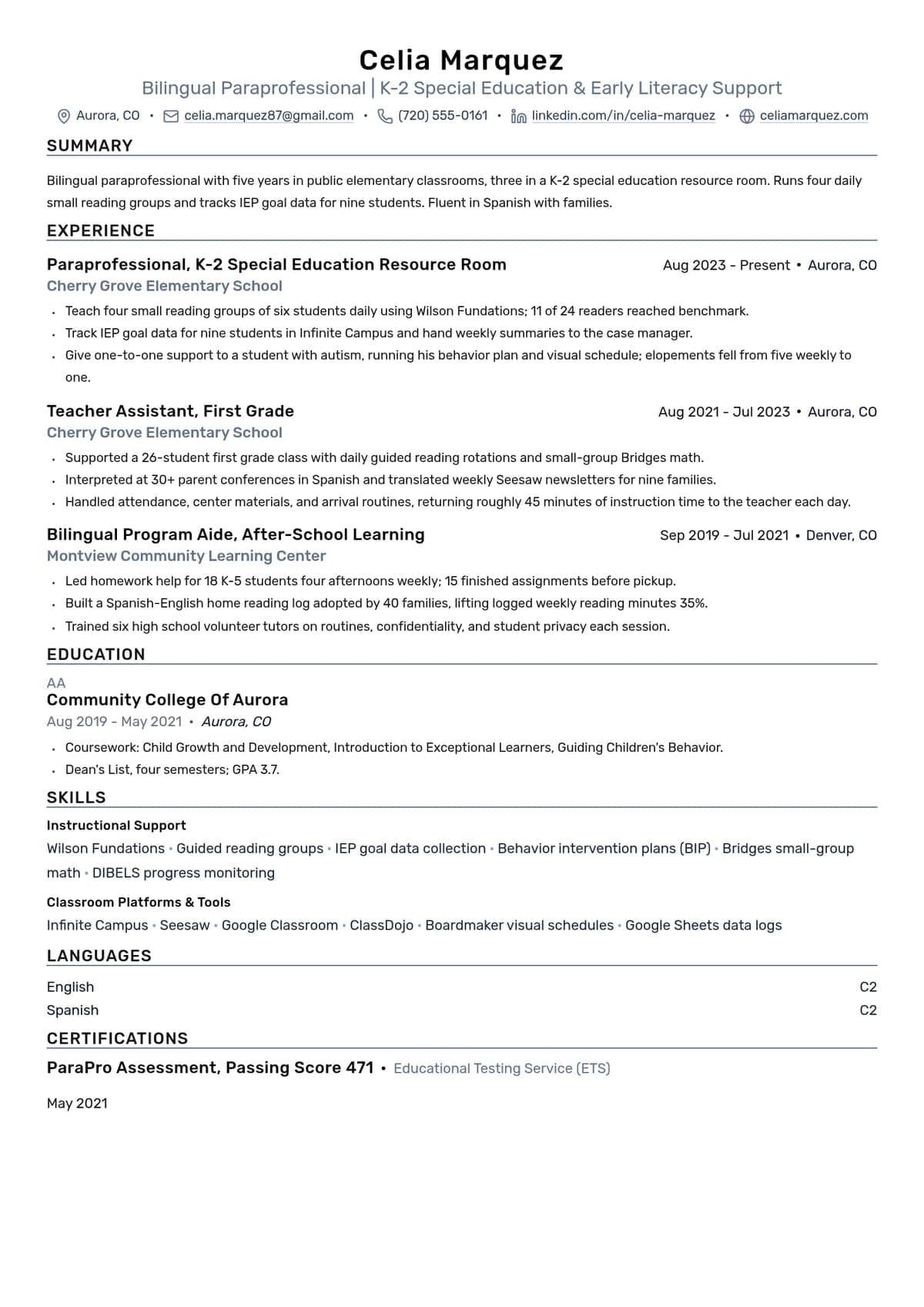
Build yours on the same template.
Every example here is built on a template you can open in the editor. Start from the same layout and write your own experience into it, then download the PDF free, as often as you like.


