Marketing Resume Examples for Entry Level and Experienced Roles
by Larbi SahliPublished
A full marketing resume example for an experienced specialist, a section-by-section build for new graduates, and the proof each area of marketing should show.
Users have landed jobs at
- 1Password
- OpenAI
- Notion
- justworks
On this page
"Marketing" is not a job. The person filling a demand generation role and the person filling a brand role are reading for different proof, and a resume that opens "experienced marketing professional with a passion for storytelling and data" answers neither of them.
Search this phrase and you mostly get template packs telling you to keep it to one page, plus galleries of finished resumes with no explanation of why any line works. Around them sit a Reddit thread where marketers argue about whether to include a photo and university sample resumes written to fit every major on campus. None of it answers the question that decides whether a hiring manager reads past your summary: does the proof on this page match the kind of marketing the job is actually for?
So this page works differently. One complete marketing resume rendered in full for an experienced demand generation specialist. A section-by-section build for new graduates. A table mapping every area of marketing to the numbers its resume should carry. And the honest way to write those numbers so you can still defend them in the interview.
A full marketing resume example: experienced specialist
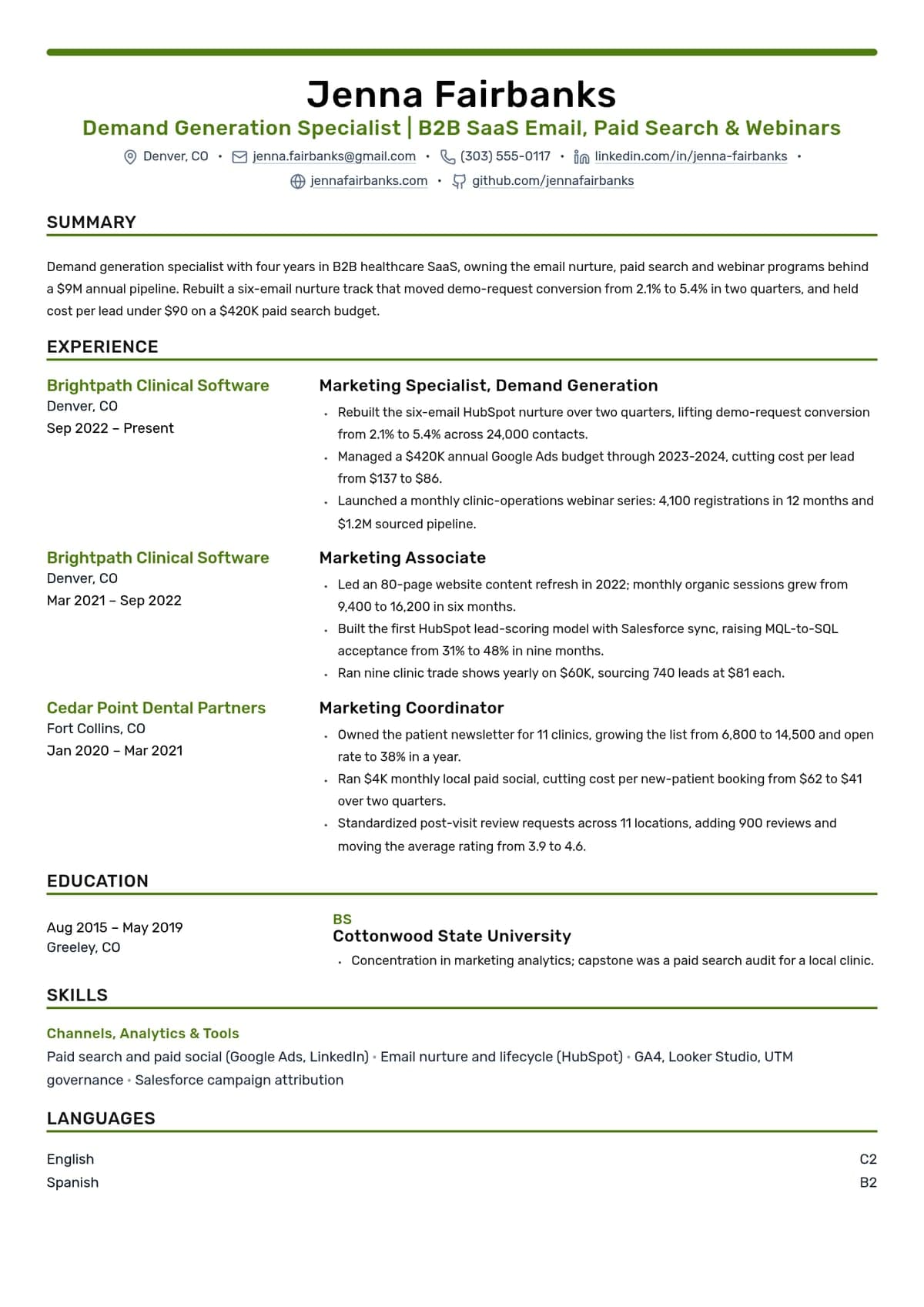
This one is written for a specialist about four years in: currently at a mid-size company selling scheduling software to clinics, applying for a senior marketing specialist role in demand generation at a software company. It is the most common version of this search, so it is the one worth seeing whole.
Two ideas run through every line of it, and both come straight from current hiring guidance. Name the platform you actually used instead of writing "marketing tools," which is how Indeed framed it in 2026. And attach each bullet to something the business counts, pipeline, conversion rate, cost per lead, customer acquisition cost, return on ad spend or traffic growth.
Watch three things as you read. The summary names the specialty in its first line. The skills block is grouped rather than dumped into one comma run. Every experience bullet carries a period and a baseline, so each number means something.
Illustrative example. The candidate, the employers and all figures are fictional, written to show the structure. Never copy a number into your own resume.
Why each section is built that way
The header carries a portfolio link. Marketing is one of the few fields where the hiring manager will actually click. A live link to campaign summaries or writing samples turns claims into evidence before anyone schedules a call.
The summary runs two lines and names the specialty. It says what kind of marketer this is, the audience she has sold to, and the scale she has worked at. No adjectives doing the heavy lifting. If you are tempted to write an objective instead, don't. An objective states what you want, and the reader is busy deciding whether you can do the job.
The skills block is grouped into channels, analytics and tools. Grouping reads fast for a human, and it forces you to name exact platforms rather than categories. "Google Analytics 4, Google Tag Manager, Looker Studio" tells a reader what you can open on day one. "Analytics" tells them nothing.
Each experience bullet has a baseline. "Increased conversion" is a hope. "Moved trial-to-paid conversion from one level to another over two quarters" is a result you can be questioned on and answer well. Budget works the same way: a paid search figure means little without the period it covers and the direction cost per lead moved.
Certifications are named as types, not padding. Platform certifications in analytics, ads or marketing automation belong on the page when the posting names the platform. A long row of free badges strengthens nothing.
The entry-level version: a new graduate applying for marketing coordinator
A new graduate's marketing resume is built from the same parts, with projects and internships carrying the weight that the specialist's job history carries. Treat each item below as a full entry with dates, scope and an outcome, never as a line in a list.
- The internship. Name what you owned, not what the team shipped. If you ran the nonprofit's email sends, say how many went out, to what list size, and what happened to open and click rates over the months you were there.
- The class project for a real local business. This is the strongest item most graduates have and the most commonly wasted. Write it as work. Name the client, the brief, the deliverable you handed over (a content calendar, a paid social test, a landing page), and what changed for them afterward.
- Social media for a campus organization. Tie growth to a goal. Follower count on its own is a vanity metric; attendance at the events you promoted is a result.
- The part-time retail or service job. Keep it, and write it around what it taught you about customers. Objections you heard daily, how you explained a product to someone who had never used it, loyalty signup results if you tracked them.
- Coursework that maps to the posting. Two or three courses that match (marketing analytics, consumer behavior, digital advertising) earn their line. A full transcript does not.
- A portfolio link with three or four samples. A campaign one-pager, a piece of writing, a dashboard screenshot with client data removed. Three strong pieces beat twelve weak ones.
That answers the question graduates usually phrase as "how do I make a resume as a fresher?" in marketing terms. You are not short of material. You are short of material written as work. Give every project an audience, a deliverable and a result, and the page stops looking empty.
GPA is a judgment call rather than a rule. It helps when it is strong and you have little else on the page, and it is dead weight otherwise. The full decision on listing your GPA takes two minutes to read before you commit.
One more trap. Skip the generic objective about seeking an opportunity to grow, and use the same two-line summary structure as the specialist example, naming the area of marketing you are aiming at and the proof you already hold.
What should be on a marketing resume
The short answer, which Indeed set out in its 2026 guidance: contact details, a targeted summary, reverse-chronological experience, education, skills and relevant certifications. The marketing-specific part is what goes inside those sections.
- A headline and summary that name your area of marketing, not "marketing professional"
- Results tied to business outcomes (pipeline, revenue, conversion, cost per lead, CAC, ROAS, retention, traffic) rather than activity counts
- The exact tools the posting names, where you have genuinely used them
- A link to work samples a hiring manager can open
- Education, plus certifications that match the platforms in the posting
Naming your specialty matters more in marketing than in most fields because the proof is not interchangeable. Brand roles want campaigns, positioning and press coverage. Performance roles want spend managed and cost per acquisition moving the right way. Product marketing wants launches, sales enablement and win rate. Send one undifferentiated "marketing" resume to all three and it reads as thin to each.
The same point holds on the keyword side. There is no universal marketing skills list, because the relevant terms shift with the specialization, as Indeed noted in 2026: SEO, paid media, CRM, analytics, content and demand generation each pull a different vocabulary. Take the words from the posting instead. Here is how to pull resume keywords from a job description without turning your bullets into word salad.
Proof by area of marketing
Find your row, then check whether your experience section actually contains those numbers. If it does not, you are looking at your editing list, Indeed and Jobscan keep naming; use only the ones you have really worked in.
| Area of marketing | Proof the resume should carry | Tools worth naming |
|---|---|---|
| Demand generation and paid media | Spend managed per period, cost per lead or acquisition and its direction, pipeline sourced, MQL to SQL movement | Google Ads, Meta Ads Manager, HubSpot, Marketo, Salesforce |
| Content and SEO | Organic traffic against a prior baseline, rankings for named target terms, leads or trials attributed to content, volume of pages shipped | Google Analytics 4, Looker Studio, Google Tag Manager, Excel or Sheets |
| Email and lifecycle | List growth and list health, conversion at each stage, retention or churn movement, revenue per send where you have it | Mailchimp, Klaviyo, Marketo, Pardot, HubSpot |
| Social and community | Growth and engagement tied to a goal such as event attendance, signups or demo requests, never follower count alone | Looker Studio and the native platform analytics |
| Product marketing | Launches shipped and their adoption, sales enablement produced and actually used, win rate or competitive displacement | Mixpanel, Salesforce, HubSpot, Google Analytics 4 |
| Brand and communications | Campaigns run end to end, coverage earned, brand guidelines authored and adopted across teams | Google Analytics 4 and your media or asset management stack |
| Events and field marketing | Registrations against target, attendance rate, pipeline sourced, cost per opportunity | Webinar platforms, HubSpot, Salesforce, Google Analytics 4 |
| Marketing operations | Automation built, data quality improvements, attribution work, reporting the team uses without being asked | HubSpot, Marketo, Salesforce Marketing Cloud, Google Tag Manager, SQL |
SQL is the line to watch. LinkedIn's 2026 data points to it emerging as a differentiator for growth, demand generation and marketing operations roles, with Python mattering where the analytical depth justifies it. If you write your own queries, that belongs in your analytics group rather than buried in a tools run.
Apply the same discipline to AI. Generative AI and prompt engineering terms are turning up in more marketing job descriptions, and LinkedIn reported in 2026 that AI mentions in marketing listings tripled between two analyzed periods while staying uncommon overall. Rutgers' 2025 guidance is the right filter: include AI terms only where you can connect them to real work. "Used AI" with nothing behind it is a question you will lose in the interview.
How to write marketing results honestly
Five rules keep your numbers persuasive and defensible at the same time.

- Give the period and the baseline. "Up 40%" with no starting point and no timeframe is unreadable, and an experienced marketer reads it as inflated.
- Write "contributed to" when the result was shared. Pipeline is almost always shared with sales. Claiming it alone is the fastest way to lose someone who has run the same program.
- Prefer business results to vanity metrics. Impressions and followers are inputs. Leads, pipeline, conversion and retention are what the budget gets defended on.
- Use percentages when budgets or revenue are confidential. "Reduced cost per lead by a quarter across the paid search account" says plenty without breaching anything.
- Keep only numbers you can explain. If you cannot say where a figure came from, what drove it and what you would do differently, cut it.
Four weak lines and their rewrites
These use the same illustrative material as the example above, so every figure is invented. Copy the shape, never the numbers.
Before. "Responsible for email marketing campaigns." After. "Rebuilt the trial onboarding nurture from three emails to a five-stage sequence; trial-to-paid conversion rose from 11% to 16% over two quarters."
Before. "Managed paid search advertising." After. "Managed a $30K per quarter Google Ads budget across 12 clinic-software terms; cut cost per lead from $94 to $68 in nine months by dropping broad match and rewriting landing pages."
Before. "Hosted webinars that generated strong interest." After. "Ran a monthly webinar series for clinic operations managers, averaging 180 registrations and 70 live attendees; contributed to $420K of sourced pipeline across the year with sales."
Before. "Improved website content and SEO." After. "Refreshed 24 product and comparison pages over five months; organic sessions to those pages grew 38% against the prior five-month baseline, and demo requests from organic went from 9 to 15 a month."
Notice what the rewrites share. Each one names a unit of work, a scale, a period, a baseline and an honest verb. "Contributed to" in the webinar line costs you nothing and buys trust.
Marketing skills: what to list and where
There is no official top three. Anyone who gives you one is ranking their own specialty. What does hold up, and BrainStation made the same split in 2026, is separating technical skills, hard marketing skills and working skills like communication or collaboration. Five groups work well on a marketing resume.
- Channel skills. SEO and SEM, paid social, email and lifecycle, content, events, community, field marketing
- Analytics. Campaign measurement, attribution modeling, funnel optimization, A/B testing, reporting, and SQL where you genuinely write it
- Tools. Google Analytics 4, Google Tag Manager, Looker Studio, Mixpanel, Tableau, Excel or Sheets, HubSpot, Marketo, Salesforce Marketing Cloud, Pardot, Mailchimp, Klaviyo, Google Ads, Meta Ads Manager
- Writing and creative work. Copywriting, messaging and positioning, briefing designers, editing, landing page writing
- Working with sales and product. Lead scoring and handoff, sales enablement, go-to-market planning, launch coordination
Let the posting decide which group leads. A demand generation posting that keeps repeating "pipeline," "MQL" and "HubSpot" should meet channel skills and tools first. A content role should meet writing and SEO first. Jobscan's 2026 list of terms recruiters search, which includes SEO, content strategy, campaign management, Google Analytics, social media marketing, email marketing and lead generation, works as a sanity check once you have pulled the posting's own words.
Then do the part most people skip and show each key skill again as proof inside a bullet. A skills block claims "marketing automation." An experience bullet describing the lead scoring model you built in HubSpot and what it changed about sales follow-up proves it. Recruiters read the second one. Applicant tracking systems (ATS), the software that stores and filters applications, read both.
Resist the urge to list every tool you have ever opened. Rutgers was blunt about this in 2025: name the tools you actually used and connect them to specific work. A fifteen-platform skills block with four real entries is a trap you set for your own interview.
Portfolio links, and keeping them safe
Link four things at most. A portfolio page, one or two case studies, a writing sample, and a campaign summary. Put the link in the header, not at the bottom where it gets skimmed past.
Confidentiality is where marketers get careless. Take out client names that were never public, scrub revenue figures you were given in confidence, and use percentages or ranges in place of raw numbers from a private account. A hiring manager who sees a former employer's unpublished CAC in your portfolio learns something about you that has nothing to do with marketing skill.
Two checks before you send. Open the final PDF and click every link inside it, because a link that works in the editor and breaks in the export is common and looks sloppy. Then make your LinkedIn headline say the same thing as your resume headline. If the resume says demand generation and the profile says "marketing enthusiast," the recruiter who checks both has a reason to pause.
File format and the last pass
Send a text-based PDF. It holds the layout you built and parses cleanly in current ATS platforms, which is what Indeed's 2026 guidance recommends when the employer does not specify. Never send a scanned or image-only PDF, since nothing inside it can be read as text. Where an application form explicitly asks for something else, follow the employer's instruction over any general rule.
Then run the last pass in this order. Does the summary name your specialty? Does every experience bullet carry a period and a baseline? Are the posting's tool names present where you have genuinely used them? Do all the links open? And can you explain every number on the page out loud, without notes?

The cover letter comes after this
This page is the resume, for any area of marketing. The letter is a separate document with a separate job: explaining why this company and this role, then taking one result from the resume and telling it properly as a story.
Applying at entry level? The marketing coordinator cover letter example matches the resume shape in the graduate section above. Applying as an experienced marketer or moving toward leadership? Use the marketing manager cover letter example.
Your next step
Take the structure from the example above and rebuild your own resume into it. Specialty in the summary, skills grouped into channels, analytics and tools, and every bullet carrying a period and a baseline. You can start from one of Roleframe's free resume templates and work in the editor, where checks run on each block as you edit and flag what to fix where it sits.
Frequently asked questions
- What file format is best for a marketing resume?
A text-based PDF. It keeps your layout and typography exactly as you built them and is readable by current applicant tracking systems, according to Indeed's 2026 guidance. Never upload a scanned or image-only PDF, because the text inside it cannot be parsed. If the application form specifies a different format, follow the employer's instruction.
- How do I list duties without copying the job description?
Turn each duty into an accomplishment. Name the campaign or process you ran, the channel and tools you used, and the measurable change in traffic, conversion, cost, leads, revenue or engagement. Start with an action verb, keep each bullet to one idea, and include the period and the baseline so the number means something. "Managed social media accounts" says nothing; "grew event registrations from organic social by 40% over two quarters" says what you did.
- How do you sell yourself on a marketing resume?
Position yourself as the answer to the employer's problem. State your specialty, your strongest capabilities, the platforms you work in, and the business outcomes you have produced, then back every one of those claims in the experience section with a quantified result. Use the employer's own terminology where it is accurate, such as demand generation, marketing automation, paid social, CRM or analytics. Claim no tool and no result you cannot defend under a follow-up question.
- What are the top marketing skills to put on a resume?
There is no single official list, and any ranking you see reflects whoever wrote it. The skills that matter are the ones the posting names and you can prove. Indeed noted in 2026 that the relevant keywords vary by specialization, so SEO, paid media, CRM, analytics, content and demand generation each pull a different set. Group yours as channels, analytics, tools, writing, and cross-functional work with sales and product, then let the posting decide which group leads.
- Should a marketing resume be one page?
One page for students, graduates and most people under about five years in. Two pages once you have enough distinct campaign and channel experience that cutting would remove evidence the posting asks for. Length is rarely the real problem; weak bullets are. Here is the full one-page versus two-page decision if you are on the line.
- Should I include a photo on a marketing resume?
Not for US applications. The convention there is no photo, and a headshot adds nothing a hiring manager is evaluating. Conventions differ by country, so check what is normal where you are applying. Use the space for a portfolio link instead, which is the thing a marketing hiring manager will actually click.
- Can I put AI tools on my marketing resume?
Yes, when you can connect them to real work. AI and prompt-engineering terms are turning up in more marketing job descriptions, and LinkedIn reported in 2026 that AI mentions in marketing listings tripled between two analyzed periods while remaining uncommon overall. Rutgers' 2025 guidance sets the standard to hold yourself to: include AI terms only where they reflect genuine, job-relevant capability. Write what you built or tested and what it changed, not the tool name on its own.
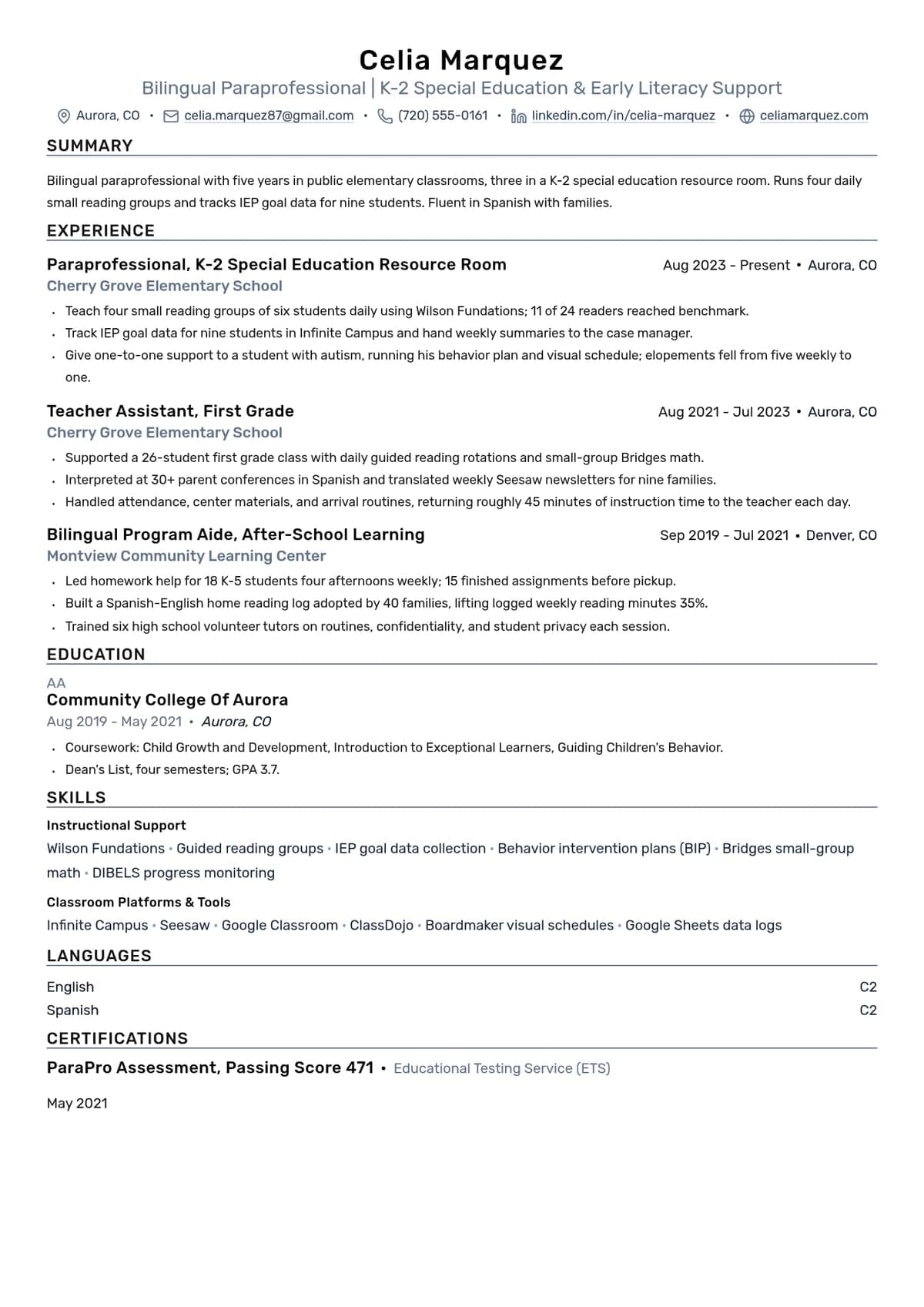


Build yours on the same template.
Every example here is built on a template you can open in the editor. Start from the same layout and write your own experience into it, then download the PDF free, as often as you like.


