Teacher Assistant Resume Example, With or Without Classroom Experience
by Larbi SahliPublished
A full teacher assistant resume example, plus what to change with no paid classroom job: proof bullets, credentials written correctly, and setting-by-setting swaps.
Users have landed jobs at
- 1Password
- OpenAI
- Notion
- justworks
On this page
A principal or HR screener reading a stack of teacher assistant applications is sorting for four things on the first pass: which grades you supported, which subjects, what kind of classroom, and what kind of help you actually gave students. Most applications never answer those four questions, which is why they get skimmed and set down.
Two very different people apply for these jobs. One is an experienced paraprofessional moving districts, with small-group data and behavior plans in her head but a resume that reads like a job description. The other is a parent or career changer with two years of classroom volunteering and no paid school job, who assumes none of it counts. Both can write a resume a principal takes seriously, but they need different documents.
Below is a complete example for the experienced case, followed by the exact changes for the no-experience case, the credential rules, and the bullets that change by classroom setting.
The four details that belong in your top third
Before the example, the rule that governs every line of it: name the setting and the support, not the title. "Assisted the classroom teacher" tells a reader nothing. "Supported a K-2 special education resource room, four small reading groups a day" tells them grade band, setting, instructional format, and frequency in one line.
Mirror the posting's own words while you do it. Current guidance recommends matching the vacancy's exact terms, including "paraprofessional" and "instructional support," when they truthfully describe your work, because that is what screening systems and hiring managers scan for. If the district calls the job teacher aide, your resume should say teacher aide somewhere above the fold, not a synonym you prefer.
Teacher assistant resume example: experienced paraprofessional
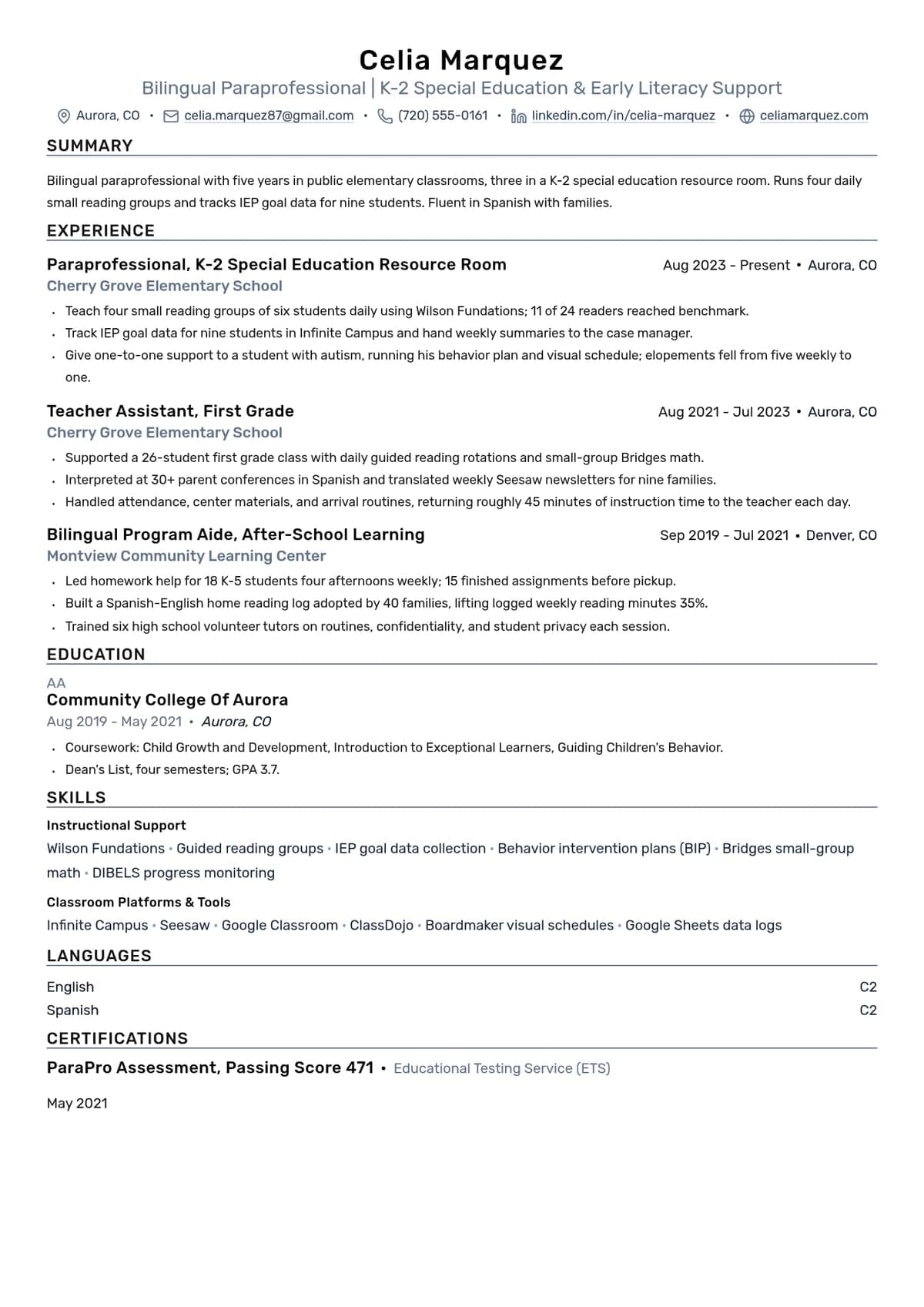
This one belongs to a paraprofessional with five years in a public elementary school, three of them in a special education resource room, applying to a different district. Read the bullets for one thing: every claim has a number, a grade level, or a named program attached to it, so a principal can picture the day and ask about it in the interview.
Why this resume works, section by section
The summary: three sentences, no adjectives you can't prove
A strong short summary runs two to three sentences at the top of the page and states your focus, your relevant experience, two or three strengths that match the posting, and the value you bring (Indeed, 2026). For a paraprofessional that means the grade band, the setting, and one thing a teacher relied on you for.
Cut "hardworking," "passionate about children," and "team player." Every applicant writes them, and none of them survive a question in the interview. Write instead what the summary in the example does: years in the role, the classroom type, the instructional format you run, and a credential or language the district is short on.
The experience bullets: the three parts of the job
"What do I even put on a teacher assistant resume?" has a clean answer. The job has three parts, and your experience section should visibly cover all three. Bullets get stronger when a duty such as tutoring, supervision, or behavior redirection is connected to a measurable student or classroom result.
1. Instructional support
Small-group instruction, reteaching, one-to-one support, progress monitoring, prepping materials for the lesson the teacher planned. Quantify the format: how many groups, how many students in each, how often, in which subject.
Weak: "Helped students with reading and math."
Strong: "Ran four guided reading groups of six students daily in grades 1-2, reteaching phonics skills from the teacher's weekly plan and logging each student's progress."
2. Student care and behavior support
This is the part districts worry about most and the part most resumes skip. Name the behavior plan work, the de-escalation, the supervision duties, and the IEP or 504 plan support. Experience implementing individualized academic or behavioral supports through IEPs and 504 plans is strong evidence for these roles.
Write the function, never the child. "Provided one-to-one support for a student with autism, following the behavior intervention plan written by the case manager" is specific and professional. A student's name, diagnosis details, or a story about a specific incident is a confidentiality problem, and a principal will read it as one.
3. Classroom operations
Attendance, materials, centers setup, copying and prep, family notes, data entry into the school system. These lines feel unglamorous and they are the ones that prove you make a teacher's week lighter. Technical skills that employers screen for in this role include data entry, Microsoft Office, Excel, PowerPoint, word processing, typing, and educational technology (Indeed, 2026), and they belong inside bullets like these rather than floating in a skills list on their own.
Skills: named platforms beat "computer skills"
Current guidance has moved toward naming the exact educational technology you have used rather than listing generic computer skills. Google Classroom, Seesaw, and ClassDojo are worth naming when you have actually run them, and worth leaving off when you have not.
The core skill set for these roles is classroom management, small-group instruction, tutoring, lesson preparation, IEP support, behavior support, and student supervision. Pick the ones the posting names, then make sure each one appears again as evidence in a bullet. A skills list with nothing behind it in the experience section is the most common weakness in these resumes, and experts broadly agree the evidence has to be in the bullets. More proof lines to borrow are in our teacher skills list.
Education and credentials: write them as they are awarded
Public-school teacher assistants generally need at least two years of college coursework or an associate degree, and Title I schools may also accept a state or local assessment (U.S. Bureau of Labor Statistics, 2026). So the myth that every one of these jobs requires a degree is wrong, and so is assuming your two years of community college do not count. List the coursework, the credit hours, and the institution if you did not finish the degree.
If you passed a state or local paraprofessional assessment, list its exact name, the awarding body, and the year you passed. The same goes for a state paraprofessional permit or certificate, CPR and first aid certification, and any crisis prevention or de-escalation training you completed: write the program's real name and keep the dates current. Clearances and background-check readiness can be listed when they are current and relevant.
Requirements differ by state, district, student population, and vacancy, and that is the expert consensus, not a hedge (U.S. Bureau of Labor Statistics, 2026). Read the posting line by line and check your state education agency's page for paraprofessional requirements before you decide what to claim. Never write "certified" for a test you have registered for but not passed; write "scheduled for [month]" instead. See also where to put certifications on a resume when a credential is the posting's hard requirement.
No paid classroom job? Build the resume from what you actually did
Tutoring, babysitting, camp counseling, coaching, and volunteering translate directly into supervision and instructional-support experience. The idea that only paid school employment belongs on the page costs people interviews they would have won.
Three structural changes turn a thin resume into a credible one.
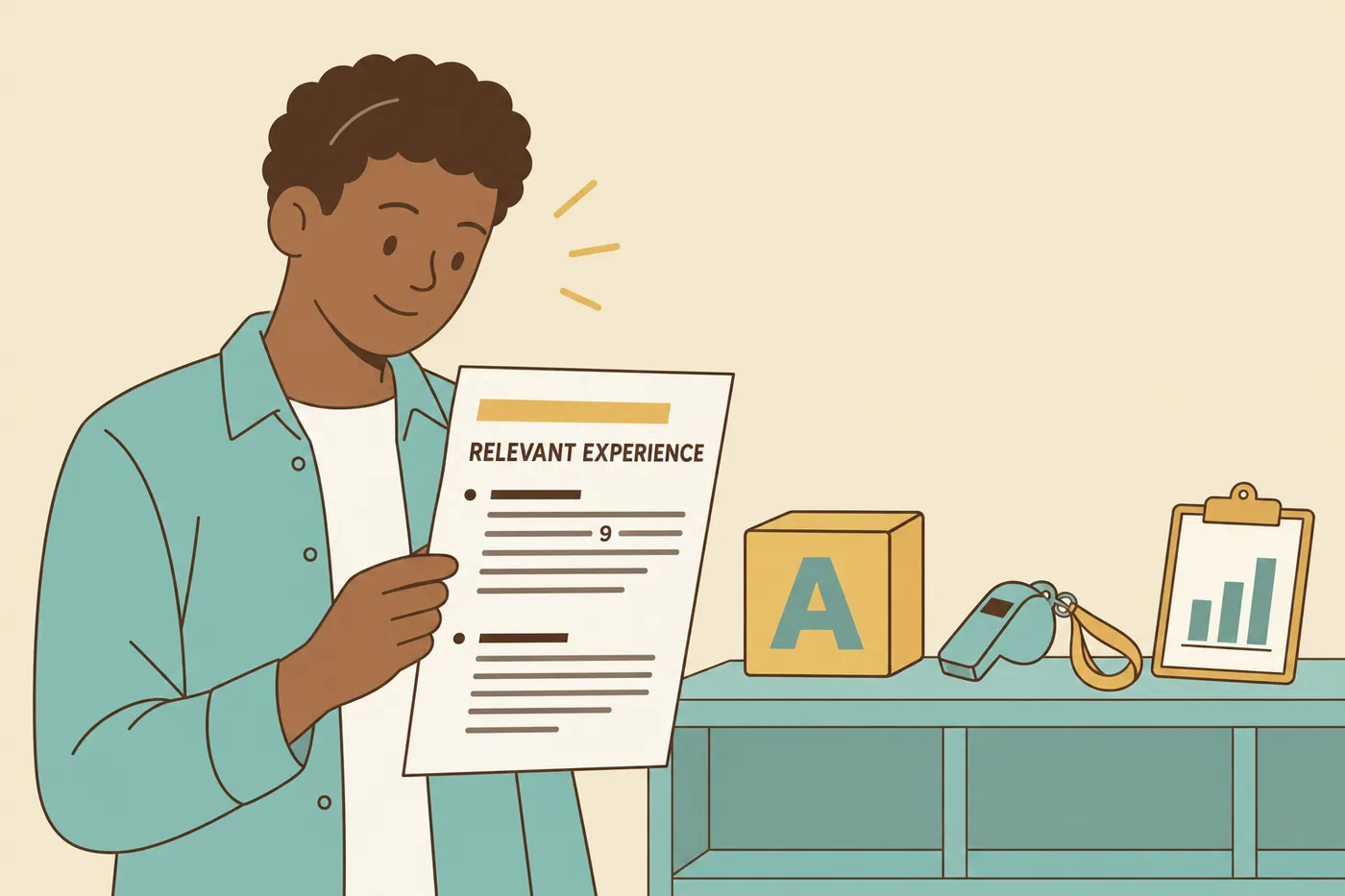
- Reorder the page. Put a Relevant Experience section above any unrelated job history, and group classroom volunteering, tutoring, and camp or coaching work inside it with real dates and hours. Your earlier office or retail job goes below, kept short, with the lines that prove records, scheduling, and accuracy.
- Give volunteer work the same treatment as a job. Organization name, role title, dates, and bullets with numbers. Two school years of weekly volunteering is roughly 60 classroom sessions, and written that way it stops looking casual.
- State the career break in one plain line. Dates, one clause of explanation, no apology. "Career break, 2021-2026: full-time family caregiving. Volunteered weekly in a second grade classroom throughout." That is it. A gap you name is a non-event; a gap you hide invites the question.
Then rewrite the bullets. The before-and-after pattern is always the same: add the grade, the count, the frequency, and what happened as a result.
Before: "Volunteered in my son's classroom."
After: "Volunteered weekly in a second grade classroom for two school years, leading a 30-minute reading rotation with groups of five students and prepping center materials for the week."
Before: "PTA volunteer."
After: "Coordinated three school events for about 200 families, scheduling 15 parent volunteers and tracking supply orders and sign-ups in a shared spreadsheet."
Before: "Babysitting."
After: "Supervised three children ages 4-9 after school for two years, including homework support in reading and math and a consistent routine for transitions."
If the first version of each pair is what your draft looks like, the problem is specificity, not experience. Roleframe's editor checks each block as you click away from it and underlines the bullets that could belong to anyone in the role, so you can see which lines still need a number before you send the file. More patterns for this are in our guide to putting volunteer work on a resume, and if the district asks for a letter, the career break cover letter example handles the gap line in prose.
What makes a good teacher assistant, in evidence a principal can check
Practitioners agree on what these roles are judged by: support for instruction, classroom behavior, student engagement, and collaboration with the lead teacher. On paper, that translates into four kinds of proof.
- Consistency with the same students. "Supported the same nine students across the full school year" says more about reliability than any adjective. Continuity is the thing special education teams hire for.
- Data a teacher relied on. If you collected IEP goal data, ran progress monitoring probes, or logged fluency scores, say so and say how often it was handed over. That is the line that separates a paraprofessional from a helper.
- Calm on a hard day. Behavior plan implementation, de-escalation, safe transitions, and recess or cafeteria supervision without incident. Describe the practice, not a dramatic story.
- Communication with families. Daily notes home, translated conversations, phone calls in a family's own language. Bilingual ability is a hiring advantage in many districts, so put the languages and your level near the top, not buried at the bottom.
Setting swaps: the two bullets that change for each classroom
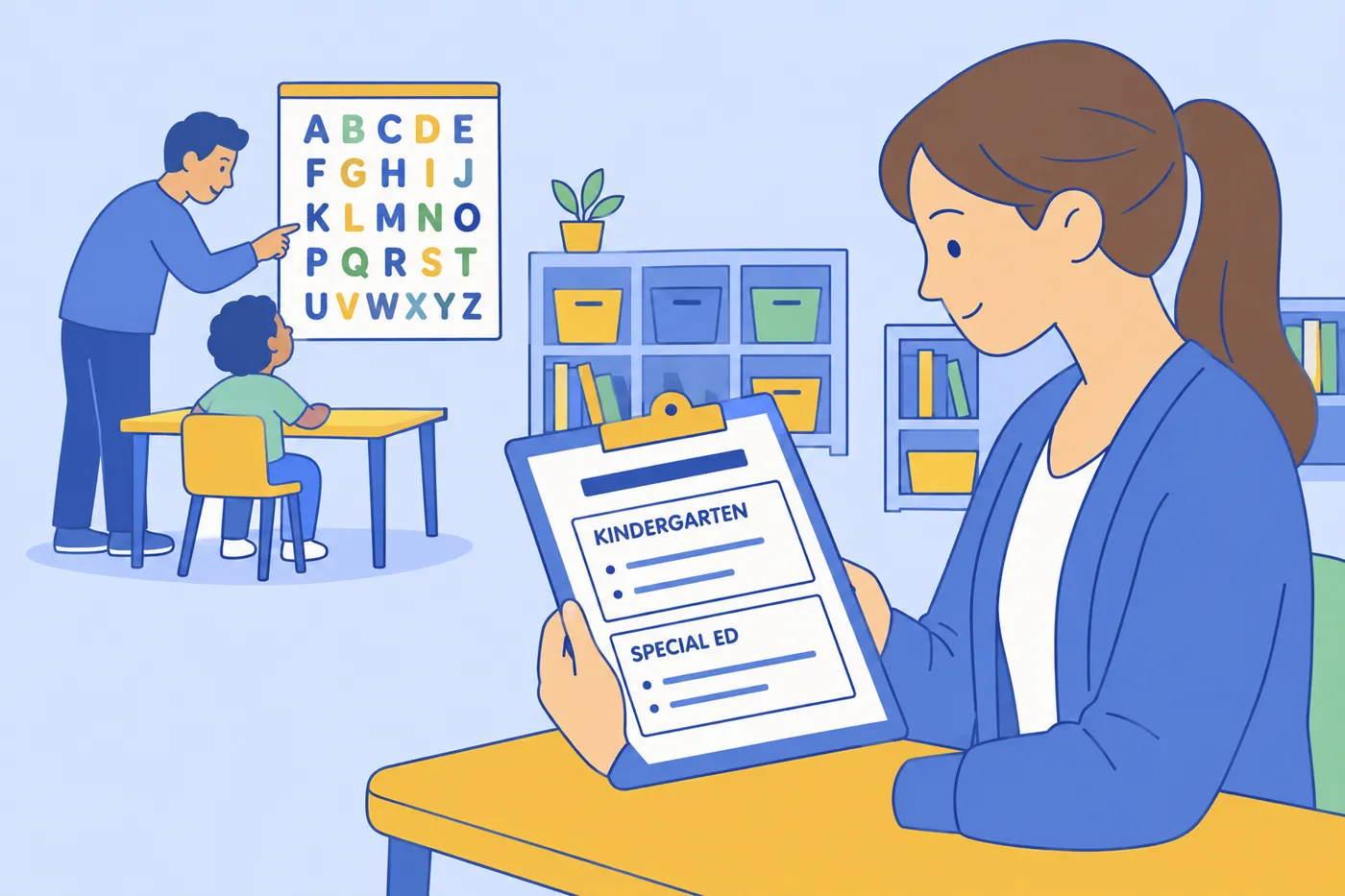
Special-education experience is one of the most commonly listed qualifications for teacher assistant roles (Indeed, 2026), but the same resume aimed at a preschool or a high school needs different evidence in the top third. Change these before you send it.
| Setting | Lead with | Skills to name |
|---|---|---|
| Special education resource room or self-contained | IEP and 504 plan support, one-to-one assignments, behavior plan implementation, data collection for the case manager | Behavior support, de-escalation training, progress monitoring, assistive technology you have used, adaptive equipment or personal care if the posting lists it |
| Preschool or Head Start | Routines, transitions, play-based learning support, ratios you worked within, family communication at drop-off and pickup | Early literacy activities, developmental screening support, CPR and first aid, health and safety procedures, diapering or toileting support if required |
| General elementary | Small-group reading and math, center rotations, reteaching from the teacher's plan, number of students per group | Guided reading, phonics programs you have run, classroom management, Google Classroom or Seesaw, attendance and data entry |
| Middle or high school | Subject-specific support, credit recovery, study skills coaching, co-teaching in content classes, caseload size | Subject knowledge (name the subject), testing accommodations, scheduling and tracking, learning management platforms you have used, independence coaching |
If you meant a college TA position
Different job, two lines of resume space. A graduate or undergraduate teaching assistantship is worth listing when the duties match what the employer wants, because it shows organization, communication, documentation, technology use, training, and stakeholder support (Indeed, 2026).
Write it as: course name and level, number of sections, students per section, and what you were responsible for. "Teaching Assistant, Introduction to Statistics (two sections, 45 students each): led weekly lab sessions, graded problem sets, held three office hours a week." Put it under Experience if you are applying to a research, analysis, or training role, and under Education if it is a minor detail in a longer career. Either way, the value depends on the job you are pursuing, so cut it to one line when the match is loose.
The mistakes that sink these applications
A duties list copied from the job description. If a bullet would be true for every paraprofessional in the building, it is not evidence. Add the count, the grade, or the outcome.
Identifying student details. No names, no initials, no "a student with a severe behavior disorder who threw chairs." Describe your role and the plan you followed.
Two pages of thin content. Most teacher assistant applicants should stay on one page, which is what current examples favor. Specialists differ on whether one page suits every candidate, so if you have ten years across three districts and real credentials, a tight second page is defensible. Padding is not.
Synonyms instead of the district's wording. If the posting says paraprofessional and instructional support, use those exact words where they are true of your work.
Sending a Word file. Save and submit a PDF. The layout holds on any screen, and the text stays selectable and readable for whatever system the district uses.
One more step before you apply: read the posting once more and check that every requirement it names appears somewhere true on your page. If you are aiming at a lead teacher role next, the teacher resume examples show how the same classroom evidence gets rewritten for the step up.
Frequently asked questions
- Do you need a degree to be a teacher assistant?
Not always. Public-school teacher assistants generally need at least two years of college coursework or an associate degree, and Title I schools may also accept a state or local assessment (U.S. Bureau of Labor Statistics, 2026). Requirements vary by state, district, and student population, so read the vacancy and check your state education agency's paraprofessional page before you rule yourself out. If you have college credits without a degree, list the institution, the coursework, and the credit hours.
- What are the skills of a teaching assistant?
Classroom management, small-group instruction, tutoring, lesson preparation, IEP support, behavior support, and student supervision are the core set (Indeed, 2026), alongside communication, patience, organization, and collaboration with the lead teacher. Technical skills matter too: data entry, Microsoft Office, typing, and educational technology. Choose the ones the posting names and that you can back up, then prove each one in an experience bullet rather than leaving it in a list.
- What is a good short summary for a resume?
Two to three sentences at the top that state your role or focus, your relevant experience, two or three strengths that match the posting, and the value you bring (Indeed, 2026). For a paraprofessional, that means the grade band, the classroom setting, the instructional format you run, and a credential or language the district needs. Skip adjectives like hardworking and passionate; they add length and no information.
- Should I put my TA position on my resume?
Yes, when it demonstrates skills the target job wants: organization, communication, scheduling, documentation, technology use, training, or stakeholder support (Indeed, 2026). List it under Experience with the course, the number of sections, the students per section, and your grading or office hours duties. If the match to the job is loose, keep it to a single line.
- Can I apply with only volunteer classroom experience?
Yes. Tutoring, babysitting, camp counseling, coaching, and school volunteering translate into supervision and instructional-support experience. Put those entries in a Relevant Experience section above unrelated jobs, with organization names, dates, and hours, and write them with the same numbers you would use for paid work: how many students, how often, in what subject.
- How long should a teacher assistant resume be?
One page suits most applicants, which is what current examples favor. Resume specialists differ on whether the one-page limit should apply to everyone, so a second page is reasonable if you have many years across districts plus credentials that matter. The test is whether every line would survive a question in the interview.
- Should I send a Word file or a PDF?
Send a PDF. It keeps your layout intact on whatever device the hiring team opens it on, and the text stays selectable so screening software and a reader can both get at it. Only send another format if the district's application page explicitly demands it.
- Is there a difference between teacher aide, teacher assistant, and paraprofessional?
Districts use the three titles for overlapping work, and the duties are defined by the posting rather than the label. Current guidance is to mirror the vacancy's exact terms when they truthfully describe your experience, so if the job is advertised as paraprofessional, use paraprofessional in your summary and job titles where it is accurate. Keep your real former job titles as they appeared on your pay stub, and add the district's wording in the summary rather than changing history.
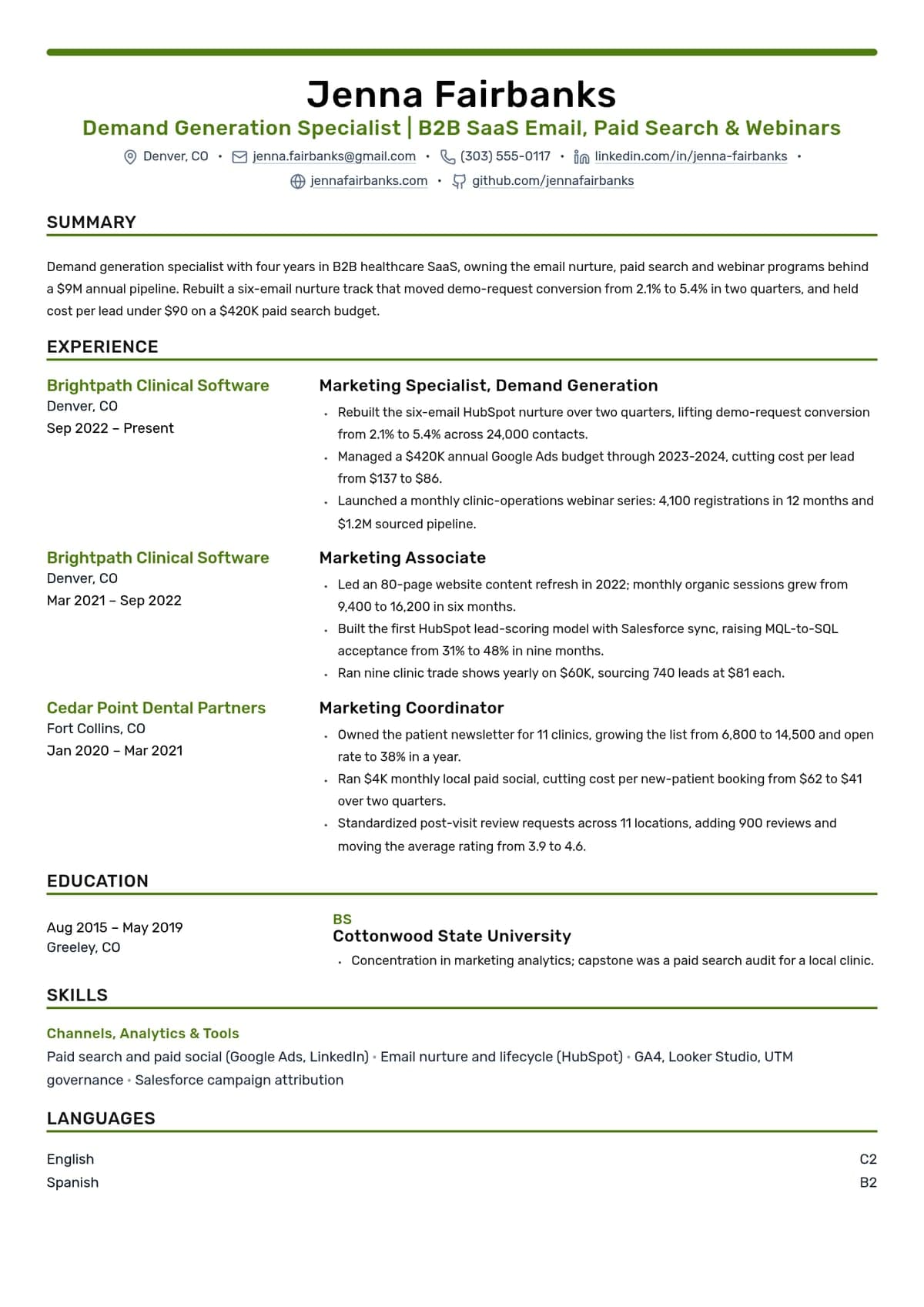


Build yours on the same template.
Every example here is built on a template you can open in the editor. Start from the same layout and write your own experience into it, then download the PDF free, as often as you like.


