Stay at Home Mom Cover Letter: Example and the Career Break Line
by Larbi SahliLast Updated
Write a returning-parent cover letter with a clear career-break explanation, relevant evidence and honest current skills. Includes a fictional payroll example.
Users have landed jobs at
- 1Password
- OpenAI
- Notion
- justworks
On this page
A cover letter for returning to work after parenting or caregiving can connect your background with the job you want now. Lead with relevant evidence, explain the break briefly if it helps, and describe current preparation and availability accurately.
There is no compulsory sentence order or need to make a career break sound productive in professional terms. You can choose how much personal context to share. This guide provides a fictional payroll example, several wording options and adaptations for returning parents, caregivers and applicants with little prior paid work.
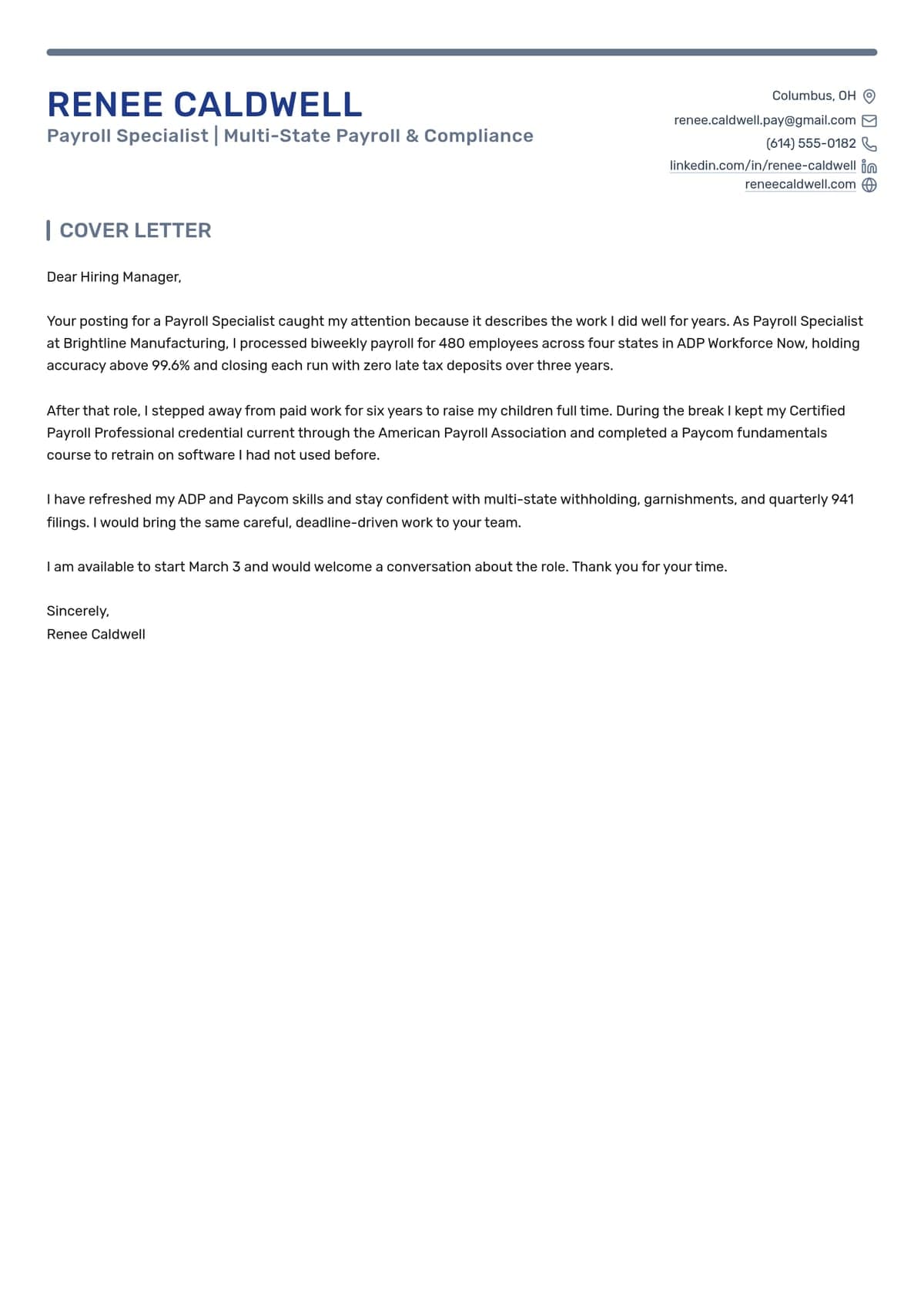
A complete stay at home mom cover letter example
This fictional letter uses prior payroll experience, a short explanation of a parenting break and recent preparation. The candidate, employer, credentials and figures are illustrative. Replace them with your own facts; do not copy the identity, certification or results as if they were yours.
The sample focuses on work relevant to payroll while making the break understandable. It also distinguishes previous software use from recent practice, so the reader is not asked to assume current proficiency in an unfamiliar version. The same approach can support a bookkeeping application or another profession.
Three ways to explain a career break
Choose wording that is accurate and comfortable for you. The following examples show different levels of detail; none requires disclosing a family member’s private circumstances or claiming unrestricted availability.
| Approach | Fictional wording | Use it when |
|---|---|---|
| Brief context | “After a career break for parenting, I am returning to payroll work.” | A short explanation helps connect your earlier experience with this application. |
| Dates and direction | “I stepped away from paid work in 2019 to care for my family and am now applying for part-time payroll roles.” | The dates or work pattern add relevant context and are accurate. |
| Relevant preparation | “During my parenting break, I maintained my payroll credential and recently completed spreadsheet reconciliation exercises.” | You actually completed the preparation and can describe its scope. |
A neutral explanation is enough; you do not need to apologize for caring responsibilities. Keep the focus on the role and the evidence that supports your application. See how to explain a career gap for other wording options.
Place the explanation where it makes the letter clear
One useful order is: interest in the role, relevant evidence, brief break context, current preparation and a close. You can also mention the return in the opening when it helps explain the application, such as a returnship or career-change opportunity.
Use as much context as the reader needs to understand your background. A sentence or two often works, but there is no rule that a particular position or exact word count changes how every hiring manager responds.
Choose your strongest relevant evidence
A previous paid role may supply the clearest evidence, but a recent project, volunteer responsibility or qualification may be more relevant. Describe the context, your work and an outcome you can substantiate.
For payroll, processing volume can show scope, while reconciliations and correction procedures explain responsibility. Use a number only when you can support it. Do not invent an accuracy percentage or imply that you alone produced a team result.
Describe old software experience in the past tense. “Used ADP Workforce Now to process payroll in my previous role” is more precise than “expert in all current payroll systems.” Explain recent learning separately.
What from the break belongs in the letter
Include activities from the break when they are both accurate and relevant to the job. They do not have to account for every month or turn caregiving into a professional project.

- A credential you earned or maintained, with its correct issuer and current status.
- A completed course, identifying the subject and the practice it actually included.
- Volunteer bookkeeping, scheduling or coordination, with a clear description of your responsibility.
- Freelance, seasonal or part-time work, accurately identified as such.
- A personal project demonstrating a skill useful for the role.
Choose the most relevant items. A career break remains valid even if you did no courses or professional activities during it. If you mention a credential, verify its status: PayrollOrg explains the recertification cycles for CPP and FPC. A past award is not automatically a current credential. See certification placement for the resume.
Describe unpaid work without inflating the role
Parenting or caregiving may involve skills relevant to an application. Describe a specific task in its actual context if it helps show preparation. Do not rename the role “household CEO” or present personal finances as professional payroll work.
A school-association treasurer role, for example, could support a bookkeeping application if you explain the records you maintained and the responsibility you held. A caregiving example might demonstrate coordinating appointments, without implying a clinical qualification. Use the evidence honestly and let the reader assess its relevance.
Describe current skills and learning accurately
Compare the posting with your current abilities. Note which tools you have used recently, which you used in an earlier role and which would require learning. A short course may help with a specific gap, but its value and time commitment depend on your background and the work involved.
Fictional wording: “I previously used ADP Workforce Now and have recently practiced spreadsheet reconciliations using sample records. I would need onboarding to your current payroll configuration.” This is clearer than claiming proficiency in every modern platform.
You do not need to postpone every application until you have completed a new certification. Prioritize genuine requirements and describe ongoing study as ongoing, not completed.
State job-related availability
State the start date or work pattern you can actually commit to when it is relevant or requested. “The part-time schedule in your posting matches the hours I am seeking” can be enough. Avoid promising full availability unless it is true.
You generally do not need to describe childcare arrangements in a cover letter. In the US, EEOC guidance says non-job-related family and childcare questions can be evidence of discriminatory intent in hiring. That is not a claim that every scheduling question is unlawful. Focus your answer on the role’s working requirements and how you can meet them.

Adaptations for different returning applicants
Keep the same emphasis on relevant evidence and accurate context, changing the explanation to fit your circumstances and preferred level of disclosure.
Stay at home dad returning to work
Fictional wording: “After four years as a full-time parent, I am returning to accounting and am particularly interested in the reconciliation work described in your posting.” Follow with the experience and current preparation that support that interest. There is no need to justify the family’s choice of caregiver.
Family caregiver returning to work
Fictional wording: “I took a career break to care for a family member and am now seeking a part-time administrative role.” You can keep medical information private. If coordinating appointments or maintaining records is relevant, describe the actual tasks without turning family caregiving into a clinical or professional credential.
Homemaker with little paid work before the break
Lead with the strongest evidence available: a project, course, volunteer role, informal work or a relevant qualification. You can also state the target role and skills you have practiced without claiming employment you have not had.
Fictional example: “As a volunteer treasurer for our school association, I recorded income and expenses and prepared a monthly summary for the committee. I am seeking an entry-level accounts-assistant role where I can build on that experience.” Use only details true to your own role. A career-change guide can help plan further preparation.
Review the letter before you send it
Check the employer and role name, dates, responsibilities, figures and credential status. Confirm that recent learning is clearly distinguished from earlier experience, and that the letter explains your relevant preparation without unnecessary repetition.
You can draft the application in Roleframe. Review any AI-suggested wording against your records; an assistant can overstate experience even when it starts with your resume. Follow the employer’s file instructions and inspect the exported letter for layout, links and unintended personal information.
Frequently asked questions
- How do I write a cover letter when I've been a stay-at-home mom?
Connect your relevant experience or preparation to the job, add brief career-break context if helpful, and state current skills and availability accurately. A past role can supply evidence, but recent volunteering or projects may also be useful.
- How do I professionally say stay-at-home mom?
“Full-time parent” or “career break for parenting” are clear descriptions. Use wording that accurately reflects your situation; you do not need to invent a corporate title to make it professional.
- How do I put stay-at-home mom on my resume?
A dated career-break entry is one option when it makes the timeline clearer. Separate volunteer work, training and paid work where useful, and describe each accurately. Follow any application form that asks for a complete history.
- What do I write for occupation as a stay-at-home mom?
Answer the specific form truthfully. “Full-time parent” or “homemaker” may fit a current-occupation field; a previous-occupation field asks a different question. Do not substitute the job you hope to obtain for your current status.
- How do I write a stay-at-home mom cover letter with no work experience?
Use relevant education, projects, volunteer responsibilities or practiced skills, clearly stating their context. You do not need to invent paid work, a metric or a certification to write a useful opening.
- Should I explain my childcare arrangements in the letter?
You generally can focus on the job’s schedule and your actual availability. You do not need to volunteer family arrangements to explain that fit. US EEOC guidance identifies non-job-related childcare inquiries as potentially discriminatory; other jurisdictions have their own rules.
- How long should the employment gap explanation be in the letter?
A sentence or two often gives enough context, but use the amount needed for clarity. There is no mandatory position in the letter or rule that you may mention the break only once. Keep the main focus on relevant evidence and the role.


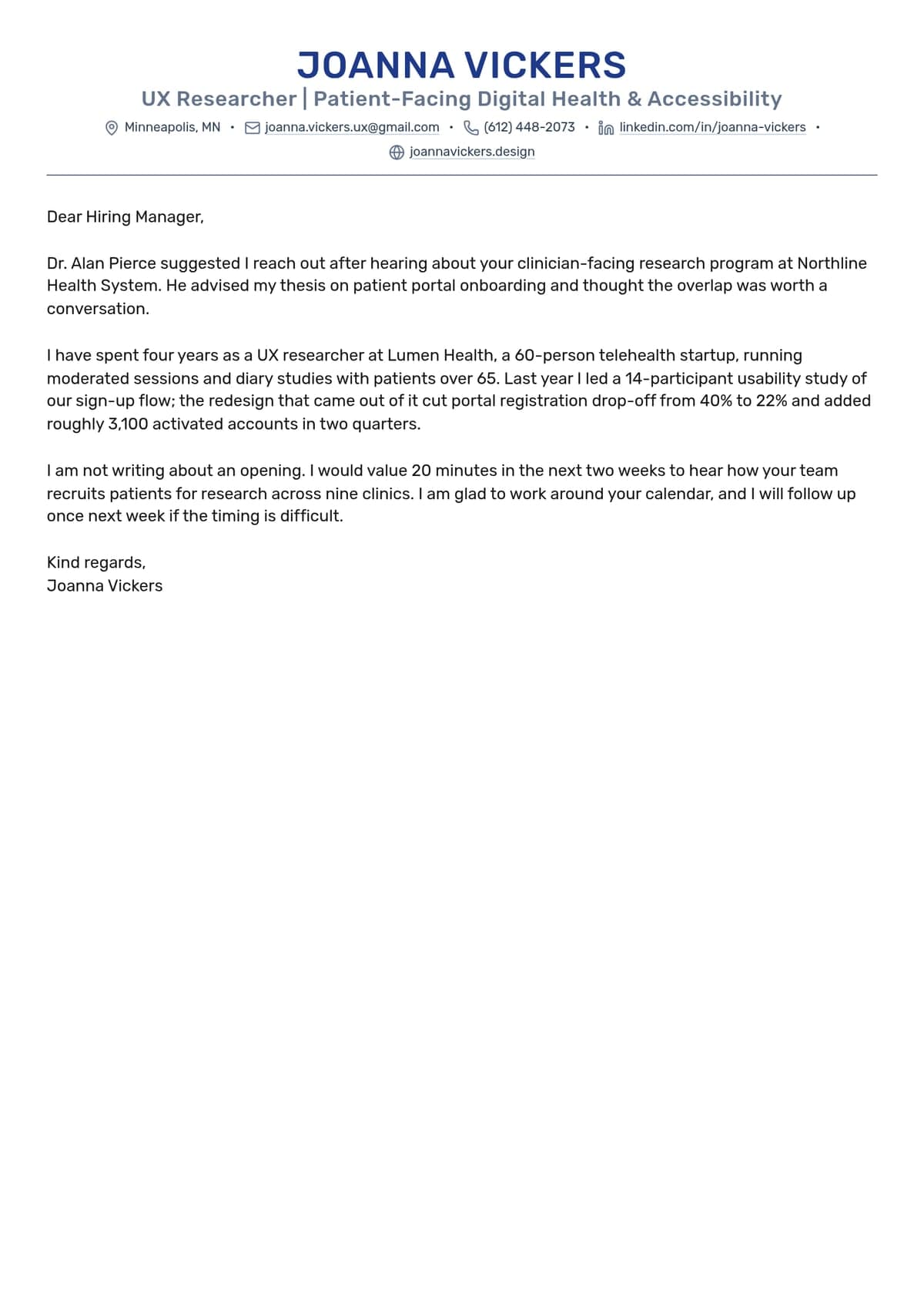
Write yours on the same template.
Every example here is built on a template you can open in the editor. Keep the structure that works and put your own story in it, or let Roleframe draft a first version from your resume and the job posting.


