What Is a CV, and When Do You Need One?
by Larbi SahliPublished
A CV, short for curriculum vitae, lists your education, work history and skills. See what CV means, how it differs from a resume, and which kind you need.

On this page
A CV, short for curriculum vitae (Latin for "course of life"), is a document listing your education, work history, skills, and achievements. In the UK, Ireland, and most of the world, it is the standard job application document, the same thing Americans call a resume. In the US and Canada, a CV means a longer academic record used for research, teaching, and some medical roles.
What does CV stand for?
CV stands for curriculum vitae, Latin for "course of life." The plural is curricula vitae, though almost everyone just says "CVs." Merriam-Webster gives the pronunciation as roughly kuh-RIK-yuh-lum VEE-tye, with VY-tee as a common alternative, and most people sidestep the whole question by saying the letters: "see-vee."
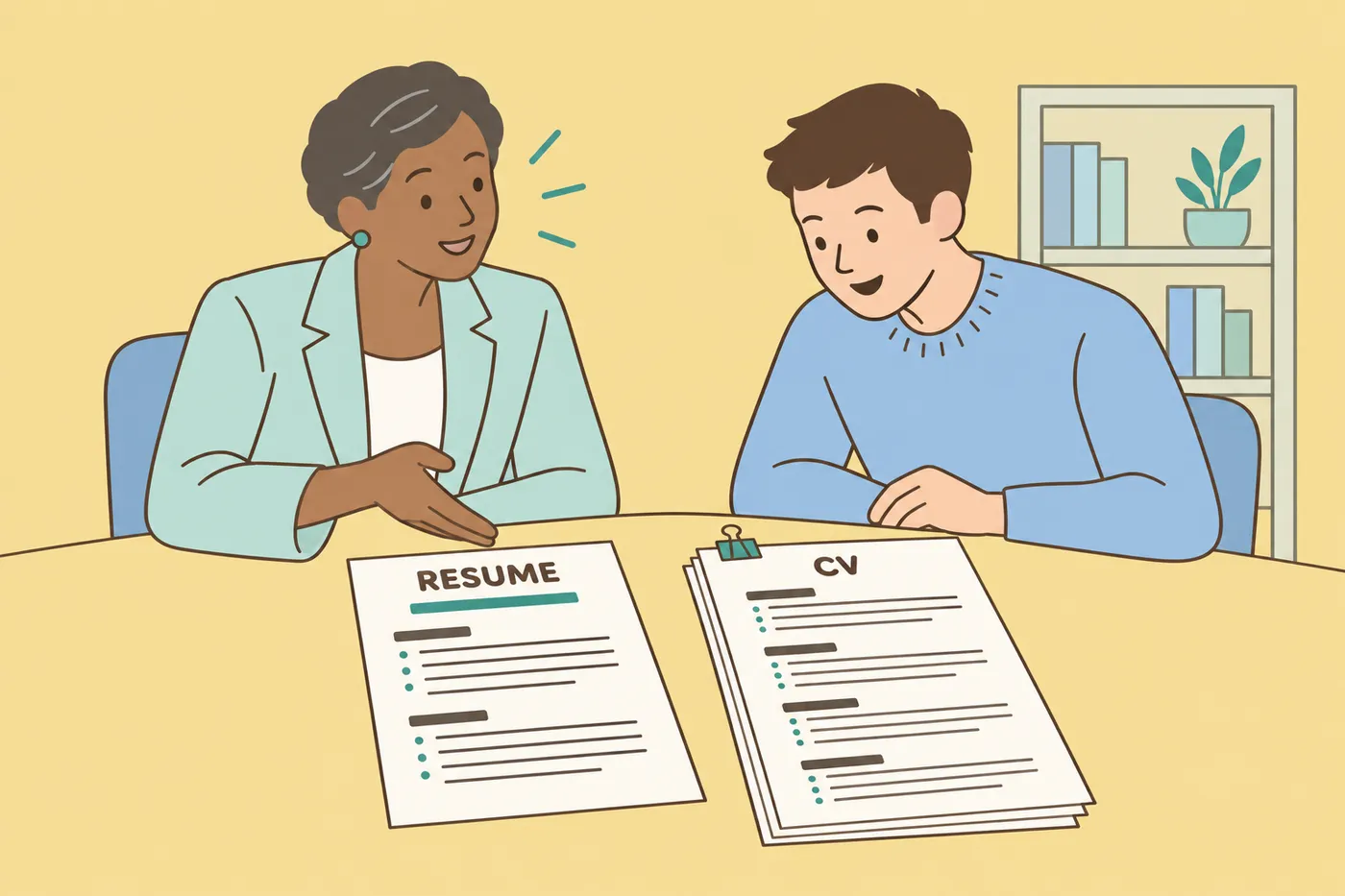
Resume, from the French for "summary," and CV name the same document in most of the world. A British job seeker's CV and an American job seeker's resume are the same thing with different labels. The confusion starts because American academia kept the older, longer meaning, which is why the rest of this page separates the two.
The two meanings, and which one applies to you
Which meaning you need depends entirely on where you are applying and for what.
The everyday meaning (UK, Ireland, Europe, Australia, New Zealand, India, most of Africa and Asia): a CV is your job application document. It runs one to two pages, leads with a short profile and your work experience, and gets tailored to each job. If a job posting in London or Dublin asks for your CV, it wants what an American would call a resume.
The US and Canadian meaning: a CV is a complete academic record. It lists every publication, conference presentation, grant, and teaching appointment, and it grows over a career rather than staying short. Nobody applying for a marketing job in Chicago needs one. A postdoc applying for a faculty position does.
A quick self-check: if you are applying for a regular job outside North America, write the short kind. If you are applying for a faculty, research, or fellowship position anywhere, write the long kind. If you are applying for a regular job in the US or Canada, you need a resume, and this page's CV advice for the everyday kind still applies because it is the same document.
What is a CV used for?
The everyday CV covers one use: applying for jobs in the countries where CV is the standard word. The US academic CV covers a narrower but longer list:
- Faculty and lecturer applications at universities
- Research positions, postdocs, and fellowships
- Grant and funding applications, where the funder wants your full publication record
- Some medical and scientific roles, where licensure, residencies, and research output all need to be itemized
- Graduate school applications, especially for PhD programs
One thing a CV is never: a cover letter. A cover letter is a one-page letter addressed to a specific employer explaining why you want this job. A CV is the structured record of what you have done. Employers that ask for both want two separate documents, and sending one where the other was requested reads as not having read the instructions.
What goes in each kind of CV
The two documents share a name and almost nothing else in structure. Here is the honest side-by-side:
| Job CV (the everyday kind) | Academic CV (the US kind) | |
|---|---|---|
| Purpose | Get an interview for a specific job | Document a full academic record |
| Core sections | Contact details, short profile, work experience, education, skills | Education, research experience, publications, presentations, teaching, grants and awards, professional service, references |
| Length | Short. Two pages is the common convention in the UK; one page is normal early in a career | No set limit. It grows with every publication and appointment |
| Ordering | Most relevant first, tailored per job | Education first, then reverse chronological within each section |
| References | Left off; provided when asked | Usually listed, often three to five academic referees |
The tailoring difference matters as much as the length difference. A job CV changes for every application: you reorder bullets, swap emphasis, and match the language of the posting. An academic CV stays close to complete every time, because search committees expect to see everything and will notice gaps.
Is a CV the same as a resume?
In the UK and most countries, yes. CV and resume are two words for the same one-to-two-page job application document, and you will rarely hear "resume" at all outside North America. In US academic hiring, no: there a CV is the long-form record described above, and a resume is the short document used for everything else.
Can you send a resume where a CV is requested? Outside academia, yes. If a UK employer asks for a CV and you have an American-style resume, send it; the employer is asking for exactly that document under a different name. The only place substitution fails is academic hiring, where a search committee asking for a CV wants the full record, and a two-page resume will look like you left most of your career out.
What does CV mean outside job hunting?
CV is a busy abbreviation. In anime and video game credits it means character voice, which is why voice actor lists are full of it. In medicine it means cardiovascular. In tech and machine learning it means computer vision. If you searched "cv meaning" after seeing it in game credits or a medical chart, one of those is your answer. Everything on this page is about the job document.
How to write a CV, in five steps
For the everyday job CV, the structure is settled and you should not fight it. Recruiters scan fast, and a predictable layout is what lets them find your experience in the first few seconds.
- Put your contact details at the top: name, phone, email, city, and a LinkedIn URL if your profile is current. No photo and no date of birth for UK and US applications.
- Write a two-line profile that names your role, your years of experience, and the one result you are proudest of. Skip empty adjectives; a profile that says "hardworking team player" says nothing.
- Lead with work experience if you have any that is relevant, or with education if you are a student or recent graduate. Within each job, write bullets that state what you did and what changed because of it.
- Add a skills section with the specific tools, software, and certifications the postings in your field ask for, using the exact words the postings use.
- Finish with extras only if they earn their space: languages, certifications, volunteering that shows relevant skills.
If you are stuck on the profile, a set of worked summary examples by role and career stage is the fastest way past the blank line. And since most CVs now pass through an applicant tracking system (ATS), the software that parses and filters applications before a human reads them, formatting matters: single column beats decorative layouts, and our guide to ATS CV templates covers how to check that yours parses cleanly.
A CV for university depends on which side of the Atlantic you are on. A UK student applying for jobs or placements writes the standard job CV with education first; the student resume examples show exactly that structure. An American applying to graduate school writes an early-stage academic CV: education, research experience, any publications or posters, and relevant coursework. For a sense of what the full academic document looks like later in a career, see the professor resume example and when to send a CV instead.
Your next step
If you need the everyday kind, remember it is the same document as a resume, so any good resume template works as a CV template. Roleframe's editor is free to use with no account, and the download is a PDF with real selectable text, which is what both recruiters and ATS parsers need. If you prefer to work in Google Docs, we have also reviewed CV templates for Google Docs that export cleanly. Either way, save and send it as a PDF: it is the one format that looks the same on every screen it opens on.
Frequently asked questions
- Is a CV a cover letter?
No. A cover letter is a one-page letter to a specific employer explaining why you fit this role. A CV is the structured record of your education, experience, and skills. When an application asks for both, it wants two separate files, and the cover letter should add context the CV cannot, not repeat it.
- What is a CV for a job in the US?
For almost all US jobs, what you need is a resume, and if a US employer outside academia says "CV" casually, they mean your resume. The exceptions are academic, research, and some medical or scientific roles, where CV means the full-length academic record with publications, teaching, and grants.
- How long should a CV be?
The everyday job CV: one page early in your career, two pages once you have enough relevant experience to fill them. The academic CV has no length limit and is expected to be complete, so a senior academic's CV can run many pages without anyone blinking. Padding either kind hurts you; length should follow substance.
- Do I need a CV or a resume for graduate school?
In the US, graduate programs, especially PhD programs, generally expect an academic CV: education first, then research experience, publications or posters if you have them, and relevant coursework or teaching. It will be short at this stage, and that is fine. A committee would rather see two honest pages than a padded five.
- What does CV mean in medicine?
Two things, depending on context. Clinically, CV is the standard abbreviation for cardiovascular. In hiring, physicians and researchers use CVs in the academic sense: a complete record of education, residencies, licensure, publications, and appointments, which is why medical CVs are often long even for regular clinical roles.
- Can I turn my resume into an academic CV?
Partly. Your education and work history carry over, but an academic CV needs sections a resume never has: publications, conference presentations, grants, teaching, and professional service, each listed in full rather than summarized. It is usually faster to rebuild from the academic structure and pull details in than to stretch a two-page resume.


Ready to start your new resume?
Writing a resume takes time, and even a polished one can miss what a hiring manager is looking for. Roleframe helps you build a clear, ATS-safe resume in minutes and tailor it to the job you want.


