Professor Resume Example, and When to Send a CV Instead
by Larbi SahliLast Updated
A professor resume example cut from a nine-page academic CV to two pages, with every cut explained, plus how to tell which document the posting wants.
Users have landed jobs at
- 1Password
- OpenAI
- Notion
- justworks
On this page
The hardest part of a professor resume is not writing it. It is deciding what to throw away. Most faculty keep a curriculum vitae (CV) that has grown by accretion for a decade: every publication, every conference talk, every committee, every guest lecture. Ours below started at nine pages. The resume version of the same career is two.
That cut is exactly the decision most searchers for this page are facing, so this article does it in the open. You will see the finished two-page professor resume, then a section-by-section account of what the nine-page CV contained, what survived, what was deleted, and why each call was made. Along the way we cover the adjacent questions: how to tell which document a posting actually wants, how to write an adjunct-to-assistant-professor progression as one story, which of twenty publications make the cut, and what changes again if you are leaving academia for industry.
The professor resume example, cut from a nine-page CV
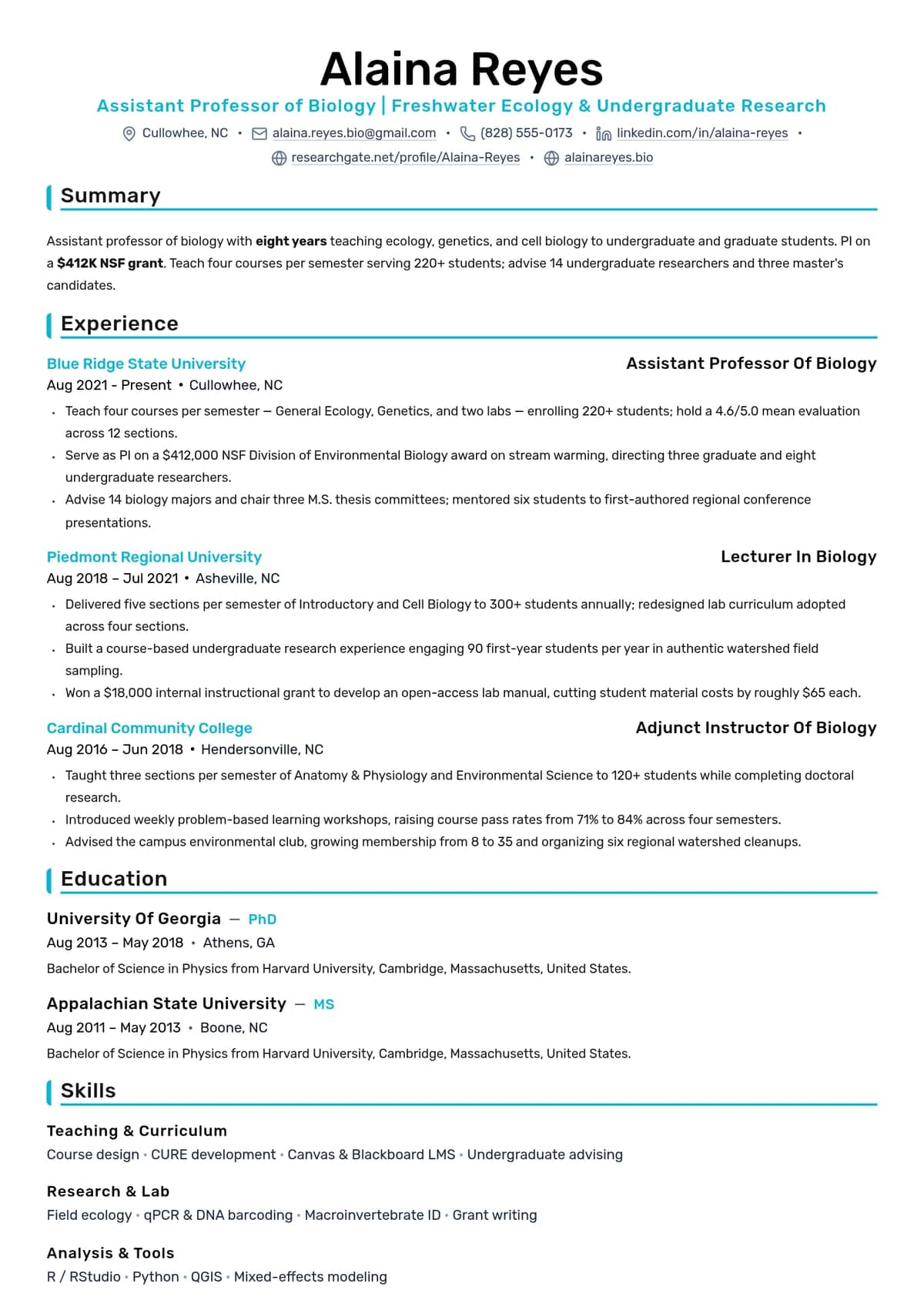
The candidate is a tenure-track assistant professor of biology at a regional public university, six years past her PhD, with a route that ran adjunct, then full-time lecturer, then assistant professor. On her CV that career takes nine pages. Here it takes two, and nothing on these two pages is filler: every line either shows teaching scope, research funding, or the kind of service a hiring committee screens for.
Read it once as a committee member would, in under a minute, then come back for the cut-by-cut breakdown below.
Academic CV or resume: which one the posting is asking for
Send the wrong document and you look like you did not read the posting. The rule is simpler than most guides make it: tenure-track and research faculty searches expect a full CV. Almost everything else expects a resume, or accepts either and rewards the shorter one.
The posting itself usually tells you, if you read the application instructions rather than just the job title. Look for these signals.
| Signal in the posting | Send this | Why |
|---|---|---|
| "Submit a curriculum vitae" for a tenure-track or research-focused role | Full CV, complete publication list | The search committee needs your entire scholarly record to evaluate research trajectory and tenure potential. |
| "Resume or CV" for a teaching-focused role at a community college | Two-page resume | Teaching-load institutions screen on courses taught and student outcomes, not on publication count. A nine-page CV signals you misread the job. |
| Adjunct or lecturer posting routed through an HR portal with an upload limit | Two-page resume | These often pass through an applicant tracking system (ATS) and an HR screener before any academic sees them. Short and keyword-complete wins. |
| Administrative roles: department chair, dean, program director, assessment lead | Two-page resume, CV available on request | These committees include non-faculty. They read for leadership scope, budgets, and accreditation work, not for your h-index. |
| Industry roles: R&D scientist, medical writer, instructional designer, data roles | Two-page resume, rebuilt (see the industry section below) | An industry recruiter gives a first pass seconds, not minutes. A CV format loses them on page one. |
One more practical marker: if the application goes through an institution's careers portal (Workday, PeopleAdmin, Interfolio's HR side), assume an ATS parses it first. That is a resume environment even when the posting says CV, so keep the formatting plain and put keywords in the body text. If it goes by email to a search committee chair, it is a human-first read and the full CV is safe. Our guide on ATS-friendly CV formatting covers the parsing side in detail.
When a posting genuinely accepts either, send the resume and add a line at the bottom: "Full CV with complete publication list available on request." You lose nothing and you respect the reader's time.
Every cut from nine pages to two, marked
This is the backbone of the page. The table below walks through each section of the original nine-page CV, shows what happened to it on the two-page resume, and gives the reason. The pattern to internalize: the CV proves completeness, the resume proves relevance. A CV answers "what is your entire record." A resume answers "can you do this specific job." Every cut below follows from that difference.
| CV section | On the nine-page CV | On the two-page resume | Why |
|---|---|---|---|
| Header and contact | Name, two addresses, ORCID, personal site | Name, one email, one phone, city, ORCID link | One point of contact. Committees do not mail letters anymore. |
| Summary | None (CVs rarely have one) | Added: 4 lines stating discipline, years teaching, grant funding, course portfolio | A resume gets a fast first read. The summary is the pitch a CV never needed. |
| Education | Half a page: dissertation title, committee members, comprehensive exam fields | 3 lines: degrees, institutions, years, dissertation title only | The committee names and exam fields matter to no one after your first job. |
| Appointments / Experience | Every appointment listed separately, including semester-long visiting stints | One progression: adjunct → lecturer → assistant professor, each with 3-4 scope bullets | Ten job entries read as churn. One progression reads as a career. See the next section. |
| Publications | 20 peer-reviewed articles, 2 book chapters, full citations, one and a half pages | 'Selected Publications': 5 entries, with a note that the full list is on request | Five well-chosen entries carry the same signal as twenty. The selection logic is a section of its own below. |
| Conference presentations | 31 talks and posters, two pages | Cut entirely, except one invited keynote folded into the experience bullets | Talks are the softest currency on a CV. On a resume they are noise unless invited and prestigious. |
| Grants and funding | Every application including declined ones, internal travel grants of a few hundred dollars | 2 lines: the funded federal grant with agency, amount, and role; one internal curriculum grant | Declined applications and small travel grants dilute the one number that matters. |
| Teaching | Every course ever taught, every semester, including one-off guest lectures, two pages | Folded into experience bullets as load, enrollment, and modality (see the scope section below) | A course list is inventory. Load and enrollment are scope. |
| Advising | Every undergraduate thesis supervised, listed by student name | 1 line: counts of graduate and undergraduate advisees, plus notable outcomes | Names mean nothing to a stranger. Counts and outcomes do. |
| Service | 14 committees across department, college, and university, plus journal reviewing | 4 lines total, chosen for leadership and screening value (section below) | Fourteen committees signal that you say yes to everything. Four signal judgment. |
| Professional memberships | 6 societies with membership years | Cut | No one has been hired for a membership. |
| References | 3 references with full contact details | Cut | Standard resume practice; the portal collects references separately. More on this in our guide to <a href='/career-faq/references-on-resume'>references on a resume</a>. |
Total effect: nine pages become two, and the two read faster and hit harder. Nothing was falsified and nothing important was hidden. The full record still exists as the CV, one click or one request away. If you are unsure the two-page target is right for your experience level, our data-backed answer to one page or two applies to academics the same way: past roughly a decade of experience, two pages is the norm, and even a twenty-year academic career should not push a resume to three.
Adjunct to lecturer to assistant professor, written as one progression
The most common structural mistake on academic resumes is listing every appointment as a separate entry. Our example candidate held seven distinct appointments before her current role: adjunct at two institutions, sometimes in the same semester, then a full-time lecturer post, then the tenure-track job. Listed separately, that is seven headers, seven date ranges, and a first impression of instability that is entirely unfair to how academic careers actually work.
The fix is to write it as a progression. Three entries, newest first, each with a clear title change that shows movement:
- Assistant Professor of Biology (current): the fullest entry, carrying the grant, the advisees, the course development work, and the strongest teaching numbers.
- Full-Time Lecturer: two to three bullets on load and enrollment, plus the one accomplishment that earned the tenure-track offer, such as redesigning the intro sequence.
- Adjunct Instructor (institutions grouped under one header): one to two bullets. Group the institutions on a single line rather than giving each its own entry. The point of this section is only that she taught at scale while finishing the PhD.
Grouping adjunct work under one header is legitimate and standard. You are not hiding anything: the institutions are named and the dates are accurate. You are refusing to let formatting turn a normal early-academic path into something that looks fragmented. The same logic drives reverse chronological format generally: recency and trajectory first, detail in proportion to relevance.
One more rule for the progression: bullet count should taper. Five or six bullets on the current role, three on the lecturer role, two on the adjunct years. If your oldest job has as many bullets as your newest, you have not decided what matters. Our guide on how many bullets per job gives the full breakdown by recency.
Which of twenty publications survive the cut
Our candidate has twenty peer-reviewed articles and two book chapters. Five entries made the resume, under the heading "Selected Publications" with a closing line: "Full publication list available on request." That label matters. "Selected" tells the committee you chose; without it, five publications reads as your entire output.
The selection logic, in priority order:

- First-author papers beat co-authored ones. A committee scanning fast reads authorship position before anything else. Four of the five selected entries are first-author.
- Venue recognition beats recency. A slightly older paper in the field's flagship journal outranks a newer paper in a journal the committee may not know.
- Relevance to the posting beats prestige. If the job emphasizes undergraduate research, a paper co-authored with undergraduate students earns a slot even if the venue is modest, and the student co-authorship gets flagged in the citation.
- Breadth as a tiebreaker. If two candidates papers tie on the above, pick the one that shows a second research line, so the selection does not look like one project sliced five ways.
- Book chapters and proceedings go last, and only if a slot remains. They carry less peer-review weight and the committee knows it.
What never makes the resume: manuscripts "in preparation." Under review is acceptable with the journal named if your field's norms allow it; in preparation is a claim no one can verify and every committee discounts to zero. It is the academic equivalent of a skill you cannot demonstrate, and it invites the one interview question you do not want.
Teaching load, enrollment, grants, and advisees as scope lines
Here is where academic resumes lag every other profession. A sales resume states quota and attainment. A project manager resume states budget and headcount. Academic resumes, oddly, tend to state duties: "taught undergraduate courses, supervised students, conducted research." Those lines describe every professor alive.
The fix is scope lines: numbers that establish the size of what you carried. On our example resume, four kinds of scope do the work:
- Teaching load: "Carry a 3-3 load across intro and upper-division courses, reaching 340+ students per year across lecture and lab sections." Load notation plus total enrollment tells the reader the scale in one line.
- Enrollment and modality: "Redesigned BIO 201 for hybrid delivery; enrollment grew from 60 to 150 per semester across three sections with no drop in average course outcomes." Growth plus modality shows you can teach at the scale modern departments run.
- Advisees: "Advise 4 master's students and 12 undergraduate researchers; three advisees placed into PhD programs, two into industry lab roles." Counts prove mentoring capacity; outcomes prove it worked.
- Course development: "Built and launched two new courses, including the department's first bioinformatics elective, now a required track course." A course that outlived you is institutional impact, not a duty.
Notice what these lines have in common: a verb, a number, and a consequence. That structure is exactly what committees at teaching-focused institutions screen for, and it is what an HR screener at a portal-driven search can actually evaluate without a PhD in your field.
Grant funding: the number and the agency, always
Grant funding is the single strongest scope line an academic resume can carry, and most candidates waste it. "Secured external research funding" says nothing. The line on our example resume says: "Co-Principal Investigator, NSF award, $412,000 over three years, funding two graduate assistantships and summer undergraduate research."
Every element of that line is doing a job. The role (Co-PI, not "contributor") tells the committee your standing on the award. The agency name carries the prestige signal, because a federal award means you survived federal peer review. The dollar amount converts research into a number a dean can compare across candidates. The "funding two assistantships" clause shows the money built capacity rather than just travel.
Two edge cases. If your only funding is internal (a university teaching innovation grant, say), include it with the amount anyway; small and real beats vague. And if you were senior personnel on a large award but not PI or Co-PI, say exactly that: inflating a grant role is the fastest way to lose a committee that can, and will, look the award up in the agency's public database.
Service and committees, kept to four lines
The nine-page CV listed fourteen committees. The resume keeps four lines, and the selection principle is screening value: which service entries answer a question the hiring committee is actually asking.
- One leadership role: "Chair, Undergraduate Curriculum Committee" beats any number of memberships, because chairing proves peers trust you to run something.
- One entry tied to the posting: if the job mentions assessment or accreditation, the accreditation self-study working group makes the cut. Search committees are often staffed by people who need that exact work done.
- One discipline-facing entry: journal reviewing or a society role, compressed to a single line, to show standing in the field.
- One line for the rest: "Additional departmental and university service available on full CV." This tells the reader the record is deeper without spending space on it.
What gets cut without hesitation: committee memberships with no output, one-off event volunteering, and anything from graduate school. Service earns tenure points internally; on an external application, it earns almost nothing unless it demonstrates leadership or matches the posting. Four lines is not a suggestion, it is a budget.
Moving from academia into industry: what to delete first
If the target is industry rather than another faculty post, the two-page resume above is still too academic. The cut order changes, and the first things to go are the sections academics consider most valuable.

- Delete the publication list first. Keep one summary line: "20 peer-reviewed publications; full list on Google Scholar." An industry recruiter does not read citations, and a publications section eating a third of page one tells them you have not translated yourself yet.
- Delete teaching detail second, unless the target is training, enablement, or instructional design. "Taught 340 students a year" becomes one line; the space goes to methods, tools, and outcomes.
- Translate the grant into project language. "Co-PI on a $412,000 NSF award" becomes "Won and managed a $412K multi-year project: wrote the proposal, ran the budget, hired and managed a team of four." Same fact, industry verbs.
- Rebuild the skills section around tools. Python, R, specific lab platforms, statistical methods, data pipelines: whatever your research actually ran on. This is the section industry ATS filters read hardest, and academic CVs usually do not have it at all.
- Rewrite the summary for the target role, not the past one. "Assistant professor of biology" becomes "Computational biologist with six years leading funded research projects," or whatever the honest industry framing is.
The mental shift underneath all five: academia rewards the record, industry rewards the transfer. Our full guide to writing a career change resume covers the framing in depth, and it applies to leaving academia more than to almost any other switch, because no field's default document is further from what industry expects.
The keywords this role is screened on, and where each goes
Faculty searches at smaller institutions, community colleges, and any posting routed through an HR portal get a keyword screen before an academic reads them. The screener, human or ATS, is matching the posting's required-qualifications language against your document. The terms below recur across professor and lecturer postings; the second column is where each belongs, because placement matters as much as presence. A keyword in a skills list is an assertion; the same keyword inside a bullet with a number is evidence.
| Keyword or phrase | Where it goes on the resume |
|---|---|
| Curriculum development / course design | Experience bullets, attached to a named course you built or redesigned |
| Student learning outcomes / assessment | Experience or service bullets, ideally tied to accreditation or program review work |
| Learning management system (Canvas, Blackboard, Moodle) | Skills section, naming the specific platform the target institution uses (check their IT pages) |
| Online / hybrid / asynchronous instruction | Experience bullets with enrollment numbers, since modality plus scale is the claim committees doubt most |
| Academic advising / mentoring | The advisee scope line, with counts and outcomes |
| Grant writing / external funding / PI or Co-PI | The grant line, with agency and amount |
| Peer-reviewed publications | The Selected Publications heading itself, plus the summary |
| Accreditation (regional body or programmatic, e.g. ABET, HLC) | Service section, if you have touched a self-study or program review |
| Committee service / shared governance | Service section, led by the chaired role |
| Student retention / student success | Experience bullets, if you can tie a course redesign or advising load to a retention result |
Do not paste these into a skills block and call it done. Screeners increasingly read context, and a skills section stuffed with pedagogy terms and no supporting bullets reads as exactly what it is. The mechanics of matching a posting's language without stuffing are covered in how to beat the ATS without keyword stuffing.
Scan your draft against a real posting before you send it
Everything above is judgment you now have to apply to your own nine pages, against a specific posting, and the honest way to check your work is to compare the two directly. Pull the posting's required and preferred qualifications, and confirm every one of them appears on your two pages in the posting's own vocabulary. If the job says "learning outcomes assessment" and your resume says "evaluated student progress," a keyword screen scores that as a miss even though it is the same work.
This is the part Roleframe does mechanically so you do not have to eyeball it. Paste the posting, and the fit report scores your resume against it: an ATS score, the exact keywords the posting asks for that your document is missing, and a prioritized plan of what to change. You make the edits yourself, with Remi, the career copilot, proposing rewrites bullet by bullet that you approve or discard. For an academic juggling faculty, admin, and industry targets at once, keeping one base resume per target with tailored versions per application is the workflow that stops you from sending the teaching-college version to an R1 search. Our guide to base resumes and tailored versions explains the system.
One last mechanical note: export and submit as PDF. Academic portals parse PDFs reliably, your formatting survives, and the committee sees exactly the page you built. Only produce another format if a specific portal explicitly demands it.
Frequently asked questions
- What does a professor's resume look like?
Two pages, reverse chronological, with a four-line summary, an experience section showing the appointment progression with quantified scope (teaching load, enrollment, grant funding, advisees), a Selected Publications section of four to six entries, education in three lines, and service held to about four lines. It differs from the CV by selecting rather than listing: the CV is the complete record, the resume is the argument for one specific job.
- What is the difference between a professor CV and a resume?
Length and purpose. A CV lists everything: all publications, all talks, all committees, and it grows for life, often past ten pages. A resume selects the two pages most relevant to one posting. Tenure-track and research faculty searches expect the full CV; teaching-focused roles, admin roles, adjunct postings through HR portals, and all industry roles are better served by the resume. When a posting accepts either, send the resume and note that the full CV is available on request.
- How many publications should go on a professor resume?
Four to six, under a heading that says "Selected Publications" so the committee knows you chose rather than listed your whole output. Prioritize first-author papers, recognizable venues, and relevance to the posting, and close with "full publication list available on request." Never include papers "in preparation"; they are unverifiable and committees discount them entirely.
- Should I list every adjunct position separately?
No. Group adjunct appointments under one header, with the institutions named on a single line and accurate dates. Seven separate entries for what was really one career stage reads as instability. Written as one progression, adjunct to lecturer to assistant professor, the same history reads as steady advancement, which is what it was.
- What skills should a professor have on a resume?
The ones postings screen for: curriculum development, learning outcomes assessment, a named learning management system (Canvas, Blackboard, or Moodle), online and hybrid instruction, academic advising, and grant writing. Put the platform names in a skills section, but prove the rest in experience bullets with numbers, because a screener trusts "redesigned BIO 201 for hybrid delivery, enrollment grew from 60 to 150" far more than the word "course design" in a list.
- Do professor resumes go through an ATS?
Often, yes. Any application submitted through a university careers portal such as Workday or PeopleAdmin is parsed by an applicant tracking system before a person sees it, and at many institutions an HR screener checks minimum qualifications before the search committee gets the file. Plain formatting, the posting's own vocabulary, and a PDF export cover you for both readers. Email applications sent directly to a search committee chair skip this layer.
- How far back should a professor resume go?
Cover the full academic appointment history, since committees expect to see the path from PhD onward, but taper the detail sharply: most bullets on the current role, one or two on the earliest. Graduate school teaching assistantships can drop off once you have held a faculty appointment. The general rules in how far a resume should go back apply, with the academic exception that the doctorate itself always stays.
- Should a professor resume include references?
Not on the document. Academic searches collect references through the portal or request letters directly, usually three of them, so a references block on the resume spends space on information the committee will gather anyway. Have your letter writers briefed and ready before you apply, because faculty searches request letters early in the process.
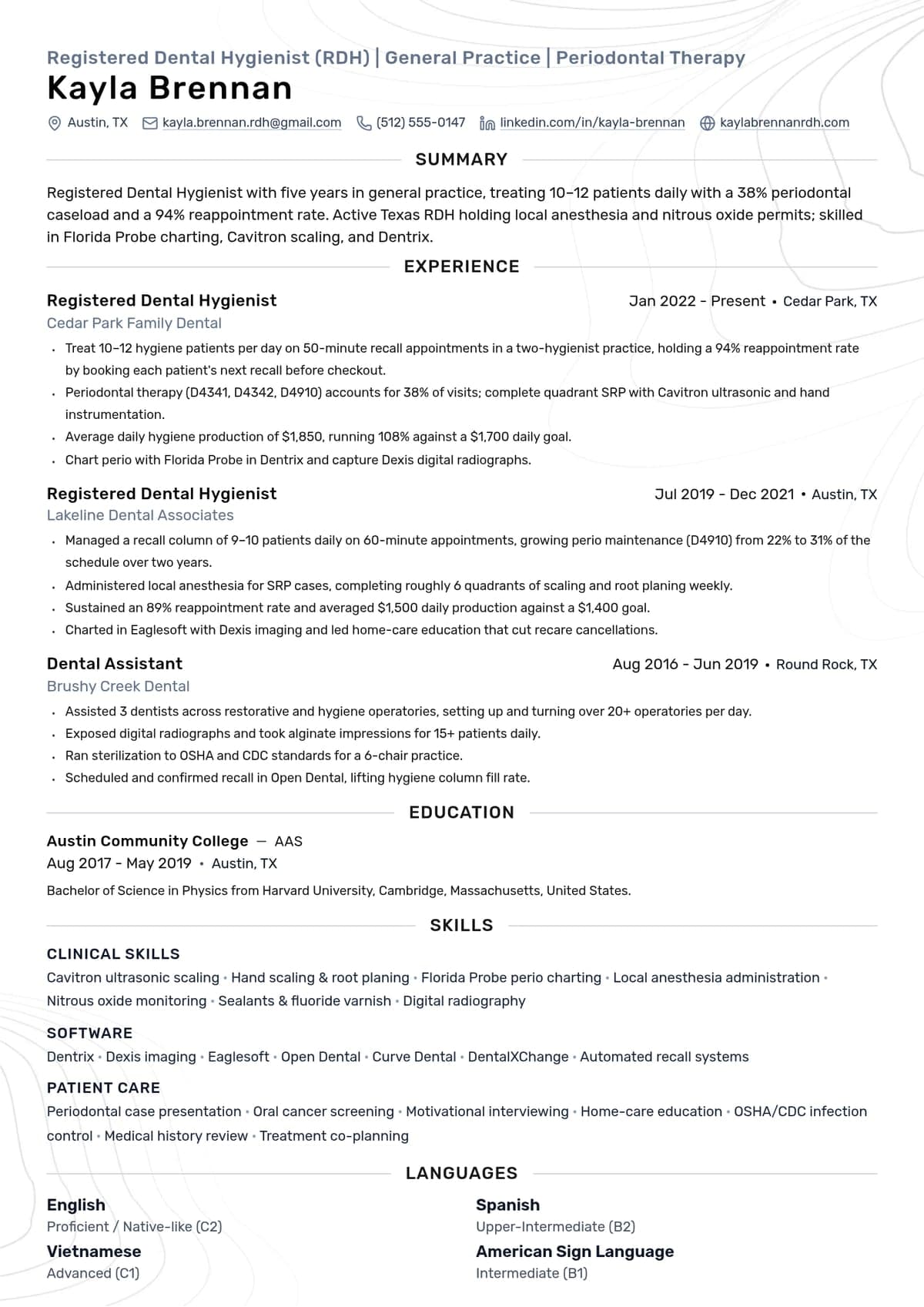

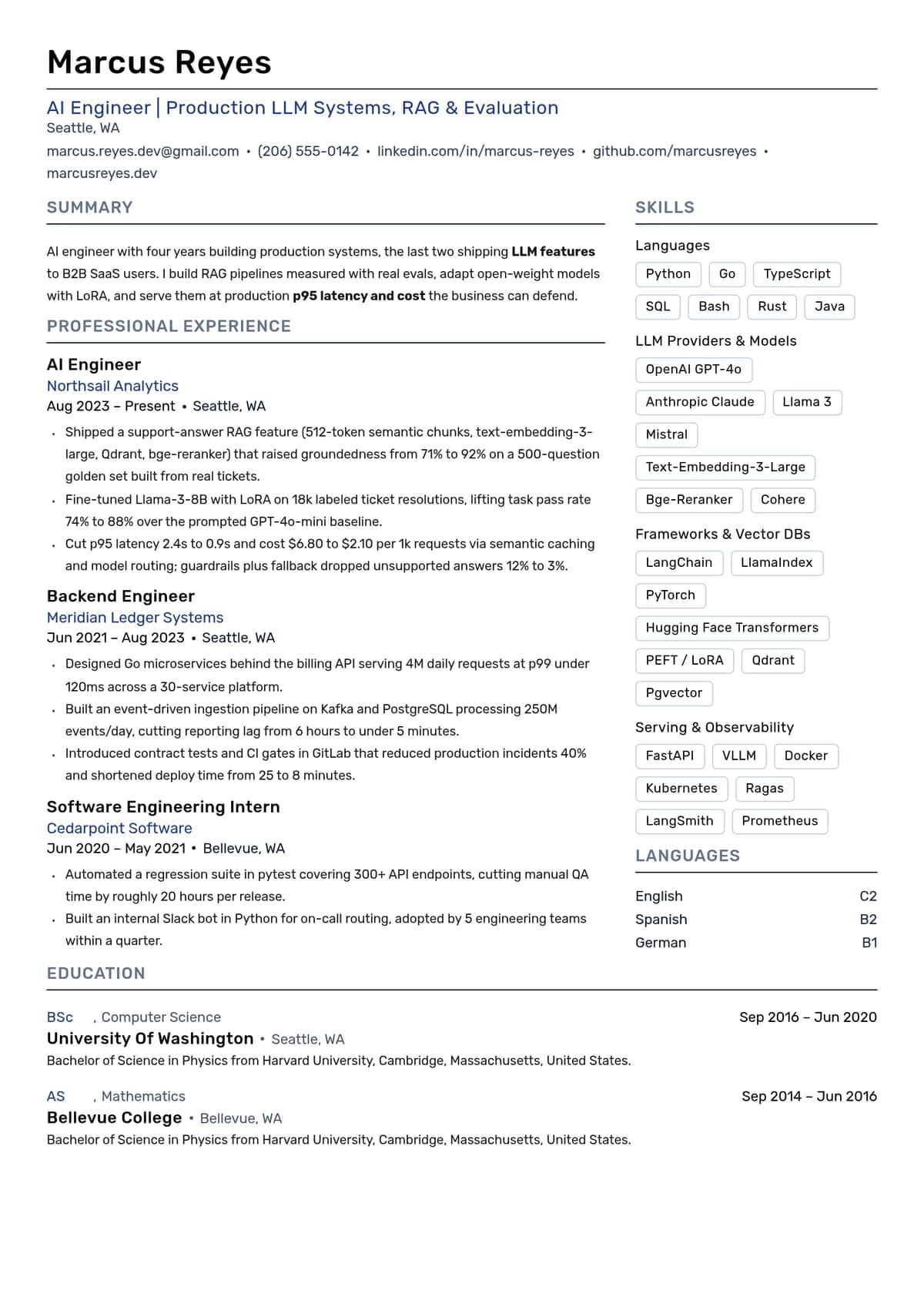
Build yours on the same template.
Every example here is built on a template you can open in the editor. Start from the same layout and write your own experience into it, then download the PDF free, with no watermark.


