Why Do ChatGPT Resumes Sound the Same? Make Your Draft Specific
Replace vague resume phrases with evidence you can support. Ten editing examples, three fact-preserving workflows, and prompts for a more specific ChatGPT draft.

On this page
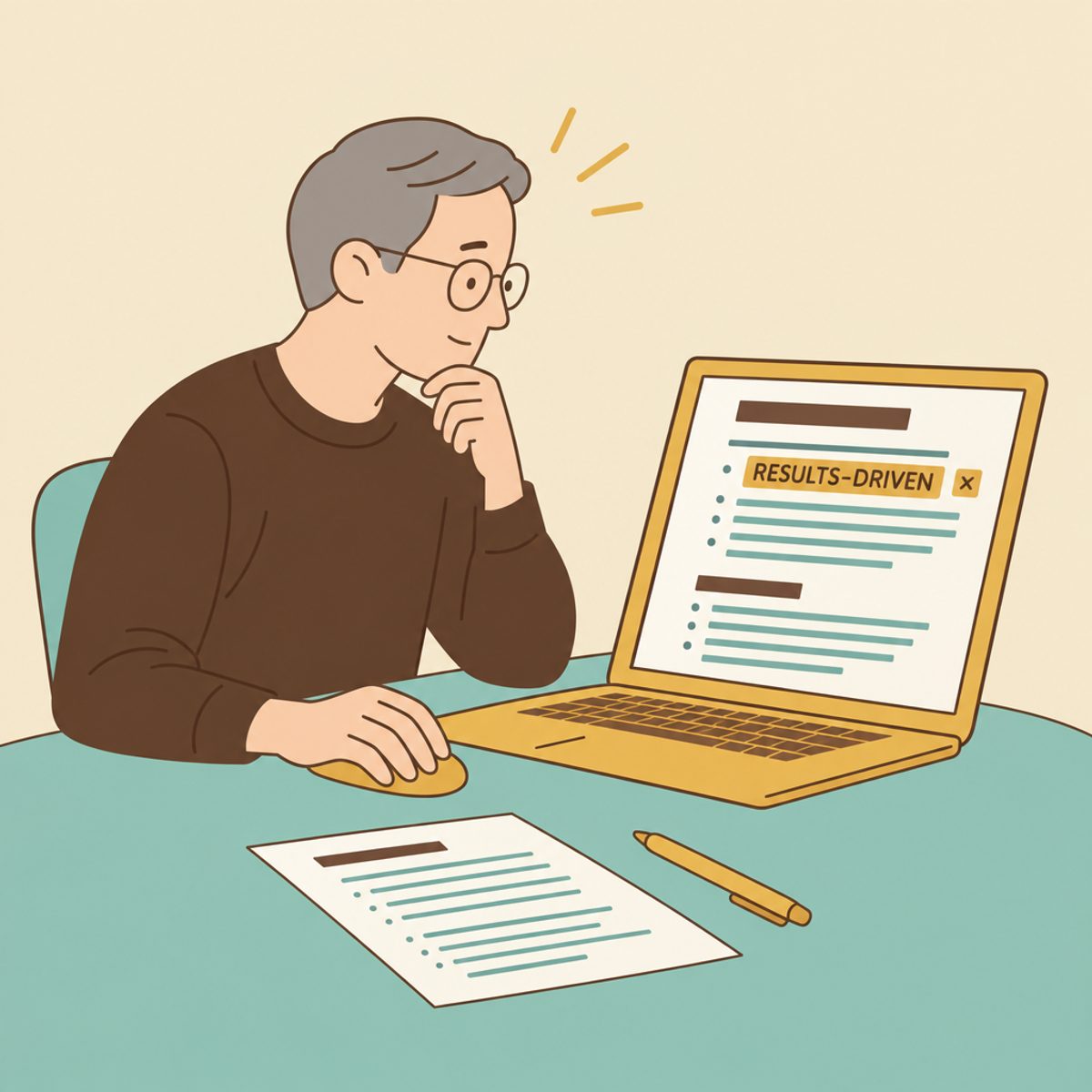
A resume summary such as “Dynamic, results-driven professional with a proven track record” says little about the work you can do. Whether a person or a tool wrote it, the reader still needs your role, relevant experience, and evidence.
When a ChatGPT draft sounds interchangeable, check the source material and the request before collecting forbidden words. This guide keeps ten common phrase examples and shows three ways to revise them without inventing accomplishments. The examples are editorial demonstrations, not reported model tests or evidence of how often recruiters reject AI-assisted applications.
The problem is missing information, not proof of AI use
A broad claim such as “excellent project manager” leaves practical questions unanswered: what kind of project, what responsibility, and what deliverable? A specific sentence can answer those questions without becoming longer or more dramatic.
Do not diagnose authorship from correct grammar, a familiar verb, or a particular bullet length. These are ordinary writing choices. Equally, changing them does not establish that a resume is accurate or help you comply with an employer’s AI policy. Judge the substance and follow the instructions for the application.
Keep useful role terminology, but connect it to work you actually did. A hiring tool’s keyword match and a reader’s understanding are different considerations; neither supports a rule that all applications pass through one universal AI screen.
Ten common phrases to examine for specificity
These words are not AI fingerprints and none needs to be banned. The question is whether a phrase communicates useful information in this sentence. The suggested alternatives below are fictional illustrations; use only the actions and details supported by your own experience.
| Word or phrase | Question to ask | A more specific direction |
|---|---|---|
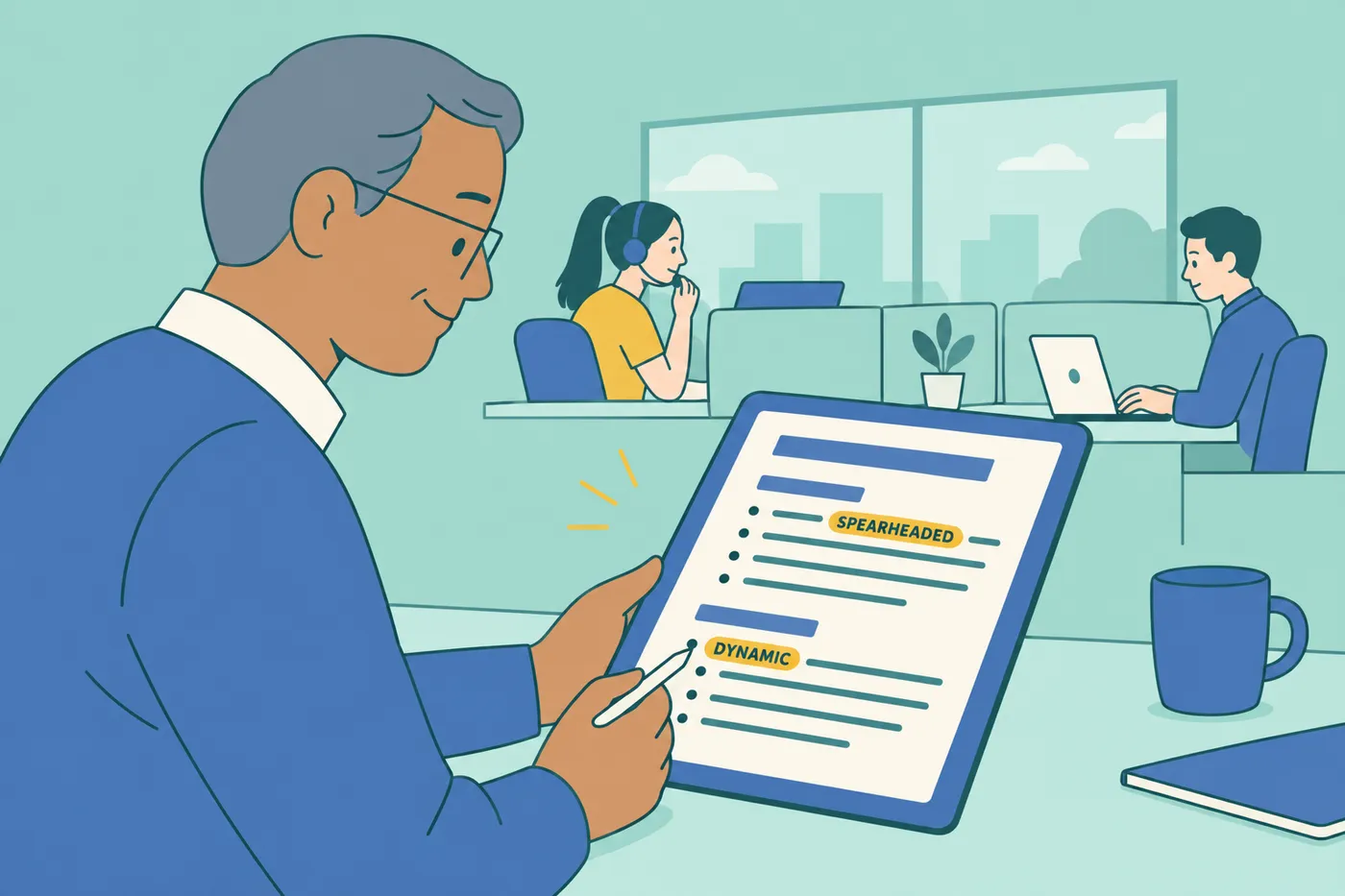
| Spearheaded | Did you lead the work, coordinate it, or contribute to it? | Name the actual responsibility: “Coordinated the customer-support handover” if that was your role. |
| Dynamic | What work is this adjective meant to describe? | Replace it with an activity, such as “Prepared release notes and coordinated launch updates.” |
| Results-driven | Which result or deliverable can you substantiate? | Name the outcome or work product; use a number only when reliable. |
| Passionate | Is the interest relevant, and is there evidence of it? | Describe a relevant personal project, volunteering activity, or course where useful. |
| Proven track record | Can the next sentence or bullets show the relevant record? | State the work directly and remove the introductory claim if it adds nothing. |
| Seasoned | What experience and scope matter for this role? | Give accurate years, responsibilities, or team scope instead of vague seniority. |
| Meticulous | What did your attention to detail involve? | For example, “Reconciled invoice records before the monthly review,” when true. |
| Honed | Which skill did you use, and where? | Name the task: “Used SQL to investigate duplicate customer records,” if supported. |
| Orchestrated | Does this verb accurately describe your level of responsibility? | Choose “coordinated,” “led,” or “supported” according to the facts. |
| Innovative | What changed, and what was your contribution? | Describe the specific process or tool you built or improved. |
Read the sentence after any edit. If removing a phrase also removes important meaning, restore that meaning in plain language. If the remaining sentence could fit almost any candidate, add a relevant fact rather than a more impressive adjective.
Our professional summary guide shows how to select role-relevant evidence. The aim is clarity, not a vocabulary blacklist.
Why a broad prompt can produce a broad answer
OpenAI’s ChatGPT prompting guide explains that responses draw on patterns learned from data and that the task, context, and desired output matter. That does not establish that any particular model trained on a specific collection of resumes or that its purpose is to write an “average resume.”
A request such as “write a bullet about managing projects” provides no evidence about your project, responsibility, budget, or result. A practical response is to supply those facts and ask for clarification wherever information is missing. Do not accept a plausible detail simply because the wording sounds polished.
Results also vary by model and request; OpenAI documents that generated outputs are not deterministic. The workflow below is a way to inspect and improve a draft, not a promise that one prompt always produces the same answer. For related editing problems, see why AI resumes can sound generic.
What to check after a whole-resume rewrite
A whole-document rewrite can be useful, but it creates more changes to verify at once. Compare the result with the original for these four problems. They are possible errors to look for, not claims that every rewrite makes them.
- Lost evidence: did a specific result become a vague statement? In a fictional example, changing “reduced the backlog from 340 to 90 tickets” into “improved efficiency” loses information.
- Added claims: check for tools, metrics, qualifications, team sizes, or outcomes that were not in your source.
- Changed responsibility: “supported a migration” must not become “led the migration” unless that stronger claim is true.
- Unhelpful compression: did a short, uniform format remove the context needed to understand a more complex project?
Keep an untouched source copy, and verify the revised sentences against it. The ChatGPT tailoring guide provides a posting-specific process. A clear instruction to preserve facts helps define the task, but you still need to check the response.
Review the writing without guessing who wrote it
You do not need to establish authorship to improve a weak sentence. Assess whether the document supplies accurate, relevant evidence and whether its summary agrees with the experience below. Use these checks for any draft, including one written entirely by hand.
- Repetition: remove a repeated claim when it adds no new evidence; similar bullet lengths alone are not a problem.
- Vague outcomes: clarify the actual deliverable or result. Do not add a number merely to make a sentence look credible.
- Grammar: correct errors and keep clear professional language. Deliberately introducing mistakes is not a useful editing goal.
- Consistency: check that a confident summary is supported by the roles, projects, and qualifications below it.
- Specificity: replace an interchangeable statement with the relevant task, tool, audience, or responsibility.
Relevant keywords are still useful descriptions of experience. Include them naturally where accurate and explain what you did with the skill. The ATS keyword guide covers that distinction. You do not need separate “machine” and “human” versions of the truth.
Three ways to make the draft more specific
Start with factual notes, request an identifiable change, and review the result. These three habits make it easier to keep useful detail and catch unsupported additions.
Fix 1: Collect the facts before asking for a draft
Write down the role, actions, tools, scope, dates, and results relevant to the target job. Use evidence you can support and avoid sharing confidential information. If you do not have a reliable metric, record the task and deliverable instead.
The following sales-development notes are fictional, included to demonstrate the editing process:
- Managed a six-person sales development representative (SDR) team for two years.
- The team’s qualified pipeline grew from $1.2 million to $2.1 million over three quarters.
- Built a Salesforce lead-scoring process; the measured time to first contact fell from two days to four hours.
A sample prompt is: “Using only the notes below, draft a short summary for a sales-development manager role. Preserve team attribution, tools, time periods, and figures. Ask about missing facts rather than adding them.”
A possible editorial draft from those fictional notes is: “Sales-development manager with two years leading a six-person SDR team. The team grew qualified pipeline from $1.2 million to $2.1 million over three quarters.” This is an illustration, not an actual ChatGPT test or a claimed applicant result.
Notice the attribution: the pipeline result belongs to the team. Do not change it to a personal achievement unless the evidence supports that statement.
Fix 2: Request a specific editing operation
Once the facts are on the page, ask for a change you can inspect: remove repetition, make a responsibility clearer, or shorten a sentence without dropping its evidence. “Edit” is not a protective keyword; the useful part is a clearly scoped request.
- “Shorten this bullet while retaining the deliverable, time period, and both figures. If it becomes unclear, explain why a shorter version would lose meaning.”
- “Rewrite this sentence in active voice. Preserve my supporting role and do not change it to leadership.”
- “Suggest verbs for the action described here. Explain if a verb would imply responsibility I have not stated.”
- “Tighten this summary while keeping the pipeline figure and team attribution. List any factual details you removed.”
Compare the proposed revision with the source, rather than assuming the instruction was followed. OpenAI’s accuracy guidance explicitly recognizes that a model can have the right context and still produce an incorrect result. Check names, numbers, scope, and implied causation before accepting the sentence.
Fix 3: Review a manageable amount of change
Working one bullet at a time can help when ownership or technical details need careful checking. Keep the original beside the proposal and identify exactly what changed. For a simple consistency edit, a larger batch may be easier; choose a scope you can genuinely review.
After local edits, read the full document again. Check for duplicated achievements, contradictory dates, missing context, or a summary that now overstates the experience. Sentence variation can improve readability, but it is not an authorship test.
Verify the claims before submitting
Read each claim and ask what supports it. For a metric, confirm the source, period, baseline, and whether it was an individual or team result. For a responsibility, distinguish doing the work, leading it, and assisting someone else.
For example, a fictional draft saying “reduced infrastructure costs by 30%” should be removed or corrected if no such result was measured. Do not keep it because an AI tool supplied the figure. If the actual work was reviewing unused resources, describe that work accurately.
Being able to explain a bullet is a useful check, but an immediate, fluent answer is not proof of truth and hesitation is not proof of fabrication. Use records and your actual experience to verify the content.
Choose an editing workflow you can inspect
A chat interface can work when you provide relevant context and compare revisions carefully. A document editor may make it easier to keep source material and application versions together. Choose by the workflow you need, rather than assuming one interface automatically prevents inaccurate writing.
Roleframe is our product. The account app provides saved documents, job-specific feedback, and optional AI assistance. Review the proposed wording and current plan conditions. Feedback can identify questions and possible edits, but it cannot reveal an employer’s exact hidden filters or validate facts only you can confirm.
The separate public builder offers editing and a free unwatermarked PDF without an account or card. Follow the employer’s required file format and inspect the finished document. Our AI tools guide compares other workflows; every tool still needs the same factual review.
Frequently asked questions
- Can recruiters tell when you use ChatGPT?
Writing style alone does not establish that a particular tool was used. Familiar verbs, correct grammar, and similar bullet lengths can appear in human writing too. Focus on accurate, specific content and follow the employer’s instructions rather than trying to pass an authorship test.
- Can ChatGPT rewrite an existing resume?
Yes, but compare the result with your original. A whole-document rewrite creates many changes to inspect; smaller edits may be easier when technical details or responsibility need care. Keep the facts, check what was added or removed, and review the final document as a whole.
- Can ChatGPT write a good resume?
It can help draft and revise resume text when you provide relevant evidence and instructions. Quality varies, and a polished answer may still contain errors. Your task is to verify the actual experience, relevance, and finished file, not to assume that a particular prompt guarantees quality.
- Do employers care if you use AI for your resume?
Employer expectations vary. Follow any policy or instructions given for the application, including disclosure requirements. Do not assume that all employers accept assistance or that careful use is undetectable. Accuracy and compliance with the stated process remain your responsibility.
- What is the best ChatGPT prompt for a resume?
Use a prompt tied to a concrete task. For example: “Shorten this bullet using only my source facts. Preserve the tools, time period, and my supporting role. List any details you remove and ask about anything unclear.” Then compare the response with the source; there is no universally best prompt.
- Should I send my ChatGPT-edited resume as a PDF or a Word file?
Follow the employer’s instructions. If both PDF and Word are accepted, use the format that meets your needs and inspect the actual file for missing content, layout problems, and incorrect links. Neither extension guarantees identical parsing in every hiring system.

Ready to start your new resume?
Writing a resume takes time, and even a polished one can miss what a hiring manager is looking for. Roleframe helps you build a clear, ATS-safe resume in minutes and tailor it to the job you want.


