Curriculum Vitae Example: Academic CVs, Grad School to Faculty
by Larbi SahliPublished
A complete curriculum vitae example for a PhD candidate, how a master's-student CV differs, and the format rules for every section, grad school to faculty.
Users have landed jobs at
- 1Password
- OpenAI
- Notion
- justworks
On this page
An academic curriculum vitae is a complete record of your scholarly output. A resume argues for one job in one or two pages; a CV documents a career, and it runs as long as the record honestly justifies. Search committees read it to answer three questions fast: what have you published, who funded you, and can you teach.
Most pages ranking for this search give you a definition and a checklist, or a university career-center handout with a sample PDF two clicks away. This page does the opposite. Below is a complete curriculum vitae example for a fifth-year PhD candidate on the academic job market, followed by how the same document changes for a master's student applying to PhD programs, a section-by-section guide in the order committees expect, and how each section grows once you hold a faculty post.
One scope note before the example. This page covers the academic CV, the multi-page document universities and research institutes ask for. If a UK, Irish, or Commonwealth employer asked you for a "CV" for an ordinary job, they mean what Americans call a resume, and the rest of this page is not what you need. Academics applying to industry roles need a resume too, and the professor resume example shows what that shorter document looks like.
A complete academic CV example
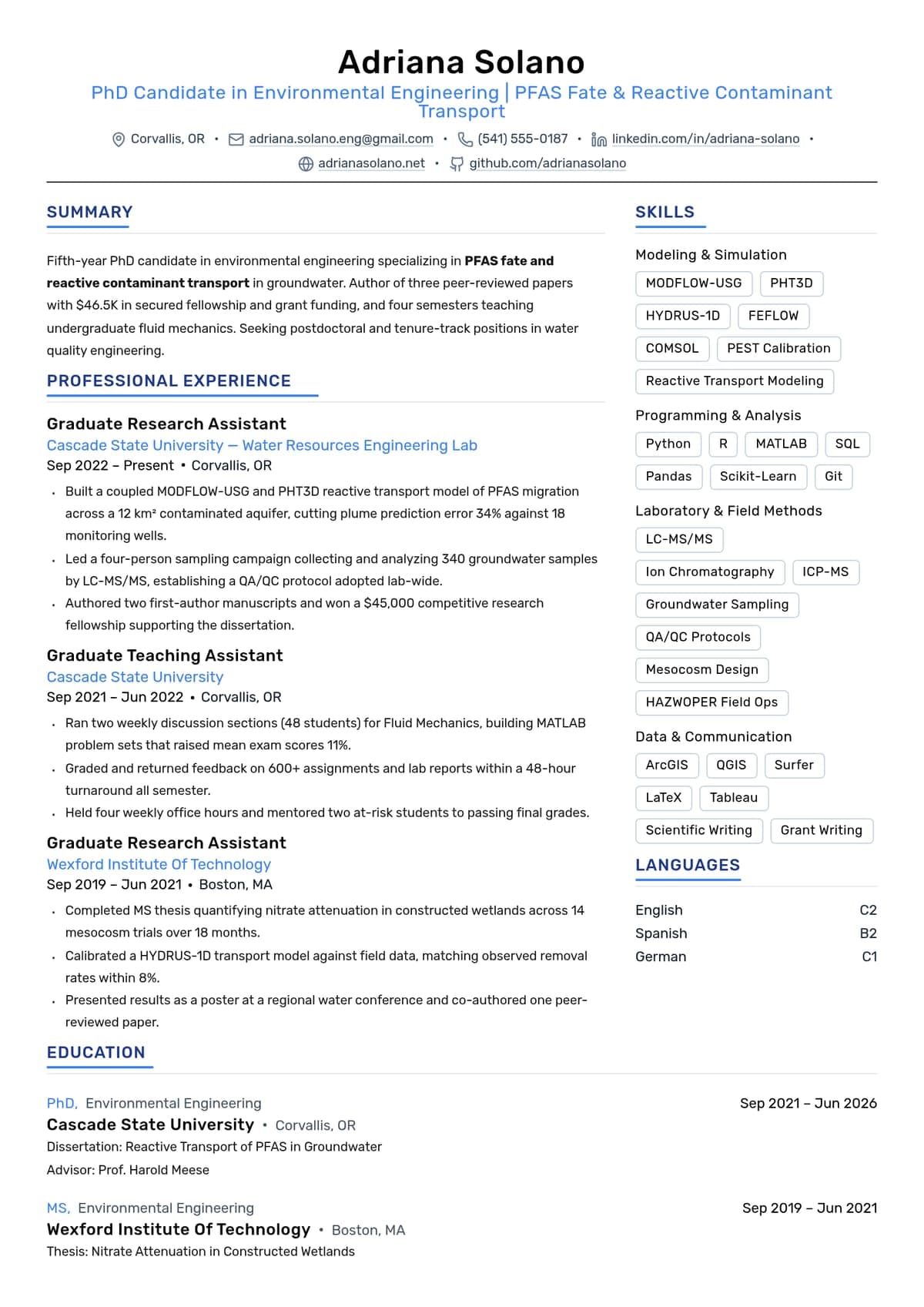
The example below is a fifth-year PhD candidate in environmental engineering applying for postdoc and assistant professor positions. It is about three pages, which is normal for someone finishing a doctorate with a few publications. Every name, journal, grant, and university in it is fictional; every date and count is plausible for a graduate student, which matters because a CV padded beyond its career stage reads as exactly that to a committee.
Read it for structure before content. Education sits at the top with the dissertation titled and the advisor named. Publications use one citation style throughout, her own name appears in bold so a skimming reader can spot authorship position, and the one manuscript still under review is labeled as such rather than blended in with published work. Presentations live in their own section, grants name the funder, and three references close the document with full contact details, which a CV includes and a resume does not.
Notice what the example leaves out. No photo, no date of birth, no marital status, no objective statement, and no paragraph of self-description beyond the short research interests block. US academic hiring runs on the record, and anything that is not record is noise a committee has to read past.
How the CV changes for a master's student applying to PhD programs
A master's student's CV is shorter, usually two pages, and it is built to answer a different question. A hiring committee asks what you have produced; an admissions committee asks whether you can do research at all. So the sections that carry a thin record are the ones that show research behavior: a thesis, time in a lab, and any public output, however modest.
Take a fictional master's student in public health applying to PhD programs. Her two pages would run in this order:
- Education first, with the thesis title and advisor on their own lines under the master's entry, plus the expected graduation date. For PhD applications, the thesis is the strongest evidence on the page, so it sits at the top rather than buried in a bullet.
- Research experience next: her research assistant position, with bullets on what she actually did in the lab, cleaning survey data, running the analysis for one study arm, drafting a methods section. Concrete verbs beat titles at this stage.
- Presentations, holding exactly what she has: one poster at a regional conference and one published conference abstract, each labeled for what it is. One honest poster outweighs three vague claims.
- Teaching, listing her teaching assistant semesters with the course name and her duties, grading, running a weekly discussion section, holding office hours.
- Awards and funding, even small ones: a departmental travel grant or a merit scholarship shows someone already chose to fund her.
- Skills, specific to the field: statistical software, survey platforms, lab methods, languages.
- References, three, with titles and institutional emails, since PhD programs will contact them alongside the formal letters.
What she should not do is inflate. Admissions committees read hundreds of these and know exactly what a second-year master's student's record looks like. A single poster listed as a poster is credible. A single poster listed under a section called "Publications" is a red flag that costs more than the poster earns.
Curriculum vitae sections, in order
Here is each section in the order the example uses, what belongs in it, and one rule per section. Inside every section, entries run reverse chronological, newest first, the same convention resumes use.
Header and contact information
Name, department, institution, institutional email, and a phone number. Add an ORCID or a lab website if you have one. No photo, no home address beyond city if you include one at all. The rule: use your institutional email, not a personal one; it signals current affiliation at a glance.
Education
Degrees in reverse chronological order: degree, field, institution, year or expected year. For a doctorate in progress, the dissertation title and your advisor or committee chair get their own lines directly under the PhD entry. This is the first thing a committee looks for, so it lives near the top of page one, never at the end. The rule: the dissertation is an entry, not a bullet.
Research interests
Two to four lines of areas, written as keywords rather than sentences: "urban stormwater management; low-cost sensor networks; watershed-scale nutrient modeling." A search committee matches these against the areas named in their posting. The rule: list areas your record supports, not areas you hope to enter.
Publications
Full citations in one style, the one your field uses, applied identically to every entry. Bold your own name in each citation so authorship position is visible on a skim, since in most fields first or last author position carries the weight. Papers under review are fine to include, clearly labeled "under review" with the journal named only if your field considers that appropriate. The rule: one citation style throughout, and nothing called "in preparation" unless a complete manuscript exists.
Presentations
Conference talks and posters, in their own section, never mixed into publications. Each entry names the talk, the conference, the location, and the year, and labels the type: talk, poster, or abstract. The rule: a presentation listed as a publication is the single fastest way to make a committee distrust the rest of the page.
Grants, fellowships, and awards
Every entry names the funder, your role, the years, and, where the money was awarded to you rather than to your advisor, the amount. A competitive fellowship with a named funder tells a committee that someone else's review process already vetted you. The rule: funder, role, amount; "Graduate Fellowship, 2023" with no funder is a wasted line.
Teaching experience
Course name, your role, institution, and term. The distinction that matters is instructor of record versus teaching assistant, so make it explicit. A line or two on duties helps at the graduate stage: designed the syllabus, ran two lab sections, guest lectured. The rule: never let a committee guess whether you taught the course or graded for it.
Mentoring and advising
Undergraduates or junior students you supervised, with their project and outcome where there is one, a co-authored poster, an honors thesis. Thin at the graduate stage is fine; the section signals you can eventually run a group. The rule: name the outcome, not just the person.
Service
Departmental committees, student organizations you ran, peer review you have done, session chairing. Peer review counts as service the moment you have done your first one, and journals' names belong here. The rule: list peer review by journal, not by count, unless the count is large.
Skills
Methods, instruments, software, and languages, grouped by type. This is the one section where an industry-facing habit helps: name the actual tools. The rule: skills a committee can verify from your publications belong here; personality adjectives do not.
References
Three referees with full name, title, institution, email, and phone. Unlike a resume, a CV carries references on the page, and committees use them. The rule: every listed referee has agreed in advance and knows which jobs you are applying to.
How the same CV grows at faculty level
A faculty CV is not a different document. It is the same document with more record in it, and a few sections that split or gain detail as the record demands. If you keep the graduate-stage structure above, the growth happens inside it:
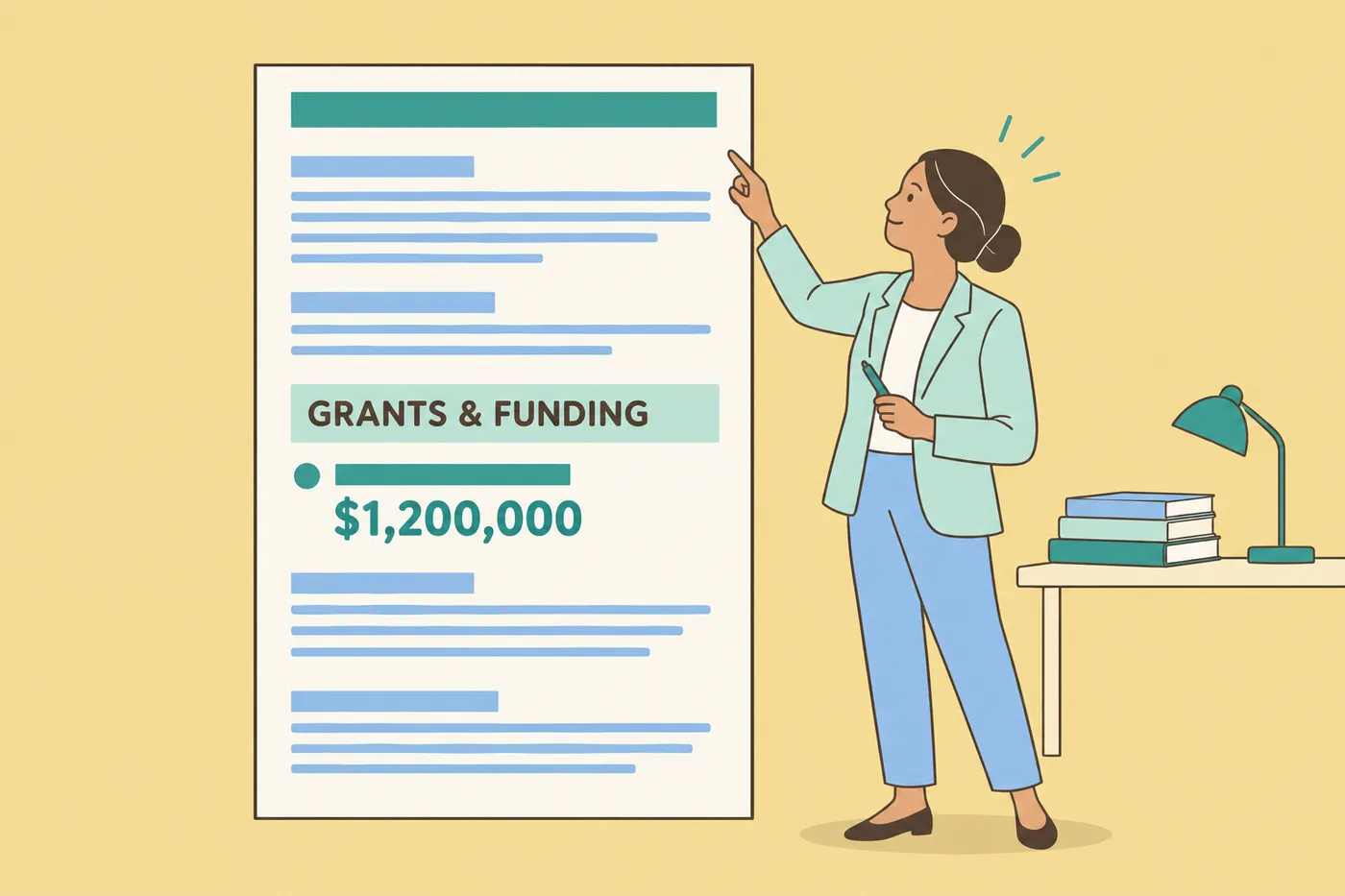
- Grants gain your role and the total award: "PI, $412,000" reads differently from "co-investigator," and committees evaluating a senior hire read the funding section before the publications.
- Courses taught gain level and enrollment: "Instructor of record, undergraduate core course, 140 students" versus "graduate seminar, 9 students" tells a chair what teaching load you can carry.
- Students advised are listed by degree: doctoral students by name with completion year and placement, then master's students, then undergraduate researchers.
- Invited talks split from contributed ones into their own subsection, because an invitation is a signal of standing that a submitted abstract is not.
- Service expands to three levels, department, university, and profession, and gains editorial work: editorial boards, program committees, and regular reviewing for named journals.
- Publications may split into subsections, journal articles, book chapters, conference proceedings, once each subsection has enough entries to justify the header.
The principle underneath all six: as the record grows, the CV's job shifts from proving you can do research to proving you can run, fund, and teach a program of it. Detail that would look like padding on a graduate CV, enrollments, award totals, placements, becomes the substance a senior committee is looking for.
Curriculum vitae format rules
Academic CV format is conservative on purpose. The document gets read by committee members in a hurry, often printed, often the twelfth of the evening, and formatting that draws attention to itself draws it away from the record.
- Your last name and a page number in the header or footer of every page after the first, so a dropped printout reassembles.
- One readable font throughout, in a body size around 11 points; the section headers can be bold, and that is all the typography the document needs.
- Dates aligned consistently, usually flush right, in the same format in every section. Mixed date formats are the most common tell of a CV assembled from old fragments.
- No photo, date of birth, nationality, or marital status on US applications. Some European applications still expect personal details; check the posting, and default to leaving them off.
- No page limit, and no padding either. A CV is exactly as long as the record; whitespace and honest labels beat a fourth page of filler.
- Name the file with your own name: Lastname-Firstname-CV.pdf. A committee downloading forty files named cv_final_v3.pdf will not rename yours.
- Save and send it as a PDF so the layout survives every device it is opened on, unless a portal explicitly demands another format.
Above all of these sits one meta-rule: your field's conventions win. Citation style, whether "under review" papers are listed, whether publications come before or after grants, all of it varies by discipline, and the correct answer is whatever the CVs of recently hired people in your field do. Your advisor or a friendly committee member in your department is the check; ask one of them to skim your CV before any application that matters.
CV or resume: a quick orientation
Three questions come up constantly around this search, so here are the short answers. Curriculum vitae is Latin for "course of life," which is a decent description of what the document does: it follows the whole scholarly career rather than summarizing it. To write one, follow the section order used above, and build it from a running master list, a file where you log every paper, talk, grant, course, and committee the day it happens, so the CV is an edit job rather than an archaeology project. And on which is better, a CV or a resume: neither, send the one the posting asks for. Academic, research, and many fellowship applications want the CV; almost everything else, including industry research roles at US companies, wants a resume.
Common CV mistakes, with the night-before-deadline fix
If you are updating a CV the night before a deadline, these are the six problems worth fixing first, in roughly the order a committee would notice them.
| Mistake | Why it hurts | The fix |
|---|---|---|
| Padding publications with "in preparation" papers | Committees discount them to zero and then discount the rest of the section for the attempt | Cut anything without a complete manuscript; label the rest "under review" only when it truly is |
| Mixed citation styles | Signals a document assembled from scraps, and makes authorship position hard to scan | Pick the style your field uses and reformat every entry to it, tonight if you have to |
| Talks listed under publications | Reads as inflation, and inflation is the one thing a CV cannot survive | Move every talk, poster, and abstract to a presentations section with type labels |
| Dissertation buried or untitled | The first thing a committee looks for is missing from where they look for it | Put the title and your advisor on their own lines under the PhD entry, top of page one |
| A stale expected date in the past | "PhD expected May 2024" on a 2026 application raises a question you do not want asked | Update the date, and reread every other date on the page while you are there |
| Teaching or research statements pasted into the CV | Doubles the length with prose the committee asked for as separate documents | Cut them back out; the CV lists the record, the statements interpret it |
When you apply outside academia
The moment a researcher applies to an industry, government, or nonprofit role, the CV stops being the right document. A hiring manager outside academia gives the first pass seconds, not minutes, and a three-page publication list does not survive it. The move is a cut, not a rewrite: one or two pages, experience framed as outcomes rather than citations, a skills section that leads with tools, and publications reduced to a count with one or two highlights.
You can build that shorter version in Roleframe's free resume editor, which needs no account and downloads a clean PDF with real selectable text, the kind an applicant tracking system, the software that parses applications before a human sees them, can actually read. Start from an ATS-safe layout, and if you want the reasoning behind those layouts, the guide to ATS CV templates covers what parses and what breaks. If you would rather draft in Google Docs first, there is a separate guide to CV templates for Google Docs that export cleanly.
Frequently asked questions
- What does curriculum vitae literally mean?
It is Latin for "course of life." The plural, if you ever need it, is curricula vitae. The name fits the document: unlike a resume, which summarizes, a CV follows the full course of an academic career and grows with it.
- Is a CV the same as a resume?
In the US, no. A resume is a one-to-two-page summary tailored to one job; a CV is a complete academic record with no page limit. Outside North America the word "CV" usually just means what Americans call a resume, so a UK employer asking for a CV for an office job wants two pages, not this document.
- Which is better, a CV or a resume?
The one the posting asks for. Academic jobs, postdocs, research institutes, and most fellowships want the CV. Industry roles, including research roles at companies, want a resume, even from PhDs. When a US industry posting says "CV," it almost always means resume; when in doubt, send the shorter document.
- How long should an academic CV be?
Exactly as long as the record. A master's student's CV runs about two pages, a finishing PhD candidate's about three, and a senior professor's can run twenty or more without anyone blinking. Length itself is never the problem; padding is. Cut anything you added purely to make the document longer.
- How do I write a curriculum vitae from scratch?
Start a master list first: a single file logging every publication, talk, poster, grant, course, and committee from your entire program, with dates. Then build the CV by selecting and ordering from it, using the section order on this page: education with dissertation, research interests, publications, presentations, grants, teaching, service, skills, references. Update the master list the day anything new happens and the CV stays a ten-minute edit forever.
- Do references go on a CV?
Yes. This is one of the sharpest differences from a resume, which should not list references. An academic CV ends with three referees, each with full name, title, institution, email, and phone, and each of them told in advance which jobs you are applying to.
- Should a CV include GPA?
Usually not. An academic CV is judged on output, publications, funding, and teaching, and a GPA adds nothing once you hold or are finishing a graduate degree. The exception is early applications, such as a first-year master's student applying to PhD programs, where a strong GPA can sit on the education line until real research output replaces it.
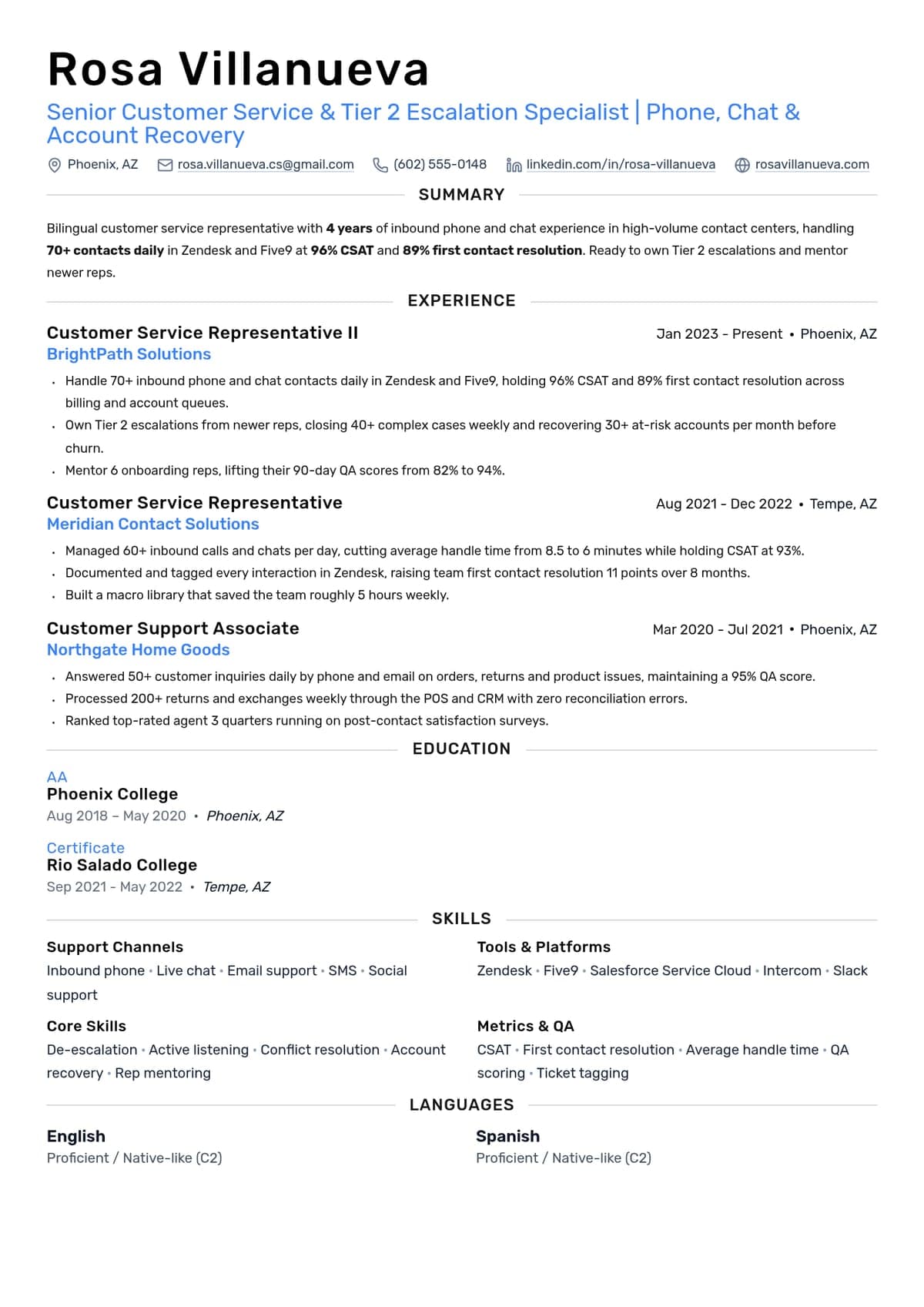


Build yours on the same template.
Every example here is built on a template you can open in the editor. Start from the same layout and write your own experience into it, then download the PDF free, with no watermark.


