Artist Resume and Artist CV: Example and Section Formats
by Larbi SahliPublished
An illustrative artist resume, with practical entry formats for exhibitions, residencies, grants, collections and bibliography on an artist CV.
Users have landed jobs at
- 1Password
- OpenAI
- Notion
- justworks
On this page
An open call, a residency and a teaching job may request different versions of your record. Start with the application instructions: which document is requested, what it must contain and how many pages are allowed?
An exhibition entry should make the work easy to identify: year, exhibition title, venue and location, with a label that distinguishes solo, two-person, group and online shows. This guide gives you a fictional painter and printmaker example, followed by formats you can adapt for a selected artist resume or a longer CV.
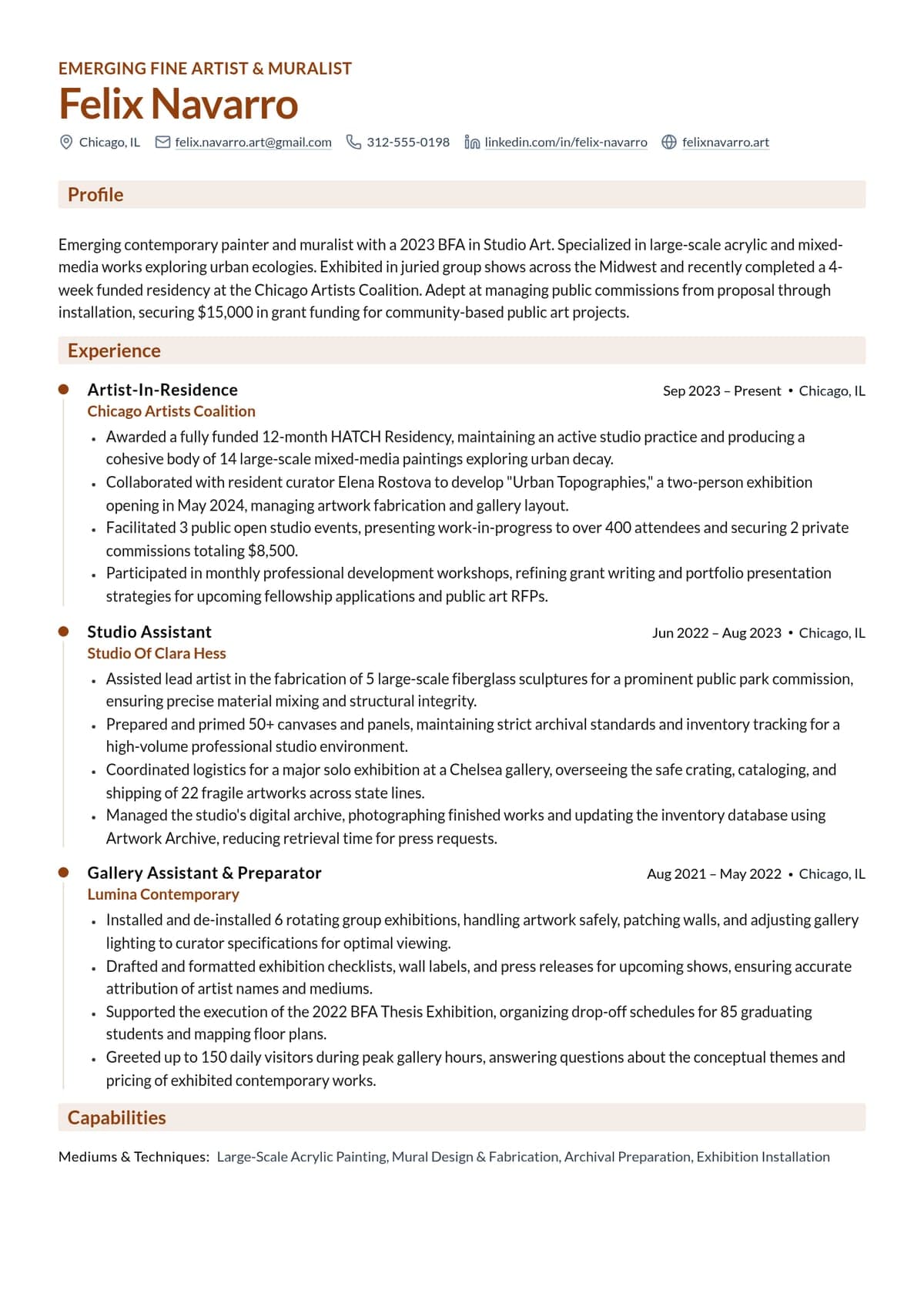
A complete illustrative artist resume
The example illustrates an emerging painter and printmaker with a BFA completed in 2023. It combines exhibitions, a residency, related employment and a project grant. The template groups the exhibition entries under one heading and identifies each show type in the entry; separate solo and group headings are another valid approach when your record is longer.
Illustrative example: the applicant, education record, venues, people, publications, awards and all numerical achievements are fictional. Tool and credential-provider names identify the kind of experience being illustrated, not a real affiliation. Do not copy these facts into an application. Preview the document and adjust its length to the call.
What each section is doing
Contact. Name, professional email, city or region and a portfolio link are usually sufficient. Share a full mailing address only when the application calls for it. Choose work relevant to the opportunity rather than following a universal portfolio-size rule.
Education. Give the degree, institution, location and completion year. List a pending degree as pending. Workshops and other training can have their own heading.
Exhibitions. Identify solo, two-person and group exhibitions accurately. A combined heading can work for a short record; split the categories when that improves clarity. Use Selected only when you have deliberately omitted entries. Add a juror or curator when relevant and verified.
Residencies, awards and press. Give the program or award name, organization and year. A separate heading helps when you have several entries; a combined section is reasonable for a shorter record.
Related experience. Studio, preparator, teaching and art-handling work belongs under related experience rather than being described as exhibitions.
Artist resume, artist CV, or a job resume: which one is being asked for
An artist CV is a fuller record of professional activity; an artist resume selects the parts relevant to a particular opportunity. A resume for an arts job places more weight on employment, responsibilities and qualifications. The labels overlap, so use the requested content and page limit to decide what to send.
College Art Association conventions recommend a concise artist resume, a comprehensive master record and tailoring to the venue. The page is longstanding guidance, not a new 2026 standard.
| Document | What it contains | Typical length | Asked for by |
|---|---|---|---|
| Artist resume | Selected exhibitions, training, residencies, awards, press and relevant experience | Set by the application; keep the selection concise | Exhibitions, residencies, commissions and grants |
| Artist CV | A fuller record of professional activity, organized in relevant categories | As long as needed within the requested limit | Opportunities requesting a complete professional record |
| Arts employment resume | Relevant roles, responsibilities, qualifications and selected creative work | Follow the employer instructions | Museum, gallery, nonprofit, studio or teaching jobs |
A longer document is not automatically more useful. Keep a comprehensive master record, then select entries for the specific call and its length limit. If you also apply for staff roles, the CV and resume guide explains how the employment context changes the emphasis.
A clear exhibition entry format
A useful exhibition entry gives the year, exhibition title, venue and location. Follow a consistent order and title style throughout. Put recent dated entries first within each section. Undated collections or representation lists may use a different order.
The modifiers below explain what kind of participation the entry represents:
- Include the verified juror or curator when relevant to the show.
- Identify solo, two-person and group shows accurately, either in each entry or under separate headings.
- Use Selected only when the list is a selection.
- Identify an online exhibition as online.
- For an art fair, name the gallery or organization that presented your work.
- List only confirmed forthcoming shows and give the future date. Remove or update the label when the event takes place.
Three exhibition entries made clearer
Wrong: "2024 Group show, Harborline Gallery"
Right: "2024 Near Distances, Harborline Gallery, Portland, ME (juror: Alma Teixeira)" (illustrative example). The title, the city and the juror are the three pieces a panel can verify and place. These details make the entry easier to identify.
Wrong: "2023 Solo exhibition, Westcroft Arts Center" when the show was you and a ceramicist.
Right: a Two-Person Exhibitions heading with "2023 Second Surface, with Dana Ruiz, Westcroft Arts Center, Lowell, MA" (illustrative example). Calling a two-person show solo misstates your participation; use the accurate show type.
Wrong: "2025 Camden Field Art Fair, Miami, FL"
Right: "2025 Camden Field Art Fair, presented by Harborline Gallery, Miami, FL" (illustrative example). The same rule applies to an online show: "2024 Flatwork, Ridge Projects, online" is accurate, and dropping the word "online" is not.
What counts when the record is short
An early-career record can include education, student exhibitions, workshops, teaching, public projects and related employment. Each section needs a clear label and the facts you can verify.
- Thesis and student exhibitions, listed with the school as the venue. A BFA thesis show is a real show; label it as the thesis exhibition and let the reader weigh it.
- Open studios and pop-up exhibitions, with the organizer and the city.
- Community murals and commissions, with the commissioning body and the site.
- Online exhibitions and curated digital projects, labeled online.
- Workshops and classes you have taught, under Teaching or Instruction, with the organization and the year.
- Features of your work in a local paper, a podcast or an artist-run publication, under Press, cited the same way every time.
A Related Experience section is the honest way to fill a short page. Studio assistant, gallery preparator, art handler, framer, gallery attendant, teaching assistant: these are art-world jobs, and a residency director reads them as competence. List them with role, organization, city and dates.
Do not list an unsuccessful application as an award or an exhibition that never occurred as a completed show. Describe the venue and your participation accurately. If a confirmed show is cancelled, update your record rather than leaving it as an accomplished exhibition.
Collections, commissions, grants and bibliography
Collections. List the institution and location when your work is genuinely held there. Protect private collectors: obtain permission before naming them and omit personal contact details. A general description is appropriate only when it is accurate.
Commissions. Give the year, work title, commissioning organization, site and location. Label work in progress clearly.
Grants and awards. Use the exact award name, awarding organization and year. A materials stipend should not be renamed a fellowship.
Bibliography and publications. Separate writing about your work from writing you authored. Use a consistent citation format with author, title, publication and date, adding pages or a URL when useful.
Teaching and representation. Give the role, institution and dates for teaching; show only current representation as current.
What an artist resume should look like on the page
Plain typography, one or two fonts, consistent date column, no images. The portfolio shows the work; the document proves the record. A decorative layout with your painting as a background makes a juror squint at a document they were planning to skim, and it does not make the work look better.
Specifics worth following:
- Use a legible typeface and body size; do not shrink the text merely to meet a page limit.
- Keep artwork images and headshots in the portfolio or requested supporting materials rather than adding decoration to the resume.
- Make dates and section headings easy to find; a date column is one option.
- Use spacing consistently and check for clipped or overlapping text.
- Follow the requested file type. If none is specified, a text-based PDF can preserve the layout; inspect the exported file before sending it.
- Use a clear filename such as lastname-firstname-artist-resume.pdf.
Keep the factual record on your website and application document consistent, while allowing a selected resume to be shorter than a full CV. Label a selected list so omissions are understandable.
An artist statement, biography and image list serve different purposes. Include them separately when requested. A brief practice summary can help some applications, but it is optional unless the instructions request one.
Using AI to format an artist CV
An AI tool can help reformat entries, identify inconsistent dates or suggest a clearer heading. It can also invent plausible venues, exhibitions and awards. Supply the factual record yourself and compare every resulting line with your records before using it.
Use your acceptance letters, catalogues, exhibition files and other records to verify names and dates. Keep a master CV up to date so selecting entries for the next application does not depend on memory. The guide to generic AI resume writing explains why specific evidence still needs an editorial pass.
When the application is a job, not a show
For an arts job, lead with the requirements in the posting and the relevant work you have done. An installation role needs evidence of handling, scheduling and safety; a teaching role needs teaching experience and the requested credentials. A selected exhibition list may supplement that evidence.
An illustrative employment bullet might be: "Coordinated installation of [number] exhibitions across [number] galleries, including crew scheduling and condition reporting." Replace every bracket with a verified fact, or describe the work without numbers.
The resume examples library, academic CV guide and teacher examples show how the emphasis changes by application type.
Before you send it
Run four checks on the PDF, not on the file you were editing.
- Each exhibition entry identifies the year, title, venue and location where applicable.
- Titles, dates and citations follow a consistent style.
- Show types and confirmed forthcoming entries are labeled accurately.
- The document follows the application requirements and highlights relevant work.
Then open the PDF on a phone. If the year column has shifted or a line has wrapped badly, fix it before a juror sees it on the same screen.
Frequently asked questions
- What is the difference between an artist CV and an artist resume?
An artist CV is a fuller professional record; an artist resume is a selected version for a particular opportunity. The terminology overlaps, so follow the requested content and page limit.
- How long should an artist resume be?
Use the limit in the application instructions. For a short record, a focused page or two may be sufficient; a fuller CV can be longer. Keep a master record and select the entries the opportunity needs.
- What is the 7 second rule in resume screening?
It is the claim that a reader forms an initial judgment in a few seconds. Treat it as practical advice rather than a measured standard: it is not a universal scientific rule or a guaranteed time limit. For an artist, the useful version is to make your medium or discipline and your strongest credential visible on the first screen, use clear section headings, and keep the layout easy to scan rather than visually elaborate.
- How do I describe myself as an artist on a resume?
Name your medium or discipline, the subjects or questions the work explores, and your working approach, in two or three lines. Cut words like passionate and creative and replace them with materials, processes, themes, communities or techniques that show the claim instead of asserting it. Keep it short and tied to the opportunity; the longer explanation of ideas and motivations belongs in your artist statement, which is a separate document.
- What goes on an artist resume with no exhibitions yet?
Education or training, any student and thesis exhibitions with the school named as the venue, open studios, pop-ups, community murals and commissions, workshops you have taught, and a Related Experience section for studio assistant, preparator, art handling or gallery work. Label each one accurately. A short, honest page beats a padded one, and inventing a show or listing a call you only applied to is the fastest way to lose a panel's trust.
- Should an artist CV include images of the work?
Usually the portfolio carries the images and the CV carries the record. Follow the call if it requests another format. Include a relevant portfolio link rather than assuming a fixed number of images works for every application.
- Should I send my artist resume as a PDF or a Word file?
Follow the application instructions. When no file type is specified, a text-based PDF is a practical way to preserve formatting. Inspect every page of the export; keep an editable source for future updates.
- Do Americans say CV or resume for art applications?
Both, and the usage overlaps. In the US art world, an artist CV means the long-form record and an artist resume means the shorter selected version, but galleries and open calls use the words loosely. Read what the call actually asks for in terms of content and page limit, then send the document that fits that description regardless of the label it uses.
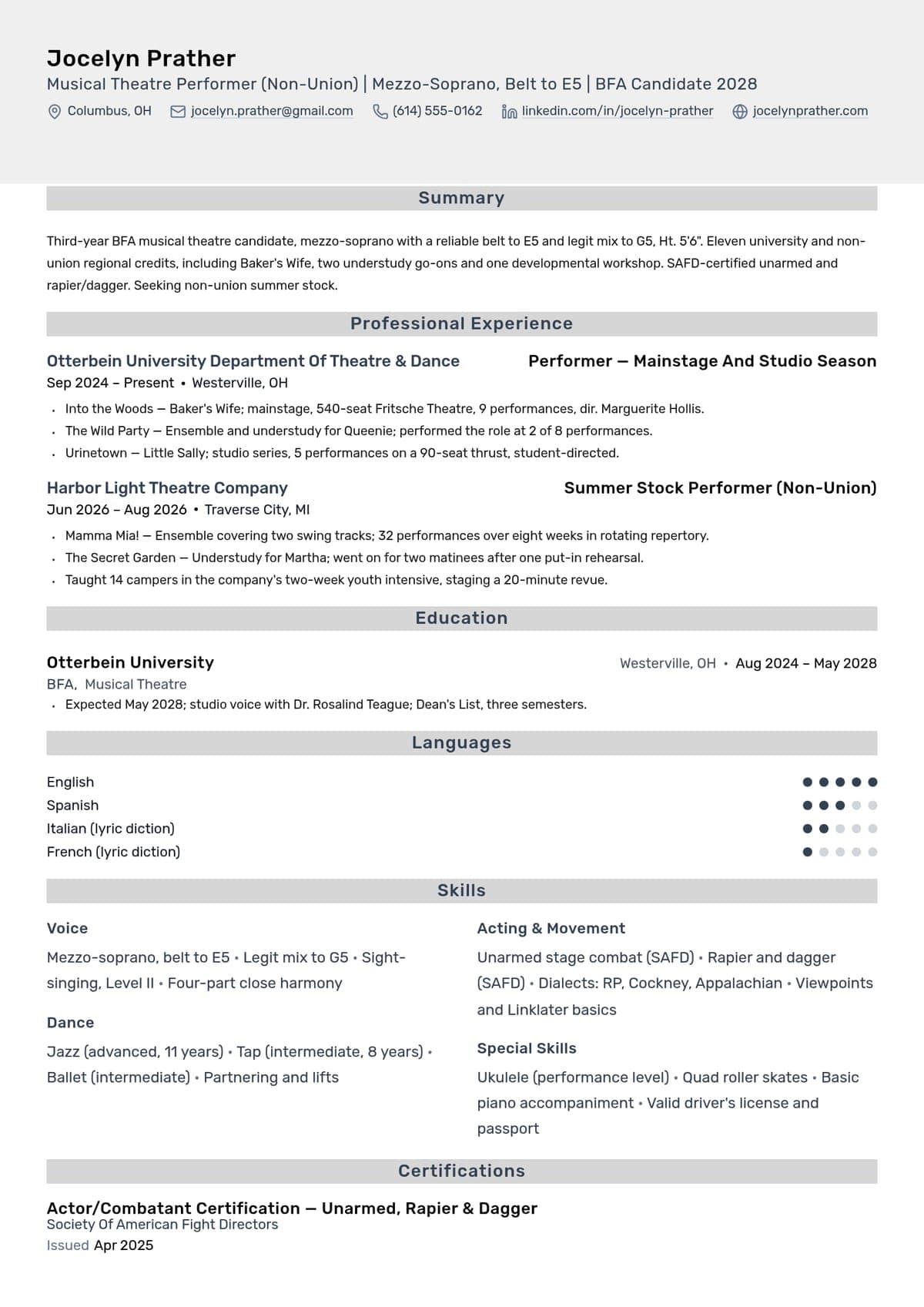

Build yours on the same template.
Every example here is built on a template you can open in the editor. Start from the same layout and write your own experience into it, then download the PDF free, as often as you like.


