No Experience Cover Letter Example: Proof in Place of a Job
by Larbi SahliPublished
A complete no experience cover letter example: one full first-job letter, the middle paragraph written four ways, and a requirement-to-proof map for the posting.
Users have landed jobs at
- 1Password
- OpenAI
- Notion
- justworks
On this page
Coursework, a class or personal project, volunteering, a club or team role, and responsibilities at home replace work experience in a first cover letter. Each one becomes proof when you attach it to a specific line in the job posting, with a detail an employer could check.
That is the whole method. A hiring manager reading a first-job application is not looking for a work history; they know you don't have one. They are looking for evidence that you show up, handle people, and pick things up without being walked through every step. A letter that says I'm willing to learn asserts that. A letter that says I taught myself spreadsheet formulas over six weeks of evenings and now run the debate club's attendance tracker proves it.
This page gives you one complete letter, written by a school leaver for a full-time customer service advisor job, then breaks down where every sentence in it came from. You'll also get the middle paragraph written four ways, for a school leaver, a college graduate, a course or bootcamp graduate, and someone whose only work has been informal, so you can swap in the version that matches your situation.
The example: a school leaver's letter for a customer service advisor job
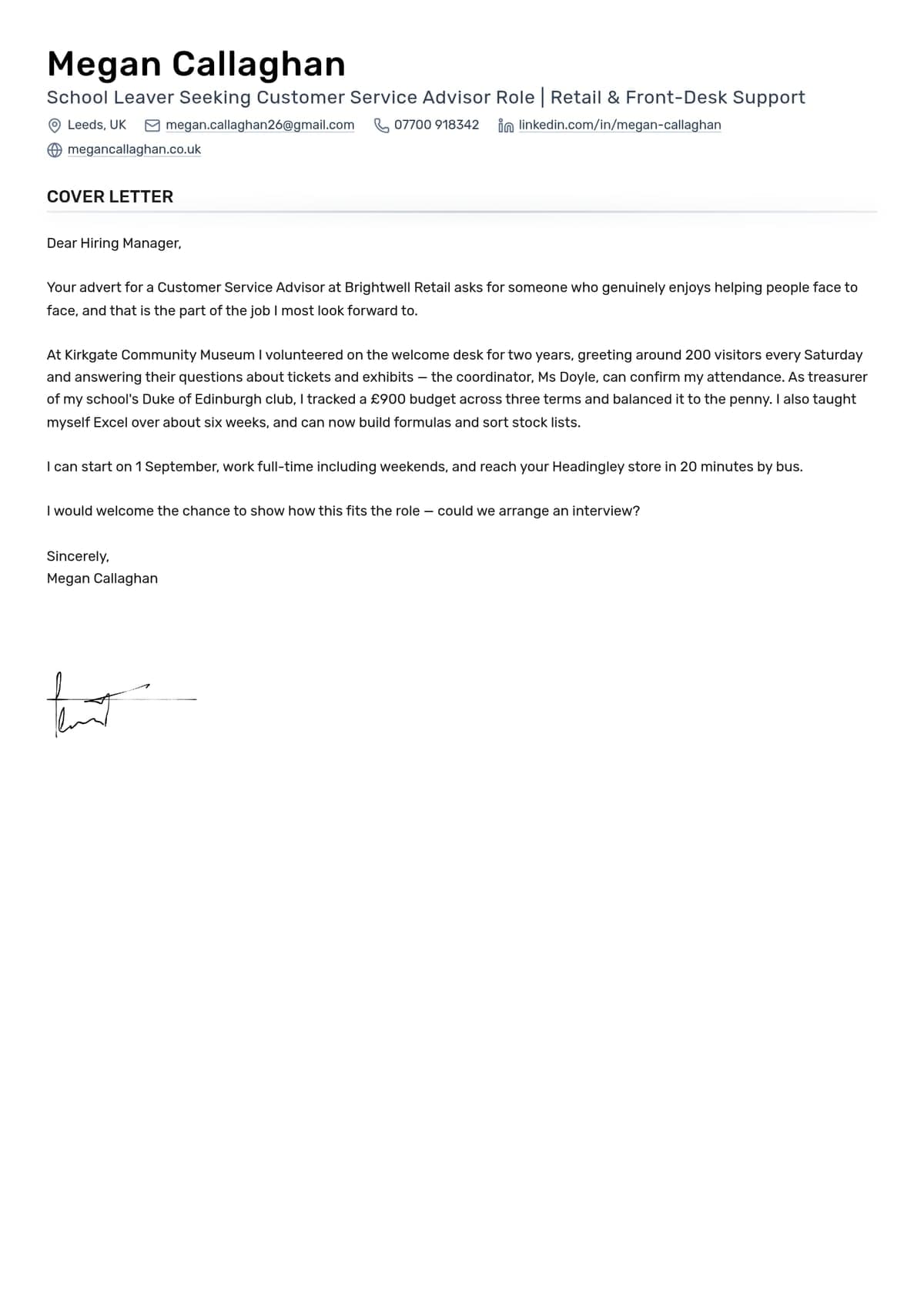
Read this letter once for tone, then a second time for structure. Notice what is missing: no apology for the empty work history, no I know I don't have experience, but, no list of adjectives. Every claim in the middle paragraph is tied to something a stranger could verify, and the availability paragraph answers the practical questions a store manager actually has before offering an interview.
Megan Callaghan
School Leaver Seeking Customer Service Advisor Role | Retail & Front-Desk Support
Cover Letter
Dear Hiring Manager,
Your advert for a Customer Service Advisor at Brightwell Retail asks for someone who genuinely enjoys helping people face to face, and that is the part of the job I most look forward to.
At Kirkgate Community Museum I volunteered on the welcome desk for two years, greeting around 200 visitors every Saturday and answering their questions about tickets and exhibits — the coordinator, Ms Doyle, can confirm my attendance. As treasurer of my school's Duke of Edinburgh club, I tracked a £900 budget across three terms and balanced it to the penny. I also taught myself Excel over about six weeks, and can now build formulas and sort stock lists.
I can start on 1 September, work full-time including weekends, and reach your Headingley store in 20 minutes by bus.
I would welcome the chance to show how this fits the role — could we arrange an interview?
Sincerely,
Megan Callaghan

The letter above runs three short paragraphs plus a closing, fits on one page with room to spare, and mentions the company by name for a reason, not as decoration. Everything below explains how to build the same letter from your own life, even if your situation looks nothing like a school leaver's.
Where the proof comes from when you have no work history
You have more usable material than you think. The question is not whether you have experience; it is which of your experiences an employer can believe without taking your word for it. Rank your options by how easily someone could check them, and lead with the most checkable.
- Volunteering. The strongest source, because a named coordinator can confirm you showed up, what you did, and for how long. A food bank shift, a charity shop Saturday, or an event registration desk all count.
- A club, team, or society role. A coach or faculty advisor can vouch for a treasurer, a team captain, or an event organizer. Roles with money, schedules, or other people's problems attached carry the most weight.
- Coursework and grades. A transcript backs these up. Useful when a class maps directly to the job: a business class for retail, a communications class for customer-facing work, a statistics class for anything with data.
- A class or personal project. Checkable if you can show it: a website you built, an event you ran, a report you wrote. A project that exists beats a project you describe.
- Responsibilities at home or informally. Babysitting, yard work, caring for a relative, helping in a family business. Hardest for an employer to verify, so anchor these with specifics: how long, how often, and one concrete incident.
Pick two or three of these, not all five. A first letter that stacks every activity you've ever done reads like a scrapbook. A letter that picks the three items matching the posting reads like an application.
Map every requirement in the posting to one piece of proof
Here is the discipline that separates a letter that gets read from one that gets skimmed: every sentence in your middle paragraph should answer a line the employer actually wrote. Print the posting, underline the requirements, and match each one to a single piece of proof. This is how the example letter above was built.
| Line in the posting | Proof from a first-job life | Why an employer believes it |
|---|---|---|
| Handle customer questions face to face and by phone | Ran the check-in desk at a school open evening, roughly 200 visitors in one night | A teacher organized it and can confirm it happened |
| Accurate cash handling | Club treasurer for two terms, tracked payments and chased late ones | A faculty advisor signed off on the books |
| Confident with basic computer systems | Taught yourself spreadsheet formulas over six weeks, now maintain the club's attendance tracker | The tracker exists and can be shown |
| Reliable and punctual | Two years of weekly volunteering without a missed shift | A coordinator can confirm the record |
| Works well in a team | One specific incident: resolved a dispute, covered a gap, coordinated a group | A single concrete story beats the adjective |
Two rules make this mapping work. First, one proof per requirement. Doubling up dilutes both. Second, use the posting's own words where they fit naturally, because a hiring manager scanning twenty letters recognizes their own phrasing instantly, and it signals you read the posting rather than a template. The same principle drives how you pull keywords from a job description for the resume that travels with this letter.
Rewrite "willing to learn" as evidence
Nearly every first-job letter contains some version of I have no experience but I'm willing to learn. The problem is not the sentiment; it's that the sentence is unfalsifiable. Everyone is willing to learn in a cover letter. Nobody has ever written that they aren't.
Replace the claim with a completed instance of it. The formula has three parts: something you taught yourself, how long it took, and what you can now do with it.
- Weak: "I'm willing to learn your booking system."
- Strong: "I taught myself spreadsheet formulas over about six weeks of evenings this spring. I can now build a lookup table and a working attendance tracker, and I expect to pick up your till and booking systems the same way."
The second version does three jobs at once. It proves the learning already happened, it puts a timeframe on it so the manager can estimate your ramp-up, and it connects the skill to their tools. One sentence like this is worth a whole paragraph of enthusiasm. It also survives an automated screen: phrases like quick learner and hard worker are exactly the stock wording the letter check on this page flags, because they appear in a huge share of entry-level letters and carry no information.
The availability paragraph: say it once, plainly
For entry-level customer service, retail, and hospitality roles, availability decides more interviews than eloquence does. A manager staffing a rota needs four facts, and a letter that states them plainly in one short paragraph saves an email exchange, which by itself puts you ahead of half the pile.
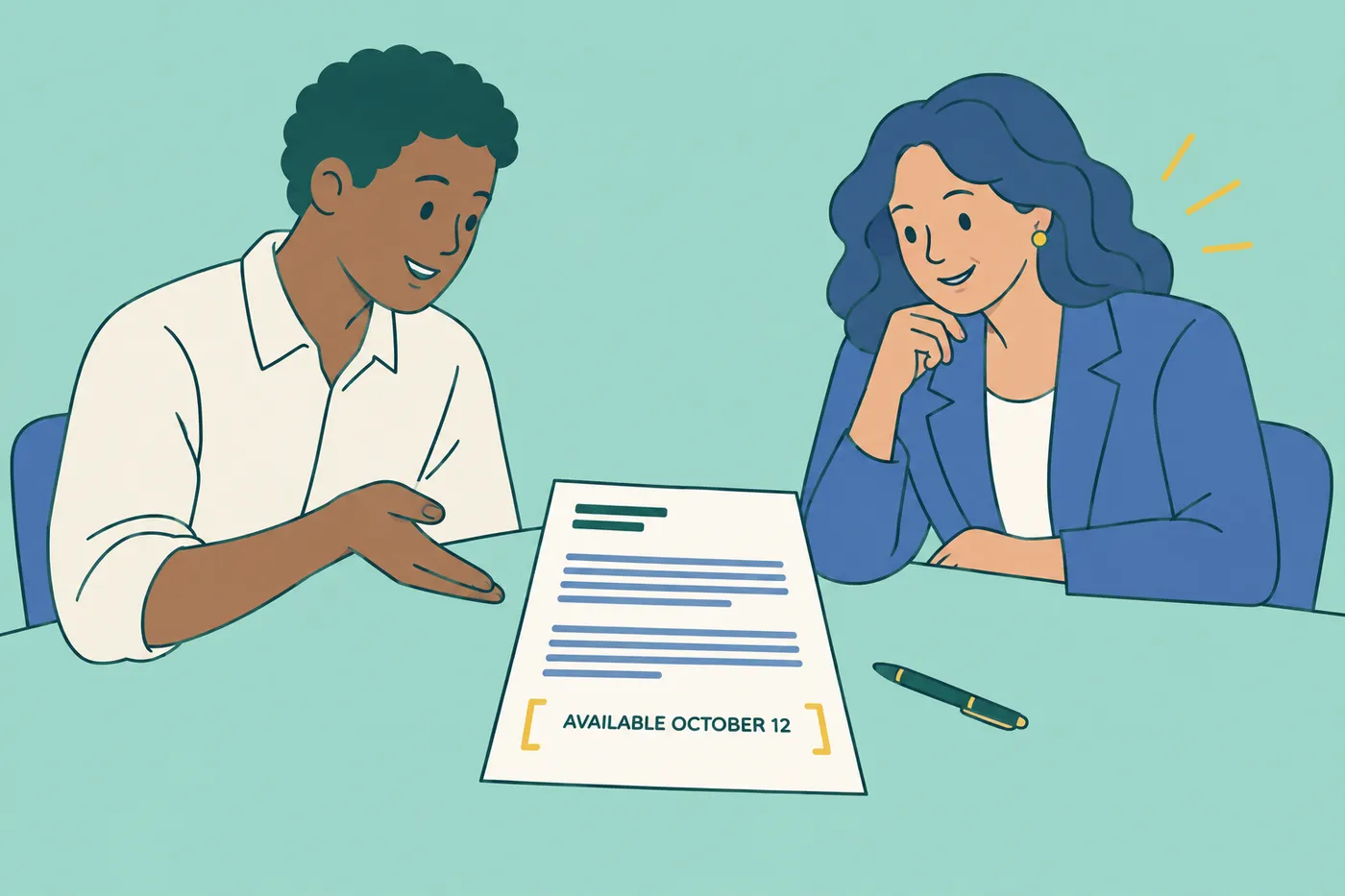
- Start date. A specific date, not "immediately" if exams or notice make that untrue.
- Hours and days. The days and time windows you can actually work, including weekends if you can.
- How you'll get there. A ten-minute bus ride or a fifteen-minute walk tells the manager you'll arrive on time in February, not just in the interview.
- Any limits, stated once. If you have classes until June or exams in May, say so in the same sentence and move on. Stated plainly, a limit reads as organized. Buried or apologized for, it reads as a problem.
One paragraph, three sentences, no hedging. Do not repeat any of it in the closing; you've said it once and the manager noted it.
The middle paragraph, written four ways
The opening and closing of a first-job letter barely change between candidates. The middle paragraph is where your situation lives, so here it is written four ways. Take the version closest to your life, swap in your own specifics, and keep the structure: proof, proof, taught-yourself skill.
School leaver
"In my final year at Northside High I ran the check-in desk at our open evening, greeting around 200 visitors and answering timetable questions while keeping the line moving. As treasurer of the debate club I tracked our budget for two terms and chased late payments without needing reminders. This spring I taught myself spreadsheet formulas over six weeks of evenings, and I now build and maintain the club's attendance tracker."
Why it works: a teacher and a faculty advisor can confirm the first two claims, and the third follows the taught-yourself formula. Notice there is no mention of grades unless the posting asks; the roles carry the weight. Pair it with a resume built from the same material, and the student resume examples show what that looks like on the page.
College graduate
"I graduated in May with a B.A. in communications. For my capstone project I interviewed fifteen local business owners about how they handle customer complaints, then presented the findings to a faculty panel. I also spent two years as an orientation volunteer, walking new students and their families through registration on the busiest two days of the academic year."
Why it works: the capstone doubles as evidence of customer research and of finishing a long project, and the volunteering shows sustained, repeat commitment rather than a one-off. If your capstone is your strongest card, it belongs on the resume too; there's a right way to list a capstone project so it reads as work, not homework.
Online course or bootcamp graduate
"In March I completed a twelve-week online course in IT support, spending about ten hours a week alongside my current commitments. For the final project I set up and documented a small home network, and I've since used the same process to troubleshoot setups for two neighbors. I chose the course specifically because your posting lists first-line support as the core of the role."
Why it works: the hours-per-week detail proves discipline, the neighbors prove the skill left the classroom, and the last sentence ties the whole paragraph to their posting. The same logic applies when you put a bootcamp on your resume: the project and its use matter more than the certificate.
Informal work only
"For the past two years I've babysat for three families in my neighborhood, usually two evenings a week, and I have never canceled a booking. Summers I helped in my uncle's landscaping business, loading the truck by 7 a.m., writing invoices, and taking payments. When a customer disputed a charge last July, I walked her through the invoice line by line, and she booked us again in August."
Why it works: informal work is the hardest proof to verify, so this version compensates with density of detail. Two years, two evenings a week, 7 a.m., one named month. Nobody invents that level of specificity, and hiring managers know it. The dispute story does more for "customer service" than any adjective could.
Lines that signal inexperience, and what to write instead
Certain sentences mark a letter as a first attempt before the manager reaches the second paragraph. They cluster into three habits: apologizing for the gap, opening with the gap, and listing soft skills with nothing behind them.
| Don't write | Write instead |
|---|---|
| "I know I don't have any experience, but I hope you'll consider me." | Nothing. Delete the apology and open with your strongest proof. The manager can see your history from the resume; naming the gap just makes it the headline. |
| "Although I have no formal work experience..." | Lead with what you do have: "I ran the check-in desk at our school's open evening for 200 visitors." |
| "I am a hard worker, a quick learner, and a team player." | One taught-yourself sentence with a timeframe, and one team story with a specific incident. Evidence for two traits beats claims for three. |
| "Dear Sir or Madam" | The hiring manager's name if the posting or company page gives one; "Dear Hiring Manager" or "Dear [Store] Team" if not. |
| "I would be grateful for any opportunity you might have." | A direct ask: "I'd welcome the chance to interview, and I can come in any weekday after 3 p.m." |
| "As detailed in my resume..." | Something the resume can't show: why this company, one story behind a bullet, or your availability. |
The pattern behind every fix is the same: state proof, not disposition. If you catch yourself writing an adjective about your character, stop and ask what event made you believe the adjective. Write the event. This is the letter-length version of the advice in resume buzzwords to avoid, and it matters more here because a letter has no bullet structure to hide behind.
References when you've never had a manager
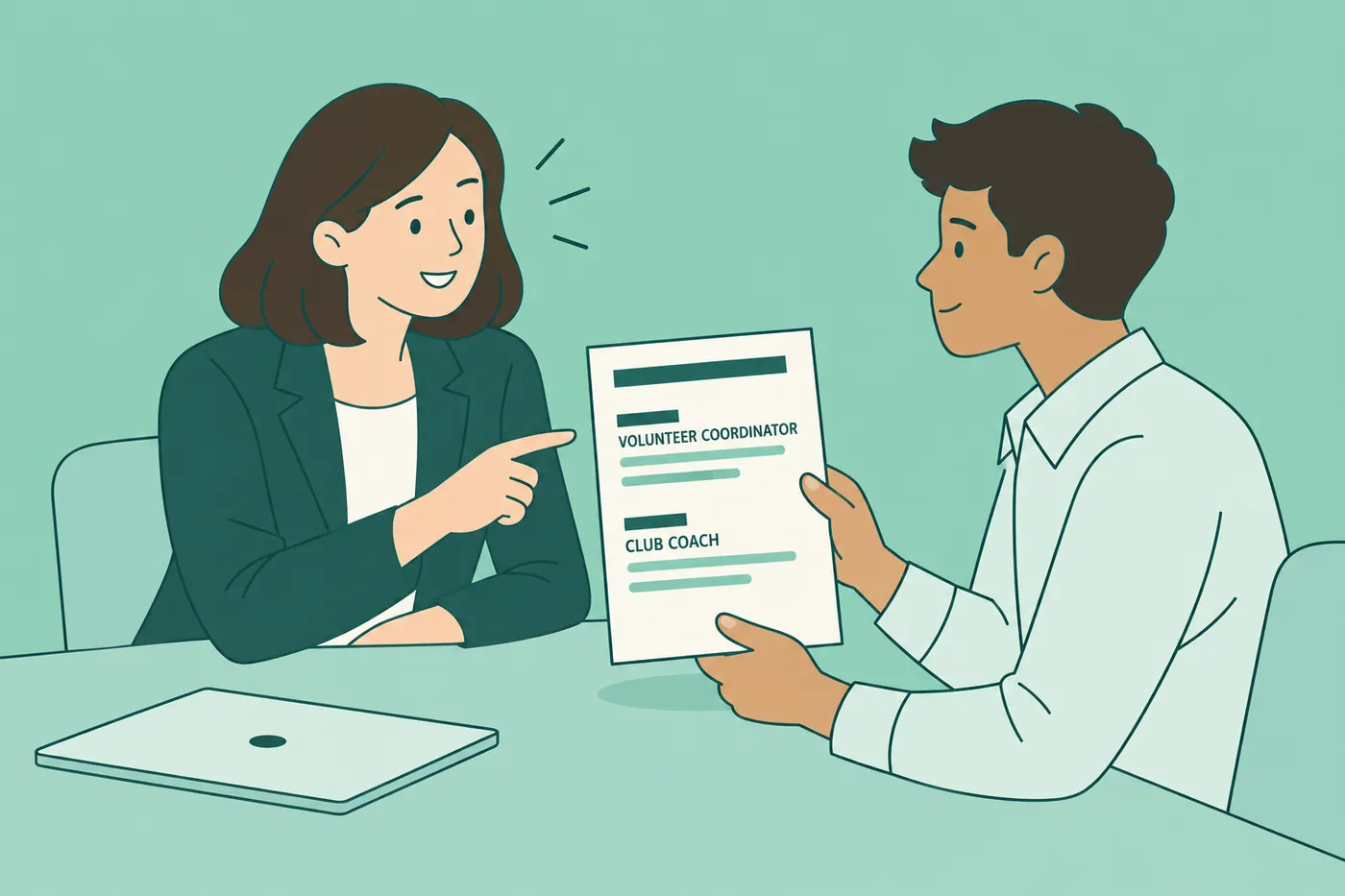
You do not need a former boss to have references. A teacher who saw you meet deadlines, a coach who saw you show up at 6 a.m., or a volunteer coordinator who saw you handle the public all count, and for a first job most employers expect exactly these.
Three rules. First, ask before you name anyone. "I'm applying for a customer service role at [company]; would you be comfortable giving me a reference if they call?" takes one message and prevents the worst outcome, a surprised referee who hesitates on the phone. Second, choose someone who watched you do something, not someone who likes you. A coordinator who supervised your shifts beats a family friend with an impressive title. Third, don't put references in the letter or write "references available upon request" anywhere; keep a separate one-page sheet with names, roles, and contact details ready for when you're asked. The reasoning is the same as for the resume line, covered in whether to put references on a resume.
Length and layout for a first letter
One page, and comfortably under it. Three or four short paragraphs, roughly 250 to 350 words. A first-job letter that runs long doesn't read as thorough; it reads as unedited, and it buries the two or three proofs that were doing the work.
- Paragraph 1: which job, where you saw it, and one sentence on why this company specifically. A detail from their site or store, not a compliment that fits any employer.
- Paragraph 2: the middle paragraph. Two or three proofs mapped to the posting's requirements, plus the taught-yourself sentence.
- Paragraph 3: availability, stated once and plainly.
- Closing: a direct ask for the interview, your name, and a signature line.
Use the same name header as your resume: identical name, phone, email, and formatting. The two documents arrive together and should look like they came from the same person on the same day. Keep the font and size consistent between them too; if you're unsure what reads well, the guidance on resume font size applies to the letter unchanged.
Check the letter against the posting, then export a PDF
Before you send anything, run two checks. The first is manual: go back to the posting and confirm every underlined requirement has exactly one answering sentence in your letter, and every sentence in your middle paragraph answers a requirement. Anything that answers nothing gets cut, however nicely it's written.
The second is on this page: paste your finished letter into the check and it scores it out of 100 on five things that sink first-job letters, length, the opening, company-specific detail, stock phrasing, and the closing ask. It will flag quick learner and hard worker on sight, which is why the rewrites above never use them.
To fix what the check finds, the Roleframe editor drafts a cover letter from your resume for the specific job you're applying to, and you edit every line before it goes anywhere. The same workspace gives you a fit report on the resume itself, an applicant tracking system (ATS) score against the posting plus the keywords you're missing, so the letter and the resume argue the same case. When both are done, export as PDF. It preserves your layout exactly and parses cleanly in the tracking systems employers use, which is why it should be your default format even when a posting doesn't specify one.
Frequently asked questions
- How do I write a cover letter if I have no job experience?
Replace work history with checkable proof: volunteering, a club or team role, coursework, a project, or informal work like babysitting or helping in a family business. Underline the requirements in the posting and match each one to a single piece of proof with a concrete detail, a number, a timeframe, or a named incident. Add one sentence about something you taught yourself and how long it took, state your availability plainly, and ask directly for the interview. Never open by apologizing for the experience you don't have.
- What are 5 common cover letter mistakes?
For first-job letters: opening with an apology for having no experience; listing soft skills like "hard worker" with no example behind them; writing a letter that could go to any company because it names nothing specific about this one; running past one page; and closing with a vague "I hope to hear from you" instead of a direct ask for an interview. Each one is fixable in a single editing pass with the posting open beside the letter.
- What 5 things should a cover letter include?
The specific role and where you found it; one sentence on why this company rather than employers in general; a middle paragraph mapping two or three of your proofs to the posting's requirements; your availability, including start date and the hours you can work; and a direct closing ask for an interview. For a first job, availability and checkable proof matter more than polish.
- How long should a cover letter with no experience be?
One page maximum, and ideally 250 to 350 words in three or four short paragraphs. With no work history to summarize, a longer letter almost always means padding, and padding buries the two or three proofs that actually earn the interview. If a paragraph doesn't answer a line in the posting or state your availability, cut it.
- Should I say I'm willing to learn in my cover letter?
Not in those words, because every applicant says it and it can't be verified. Prove it instead: name something you taught yourself, how long it took, and what you can now do with it. "I taught myself spreadsheet formulas over six weeks and now maintain our club's attendance tracker" makes the same claim with evidence attached, and it survives automated checks that flag stock phrases like "quick learner."
- Who can be my reference if I've never had a manager?
A teacher, a coach, or a volunteer coordinator, anyone who supervised you doing something, showing up on time, handling money, or dealing with the public. Ask their permission before naming them, and keep their details on a separate sheet rather than in the letter itself. For a first job, employers expect academic and volunteer references and treat them as normal.
- Do I need a cover letter if the application says it's optional?
With no work experience, yes. Your resume is short by definition, and the letter is the only place you can connect your coursework, volunteering, and projects to the specific requirements in the posting. "Optional" means some candidates will skip it, which makes a sharp one-page letter one of the few ways a first-time applicant can outwork the rest of the pile.
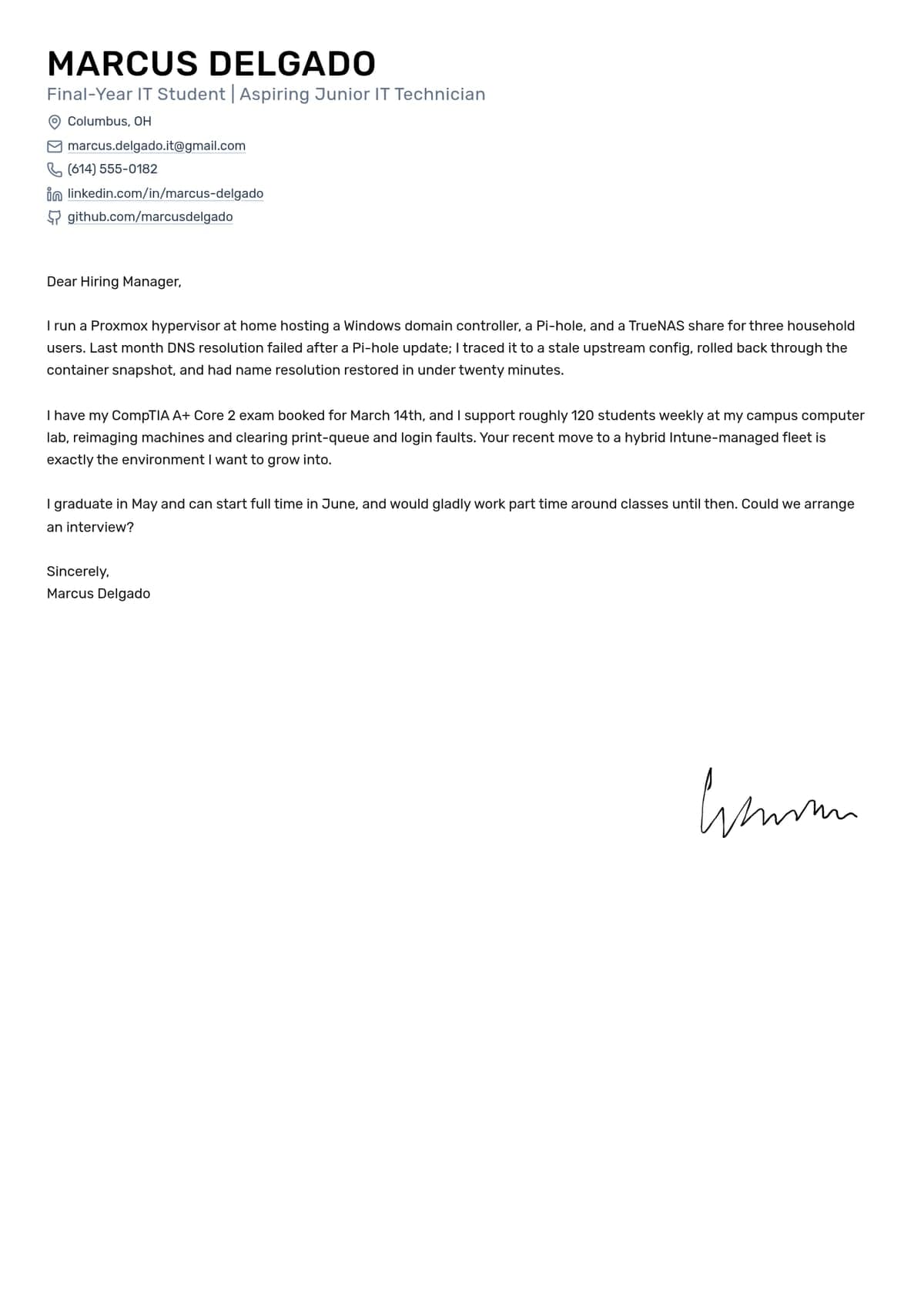
Write yours on the same template.
Every example here is built on a template you can open in the editor. Keep the structure that works and put your own story in it, or let Roleframe draft a first version from your resume and the job posting.


