
Copywriter Cover Letter Examples: Writing a Letter That Sells You
by Larbi SahliLast Updated
A real copywriter cover letter example, plus how to decode direct-response vs. brand postings, nail the hook, and link your portfolio without clunk.

On this page
Your Cover Letter Is Your First Copy Test
A hiring manager reading copywriter applications grades the cover letter before they read a single credential. For every other job, the letter is context. For yours, it is a writing sample, and it gets judged like one: does the first line earn the second, does the whole thing respect the reader's time, and would this person's copy survive a client review?
That changes the assignment. A serviceable letter that would pass for an accountant fails for a copywriter, because "serviceable" is exactly what the hiring manager is screening out. Creative directors and content leads have read hundreds of letters that open with "I am writing to express my interest in the Copywriter position." A copywriter who opens that way has already answered the only question that matters.
The good news is the brief is sitting right in front of you. The job posting tells you the audience, the tone, and the conversion goal. Treat the letter like any other piece of copy: one reader, one desired action, one clear argument for why you are the person who gets them there. This page shows you a full copywriter cover letter example, then breaks down how to adapt it for agency and in-house roles, how to read the posting for direct-response versus brand signals, and where most copywriter letters fall apart.
Copywriter Cover Letter Example: Ad Agency
Agency roles reward range and speed. The person reading your letter has pitched at ten this morning and has a deck due at five, so the letter that works is the one that sounds like a colleague, gets to a real result fast, and shows a voice they could put in front of a client tomorrow. Here is what that looks like in practice.
Nora Kessler
Copywriter | Direct-Response & Brand Voice
Dear Hiring Manager,
Last spring I rewrote one subject line for a challenger skincare brand and watched open rates jump from 14% to 31% — the client stopped A/B testing and shipped it to their full 90,000-subscriber list. That is the kind of small, testable bet I want to make for your agency.
I spent three years writing across the spectrum: paid social and landing-page CRO that lifted checkout conversion 22%, then long-form brand storytelling for a heritage coffee account that needed warmth, not urgency. Two pieces in my portfolio show that range — a deadpan retargeting sequence and a founder's-letter campaign — so you can judge the voices side by side.
I read your roster and know these accounts pull in opposite tonal directions. That is precisely the problem I like solving. My work is at the link below; a fifteen-minute call is all I'd ask for.
Warm regards,
Nora Kessler

Notice what the example above does not do. It never summarizes the resume, it never lists soft skills, and it never asks for permission to be read. Every paragraph does a job: the hook proves voice, the campaign story proves results, the portfolio references prove range, and the close makes the next step easy. That structure is the template. The words should be entirely yours.
Copywriter Cover Letter Example: In-House Tech
An in-house role at a tech company is a different brief, and sending the agency letter to a SaaS content lead is how strong candidates lose winnable jobs. The same skeleton works. Three things need to change.
The proof changes. Agencies buy concepts and awards. In-house teams buy funnel ownership. Your campaign story should move from "the idea that won the pitch" to "the onboarding email sequence I rewrote and what happened to activation." If you have touched lifecycle email, landing pages, in-app copy, or paid social for a product, that is the story to tell, with the outcome attached.
The collaboration changes. In-house copywriters sit between product, design, and growth, and hiring managers screen for people who can work inside that structure. One sentence showing you have shipped copy through a product team, or worked inside a design system and a brand voice guide, does more than a paragraph about creativity.
The voice calibrates down, slightly. The letter still needs personality, because a flat letter fails the copy test everywhere. But a stunt opening that would charm a creative director can read as noise to a head of content who mostly needs clarity, consistency, and someone who hits deadlines. Match the register of the company's own marketing site. If their homepage is warm and plain, write warm and plain.
Direct-Response or Brand? Read the Posting Before You Write a Word
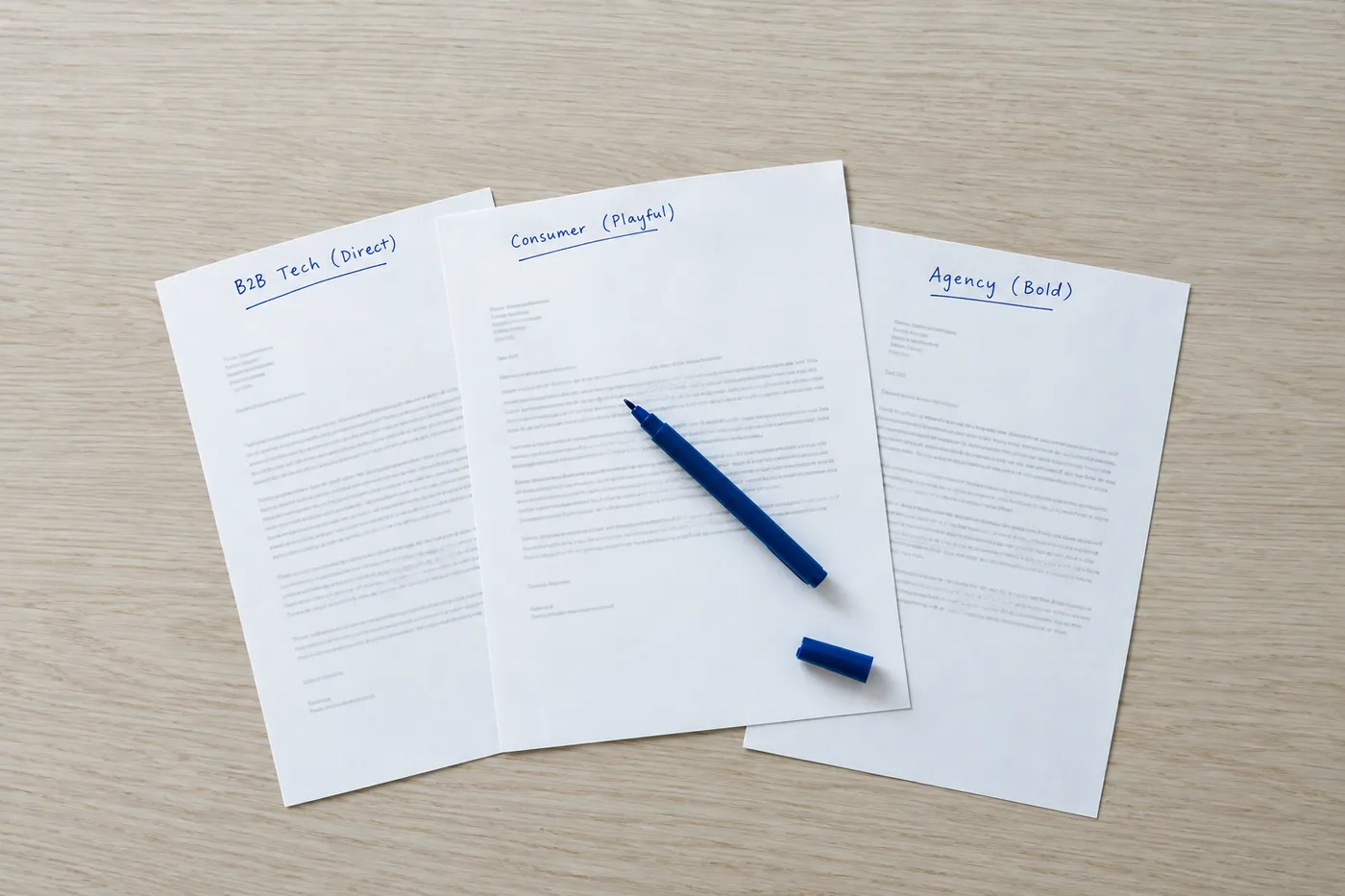
Copywriting postings split into two vocabularies, and the split tells you exactly which letter to write. Read enough of them and the pattern is hard to miss. One cluster of postings talks in direct-response language: conversion, click-through, A/B testing, landing pages, email sequences, paid social, funnels. The other talks in brand language: tone of voice, storytelling, brand guidelines, campaign concepts, editorial, thought leadership.
Most candidates ignore this and send one letter everywhere, which is why most letters read as generic. The fix is mechanical. Scan the posting, count which vocabulary dominates, and build your letter around that cluster.
| Signals in the posting | The role leans | Lead your letter with |
|---|---|---|
| Conversion, CTR, A/B testing, landing pages, CRO, email sequences, paid social | Direct-response | A measurable result: a test you ran, a sequence you rewrote, and what the numbers did |
| Brand voice, tone of voice, storytelling, brand guidelines, campaign concepts, editorial | Brand-awareness | Voice and a concept story: show the register in your own prose, then prove you can hold a brand's voice that is not yours |
| A genuine mix of both clusters | Hybrid (common in-house) | One result and one voice moment, in that order, and a line showing you know when each mode applies |
The deeper point: a direct-response hiring manager reads "I'm a passionate storyteller" and hears "I have never been accountable to a number." A brand lead reads a letter that is all CTR percentages and hears "this person will fight our style guide." Mirroring the posting's dominant vocabulary is the fastest credibility move available to you, and it costs one careful read of the job description.
Nailing the Hook: How to Open Your Letter
The first line of a copywriter cover letter carries more weight than the rest of the letter combined, because it is the one line the reader grades as copy before they grade anything as biography. Four openings reliably work.
- The result hook: open on the outcome, then unwind the story. "Last spring I rewrote one subject line and the client stopped asking whether email was dead." It proves you think in effects, not adjectives.
- The observation hook: open with something specific and true about their brand or product that a casual applicant would not notice. It proves you did the reading, and it flatters without flattery.
- The voice hook: write your first paragraph in the register of their own copy. If their brand is dry and deadpan, be dry and deadpan. The demonstration is the argument.
- The referral hook: if someone on the team told you to apply, say so in the first sentence. Warm beats clever every time it is available.
What does not work is the gimmick that ignores the brief: the letter formatted as a fake press release, the "this is not a cover letter" opening, the pun on the company name. Occasionally one of these lands with exactly the right creative director. Far more often it reads as a writer performing for themselves instead of writing for a reader, which is the precise failure the letter exists to screen for. If your stunt does not serve the posting's actual goal, cut it and open with a result.
Showcasing Versatility Across Different Brand Voices
"I can write in any voice" is a claim. Two contrasting samples are proof. The strongest versatility move in a copywriter cover letter is naming two specific portfolio pieces in different registers: "the fintech onboarding flow and the craft brewery campaign are the range endpoints, and everything else sits between them." One sentence, and the reader now knows your span and has a reason to click.
Pick the two pieces deliberately. They should bracket the voice of the company you are applying to, so the reader can see their brand fits inside your range. Applying to a playful DTC brand? Your serious B2B sample and your funniest social work make the bracket. Applying to enterprise software? Lead with the sample that proves you can be clear about complicated things, and let the playful one show you are not a robot.
Resist the urge to list every industry you have touched. A catalog reads as scattered. Two endpoints read as range. The same logic applies to designers, and the reasoning in our graphic designer cover letter guide is worth a read if your work straddles copy and visual.
Using the Fit Report to Hit SEO and Conversion Keywords
The vocabulary problem from earlier has a practical wrinkle: before a human grades your letter as copy, an applicant tracking system (ATS) and a recruiter's keyword filter often grade your application as data. If the posting says "conversion rate optimization" and "lifecycle email" and your materials say "persuasive writing," you can lose the match on terminology alone, which is a bitter way for a professional writer to go out.
This is where Roleframe earns a mention. Duplicate your base resume for the job and Roleframe produces a fit report: it reads the posting the way a senior recruiter would, scores your resume against it, and lists the exact keywords the posting asks for that your materials are missing. That keyword list is written for the resume, and it doubles as a brief for the letter. If the report shows the posting leans on "A/B testing," "email sequences," and "paid social," you know the letter should lead direct-response. If the gaps are "brand voice" and "editorial," you know which portfolio story to tell. Roleframe will also draft a job-specific cover letter for you to edit, which for a copywriter is best treated as a structural first pass you rewrite in your own voice. For the underlying mechanics of keyword matching, see our guide to ATS resume keywords.
One caution: hitting keywords in a cover letter means using the posting's terms where they are true of your work, in natural sentences. A letter stuffed with the job description's phrasing reads exactly as cynical as it is, and copywriting hiring managers are the readers most likely to notice.
How Remi Assists Without Overwriting Your Voice
Copywriters are, reasonably, the most skeptical audience for AI writing tools. Your voice is the product. A tool that rewrites your letter into confident beige has destroyed the thing you were selling, and most generator-style tools do exactly that, for reasons we unpack in why ChatGPT resumes all sound the same.
Remi, Roleframe's career copilot, is built on the opposite premise. It works inside the editor on the document you are about to send, and every suggestion arrives as a proposal with a word-by-word diff: what it would cut, what it would add. Nothing touches the page until you accept it, and the approval is enforced by the tool, so there is no mode where it quietly rewrites a paragraph behind you. In practice that makes it useful for exactly the jobs a good editor does: tightening a sentence that runs long, flagging where the letter drifts off the posting's vocabulary, offering an alternative construction you can reject in one click. You keep authorship of every word, which matters twice for a copywriter. Once because the voice is the audition, and once because you should be able to stand behind every claim in the letter when it comes up in the interview.
Linking to Your Portfolio Without Being Clunky
Your portfolio link belongs in two places: the header, next to your contact details, and once in the body, attached to a specific promise. "Portfolio: janedoe.com" in the header handles the recruiter who scans. The body mention handles the reader you have actually hooked, and it works hardest when it points at something particular: "the two email sequences on the first page of my portfolio are the closest match to this role." A directed link gets clicked. A bare "you can view my work at the link below" gets skimmed past.
Two mechanical details. Send the letter as a PDF so the hyperlink survives and the formatting holds; a link that dies in transit is a portfolio that does not exist. And make sure the first thing on the portfolio page matches the role. If the posting is direct-response and your portfolio opens with brand campaigns, reorder the page before you apply. The reader gives you one click and a few seconds of scroll, and the letter should have already told them what they will find there.

What Not to Do in a Copywriting Cover Letter
Every one of these has sunk otherwise strong applications, and every one is more expensive for a copywriter than for anyone else, because each is a copy failure, not just a job-search failure.
- Opening with "I am writing to apply for the Copywriter position at [Company]." The reader knows. You have spent your strongest real estate proving you write like everyone else.
- Typos and grammar slips. In any other letter they are a demerit. In yours they are disqualifying, because attention to the sentence is the job. Read it aloud, then have someone else read it.
- Summarizing your resume. The letter's job is the one story and the one argument the resume cannot make. If a paragraph restates your work history, cut it and let the resume carry it.
- Keyword stuffing. Mirroring the posting's vocabulary is smart; transplanting its phrases wholesale reads as pandering to the exact reader trained to spot filler.
- Generic flattery. "I've long admired your innovative campaigns" tells the reader you wrote one letter for forty companies. A single specific observation about their actual work replaces the whole paragraph.
- Running long. A copywriter who cannot make the case in under a page has made a different case entirely. Under 300 words is a good discipline; the example on this page shows how much fits in that space.
- The stunt that ignores the brief. Cleverness that serves the reader wins. Cleverness that serves the writer is the most common failure mode in creative applications.
Draft Your Letter in a Document-Grade Editor
The writing is yours. The production should not slow you down. Roleframe's editor gives you real control over layout and typography, matching cover letter and resume templates, and a PDF export that looks exactly like what you see on screen, so the letter that took you an hour to write does not get undermined by a template that fights you. The editor is free to use with no account, and the PDF download has no watermark; we compare it against the sign-up-walled alternatives in our guide to the best free cover letter builder without sign-up.
Frequently asked questions
- What is the 80/20 rule in copywriting?
The 80/20 rule holds that a small fraction of your copy does most of the work, and in practice that fraction is the headline or opening line. Most readers decide from the first line alone. Applied to your cover letter, it means the opening sentence deserves as much revision time as the rest of the letter combined, because it decides if the rest gets read at all.
- What are the 5 C's of copywriting?
The 5 C's are a common shorthand for what working copy needs: clear, concise, compelling, credible, and carrying a call to action. They map directly onto a cover letter. Clear means no throat-clearing, concise means under a page, compelling means a hook and a story, credible means a real result you can defend, and the call to action is a confident close that makes the next step easy.
- What are the most common cover letter mistakes for copywriters?
The five that come up most: opening with a boilerplate "I am writing to apply" line, typos (disqualifying in this field specifically), summarizing the resume instead of telling one story, generic flattery about the company, and stunts that entertain the writer rather than serve the reader. Each one is a copy failure in a document being graded as copy, which is why they cost copywriters more than they cost other applicants.
- Are cover letters outdated in 2026?
For many roles they are optional, and plenty of recruiters skip them. For copywriters they remain close to mandatory, because the letter is a free writing sample the hiring manager receives before opening your portfolio. Skipping it, or sending a template, forfeits the one place in the application where you can demonstrate the exact skill being hired.
- How do I write a copywriter cover letter with no experience?
Replace client results with proof you have shipped writing somewhere: spec ads for real brands, a newsletter you run, landing pages for a friend's business, or rewrites of live copy with your reasoning attached. The letter itself carries extra weight when the resume is thin, so treat the hook and the voice as your primary evidence. Name two contrasting samples so the reader sees range, exactly as an experienced applicant would.
- How long should a copywriter cover letter be?
Under a page, and ideally under 300 words. Brevity is itself a demonstration of the skill: a copywriter who needs 600 words to make the case has undermined it. One hook, one story with an outcome, one line on range, one confident close. If a paragraph is not doing one of those four jobs, cut it.
- Should I match my cover letter keywords to the job posting?
Yes, where the terms are true of your work. Postings split between direct-response vocabulary (conversion, A/B testing, email sequences) and brand vocabulary (tone of voice, storytelling, brand guidelines), and mirroring the dominant cluster signals fit fast. Roleframe's fit report shows the exact keywords a posting asks for that your materials are missing, which doubles as a brief for the letter. Use the terms in natural sentences; stuffing them reads as cynical to the one audience guaranteed to notice.


Ready when you are
Send the tailored resume, not the generic one.
Paste a job posting and Roleframe scores your resume against it, then helps you close the gaps one approved edit at a time, so you apply while the role is still fresh.