
Graphic Designer Cover Letter: Examples and How to Write About Your Work
by Larbi SahliLast Updated
A full graphic designer cover letter example, plus how to frame your design work as business impact for in-house and agency roles.

On this page
A graphic designer cover letter has one job your portfolio can't do: explain the thinking. A hiring manager can see that your rebrand is beautiful. They can't see that it lifted signups, shipped under a brutal deadline, or survived eleven rounds of stakeholder feedback without losing its spine. The letter is where that story lives.
This matters more than most designers realize, because the person screening applications is often not a designer. Read a stack of in-house design postings and the pattern is hard to miss: alongside the craft requirements, they ask for cross-functional collaboration. Partner with marketing. Work closely with product. Present to leadership. Your letter has to prove you can do that, and prove it in writing, which is itself the medium those collaborators will judge you in.
Below you'll find a complete graphic designer cover letter example, a breakdown of why each part works, how to adapt it for agency versus in-house roles, and a repeatable way to translate visual work into business language.
Why your portfolio isn't enough
Portfolios show output. Hiring decisions are made on process, context, and fit, and none of those are visible in a JPEG.
Think about what a recruiter actually knows after looking at your best case study. They know the final artifact looks good. They don't know what the brief was, what constraints you worked under, what you pushed back on, or what happened after launch. Two designers can show nearly identical work where one drove the concept and the other executed someone else's direction. The portfolio can't tell them apart. The cover letter can.
There's a second reason the letter carries weight for designers specifically. In-house design work is mostly persuasion: defending a concept to a marketing VP, explaining to a product manager why the cheaper option undermines the brand, writing rationale into a design system doc. A clear, confident cover letter is a work sample for that part of the job. A sloppy or generic one suggests you can make things but can't advocate for them.
So treat the letter as the narration track for your portfolio. Not a repeat of your resume, and not a list of adjectives about your passion for design. One or two projects, told as decisions and outcomes.
Graphic designer cover letter example: in-house corporate role
Here is a full graphic designer cover letter example for an in-house brand designer role. Notice what it leads with: a business result, not a statement of interest. Notice too how much space goes to collaboration with non-designers, because that is what in-house postings screen for.
Nathan Cole
Graphic Designer | Brand Systems & B2B Marketing Design

Dear Hiring Manager,
Last year I rebranded a B2B analytics platform's entire lead-gen funnel, and the redesigned demo landing pages lifted trial signups by 34% in a single quarter. That kind of measurable result is why your in-house brand designer role caught my attention.
The project that taught me most was a pricing-page redesign. Sales flagged that prospects couldn't tell our three plans apart, so on a two-week deadline I rebuilt the comparison layout and iconography in Figma, testing two variants. The clearer version cut pricing-related support tickets by 40% and became our brand template.
I work closely with marketing and product—pairing with PMs on messaging and marketers on campaign assets—so design decisions survive stakeholder rounds without losing their spine. My portfolio at nathancole.design shows the analytics rebrand and a launch-template system relevant to your team's cadence.
I'd welcome a conversation about how I can strengthen your brand. When works for you?
Warm regards,
Nathan Cole
What this letter gets right
The opening line does the work. No "I am writing to apply for the Graphic Designer position." The hiring manager already knows what you're applying for; it's on the application. The first sentence gives them a reason to keep reading: a concrete outcome tied to design work, at a company type they'll recognize.
Projects are told as decisions, not deliverables. "I designed a campaign" is a job description. "The brief asked for X, I chose Y because of Z, and it produced this result" is a story only you can tell. The example above does this twice and stops. Two projects with depth beat five projects with none.
Collaboration is shown, not claimed. "Strong cross-functional collaborator" is a phrase from the posting pasted back at the reader. A named moment, like reworking a launch asset after a product manager flagged a positioning problem, proves the same thing and is far more memorable.
The portfolio gets one sentence, aimed. It points to two specific pieces chosen for this employer, which quietly demonstrates that you researched them. More on this below.
It fits on one page with room to breathe. Three to four short paragraphs. If your letter runs longer, you're re-narrating your resume instead of adding to it.
Adapting the example for an agency role
Agency hiring managers read for different signals than in-house ones. An in-house team is buying depth in one brand and the ability to work with non-designers who outrank you. An agency is buying range, speed, and the ability to absorb a new client's world by Thursday. Same skeleton, different emphasis.
| What to emphasize | In-house corporate role | Agency role |
|---|---|---|
| Lead story | One brand, sustained impact: a rebrand, a design system, a campaign that moved a company metric | Range across clients: two contrasting projects that show you can switch industries and styles |
| Collaboration proof | Working with marketing, product, and leadership; presenting rationale to non-designers | Working with account teams and clients; handling feedback and revisions without losing the concept |
| Metrics that land | Conversion, engagement, brand consistency, production time saved | Client retention, pitch wins, turnaround speed, work that shipped on deadline |
| Pace signal | Process maturity: briefs, reviews, design systems | Volume under deadline: concurrent projects, fast concepting |
| Tone | Steady, strategic, brand-guardian | Energetic, adaptable, idea-forward, still professional |
One warning for agency letters: don't perform quirkiness. Agencies see a lot of letters that open with a pun and close with an emoji, and creative directors are largely tired of it. The creativity should be in the work you describe and the sharpness of the writing, not in gimmicks. A tight, vivid paragraph about how you cracked a hard brief reads as more creative than any wordplay.
Connecting your design work to business impact
This is the section most graphic designer cover letters miss entirely, and it's the gap that decides interviews for in-house roles. Companies don't hire designers to make things look good. They hire designers because good design sells more, confuses less, and costs less to produce at scale. Your letter should speak that language without abandoning craft.
The translation is a three-part move. For each project you mention, answer: what was the business problem behind the brief, what design decision did you make, and what changed in the world after it shipped. Craft lives in the middle part. The first and last parts are what a hiring manager can repeat to their boss when they argue for interviewing you.
Here's what the shift looks like in practice. Use your own real numbers; these are phrasing templates, not claims to borrow.
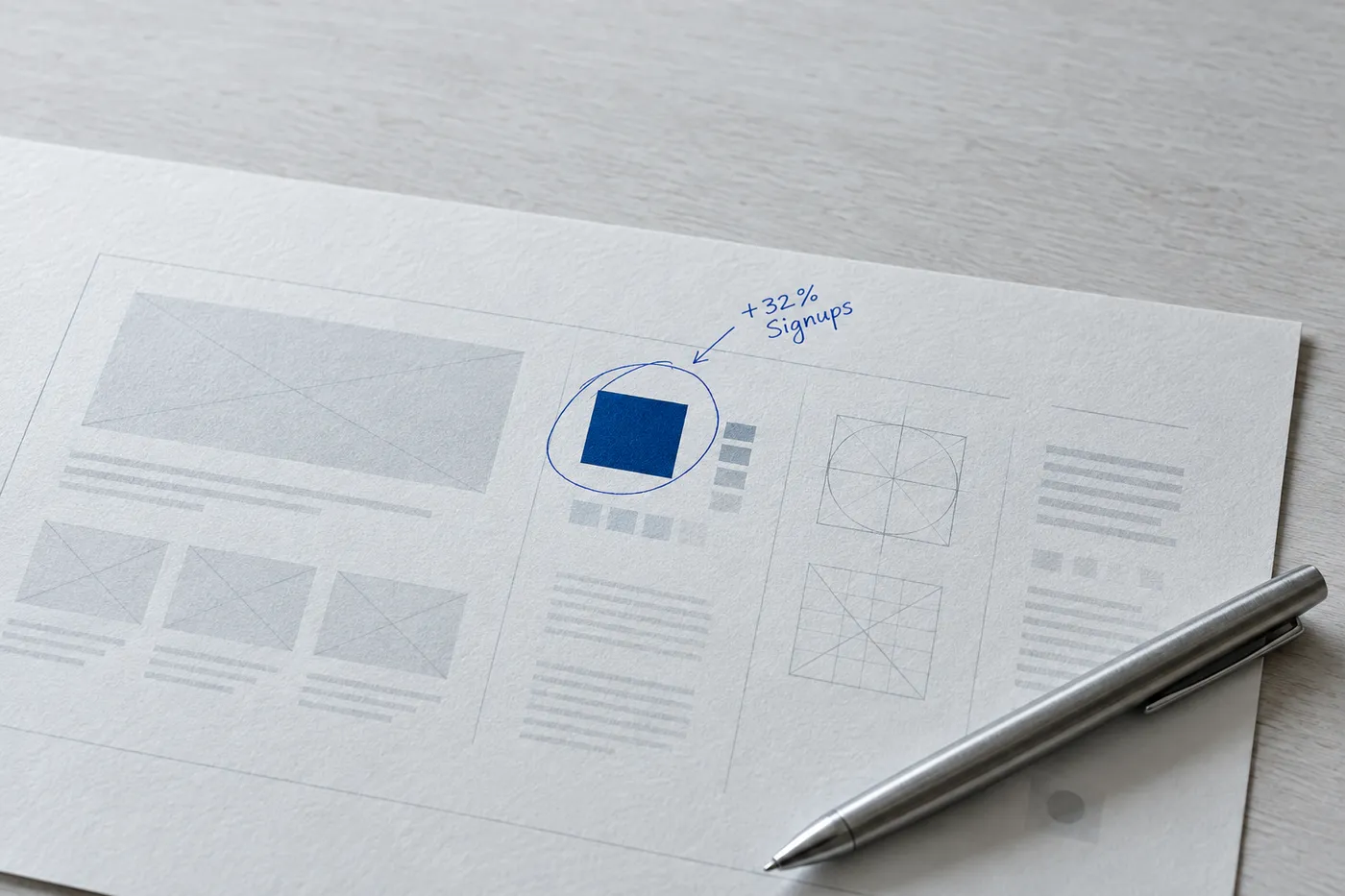
- Instead of "Designed social media graphics for product launches," write "Built a launch template system that cut social asset turnaround from three days to same-day, so marketing stopped missing posting windows."
- Instead of "Redesigned the company website," write "Redesigned the pricing page after sales flagged that prospects couldn't compare plans; demo requests from that page rose noticeably the following quarter."
- Instead of "Created brand guidelines," write "Wrote and rolled out brand guidelines that let three regional teams produce their own materials without design review, freeing our team for campaign work."
If you don't have hard numbers, use proxies. Most designers were never given a dashboard. Speed is a metric (turnaround time, assets per sprint). Adoption is a metric (how many teams use your templates or design system). Scope is a metric (audience size, number of markets, budget of the campaign your work carried). Even "the concept was approved in one round instead of the usual four" is a real, credible outcome that says something about your ability to read stakeholders.
What you should never do is invent a number. You'll be asked about it in the interview, and a figure you can't explain collapses the whole letter. The rule that applies to resumes applies here too: only claim what you can defend out loud. The same thinking behind how employers weigh hard and soft skills applies to letters: the soft skill claim only counts when it's attached to a concrete situation.
How to mention your portfolio naturally
Every designer's letter links a portfolio. Almost all of them do it the same lifeless way: "Please see my portfolio for examples of my work." That sentence tells the reader nothing and asks them to do the curating themselves.
Do the curating for them. One sentence, specific, tied to the role: "The Meridian rebrand and the Atlas packaging system on my portfolio are the closest matches for what this role describes." Now the hiring manager knows exactly what to open, you've shown you read the posting closely, and you've turned a formality into a small act of service.
Three practical rules:
- Name one or two specific pieces, chosen for this employer, and say why they're relevant in a clause or less. Different application, different pieces.
- Put the URL in your header next to your contact details, not buried mid-paragraph. Recruiters look for it there first.
- Check access before you send. A password-protected case study with no password in the letter, or a dead Behance link, ends the application quietly. If a piece needs a password, include it right there in the sentence.
One more thing: don't assume the link gets clicked. Screeners work fast, and some applicant tracking system (ATS) views strip or flatten links. The letter has to make your case on its own; the portfolio is the evidence for the reader who's already interested.
Naming your software, beyond Adobe CC
"Proficient in Adobe Creative Suite" is the design equivalent of "proficient in Microsoft Office." Every applicant says it, so it differentiates no one. Software belongs in your letter only when it maps to the posting or carries a story.
Mirror the stack the posting names, using their exact words. If the job description says Figma, write Figma, not "modern design tools." Recruiter keyword screens are literal, and so are skim-reading hiring managers. Beyond mirroring, here's how the common tools play:
- Figma: name it for any role that touches product, web, or marketing sites. In-house teams increasingly run brand work through Figma too, so its absence reads as a gap for digital-leaning roles.
- After Effects and motion: a genuine differentiator. If you can animate, say so with an example, because most brand designers can't and most postings quietly wish for it.
- Webflow, Framer, or basic front-end fluency: worth a sentence for marketing-site-heavy roles. "I designed and built the landing pages" is a budget line the hiring manager doesn't have to spend on a developer.
- Canva: don't lead with it as your craft tool, but do mention it as a collaboration story if you've built Canva template systems that non-designers use. That's a cross-functional win, exactly what in-house postings ask for.
- Print production knowledge: prepress, color management, vendor wrangling. Rare among younger designers, and decisive for roles with packaging or event work.
- AI image tools: name them only with judgment attached, such as using them for moodboards or concept exploration. "I generate finals with Midjourney" is a red flag to most creative leads; "I use it to compress the exploration phase" is not.
Keep the software mention to one or two sentences total. Tools are table stakes; the letter's real estate belongs to outcomes.
Drafting it faster: treat the job posting as a creative brief
Designers already have the exact skill this letter requires. You know how to read a brief, find the actual problem behind the stated ask, and respond to it. A job posting is a creative brief: the deliverable is you, the audience is the hiring manager, and the constraints are the requirements list. Read it that way and the letter almost outlines itself.
Pull the real requirements out of the posting
Underline every noun the posting repeats and every requirement that appears in the first three bullets; that's what the screen filters on. If you'd rather not do this by hand, Roleframe does it as part of its fit report: paste the posting into a role workspace and it maps every requirement against your resume, shows the exact keywords recruiter filters scan for, and flags which ones you're missing. Those same missing keywords are your cover letter's outline, because the letter is where you cover a gap the resume can't. The mechanics of keeping a base resume and per-job versions are covered in this guide to resume variants, and the same one-version-per-job logic applies to letters.
Let Remi draft the first pass, then make it yours
The blank page is the hard part, and it's the one part worth automating. In Roleframe, Remi, your career copilot, drafts a job-specific cover letter grounded in the posting you attached and the experience already on your resume, then hands it to you to edit line by line. That grounding is the difference between a usable draft and the interchangeable output generic chatbots produce; most AI cover letter generators fail precisely because they write from a thin prompt instead of your actual history.
Then edit hard. Rewrite the opening in your own voice, swap in the project stories only you know, and cut anything you couldn't say across a table in an interview. A draft is scaffolding. The letter that gets sent should be unmistakably yours, because the interviewer will hold you to every sentence in it.
Export a clean PDF that matches your resume
Your cover letter and resume should look like they came from the same designer, because for you that's literally the claim being evaluated. Same typeface, same header, same margins. A mismatched pair, or worse, a letter carrying a builder's watermark, undercuts a design application before a word is read.
Build both in the same editor and the problem disappears. Roleframe's editor exports an unwatermarked PDF that matches what you see on screen exactly, and the free version has no watermark and no export paywall. Send PDF, always: it locks your typography and layout on every device, which for a designer is the whole point. Only send another format if an employer explicitly demands it, and treat that as the exception.
Frequently asked questions
- What is a good example of a short cover letter for a graphic designer?
Three paragraphs, under 250 words. Paragraph one: a specific outcome from your work plus why this company. Paragraph two: one project told as problem, design decision, and result, with a named collaboration moment. Paragraph three: a pointer to one or two relevant portfolio pieces and a direct ask for a conversation. Short works when every sentence is specific; it fails when brevity is achieved by staying vague.
- Do graphic designers really need a cover letter if they have a portfolio?
When the application asks for one, yes, and it matters more for designers than for most roles. The portfolio shows output; the letter shows thinking, business context, and whether you can communicate with the non-designers you'd work with daily. In-house roles in particular screen for cross-functional collaboration, and the letter is the only document where you can demonstrate it in your own words. If a posting marks it optional, a strong letter is a cheap edge most applicants skip.
- Can I use Canva for my cover letter?
You can, but keep the design restrained: one column, real margins, a text-first layout, exported as PDF. Heavily decorated Canva letter templates can garble in ATS parsing and can read as template-spotting to a creative director. The safer route is building the letter in the same editor as your resume so the pair matches; there are free cover letter builders with no sign-up that export clean, unwatermarked PDFs.
- How should I describe a graphic designer on my resume?
Lead with outcomes, not tools. Each bullet should pair a design deliverable with what it changed: turnaround time cut, a campaign's performance, templates adopted by other teams, a rebrand shipped across a number of markets. Put the software list in a skills section that mirrors the posting's exact tool names, and keep the bullets for results. See these skills section examples for what to keep and what to cut.
- What can I write off as a freelance graphic designer?
This is a tax question rather than a job search one, but briefly: freelancers can typically deduct legitimate business expenses such as software subscriptions, hardware, a dedicated home office, professional development, portfolio hosting, and client-related travel. Rules and thresholds vary by country and change often, so confirm specifics with a tax professional before filing. If you're moving from freelance into an in-house role, none of this belongs in your cover letter.
- Should my cover letter match my resume's design?
Yes. Same typeface, same header block, same margins, sent as PDFs so nothing reflows on the reader's machine. For a design candidate the pair is an implicit work sample: consistent documents signal system thinking, mismatched ones signal carelessness. Restraint wins here; the letter should look considered, not decorated.
- Who do I address a graphic designer cover letter to?
Find a name if you can: the creative director, design manager, or head of brand, usually findable on LinkedIn in a couple of minutes. A name signals you researched the team, which matters in a field where knowing the audience is the job. If you genuinely can't find one, "Dear [Company] Design Team" or "Dear Hiring Manager" is fine; never use "To Whom It May Concern."


Ready when you are
Send the tailored resume, not the generic one.
Paste a job posting and Roleframe scores your resume against it, then helps you close the gaps one approved edit at a time, so you apply while the role is still fresh.