Panel Interview: How to Prepare and Answer Several Interviewers
Prepare for a panel interview with a mock three-person script, worked answers that include every interviewer, and a simple rehearsal scorecard.


On this page
A panel interview places one candidate with several interviewers at the same time. UC Berkeley’s staff interview guidance describes panels of two or more people who may represent the hiring department or other stakeholders. The exact membership and assessment process vary.
This guide offers an original fictional three-person practice script, worked answers and an observation sheet. Use them to rehearse clear evidence and listening across several people. They are not an employer’s transcript, a validated scoring rubric or a prediction of your result.
Panel interview, group interview and structured interview
A panel interview has several interviewers and one candidate. A group interview includes several candidates. A structured interview describes how the questions and answers are assessed, rather than how many people attend. These categories can overlap; ask the recruiter which format to expect.
The US Office of Personnel Management describes structured interviews as using predetermined job-related questions in the same order, with common rating standards. That is one format a panel may use, not a rule for every employer.
You may see note-taking, pauses, follow-ups or repeated themes. Do not treat those behaviors as reliable evidence of approval, rejection or a deliberate stress test. Answer the question asked, include the relevant evidence and ask for clarification when necessary.
Ask how long the interview is scheduled to last. For rehearsal, a 90-second to two-minute answer can be a useful starting target, but a technical question or multi-part prompt may need more time. Follow any stated time limit rather than forcing every answer into the same length.
Ask who will attend, then prepare for each role
Ask the recruiter: “Could you share the interview format, duration, and who will attend with their roles?” If that information is available, use it to understand the work each person does. The table gives possible areas of interest, not a claim that each panelist evaluates only one thing.
| Panel member | Possible areas of interest | What to prepare |
|---|---|---|
| Hiring manager | Can you do the core job, and will the team be stronger with you on it | Relevant examples of core job requirements, with verified results or concrete outputs |
| Peer or future teammate | What you're like to work with on a normal Tuesday | A collaboration example involving a handoff, shared deadline or disagreement |
| Cross-functional partner (sales, design, clinical, finance) | Whether you understand their world and can communicate across it | One story where you translated your work for a non-specialist audience, plus a question about their team's pain points |
| HR or recruiter | Application consistency, process and employment logistics | Accurate dates, a factual explanation of a career move, and your questions about the role and pay range |
| Skip-level or senior leader | Judgment and growth potential | A decision you made with incomplete information, and how you'd make it again |
| Technical specialist | Depth behind the skills you list | Tools, versions and tradeoffs you can defend under follow-up questions |
If the panel details are not available, prepare examples of the job’s core work, collaboration and communication with other teams. The fictional script below uses a manager, peer and partner as one possible mix. The behavioral questions guide can help you build a small story bank from your actual experience.
The mock panel: a three-person script to rehearse against
This is an original fictional rehearsal, not a company transcript or a tested hiring method. Dana is the hiring manager, Marcus a senior peer, and Priya a customer-success partner. All names, situations, projects, numbers and outcomes in the sample answers are invented to demonstrate structure. Rehearse the five prompts within a practice session that leaves time for your questions and feedback; use your own true examples.
Round 1 — Dana, the opener
Dana: “Thanks for making time. To start us off, give us a quick tour of your background and what drew you to this role.”
Practice note: Try a brief current-role summary, one relevant example and your reason for applying. Around 90 seconds is a rehearsal target, not a hiring rule. The tell-me-about-yourself guide has more structure. Include the other interviewers naturally where comfortable; do not make eye contact a choreographed performance.
Round 2 — Dana, the competency question
Dana: “Tell us about a project you owned end to end. What did you do, and what came of it?”
Practice note: Explain the context, your own responsibility, actions and result. Use a documented number when you have one, or describe a concrete output without inventing a metric. Keep enough detail available for a follow-up.
Round 3 — Marcus, the peer question
Marcus: “Tell me about a time a teammate pushed back on your approach. What happened?”
Practice note: Explain the disagreement without pretending you know what a particular panelist will score.
Fictional sample: “A designer wanted to reduce a feature I had scoped for launch. I asked her to show me the user-session findings behind her concern. We agreed to ship a smaller version and took a joint recommendation to our manager. That experience changed how early I involve design in scope decisions.”
This example identifies an issue, a specific action and what changed. Use only a disagreement and outcome that actually happened in your own work.
Round 4 — Priya, plus an interruption
Priya: “My team usually hears about changes after they've already been decided. How would you keep a partner team in the loop?”
Thirty seconds into your answer, Dana cuts in: “Can you make that concrete? An actual example.”
Pacing note: this round rehearses two skills at once: answering a partner whose priorities differ from the hiring manager's, and absorbing an interruption without losing the thread. The full worked answer is in the next section.
Round 5 — Marcus, the apparent repeat
Marcus: “Earlier you mentioned that launch project. Walk me through what you did when the timeline slipped.”
Practice note: Address the new aspect rather than repeating the first answer word for word. A follow-up can seek a different competency or simply clarify detail; you do not know the reason from the wording alone. It is fine to acknowledge that you are using the same project and then focus on the scheduling decision.
Dana, closing: “We have a few minutes left. What questions do you have for us?”
Worked answers: speak to the questioner, include the room
Begin by acknowledging the questioner, then include the rest of the panel naturally where comfortable. There is no evidence-based three-beat gaze rule to obey. On video or when eye contact is difficult, clear answers, active listening and occasional use of names can help you communicate without forcing a particular movement pattern.
Compare this vague fictional response: “I always over-communicate and make sure stakeholders are aligned.” It does not explain a method or give evidence.
A more useful fictional response to Priya’s question might be: “I would first ask which decisions your team needs to influence and how early. On a previous project, I used a short weekly update covering decisions, risks and requests for input.”
Dana: “Can you make that concrete?”
“In this example, a launch moved by two weeks. The update gave support time to revise its customer materials before the new date. For your team I would agree on the decisions that need an earlier discussion, not just send more status messages.”
The project and two-week figure are invented. In a real answer, replace them with your own process, contribution and observed result. You can check whether you answered the question, but you do not need to ask for reassurance after every response.

Interruptions, repeated questions and panelists who disagree
Interruptions. Pause and listen. If the interviewer redirects you, answer the new request. If part of the original question remains, ask whether they would like you to return to it. Do not assume an interruption was a test.
Repeated themes. Address the specific emphasis of the new question and add useful detail. If you are unsure whether they want another example, ask. It is acceptable to use the same project when it is relevant, provided you answer the new question.
Different priorities. Explain your reasoning and tradeoffs instead of trying to decide which panelist to agree with. A fictional example is “We reduced scope to preserve time for testing.” Support the principle with a real decision you made.
Challenges. Clarify what is being challenged, correct an error if necessary and acknowledge limits in your evidence. Do not defend a number you cannot support or invent a stronger result to answer pressure.
Your questions, and the in-person and video logistics
Prepare questions that fit the job and the people attending. You can direct a question to a named panelist when relevant, but do not force one question per person if time is short or the panel invites a shared answer.
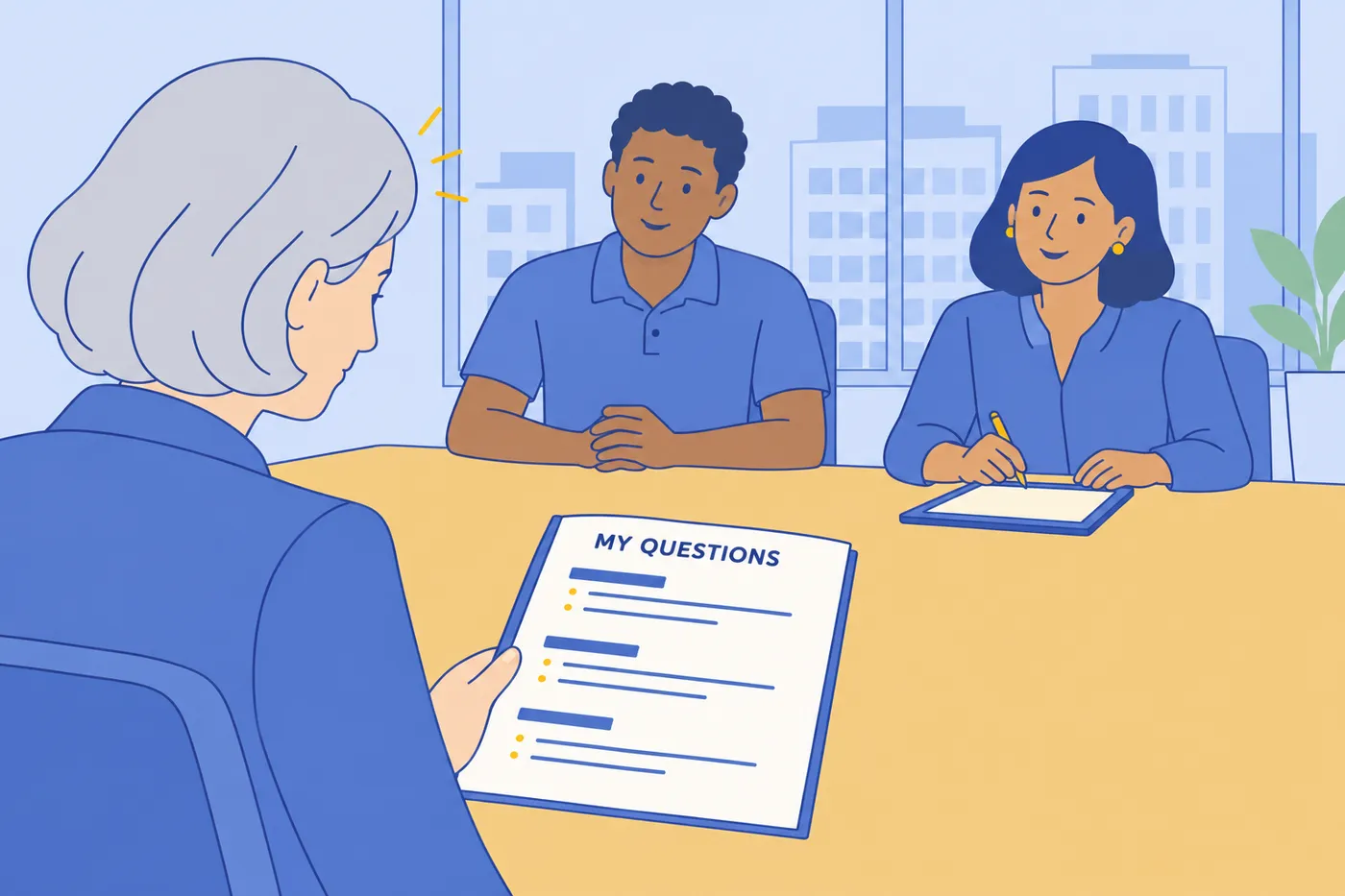
- For the hiring manager: "What would a strong first 90 days look like in this seat?"
- For the peer: "What does the busiest week of the quarter actually look like on this team?"
- For the partner: "Where does the handoff between your team and this role break down today?"
More options are in questions to ask during an interview. Confirm the practical details in advance.
In person. Note names if helpful and permitted, ask about pronunciation when needed, and bring requested materials. Additional resume copies can be useful. Choose a position from which you can hear and see the panel comfortably.
On video. Test the link, audio and connection. Use a view that helps you follow who is speaking. Pause briefly to avoid overlapping audio and ask who spoke if you could not tell. Camera and screen placement can help, but a fixed eye-contact pattern is not a prerequisite for a clear answer.
If you need an accommodation or an alternative format, ask the recruiting contact about the process before the interview when possible.
Rehearse with an observation sheet, then follow the confirmed next steps
Use the sheet below for informal rehearsal feedback, not to predict an employer’s decision. A friend can read the parts, or you can record yourself if you choose. Review whether the evidence is understandable and the pace works for the prompt. These criteria are informal practice prompts, not a validated assessment.
| What to review | Needs work | Developing | Useful target |
|---|---|---|---|
| Focus and timing | Missed the question or much detail was unrelated | Answered the question but could be clearer | Direct answer with enough context, within any stated limit |
| Including the panel | Did not hear or address part of the question | Followed the main speaker but missed another contribution | Listened and acknowledged relevant contributions in a comfortable way |
| Evidence | Broad claims without an example | Example lacks the applicant’s action or outcome | Specific real contribution and supportable result or learning |
| Redirection | Continued without listening to the new request | Answered the new request but left confusion | Paused, clarified if needed and answered the requested point |
| Follow-up | Repeated the first answer without addressing the new detail | Added detail but missed the emphasis | Answered the follow-up with relevant additional evidence |
| Questions for the panel | No useful question remained | Question was broad or already answered | Prepared question helps understand the work or process |
After a practice run, choose one or two things to improve and rehearse again if useful. There is no required minimum number of runs. The mock interview guide offers more prompts. You can also ask Remi for practice based on your resume and the linked role where available; treat generated feedback as rehearsal feedback rather than a hiring prediction.
After the real interview, confirm the expected next steps and follow-up timing. If appropriate, send a short thank-you email referencing a useful exchange. Use contact details the panel or recruiter provided; one note through the recruiter is an option when you do not have individual addresses.
Frequently asked questions
- What exactly is a panel interview?
One candidate meets several interviewers at the same time. The panel may include managers, peers, specialists or other stakeholders. It can be structured or conversational and can take place in person or remotely. Ask the recruiter about the actual format.
- Is a panel interview a good sign?
The format itself does not predict an offer. Some employers use panels routinely at a particular stage. Focus on understanding the role, giving accurate evidence and confirming what happens next instead of reading the number of interviewers as a hiring signal.
- Is the panel interview usually the last interview?
It can be, but employers arrange stages differently. Ask what steps remain and when a follow-up is expected. A panel invitation alone does not establish where you stand in the process.
- What are the downsides of a panel interview for candidates?
You may need to follow several speakers, handle multi-part questions and allow for a less conversational pace. Take a moment to organize an answer, ask for clarification and request that a missed part be repeated. You do not need to read every facial reaction or force a fixed eye-contact pattern.
- How do I answer a multi-part panel question?
Note the parts if you can, briefly signpost the order of your answer and address each point. Ask the panel to repeat a part you missed. If time is limited, clarify which part they want you to prioritize rather than guessing.
- What is the biggest red flag to hear when being interviewed?
Investigate unclear or contradictory duties, pay or employment terms. A demand to pay for a job is a separate serious warning: the US Federal Trade Commission warns applicants not to pay for a job or promise of employment. Verify suspicious contact through an independently found company channel.
- How long does a panel interview last?
There is no universal duration or question count. Use the scheduled length and ask about the format when confirming the meeting. The practice script on this page is an illustration, not a standard 45-minute employer process.


Ready to start your new resume?
Writing a resume takes time, and even a polished one can miss what a hiring manager is looking for. Roleframe helps you build a clear, ATS-safe resume in minutes and tailor it to the job you want.


