Mock Interview Questions With a Script and Scoring Sheet
Run a real mock interview: a 30-minute script of 12 questions in order, follow-up probes, a scoring sheet, and how to build a mock from a job posting.

On this page
A list of mock interview questions is not a mock interview. Almost everything ranking for this search is a bare question list: nobody tells you who plays the interviewer, what order to ask in, how long each answer gets, or how to score what you hear. This page is the missing kit. You get a timed 30-minute script in real interview order, follow-up probes for every answer, a scoring sheet that describes what a weak and a strong answer sound like, a method for building a mock from any job posting, and the feedback routine to run when it ends.
The reason to bother is simple. The first time you answer "tell me about a time you failed" out loud should not be in the interview that decides your next job. Answers that sound fine in your head fall apart when spoken, and a mock is the cheapest place to find that out.
The 30-minute mock interview script
Run the session as a real interview would run: twelve questions in the order a live interviewer asks them, with the clock deciding when to move on. The interviewer reads each question exactly as written and does not coach between answers. If an answer ends early, use a follow-up probe from the next section rather than jumping ahead.
| Minutes | Round | Questions |
|---|---|---|
| 0:00 to 4:00 | Openers | 1. Tell me about yourself. 2. Walk me through your resume. |
| 4:00 to 8:00 | Motivation | 3. Why do you want this role? 4. Why do you want to work at this company specifically? |
| 8:00 to 18:00 | Behavioral | 5. Tell me about a time you solved a difficult problem. 6. Tell me about a conflict with a coworker and how it ended. 7. Tell me about a mistake you made at work and what you did about it. 8. Tell me about a project you are proud of and your specific part in it. |
| 18:00 to 23:00 | Role-specific | 9. What in your background best prepares you for the day-to-day of this job? 10. One question written from the top requirement in the posting (see the build-your-own section below). |
| 23:00 to 26:00 | Curveball | 11. What would your last manager say you most need to work on? |
| 26:00 to 30:00 | Close | 12. Do you have any questions for us? |
Two of these deserve preparation of their own. "Tell me about yourself" opens nearly every real interview, and a rambling version sets the tone for everything after it; there is a full structure for it in how to answer tell me about yourself. Question 12 gets scored too. A candidate with no questions reads as a candidate with no interest, so bring two from questions to ask during an interview.
How to run the mock
The mock needs two people and works better with three. The candidate answers. The interviewer runs the script and keeps the time. An optional note taker fills in the scoring sheet so the interviewer can stay in character. With just two of you, the interviewer scores between questions; it adds a minute or two and that is fine.
In person or on video both work, and video is worth choosing on purpose when the real interview will be on video, because camera habits (eye line, where your notes sit, the pause before you answer) only show up on camera. Record the session only if the candidate agrees before it starts, and delete the recording after the review if they want it gone.
The one rule the interviewer must hold: no coaching mid-answer. Rescuing a rambling answer with a hint or wincing at a weak one destroys the data. Real interviewers keep a neutral face, so the mock interviewer does too. Every observation waits for the feedback talk at the end.
Four follow-up probes to use on every answer
- "What did you do yourself?" Separates the candidate's contribution from the team's.
- "What was the result?" Forces an outcome; most first drafts of a story stop at the effort.
- "How do you know?" Tests whether the result is measured or assumed.
- "What would you change?" Reveals judgment and whether the candidate has actually reflected on the work.
Use at least one probe on every answer, even a good one. Real interviewers probe hardest on the answers they like, and a candidate who has never been probed often has one polished layer with nothing underneath. The probes are also what makes a mock feel real: the moment the interviewer pushes back, the candidate stops performing a memorized speech and starts thinking.
A question bank for repeat mocks
The script covers one session. For repeat mocks, pull from the bank below so the candidate never hears the same twelve questions twice. Each question carries a one-line note on what a strong answer includes, which is what the interviewer scores against. There are no sample answers here on purpose; a memorized model answer is worse than a rough honest one. For worked answers to the story-based set, see behavioral interview questions and STAR method interview questions.
Warm-up questions
- "How did you hear about this position?" Listen for evidence of research: a named source plus something specific that caught their eye.
- "Walk me through a typical day in your current job." A strong answer picks the two or three responsibilities relevant to the target role instead of listing everything.
- "What accomplishment are you most proud of?" Listen for a specific project and the candidate's own part in it.
- "What do you know about our company?" Strong answers cite something recent, like a product launch or a public announcement, rather than the homepage tagline.
Motivation questions
- "Why are you leaving your current job?" Strong answers point forward to what the new role offers, with no complaint about the old one.
- "Where do you see yourself in five years?" Listen for a direction connected to this role, delivered without a rehearsed ladder speech.
- "What are your salary expectations?" A strong answer gives a researched range and holds it without apologizing.
- "Why should we hire you?" Listen for a match between two or three of the posting's requirements and specific evidence for each.
Behavioral questions
- "Tell me about a time you disagreed with your manager." Strong answers show respectful pushback and a resolution, whichever way it went.
- "Tell me about a time you had to learn something fast." Listen for the method they used, plus proof it worked.
- "Describe a time you missed a deadline." Strong answers own the miss and name what changed afterward.
- "Tell me about a time you dealt with a difficult customer or stakeholder." Listen for de-escalation and the outcome for that person.
- "Give me an example of leading without formal authority." Strong answers show influence: who moved, and why they moved.
- "Tell me about a time you received tough feedback." Listen for what they actually did differently, with a concrete before and after.
Situational questions: what would you do if
- "What would you do if you fell behind on a deadline you could not move?" Listen for triage and early communication, in that order.
- "What would you do if you spotted a coworker's serious mistake?" Strong answers go to the coworker first, then escalate if the risk demands it.
- "What would you do if two managers gave you conflicting priorities?" Listen for making the conflict visible to both instead of quietly picking one.
- "What would you do in your first 30 days in this role?" Strong answers start with learning and specific questions, saving big changes for later.
- "What would you do if a customer asked for something the product cannot do?" Listen for honesty about the gap plus a workaround or a follow-up commitment.
Role-specific: customer-facing jobs
- "A customer is angry before you have said a word. Walk me through your first two minutes." Listen for letting them finish, then summarizing the problem in the customer's own terms.
- "Tell me about a time you turned an unhappy customer around." Strong answers include what the customer said or did afterward as evidence.
- "How do you handle a request you have to refuse?" Listen for a clear no plus an alternative, without hiding behind policy.
- "Tell me about balancing speed against thoroughness with a queue behind you." Strong answers name the tradeoff they made and why it fit that case.
Role-specific: technical roles
- "Walk me through a recent project from problem to result." Listen for the why behind the technical choices, at a level a non-specialist could follow.
- "Tell me about a bug or failure that took days to resolve." Strong answers show a search that narrowed methodically rather than guess-and-check.
- "How do you decide something is good enough to ship?" Listen for named criteria, plus who else weighs in.
- "Explain a technical concept from your work to someone outside your field." Score the explanation itself; employers weight communication heavily in technical hiring, and this question tests it directly.
Role-specific: office and administrative roles
- "How do you keep track of tasks coming from several people?" Listen for a real system with a named tool, never "I'm just organized."
- "Tell me about a time you caught an error before it went out." Strong answers include what the error would have cost.
- "A confidential document lands in your hands by mistake. What do you do?" Listen for discretion first, then a quiet correction of the routing.
- "Tell me about managing a calendar conflict between two executives." Strong answers show judgment about priority plus how each party heard the decision.
The five hardest interview questions
- "What is your greatest weakness?" A strong answer names a real weakness and the specific fix in progress, never a strength in disguise.
- "Why is there a gap in your work history?" Listen for one calm sentence and a pivot to what they did or learned during it.
- "Tell me about a time you failed." Strong answers pick a real failure with stakes, plus what changed in how they work.
- "Why were you let go from your last job?" A strong answer is brief and factual, assigns no blame, and does not volunteer extra detail.
- "Tell me something about yourself that is not on your resume." Listen for something with a work-relevant thread, delivered without a rehearsed feel.
The scoring sheet: five criteria, scored 1 to 3
Score every answer on the five criteria below, 1 to 3 each, for a total between 5 and 15 per answer. The descriptions matter more than the numbers; read a row aloud before the first mock so both people agree on what a 2 sounds like. The note taker (or the interviewer, between questions) jots the five scores plus one short phrase of evidence, no essays.
This is closer to real hiring than it looks. Structured interviews, where every candidate gets the same questions scored against a rubric, are how a growing share of companies run the process, and hiring platforms such as Greenhouse and Lever ship interview kits built around exactly this kind of sheet. Practicing against a rubric is practicing for the real thing.
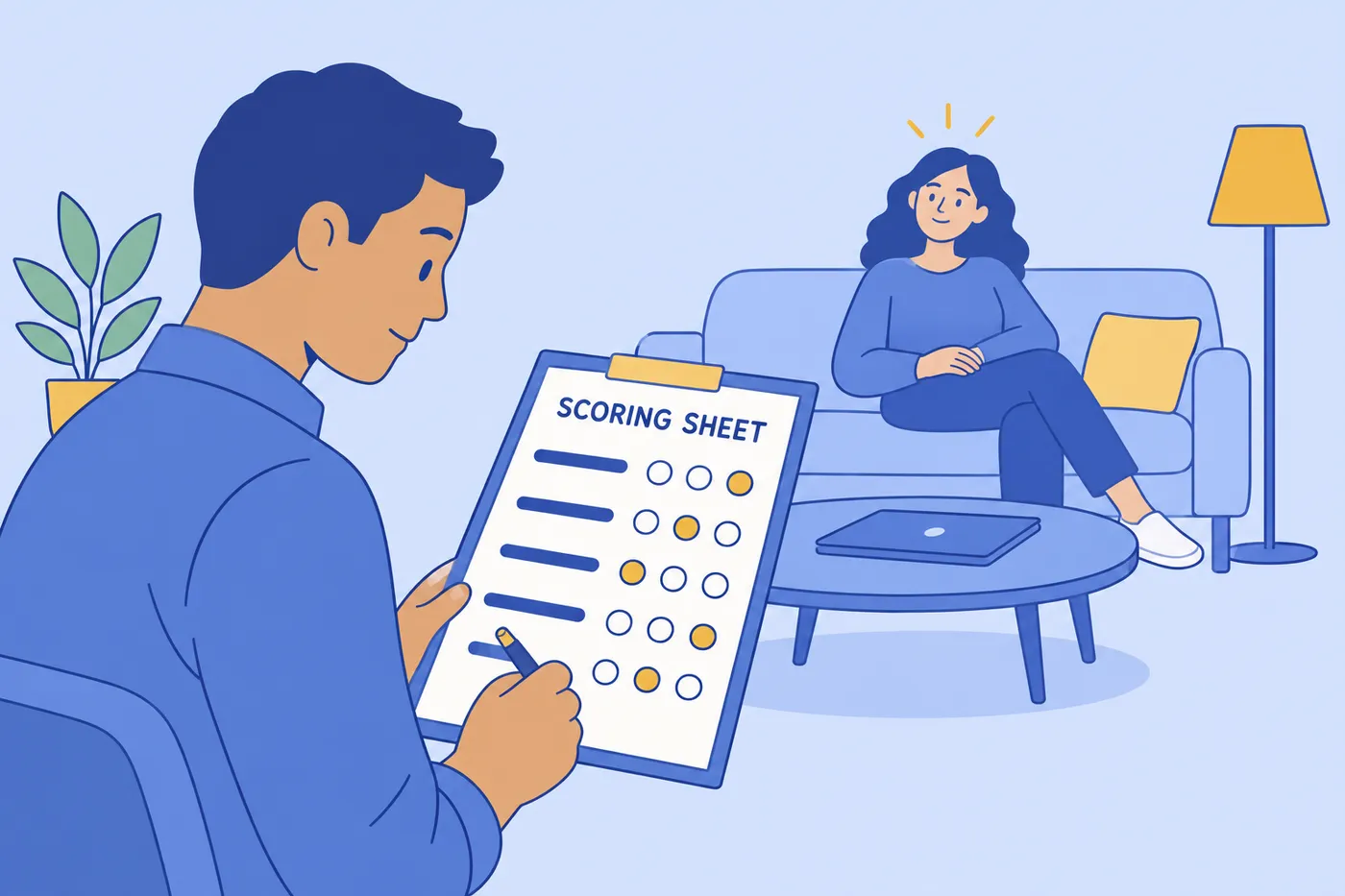
| Criterion | A 1 sounds like | A 2 sounds like | A 3 sounds like |
|---|---|---|---|
| Answered the question asked | Talked around it or answered a different question | Got there eventually, after a detour | Addressed the exact question in the first sentence |
| Specific example | Spoke in generalities ("I always try to...") | Named a situation but stayed vague on the details | Named the project and the people, and made the candidate's own part clear |
| Clear result | No outcome mentioned at all | An outcome, but fuzzy ("it went well") | A concrete result, with a number or a verifiable change where one exists |
| Relevance to this job | No connection to the posting | Related, but the link was left for the interviewer to make | Tied the example to a requirement in the posting explicitly |
| Length and delivery | Under 30 seconds or past three minutes, with heavy filler | Right length but rambling or monotone | Runs 60 to 120 seconds and stays structured and conversational |
Turning the totals into three fixes
After the session, read the sheet two ways. Down the columns first: the criterion with the lowest average is a habit, and habits need a drill, not a pep talk. If "clear result" averages low, the drill is rewriting every story until it ends with an outcome sentence. Then across the rows: the single lowest-scoring answer is the one to redo on the spot during the feedback talk.
Commit to exactly three fixes before the real interview. One rebuilt answer, from the worst row. A drill for the weakest habit, from the worst column. And a single delivery change taken from the length-and-delivery scores, such as cutting answers to under two minutes or dropping one filler word. Three is deliberate; a page of feedback fixes nothing.
Build a mock interview from a real job posting
A generic mock rehearses generic answers. The version that actually moves your interview performance is built from the posting you applied to, and writing it takes about twenty minutes.
- Paste the job description somewhere you can mark it up, and pick the five requirements that appear earliest, get repeated, or sit in the job title. Those five carry the interview.
- For each requirement, write one behavioral question ("tell me about a time you...") and one situational question ("what would you do if...").
- Match each requirement to a proof point on the candidate's resume: the bullet or project the answer should be built around. If no proof point exists, that is a finding in itself, because the real interviewer will find the same hole.
- Add the two openers from the script plus "do you have any questions for us," and you have a tailored thirteen-question mock.
Here is the method worked end to end for a fictional posting: a customer success associate at a mid-size software company. The five requirements pulled from the description are owning onboarding for new accounts, driving renewals and reducing churn, handling escalations, working in Salesforce daily, and turning customer feedback into product requests.
| Requirement from the posting | Behavioral question | Situational question | Resume proof point |
|---|---|---|---|
| Own onboarding for new accounts | Tell me about a time you taught someone a process or product from zero. | A new customer has not logged in two weeks after kickoff. What do you do? | A training bullet from any prior job: onboarded new hires, wrote the guide they used |
| Drive renewals and reduce churn | Tell me about a time you kept a customer who was about to leave. | A customer says they are evaluating a competitor at renewal. Walk me through your next call. | Any retention or repeat-business bullet, even from a non-software job |
| Handle escalations | Tell me about the angriest customer you have dealt with and how it ended. | A customer emails your CEO directly about a bug you already knew about. What happens next? | The de-escalation story behind a support metric on the resume |
| Work in Salesforce daily | Tell me about a tool you learned on the job and how you got fluent. | You notice stale account data in the CRM is skewing reports. What do you do? | The systems line in the skills section, backed by one bullet showing real use |
| Turn feedback into product requests | Tell me about a time you carried a customer's problem to another team and pushed it through. | Three customers report the same friction this week. What do you do with that? | A cross-team bullet showing information moved across a boundary and something changed |
Notice what the third column does: it turns the mock into resume practice too. Every answer in the real interview should be anchored to something the interviewer can see on the page in front of them, because the resume is the script the interviewer works from.
Mock interview formats, and where to find a partner
Match the mock's format to the real interview's format, because each one fails differently.

- Phone screen: 15 to 20 minutes, voice only. Practice sounding engaged with no face to react to; energy drops noticeably on the phone and the candidate rarely hears it themselves.
- Video interview: run the full 30-minute script on the platform the real interview will use. Check the eye line and practice a two-second pause before answering to cover audio lag. Some employers now run automated video screens with no human on the other end, so answering to a silent camera is worth practicing at least once.
- Panel: two interviewers alternate questions from the script while a third person scores. Practice answering the person who asked while including the other with your eyes.
- Technical or case mock: pair the behavioral core of the script with one real exercise from the role. Engineers can also book peer mock interviews through platforms like Exponent or interviewing.io for the technical round itself.
Free mock interviews exist in more places than most job seekers check. College and university career centers run them for students and often for alumni, so call yours even years after graduating. American Job Centers, the public workforce offices across the US, list interview practice among their free services at many locations. A mentor or a former manager is often the best interviewer you can get, because they will probe harder than a friend will. Availability varies by location and season, so confirm the service is currently offered before you plan around it.
Solo interview practice when there is no partner
No partner does not mean no mock. The solo version trades a live interviewer for a camera, and it works if you keep the scoring honest.
- Shuffle the question bank and pull twelve, so you cannot pre-load answers in order.
- Record video answers on your phone, sitting or standing the way you would in the real interview. One take per question, no restarts.
- Watch the playback with the scoring sheet beside you and score every answer on all five criteria. Scoring your own recording feels brutal the first time; that is the point.
- Redo the weakest answer three times, watching each take before recording the next.
- Keep every answer between one and two minutes. Under one minute usually means no example; past two usually means no structure.
The gap in solo practice is that nobody asks the follow-up probe, and the probes are where real interviews are won. Remi, the career copilot in Roleframe, closes part of that gap. It reads your actual resume and, on a version tailored to a job, the posting attached to it, then runs a practice round one question at a time and scores what it hears, flagging the thin spots. Because the questions come from your own experience and the job you are chasing, it sits closer to the tailored mock above than to a generic question app.
The feedback talk after the mock
The ten minutes after the mock decide whether it was worth running. Skip the vague "that was pretty good" debrief and run this order instead.
- The interviewer starts with the strongest answer and names exactly why it worked: "you opened with the result, and the example matched the requirement." This sets the standard the other answers get measured against.
- Next comes the one answer to redo, chosen from the scoring sheet's lowest row. Explain the scores, then hand the moment back: the candidate redoes that answer on the spot, cold, before the feedback fades.
- Then one habit to change, from the lowest-scoring column. One. The second-worst habit waits for the next session.
- Book the second mock three to five days out. A single rehearsal helps, but the real improvement shows up between the first session and the second, once the fixes have had a few days to settle.
Treat the mock as one piece of wider preparation rather than the whole plan. The full week-out sequence, from company research to logistics, is in how to prepare for an interview.
Frequently asked questions
- What are the common questions in a mock interview?
A good mock mirrors a real first-round interview: two openers ("tell me about yourself" and "walk me through your resume"), a motivation round like "why do you want this job," four behavioral "tell me about a time" questions, one or two role-specific questions pulled from the posting, a curveball, and "do you have any questions for us." The 30-minute script at the top of this page puts twelve of them in the order a real interviewer asks.
- How long should a mock interview run?
Thirty minutes of questions plus ten minutes of feedback is the standard session, and it matches the length of most real first-round interviews. Cut it to 15 or 20 minutes when rehearsing a phone screen. Running past 45 minutes of questions rarely helps, because both answer quality and scoring attention drop.
- What are the 5 P's of an interview?
Proper preparation prevents poor performance. It is a memory aid rather than a method, so the working version of it is a mock interview: preparation you can time, score, and repeat. One scored rehearsal does more than any acronym.
- What are the 10 best interview questions to practice?
If you only practice ten, use these: tell me about yourself; walk me through your resume; why do you want this job; why should we hire you; what is your greatest strength; what is your greatest weakness; tell me about a time you solved a difficult problem; tell me about a conflict with a coworker; tell me about a mistake and what you did about it; do you have any questions for us. That set covers every round of the script above and shows up in some form in nearly every interview.
- What are the 5 hardest interview questions?
The five that produce the most bad answers are the greatest weakness, the employment gap, a real failure, why you were let go, and salary expectations. They are hard because they demand honesty and composure at the same time, and an unrehearsed answer tends to either overshare or dodge. Practice each with a follow-up probe, since the probe is where a shaky answer collapses.
- Should a mock interview be recorded?
Only with the candidate's consent, agreed before the session starts. The playback is worth it: delivery habits like filler words and trailing sentence endings are far easier to hear on a recording than to notice live. Delete it after the review if the candidate wants it gone.
- How many mock interviews should I do before the real one?
Two, spaced three to five days apart, is the minimum that shows measurable improvement on the scoring sheet. The first session surfaces the problems and the second confirms the fixes held. Before a high-stakes final round, add a third focused only on the weakest round from your sheet.

Ready to start your new resume?
Writing a resume takes time, and even a polished one can miss what a hiring manager is looking for. Roleframe helps you build a clear, ATS-safe resume in minutes and tailor it to the job you want.


