Phone Interview Questions Recruiters Ask, With Sample Answers
Prepare for 12 possible phone interview questions with fictional sample answers, a call-sheet checklist, and official guidance for checking recruiter scams.


On this page
A phone interview may cover qualifications, motivation and practical details such as availability and location. Some calls are brief recruiter screens; others include technical or behavioral questions. Confirm who is calling, how long the meeting is scheduled for and what format to expect.
The twelve questions below are preparation prompts, not a universal recruiter checklist or a claim about their frequency. Use the job description and interview invitation to decide what else to prepare.
- Are you still interested in the role?
- Walk me through your background.
- Why are you looking to leave your current job?
- Why this company?
- What do you know about the role?
- When could you start, and what's your availability for interviews?
- Where are you located, and does the commute or remote setup work?
- Are you authorized to work here, and will you need sponsorship?
- What are your salary expectations?
- What's your notice period?
- Are you interviewing anywhere else?
- Do you have any questions for me?
The page offers a fictional example answer to each question, a suggested opening, a call-sheet checklist and guidance for checking suspicious recruiter contact. Use your own facts rather than borrowing the candidate’s history.
What the screener is actually checking
Prepare to explain how your background fits the vacancy, why the role interests you and any practical constraints that affect it. A recruiter may also ask about skills or examples of your work; do not assume that all substantive questions wait until a hiring-manager round.
The National Careers Service’s phone interview guidance recommends researching the employer, reviewing the job description and your application, and preparing relevant examples. The interview invitation is the best place to confirm the call’s purpose and expected duration.
Prepare factual answers about location, schedule, start date and any relevant work-authorization requirement. If an interviewer asks something you do not understand, ask what they need to establish rather than guessing or over-disclosing personal information.
The 12 questions answered, phone-screen length
Dana is a fictional accounts-payable specialist applying to a fictional larger finance operation. All employers, responsibilities, dates, counts and outcomes in the sample answers are illustrative. Replace them with your own record. Keep logistics answers short; give a work-example question enough detail to explain your contribution and result.
1. Are you still interested in the role?
This is a real question, since recruiters call candidates who applied weeks ago or never applied at all. Confirm, and add one specific reason.
Dana: "Yes, I'm interested. The posting stood out because it's a higher-volume AP operation than the one I run now, and that's exactly the step I want next."
2. Walk me through your background
For a background question, connect your current or recent work to this vacancy. A useful structure is role, scope, relevant contribution and reason for the next move. Around a minute is a practice target, not a required limit. See answering “tell me about yourself”.
Fictional Dana: “I’m an accounts-payable specialist at a regional distributor. Over five years I moved from invoice entry into vendor reconciliations and month-end close support. I’m interested in this position because it combines that work with a larger finance operation.”
3. Why are you looking to leave?
Give a brief, truthful reason for your move and connect it to what you are seeking. You do not have to praise an unsuitable situation or conceal a layoff; keep the account factual and avoid sharing confidential details.
Fictional Dana: “I have developed broad responsibilities in a small finance team, and I’m now seeking a role with deeper systems exposure and a larger AP operation.”
4. Why this company?
One specific fact about the company plus one honest reason it fits your plan. "I saw the posting online" is an answer to a different question.
Dana: "You're processing at a scale my current company doesn't reach, and the posting mentions an ERP migration. I want to be part of a team that's modernizing its AP process rather than one that finished years ago."
5. What do you know about the role?
The recruiter is checking that you read the posting. Name the two or three responsibilities it emphasizes, then flag your match to one of them.
Dana: "From the posting, it's full-cycle AP with a focus on three-way matching and vendor dispute resolution, reporting to the AP manager. The dispute side is where I've spent most of my last two years, so that part drew me in."
6. When could you start, and what's your interview availability?
Check your real availability and obligations before giving a date. Offer interview windows you can keep, with a time zone. If you need to verify a notice period or commitment, say when you can confirm rather than inventing certainty.
Fictional Dana: “I expect to be available about three weeks after agreeing an offer, subject to confirming my current notice obligations. For another interview, I can do Tuesday before 9 a.m. or Thursday after 4 p.m., Eastern time.”
7. Location, commute, or remote setup
State your actual location and whether the advertised workplace arrangement fits. If the posting is unclear about onsite days or relocation, ask. Do not assume that a role described as remote has no location restrictions.
Fictional Dana: “I’m based near the office and can work the three onsite days described in the posting. Could you confirm whether that pattern is fixed?”
8. Work authorization
In a US hiring context, the Department of Justice’s employer FAQ says employers can generally ask whether an applicant has the right to work and whether visa sponsorship will be needed. Answer according to your own status; the fictional response below is not wording to copy if it is untrue.
Fictional Dana: “I am authorized to work in the US and do not need sponsorship.”
Work-authorization requirements differ by jurisdiction and situation. Clarify the question if needed rather than guessing about your status or sending sensitive identity documents to an unverified contact.
9. Salary expectations
The recruiter needs to know you fit the budgeted range. You don't have to name a number first; asking for their range is a normal, professional move, and the full strategy is in our guide to answering the salary expectations question.
Dana: "I'd like to learn more about the full scope before naming a figure. Could you share the range budgeted for the role? I can tell you right away whether we're in the same territory."
10. Notice period
State the notice period that actually applies to you and any confirmed constraint on availability. Two weeks is not a universal rule. Keep private details private; explain only what the employer needs to understand your possible start date.
Fictional Dana: “My current notice requirement is two weeks. I would confirm an exact start date with you before making a commitment.”
11. Are you interviewing elsewhere?
Be honest about other processes or deadlines if you choose to share them. You can discuss timing without naming employers. Do not invent competing offers or promise that one employer will accelerate its process.
Fictional Dana: “I’m in early conversations elsewhere and do not currently have an offer deadline. I’ll let you know if a confirmed timing constraint develops.”
12. Do you have questions for me?
Prepare a few questions and ask the ones still unanswered when time is offered. Process, role priorities and next steps can be useful topics. If the interviewer has already covered everything, say that and confirm a useful next-step detail instead of asking a redundant question.
Fictional Dana: “Could you tell me the next step and who I would meet? Is there anything about my experience you would like me to clarify before we finish?”
What to say first on a phone interview
A clear opening is enough: “Hello, this is Dana.” After the caller introduces themselves, confirm the role and meeting: “Thank you for calling about the AP specialist position.” Follow their opening rather than launching immediately into a long pitch.
If you are calling them, state your name and the agreed purpose: “This is Dana Reyes calling for our scheduled interview about the accounts-payable position.” These names and details are fictional examples.
If an unexpected call arrives when you cannot speak privately, ask to schedule it. For example: “Thank you for reaching out. I’m not somewhere I can discuss this properly. Could we arrange a time, and could you send the role and your contact details?” Verify an unfamiliar recruiter through independent company contact information before sharing sensitive information.
Brief screen or deeper phone interview: confirm the format
The length and content vary. A short call may prioritize qualifications and practical details, while a longer discussion may explore examples and methods, but either can contain both. The comparison below shows possible emphases rather than rules. Use the confirmed invitation and ask if you need more detail.

| Question area | Possible emphasis in a brief screen | Possible emphasis in a deeper interview |
|---|---|---|
| Background | Brief relevant summary | Experience walkthrough and follow-ups |
| Motivation | Reasons for applying or moving roles | More detail about interests and job fit |
| Skills | Qualifications and selected examples | Methods, tools, reasoning and evidence |
| Behavioral | A short example may be requested | Several examples or follow-up questions may be requested |
| Logistics | Availability, location, pay or other requirements | Any unresolved practical details |
| Your questions | Choose the highest-priority unanswered question | Explore work, expectations and process within the time offered |
Adjust the preparation to the job. For nursing, accurately state your license or application status, relevant settings and shift availability; confirm requirements with the employer and regulator. See nursing interview questions for more.
For customer service, prepare real examples of customer communication, schedule requirements and systems use; the customer service interview guide has prompts. For a technical role, prepare the methods and tools you list, even if the invitation describes a recruiter screen. No job title guarantees a particular question mix.
Red flags: is this recruiter call real?
Be cautious when an unfamiliar contact quickly requests money or sensitive information. The US Federal Trade Commission warns about fake recruiters who send official-looking offers and press for financial information before explaining the job. A plausible profile, company name or offer document is not proof of identity.
Pause and verify the contact independently if you see warning signs. Do not pay for a job or a promise of employment. Do not send bank or government-identifier details to an unverified recruiter.
- An early request for bank details, government identifiers or “onboarding” documents before a credible hiring discussion.
- A demand for payment, or a check you are told to deposit and then partly send elsewhere.
- Pressure to share sensitive information or commit immediately while basic job questions go unanswered.
- A personal email or chat-only contact presented as a major employer’s official recruiting channel.
- An identity or role that you cannot verify through an independently found employer contact.
Find the company’s official site yourself and use its published recruiting or main contact channel to confirm the person and vacancy. Do not rely solely on links, phone numbers or profiles supplied by the caller. A warning sign is a reason to investigate, not a guarantee that every similarly named contact is fraudulent.
The FTC’s job-scam guidance explains payment and fake-check schemes. Review official guidance before sending anything further when the process appears suspicious.
Your one-page phone interview call sheet
If notes are permitted, keep a short prompt sheet beside your resume and the posting. Use keywords rather than a script so you can listen and answer the question actually asked. Follow any instructions about closed-book assessments or outside assistance.
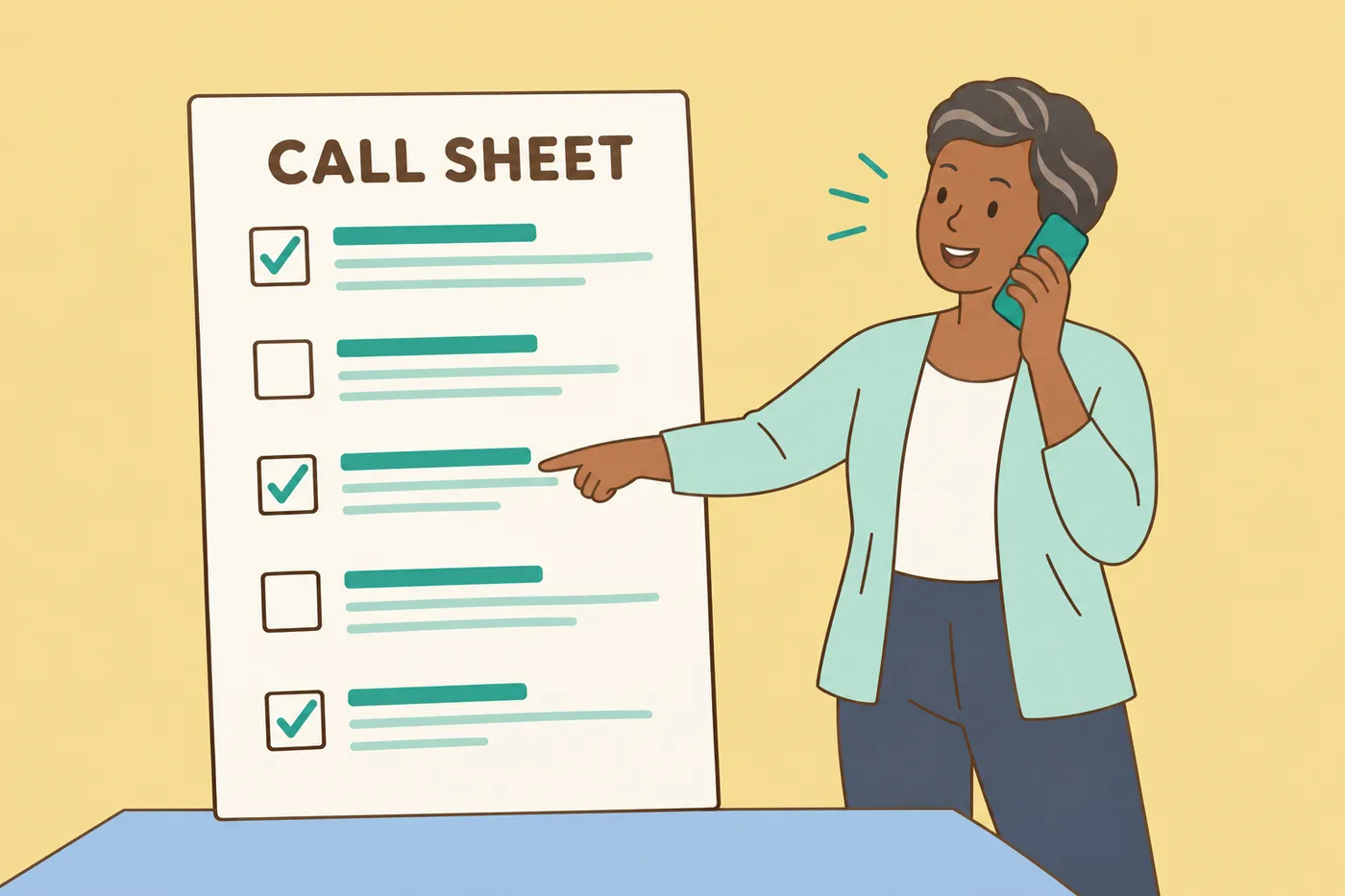
| Call sheet section | What to write |
|---|---|
| The job | Job title, company name, the posting (printed or open), and the two requirements it repeats most |
| Three proof stories | Brief examples of your actual actions and results; use verified numbers only where relevant |
| Salary | Your researched expectations and questions about the role’s budgeted range |
| Availability | Confirmed constraints, actual notice obligations, and interview windows with a time zone |
| Logistics | Your commute or remote answer, and your work authorization answer, each one sentence |
| Two questions | Next steps and timeline, plus one about the team's biggest need right now |
| The interviewer | Their name and title, written large enough that you cannot forget it mid-call |
Delivery matters as much as content on the phone:
- Choose a position in which you can speak comfortably; standing is optional.
- Test the connection, charge your phone, reduce interruptions and use a quiet location where possible.
- Leave a short pause so the interviewer can respond. Ask for a repeated question or better audio if needed.
- Listen to a practice recording if useful and adjust clarity and pace. You do not need to force a particular vocal style.
Questions to ask the recruiter on the call
Prepare a few relevant questions and select the highest priority ones that remain unanswered. Possible topics include the next stage, the role’s priorities and the practical conditions you need to understand.
- What are the next steps, and what's the timeline for a decision?
- Who is the hiring manager, and what's the format of the next round?
- Can you share the pay range for the role, if it hasn't come up yet?
- What's the team's biggest need right now, the thing this hire has to fix first?
A recruiter may be able to answer role-specific questions or may suggest discussing them with the hiring manager. Ask rather than assuming they cannot help. More options appear in questions to ask during an interview.
After the call: record what you learned and prepare next steps
Before the call, rehearse a few relevant answers out loud without memorizing the fictional sample. Afterward, record what you were asked, what the employer explained and any agreed next step. If a follow-up date passes, send a brief process question through the agreed channel.
Prepare specific examples for any deeper interview that follows. The interview preparation guide can help you organize them. You can also use Remi for practice with your resume and linked role where available; review generated feedback critically and keep every experience claim true.
Frequently asked questions
- Which answers should I prepare for a recruiter call?
Prepare a relevant background summary, reasons for applying, actual availability and constraints, and a few examples that show the job requirements. The question mix varies; a recruiter call can include behavioral or technical content as well as logistics.
- How do you ace a 30-minute phone interview?
Confirm who is calling and the scheduled format, research the job, and practice explaining relevant experience. Use a quiet place and short notes if allowed. Listen, ask for clarification when needed, and leave time for important unanswered questions. No preparation method guarantees an offer.
- How long should a phone interview answer be?
Make a logistics answer as short as it needs to be. A background summary may take about a minute, while a behavioral example may need longer to explain the situation, your action and the result. Treat those as rehearsal targets and follow the interviewer’s time guidance.
- Do behavioral questions come up in phone screens?
Yes, they can. Have real examples of collaboration, prioritization, a difficulty or an improvement ready, even for a brief recruiter call. Do not assume a label such as “screen” rules out a substantive question.
- Should you ask about salary in a phone interview?
It is reasonable to ask about the budgeted range when pay fit matters or the interviewer raises it. You can say you would like to understand the role’s scope and range before giving an expectation. Use researched figures and your actual constraints; do not invent a competing offer.
- How should you end a phone interview?
Thank the interviewer, state your interest if it remains genuine, and ask about the next step and expected timing. Confirm any information you agreed to provide. A short follow-up can refer to a specific point from the conversation without repeating the whole interview.



Ready to start your new resume?
Writing a resume takes time, and even a polished one can miss what a hiring manager is looking for. Roleframe helps you build a clear, ATS-safe resume in minutes and tailor it to the job you want.


