Group Interview: How to Prepare, What to Say and How to Practice
Prepare for a group interview with a practice task, sample contributions, ways to handle disagreement and a collaboration checklist.

On this page
A group interview brings several candidates together for questions, a discussion or a shared task. Interviewers can observe how you explain an idea, listen to others and help a group reach a decision. The invitation should tell you what format to expect; ask the organizer if it is unclear.
Prepare individual answers, then practice the interactions too: making a concise point, inviting another person’s view and summarizing a decision. This guide includes a fictional practice brief and a self-review rubric you can use with friends.
Group interview vs. panel interview: which one did you get invited to?
Employers sometimes use “group interview” to describe different arrangements. A candidate-group interview includes several applicants; a panel interview usually means one applicant meeting several interviewers. Confirm which arrangement the invitation means before choosing how to practice.
| Group interview | Panel interview | |
|---|---|---|
| Who is in the room | Several candidates, one or more interviewers | One candidate, two or more interviewers |
| What is tested | How you interact with peers: collaboration, listening, communication under social pressure | Your individual answers, seen from several perspectives at once |
| Typical formats | Same questions answered in turn, a group discussion, or a shared task | Structured question rounds, often with each panelist owning a topic |
| Core skill to practice | Contributing concisely while making the group better | Answering the person who asked while keeping the whole panel engaged |
In a panel, begin your answer with the person who asked, then include the other interviewers naturally. In a candidate-group exercise, pay attention to your peers as well as the assessors. The rest of this guide focuses on that candidate-group format.
Confirm the format before you prepare anything
Some sessions ask each candidate questions in turn; others include a shared project or discussion. Confirm the format so you can prepare for the actual task. You can ask the scheduler:
- How many candidates will attend, and roughly how long is the session?
- Is the format individual questions, a group discussion, or a shared task or exercise?
- Will any materials, case information or props be provided, and should we bring anything?
- If virtual: which platform, and will we be in one room or breakout groups?
For a video session, confirm the platform and whether you will use breakout rooms. Practice verbal hand-offs such as “Dana, what’s your view?” so people can contribute without talking over one another.
For a broader preparation timeline, see how to prepare for an interview.
What interviewers are actually scoring
A useful preparation goal is to contribute clearly while helping others contribute. Avoid assuming that the person who speaks most will perform best. Actual assessment criteria vary by employer and exercise.
Practice observable behaviors: explain a position with a reason, refer accurately to another person’s point, invite a different view and help the group reach a conclusion within the time available. These behaviors provide evidence of collaboration without requiring you to dominate the discussion.
A practice brief you can run this week
This fictional exercise and the rubric below are practice aids, not a real employer’s assessment or a validated hiring test.
The brief. You and three other candidates are a temporary team at a fictional 12-store coffee chain. Weekday afternoon sales have dropped. You have 20 minutes to choose one option: a loyalty punch card, a 3 to 5 p.m. drink discount, or a nearby coworking-space partnership. Present your recommendation with two reasons and one uncertainty you would investigate. There is no predetermined correct choice.
Practice with friends. If everyone agrees to being recorded, watch the recording together and note specific moments where you helped or interrupted the discussion.
Four candidates, four very different sessions
Here is how four fictional candidates might play the same 20 minutes. Each illustrates a different way of participating.
Marcus talks first, most, and over people. He opens with "Easy, it's the discount" before anyone has framed the problem, restates his point whenever someone else finishes, and treats Dana's one attempt to speak as a pause to talk into. His individual reasoning is fine. His effect on the group is that two of the three options never get a fair hearing.
Dana barely registers. She has thought about the coworking partnership and has the best point in the room about recurring weekday traffic, but she waits for a silence that never comes. By minute 15 she has said eleven words. Interviewers cannot score reasoning they never heard.
Priya has good ideas and connects none of them. She makes two sharp, self-contained points, then stops engaging. She never responds to what others said, never builds, never signals agreement or disagreement. On paper she contributed. In the room she worked alone, in parallel with a team.
Leo makes the group work. He contributes one clear position early ("I lean punch card, because rewards can be tied to repeat purchases, although printing and administration still have costs"), then spends the rest of his airtime on the group: "Dana, you mentioned coworking, what's the case?" At minute 14 he checks the clock out loud: "Six minutes left, we have two options with support, can we pick?" At the end he summarizes: "So we're recommending the coworking partnership, because it brings new recurring traffic rather than discounting existing customers, with the punch card as a fallback. Everyone comfortable?" He did not talk the most. He gives observers concrete examples of collaboration.
The collaboration rubric, explained
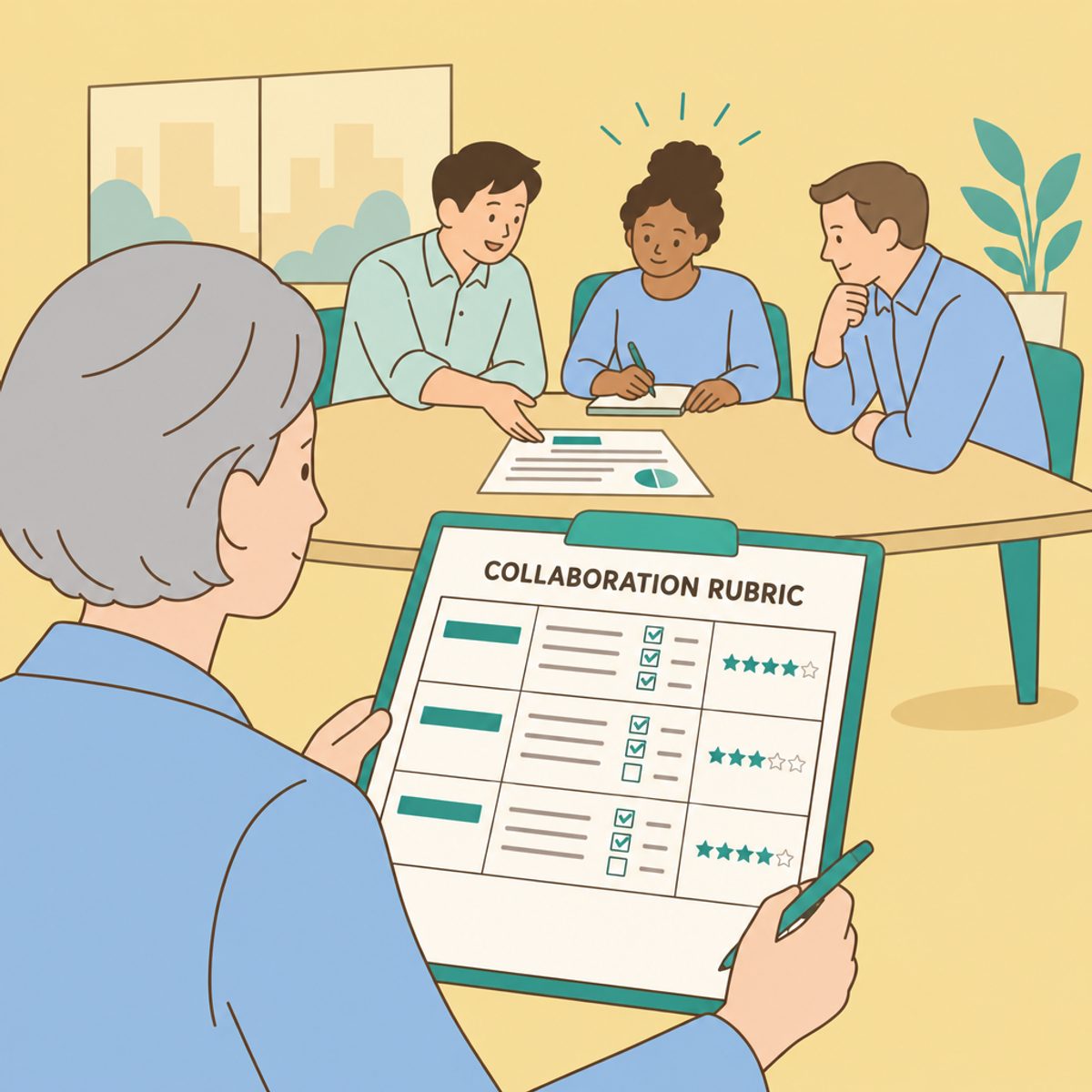
Use these five dimensions to discuss your practice session. This is an editorial self-review checklist, not a scoring sheet used by a particular employer or a prediction of hiring success.
| Dimension | Weak signal | Strong signal |
|---|---|---|
| Contribution quality | Vague agreement ("yeah, good point") or long monologues | A clear position with a reason, in under 30 seconds |
| Listening and building | Points that ignore what was just said (Priya) | References others by name: "Building on Dana's point about recurring traffic..." |
| Inviting input | Speaking only when you have something to say (and letting Dana stay silent) | At least one genuine hand-off to the quietest person in the room |
| Handling disagreement | Repeating your point louder, or folding instantly | Naming the trade-off: "The discount is faster, the partnership is more durable. Which matters more here?" |
| Decision discipline | The group runs out of time with no conclusion | Someone tracks the clock and someone summarizes the decision. Be one of them. |
Use the fictional session to identify observable behaviors. Marcus interrupts and narrows discussion; Dana’s reasoning is not heard; Priya contributes ideas without responding to others; Leo invites input and helps summarize a decision. Discuss what each person could change in the next practice run. These observations are not predictions of an employer’s scores.
The three moves worth scripting in advance
You cannot script a group discussion, but you can script the three moves that carry the rubric. Practice saying each out loud until it stops sounding rehearsed. These are first-person lines to adapt, not to recite.
Contributing a point. Position first, reason second, stop. "I'd go with the coworking partnership. It brings in new weekday customers instead of giving a discount to people already coming." Two sentences. If your point needs a third, it is usually two points.
Inviting input. Name the person and give them a real question, not a courtesy. "Dana, you work in retail now, right? Does the punch card actually change behavior in your experience?" A genuine invitation gives the group access to an idea it might otherwise miss.
Summarizing a decision. Decision, reasons, confirmation. "So the recommendation is the partnership, for the new recurring traffic and because it protects margin. Any objections before we lock it?" Whoever says this sentence is the person who turned a conversation into an outcome. Offer a summary when the group needs one.
These are communication skills with a long shelf life beyond the interview; the worked examples in our guide to communication skills at work cover how to evidence them afterward.
Disagreement, and the Marcus problem
Disagreement is a scoring opportunity, not a hazard. The weak responses are the two extremes: repeating yourself with more force, or abandoning your position the moment someone pushes back. The strong response names the trade-off and puts it to the group. "Both options have a case. The discount moves numbers this month, the partnership compounds. I think the brief is asking about the longer fix, but I'd want the group's read." You have disagreed, shown reasoning, and made the next contribution easier for everyone else.
A dominant participant is a different problem, and the trap is competing for every sentence. If you match Marcus interruption for interruption, the observers see two people who cannot collaborate instead of one. Three better options, in escalating order:
- Enter at the first natural pause with a build, not a counter: "Taking Marcus's point about speed, the question is what happens after the discount ends."
- Redirect the floor: "Before we settle it, I'd like to hear from the two people who haven't weighed in." That gives quieter participants a chance to contribute.
- Use the clock: "We have eight minutes and one option we haven't discussed. Can we give the punch card three of them?" A time check can help the group decide how to use its remaining minutes.
Notice what none of these do: tell Marcus he is talking too much. The observers can see that without your help. Your job is to make the group function despite him, which is precisely the skill a customer-facing or team-heavy role needs.
Group interview questions to practice individually
A group interview may include individual questions in addition to a shared exercise. Two clusters matter more here than in a standard interview.
Questions about the exercise you just did. "What did you contribute to the discussion?" and "What would you do differently?" are useful debrief questions to practice. Answer with specifics, not virtues: "I proposed the partnership option and I brought Dana in when I noticed she hadn't spoken, which changed the recommendation." If you ran the practice brief above, you already have this vocabulary.
Standard collaboration prompts. Expect variants of these, each answerable with a structured story:
- Tell us about yourself, in under a minute (the group format punishes rambling harder than any other)
- Describe a time you worked on a team where someone wasn't pulling their weight
- Tell me about a disagreement with a colleague and how it was resolved
- Describe a time you changed your mind because of someone else's argument
- When have you led without having the title?
Build each answer as a specific situation, your action and the result. Our guides to behavioral interview questions and the STAR method walk through constructing these from your real experience, which matters here: in a debrief, interviewers can compare your claimed teamwork story against the teamwork they just watched. The two need to match.
Practice these out loud, not in your head. If you want a practice partner that works from your actual background, Remi, the career copilot in Roleframe, runs interview practice built from what is on your resume: it asks a question at a time, you answer, and it tells you where an answer was thin.
After the session: reflect on evidence, not vibes
Within an hour of the interview (or your practice run), while the session is fresh, fill in a short observation checklist. Memory of group situations is flattering; evidence is not.
- How many substantive points did I make, and can I state each in one sentence?
- Did I reference anyone else's point by name? Whose?
- Did I invite anyone in? Did anyone stay silent the whole session?
- When someone disagreed with me, what exactly did I say next?
- Who summarized the final decision? If nobody, why wasn't it me?
- What is the one behavior I would change in the next session?
Repeat the exercise and choose one behavior to improve each time. Then close the loop on the application itself: a same-day thank-you email that references something specific from the group discussion can acknowledge something specific you learned during the session.
Frequently asked questions
- What is the point of a group interview?
The format lets interviewers observe how candidates communicate and work with others, alongside their individual answers. The purpose and criteria vary, so confirm whether your session includes questions, discussion or a shared task.
- Is a group interview a good sign?
The invitation tells you the employer wants to assess you in that format. It does not reliably indicate your ranking, the number of vacancies or your likelihood of receiving an offer. Prepare for it as a substantive interview.
- How do you handle a group discussion in an interview?
Listen first, then contribute concise points with a reason attached, build on what others said by name, and invite quieter participants in. Disagree by naming the trade-off rather than repeating yourself, and help the group reach an actual conclusion before time runs out. Employers assess communication, teamwork, listening, critical thinking and problem-solving in these discussions, so helping the group work beats trying to win it.
- What group interview questions should I expect?
Three types: individual round-robin questions (a short self-introduction, why this role), collaboration-focused behavioral questions (a team conflict, a time you changed your mind, leading without a title), and debrief questions about the exercise itself, such as "What did you contribute to the discussion?" Prepare the debrief answers in advance by deciding which behaviors you want to be able to point to: a clear proposal, a hand-off to a quiet participant, or the final summary.
- How is a group interview different from a panel interview?
A candidate-group interview includes several applicants. A panel interview usually includes one applicant and several interviewers. Because employers may use the terms loosely, ask the organizer to confirm who will attend and how the session will run.
- How early should I arrive for a group interview?
Earlier than you would for a one-on-one, because the session starts on a fixed schedule for everyone and a late arrival disrupts the whole group. Arriving with a buffer also gives you a chance to meet the other candidates informally, which makes using their names in the discussion natural. See our guide on how early to be for an interview for the specifics.
- What is the biggest red flag to hear when you are the one being interviewed?
There is no single universal red flag, but the most serious pattern is vagueness about essential conditions: duties, pay, hours, reporting lines, or why the vacancy exists, especially when different interviewers give inconsistent answers. In a group interview specifically, watch how the facilitators treat candidates, since a disorganized or dismissive session often reflects how the company runs teams. Verify any concern with specific follow-up questions and compare the answers against the written posting.
Ready to start your new resume?
Writing a resume takes time, and even a polished one can miss what a hiring manager is looking for. Roleframe helps you build a clear, ATS-safe resume in minutes and tailor it to the job you want.


