Decision-Making Skills: Examples, Methods and Evidence
Decision-making skills explained with observable examples, a worked decision matrix, a self-assessment, and resume bullets you can defend in interviews.

On this page
Decision-making skill means choosing an action in light of a goal, alternatives, evidence, constraints and a deadline. A useful way to demonstrate it is to explain a real choice: what you considered, why you chose it and what you learned afterward.
Most pages on this topic hand you a list of adjectives. This one does something different. For each example you get the observable action, the artifact you could show someone, and the interview follow-up it invites. Then a worked decision matrix, a self-assessment, a practice plan, and resume bullets built from real decision records rather than claims.
What decision-making skills are, and where they apply
Decision-making involves comparing options, weighing trade-offs and selecting an action. Incomplete information adds uncertainty, but even with strong evidence a choice may involve conflicting priorities or values.
Critical thinking helps you examine assumptions and evaluate the evidence. Decision-making applies that work to a choice, identifies who owns it and sets a condition for reviewing it.
The structure can apply at different levels: a warehouse associate choosing which delayed order to escalate, or a director comparing suppliers. Use relevant information such as delivery dates, costs, capacity and stakeholder needs, and state what remains uncertain.
It is a transferable skill that can produce concrete evidence: an options memo, a decision matrix or a follow-up review.
Decision-making skills examples: observable actions, not adjectives
"Strong decision-maker" on a resume proves nothing. An interviewer cannot check an adjective, so they discount it. What they can check is behavior: what you did, what it produced, and whether you can answer the follow-up question it invites.
The matrix below maps five behaviors that make up practical decision-making at work. For each: the task, the action someone could watch you do, the artifact you could share, and the follow-up an interviewer will likely ask. If you can fill a row from your own work, you have evidence. If you can fill three, you have an interview answer and a resume bullet.
Use work records only with permission. Redact confidential details or describe the example instead of sharing the original artifact.
| Task | Observable action | Shareable artifact | Likely interview follow-up |
|---|---|---|---|
| Comparing alternatives | Lists at least two real options, including "do nothing," with the criteria that separate them | A short options memo, or the comparison tab of a spreadsheet | "Why did you reject the runner-up?" |
| Prioritizing criteria | Weights the criteria before scoring options, and writes down why cost outranks speed (or the reverse) | The weighted matrix, with a dated note explaining the weights | "Who set the weights, and did anyone push back?" |
| Assessing reversibility | Labels the choice as easy or hard to undo, and sizes the process to match | A one-line risk note: what reversing costs, and what would trigger it | "What would have made you reverse it?" |
| Consulting affected people | Asks the people who will live with the outcome before deciding, and records what their input changed | Meeting notes or a message thread where feedback altered an option or a weight | "Whose input changed your mind, and how?" |
| Reviewing the outcome | Compares the result against what was predicted, and writes down the lesson | A follow-up note: predicted vs. actual, plus what changes next time | "What would you decide differently now?" |
Consider reversibility alongside speed. A choice that is cheap to undo may justify a shorter review than one with lasting consequences. Required safety, legal and approval procedures still apply, even under time pressure.
A worked example: one decision matrix, two outcomes
Everything in this scenario is fictional, people, companies and figures included. It is here to show the method, and to show something most guides skip: how one changed assumption flips a defensible decision.
Dana, a fictional operations manager, needs analysis capacity for a six-month project. Two options: bring in an external contractor, or reassign an internal analyst from another team. Dana sets four criteria, weights each from 1 (minor) to 4 (major), then scores each option from 1 (poor) to 5 (strong) on every criterion. Weighted score = weight × score, summed.
| Criterion | Weight | Contractor (score) | Contractor (weighted) | Internal analyst (score) | Internal analyst (weighted) |
|---|---|---|---|---|---|
| Cost | 3 | 2 | 6 | 5 | 15 |
| Speed to start | 2 | 5 | 10 | 2 | 4 |
| Quality risk | 3 | 3 | 9 | 4 | 12 |
| Disruption to other teams | 2 | 4 | 8 | 2 | 4 |
| Total | 33 | 35 |
The internal analyst wins, 35 to 33. Dana writes the recommendation, notes that the margin is thin, and records the assumption carrying the most weight: the project start date is flexible, so "speed to start" only merits a weight of 2.
Then the client moves the deadline up six weeks. Speed to start now receives the highest weight, rising from 2 to 4 while cost stays at 3. Recalculate: the contractor's total becomes 43 (6 + 20 + 9 + 8), the internal analyst's becomes 39 (15 + 8 + 12 + 4). The choice flips.
Nothing about the options changed. One assumption did, and the matrix made that visible instead of leaving it to argument. This is the real value of the method: not that it produces the right answer, but that it shows exactly which belief the answer depends on. When Dana explains the reversal to her director, the explanation is one sentence: "The deadline moved, speed doubled in weight, and the ranking flipped." That sentence is decision-making skill, demonstrated.
A quick self-assessment: six things a sound decision states
This informal checklist helps you examine your process; it is not a validated score for decision quality. Pick a real decision from the last month and see whether you can explain these six elements:

- Goal: what the decision was supposed to achieve, in one sentence.
- Alternatives: at least two options you genuinely considered, including doing nothing.
- Evidence: the specific data, input or observation that separated the options.
- Owner: who was accountable for the call (if the answer is "the group, vaguely," that is a finding).
- Trade-off: what you knowingly gave up by choosing this option.
- Review condition: what event or date would make you look at it again.
Scoring low on a past decision does not mean the outcome was bad; a good outcome can follow a sloppy process, and a careful process can still produce a bad outcome when the world shifts. The point of the check is the gap it exposes. If you never state alternatives, you are ratifying defaults. If you never set a review condition, your decisions are quietly permanent. Each missing element tells you exactly what to add next time.
How to improve decision-making skills
Practice makes more sense when you record what you expected and later compare it with what happened. The methods below use a decision log, a brief failure scenario and feedback from people affected by the choice.
Keep a decision log
A decision log gives you a record to compare with the outcome. For each meaningful decision, write five lines at the moment you decide: the goal, the options, the evidence, what you predict will happen, and when you will check. The prediction is the part people skip and the part that does the work. Without it, hindsight rewrites your memory and every outcome feels foreseen.
Then actually revisit one reversible decision after new evidence arrives. Compare the outcome to the prediction, and write one sentence on what would have changed the recommendation. That sentence is simultaneously a learning record, a resume bullet in waiting, and an interview answer.
Know which biases your situation amplifies
Under a deadline, ask what evidence would challenge your preferred option. When a decision feels too complex to start, separate reversible steps from commitments that would be expensive to undo.
Write down the assumptions, ask an affected colleague to challenge them and set a review date. These checks do not remove bias, but they make your reasoning available for inspection instead of relying on a private impression that you were objective.
A repeatable weekly practice plan
- Monday: pick one upcoming decision, however small, and log the goal, options, evidence and prediction before choosing.
- Midweek: run a two-minute premortem on it. Assume the choice failed; write the most likely reason. If the reason is cheap to guard against, guard against it.
- Friday: review one past logged decision whose check date has arrived. Record predicted vs. actual and the one-sentence lesson.
- Monthly: ask one person affected by a decision you made what they would have weighted differently. Their answer is your feedback signal, and it costs nothing.
Take emotions and stakeholder concerns seriously without treating them as the only evidence. Ask what concrete risk a concern points to, then compare it with the decision’s other requirements.
How to show decision-making on a resume
Do not write "decision-making" in your skills list and stop there. A bare skill label gives little context. Explain the situation, the options considered, your recommendation and a verifiable outcome or lesson. That evidence belongs in your experience bullets, where it has context. Keep the skills section for tools and competencies a posting screens for by name.
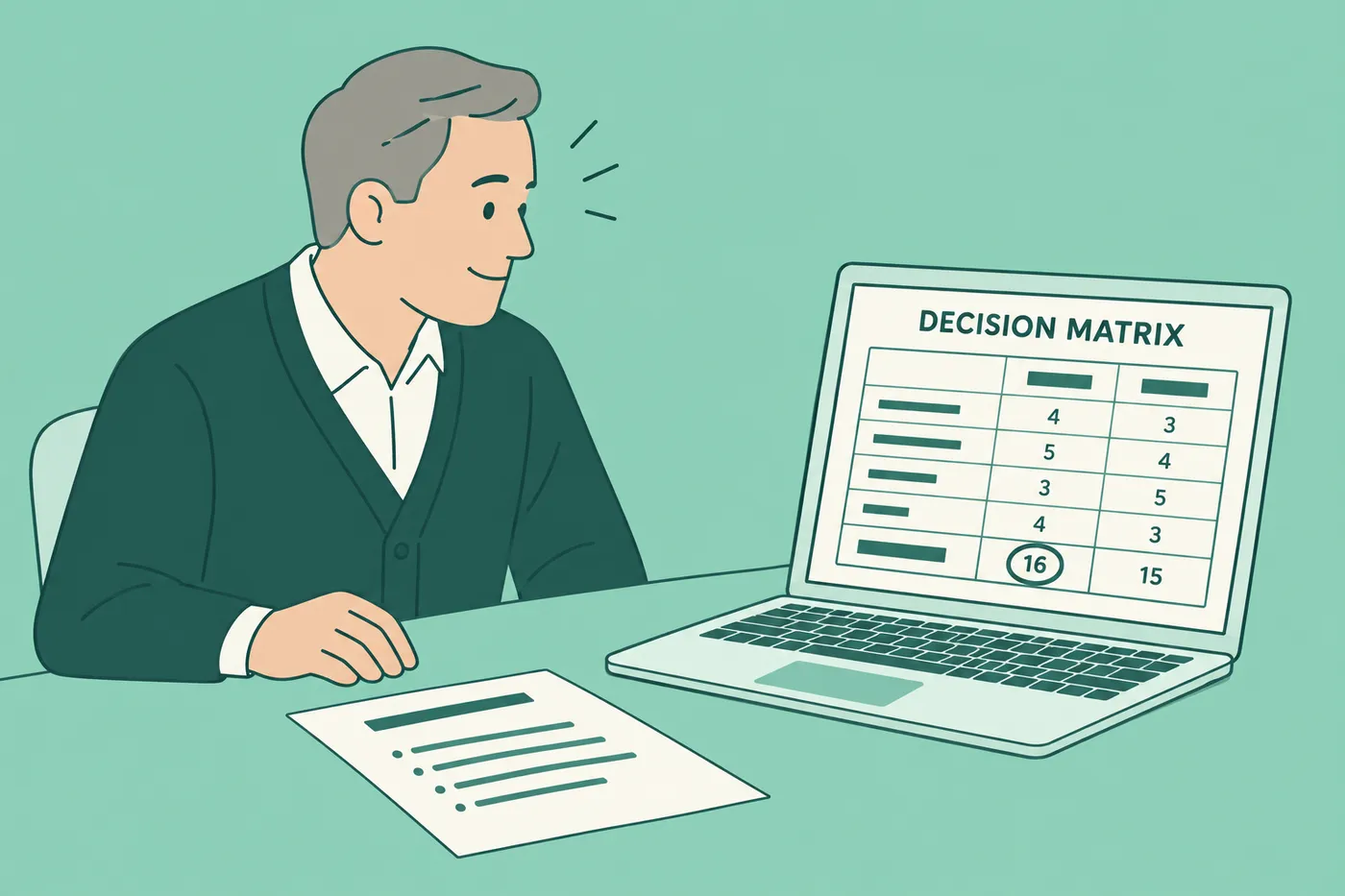
If you kept a decision log or built a matrix, the bullet almost writes itself: the options you compared, the recommendation you made, and what the follow-up showed. Here is the weak-to-strong rewrite.
Weak: "Responsible for vendor selection and strategic decision-making for the department."
Strong: "Compared [number] vendor proposals against weighted criteria (cost, onboarding time, support terms), recommended [vendor] with the trade-off documented, and confirmed at the [timeframe] review that onboarding finished [X weeks] early."
The weak version is a duty anyone in the role could claim. The strong version names the method, the call and the verification, and every bracket marks a fact only you can supply. Fill the brackets with your real numbers; never estimate one into existence, because the interview follow-up will find it. Four more patterns, by role:
- Analyst: "Built a weighted comparison of [number] reporting tools, recommended [tool] over the incumbent on [criterion], and documented the two assumptions that would reverse the choice."
- Team lead or manager: "Chose to reassign [number] staff to the backlog instead of hiring, after consulting both affected teams; reviewed at [date] and cut average ticket age by [X%]."
- Early career or retail: "Prioritized restock of [category] over [category] during the holiday rush based on prior-week sell-through, and flagged the call to the shift lead with the reasoning."
- Engineering: "Selected [technology] over [alternative] for [system] after a spike comparing [criterion] and [criterion]; wrote the decision record, revisited it at [milestone], and confirmed the choice held."
In Roleframe’s resume editor, live checks can flag wording to review while you edit. Signed-in accounts have a limited free allowance for AI features. If you ask Remi for a rewrite, supply the facts and review the proposed changes before applying them; keep only claims you can support.
Interview evidence: building the answer
Decision questions are a staple of behavioral interviews: "Tell me about a difficult decision," "a decision you made with incomplete information," "a decision that turned out to be wrong." The structure that works is a real situation, the action you personally took, and a verifiable result or an honest learning. The STAR method gives you the scaffolding; the decision log gives you the material.
Build one answer around a decision where you can name all three parts. The situation sets the constraint (the deadline, the missing data, the disagreement). The action is where the matrix behaviors appear: "I laid out three options including doing nothing, weighted speed above cost because of the launch date, and asked the support team what each option would do to their queue." The result is a number if you have one, and a learning if you do not: "The rollout held, and the review showed my cost estimate was 20 percent low, so I now add a contingency line to every comparison." A wrong decision honestly reviewed is often a stronger answer than a right one luckily made.
Three boundaries keep the answer credible. Claim only the part of the decision that was yours; "I recommended and my director approved" reads as more senior than pretending final authority you did not have. Keep confidential figures out, and say so plainly if asked: "I can't share the exact numbers, but the margin between options was under ten percent." And never present a group outcome as a solo call, because reference checks exist. The common mistakes are the mirror of the matrix: no alternatives ("it was the obvious choice" means no decision was made), no evidence ("I went with my gut" invites the follow-up you cannot answer), and no review ("it worked out" with nothing behind it).
Frequently asked questions
- What are 5 decision-making skills?
A practical set is defining the problem, gathering information, generating alternatives, weighing consequences and reviewing the choice after implementation. This is a useful checklist, not a single official list that applies to every role.
- What are the 5 C's of decision-making?
Different training materials use different five-C formulas. For this guide, a useful mnemonic is clarify the decision, collect evidence, consider alternatives, choose and check the outcome. Treat it as a reminder of the steps, not a universal decision-science standard.
- When should I revisit a decision?
Revisit it when an important assumption changes, a pre-agreed threshold is crossed or the review date arrives. In the example above, a changed deadline increases the weight of speed and reverses the preferred option. Record both the original assumption and the reason for the change.
- What are 5 ways to make a decision?
Possible methods include a decision by the accountable owner, a delegated expert or group, majority vote, consensus, and a negotiated compromise. Choose a method that fits the authority, urgency and commitment needed; a vote is not appropriate when a required approval belongs to a particular role.
- Is decision-making a hard skill or a soft skill?
It is usually classed as a soft skill, but it produces hard evidence: a weighted matrix, an options memo, a review note comparing prediction to outcome. That is why the strongest way to present it is through an experience bullet with a documented method and result, not through the word "decision-making" sitting in a skills list. The artifacts make it verifiable, which is what separates it from adjective-only soft skills on a resume.
- How do I describe decision-making on a resume without inventing results?
Write the bullet from what you can document: the options you compared, the criteria you weighted, the recommendation you made and who approved it, and what the follow-up showed. If you do not have a number, use the learning instead: what the review revealed and what you changed. Never estimate a figure to fill the gap. An interviewer's follow-up question will reach the exact fact you invented, and a defensible modest bullet beats an impressive one you cannot back up.

Turn your skills into proof.
A skills section helps most when your experience backs it up. In the editor, write each skill into a bullet about real work, then check the page against the posting before you send it.


