Customer Service Skills: What to List on a Resume
The customer service skills support postings actually name, ranked by how often they appear, with the posting's phrasing next to what to put on your resume.

On this page
Open ten customer service postings and the same requirements keep repeating: excellent verbal and written communication, and hands-on experience with a helpdesk like Zendesk. Open ten customer service resumes and you get "team player" and "people person." That gap is why solid candidates get filtered out before a human ever reads them.
This page closes the gap. Below is a customer service skills list ranked by how often support postings ask for each one, with the posting's own wording set next to the phrasing that belongs on your resume. At the end you can check your own posting against the list, instead of trusting anyone's ranking, including this one.
The customer service skills postings actually ask for, ranked
Recruiter filters and applicant tracking systems (ATS) search for exact terms from the posting. If the posting says "conflict resolution" and your resume says "good with difficult people," the filter finds nothing, even though you have the skill. So the first rule is simple: write the skill in the vocabulary the employer used.
The ranking below reflects how consistently each skill shows up when you read support postings closely, from near-universal requirements down to skills that only certain roles name. The third column is what goes in your skills section. The proof, the bullet with a number behind it, goes in your experience section, and we cover that further down.
| Skill | How postings phrase it | How to write it on your resume | How often postings name it |
|---|---|---|---|
| Communication | "Excellent verbal and written communication skills" | Customer communication (phone, email, live chat) | Nearly every posting |
| Problem solving | "Strong problem-solving skills," "troubleshoot customer issues" | Issue troubleshooting and root-cause resolution | Nearly every posting |
| Helpdesk / CRM software | "Experience with Zendesk, Salesforce, or similar CRM" | Name the exact tools: Zendesk, Salesforce Service Cloud, Freshdesk | Most postings |
| Multitasking | "Ability to multitask in a fast-paced environment" | High-volume queue management across concurrent channels | Most postings |
| Empathy | "Empathy and patience when handling customer concerns" | Empathy (keep the word, prove it in a bullet) | Most postings |
| De-escalation | "De-escalate difficult situations," "handle escalated calls" | De-escalation and complaint resolution | Common, heaviest in phone roles |
| Active listening | "Active listening skills" | Active listening and needs assessment | Common |
| Attention to detail | "Strong attention to detail," "accurate documentation" | Accurate ticket documentation and account updates | Common |
| Time management | "Prioritize competing demands," "meet SLAs" | Queue prioritization and SLA management | Common |
| Typing / data entry | "Minimum 40 WPM," "accurate data entry" | State your speed: "65 WPM typing, accurate CRM data entry" | Call center postings specifically |
| Product knowledge | "Learn our product quickly," "become a product expert" | Fast product onboarding (prove with a ramp-time bullet) | Common in SaaS and retail |
| Bilingual | "Bilingual English/Spanish preferred" | Fluent Spanish (customer-facing support) | Role-specific, but often decisive when named |
Notice what is missing: "positive attitude," "passionate about helping people," "customer-obsessed." Postings use those phrases in the culture paragraph, but recruiters do not filter on them and they take up space a searchable skill could hold. If you want the full picture of which skills belong in a skills section versus a bullet, the broader guide to skills to put on a resume covers the split by role.
Tools named by name: Zendesk, Salesforce Service Cloud, Intercom, Freshdesk, Five9
When a posting names a tool, the recruiter's filter almost certainly searches for that exact string. "CRM experience" on your resume does not match a search for "Zendesk." Name every helpdesk, telephony system, and chat platform you have actually used, spelled the way the vendor spells it.
| Tool | Where it shows up | What to say you did with it |
|---|---|---|
| Zendesk | The default helpdesk across SaaS, e-commerce, and mid-size support teams | Ticket handling, macros, views, tagging, internal notes |
| Salesforce Service Cloud | Enterprise support organizations, often paired with a sales-side Salesforce org | Case management, knowledge base articles, escalation queues |
| Intercom | Chat-first startups and product-led SaaS companies | Live chat, saved replies, bot handoffs, proactive messages |
| Freshdesk | Small and mid-size businesses, agencies, outsourced support teams | Ticketing, SLA policies, canned responses, customer portal |
| Five9 | Inbound and outbound call centers | Dialer operation, call dispositioning, adherence to schedule |
Two rules keep this section honest. First, if you used a different helpdesk, say Help Scout, Gorgias, or HubSpot Service Hub, list it by name and add the category in plain words ("Gorgias ticketing system") so both the exact-match filter and the human skimmer understand it. Second, never list a tool you have not touched. Helpdesks look similar from the outside, but an interviewer will ask how you set up a macro or a view, and that question ends interviews.
One more line worth adding if it is true for you: comfort using AI drafting and summarization tools inside the helpdesk. Support postings increasingly mention AI-assisted workflows, and "used AI reply drafting with manual review before send" reads as current without overclaiming.
Channel skills: phone, email, live chat and social are different jobs
Postings separate channels because the work is genuinely different, and a hiring manager staffing a chat queue does not want to discover in week two that you have only ever answered phones. Name the channels you have worked, and attach a volume to each one.
- Phone: one conversation at a time, live emotion, no edit button. Postings for phone-heavy roles ask for de-escalation and call control. Write it as "Handled 50+ inbound calls per day, including escalations."
- Email: writing quality and queue discipline. The customer reads your grammar. Write it as "Cleared 40+ email tickets daily with responses at or above a 95% QA standard."
- Live chat: concurrency is the skill. Handling three conversations at once without dropping tone is hard and postings know it. Write it as "Managed 3 to 4 concurrent chats while updating the CRM in real time."
- Social and public reviews: every reply is public and screenshot-able. Write it as "Responded to public complaints on X and Google Reviews within brand guidelines, moving resolution to private channels."
If you have worked all four, say so explicitly. "Omnichannel support (phone, email, chat, social)" is a phrase postings themselves use, which makes it a phrase filters search for.
Patience, empathy and ownership: one line each a screener can believe
Soft skills for customer service have a credibility problem: every applicant claims them, so the bare word carries no information. A screener believes a soft skill only when it comes wrapped in a specific behavior and, ideally, a result. The formula is skill, situation, behavior, outcome.
- Patience: "Walked first-time users through 20-minute account setup calls without transferring or rushing, holding a 4.8/5 post-call rating."
- Empathy: "Rewrote the team's refund-denial template to acknowledge the customer's situation before stating policy; angry follow-up replies to those emails dropped noticeably within a month."
- Ownership: "Followed every billing handoff personally until resolution instead of closing on transfer, so customers never had to re-explain their issue."
Keep the words "empathy" and "de-escalation" in your skills section because filters look for them. Put lines like the ones above in your experience section because humans look for those. The two sections do different jobs, and the difference between them is the core argument of hard skills vs. soft skills on a resume.
De-escalation, refunds and repeat callers: how to write the hard parts
The hard parts of support are the actual job, and postings say so directly: "handle difficult customers," "resolve escalations," "retain at-risk accounts." Most resumes skip these entirely, which is a waste, because a believable escalation bullet is the strongest thing a support resume can carry. These situations are also exactly what employers know software cannot handle on its own, which is why judgment and escalation handling keep appearing as explicit requirements.
De-escalation
Show the mechanics, not the adjective. "Calmed angry customers" says nothing. "Took over escalated calls from tier-one agents, acknowledged the failure first, then offered two concrete resolution paths; roughly half of my escalations closed on that same call" shows a screener you have a method.
Refunds and policy judgment
Refund handling is a judgment skill dressed as a process. A strong bullet shows you can hold the line and keep the customer: "Applied refund policy on 200+ requests per quarter, converting a meaningful share of refund requests into exchanges or credits by offering alternatives before processing." If your team tracked save rate, use your real number. If it did not, describe the behavior and skip the figure rather than inventing one.
Repeat callers
A repeat caller means the first resolution failed, so the skill here is root cause. "Flagged recurring billing-error contacts to the product team with ticket evidence, which removed a whole category of repeat calls" tells a manager you reduce future work instead of just clearing today's queue. This is also the raw material for behavioral interviews later; the same stories answer half of the customer service interview questions you will face.
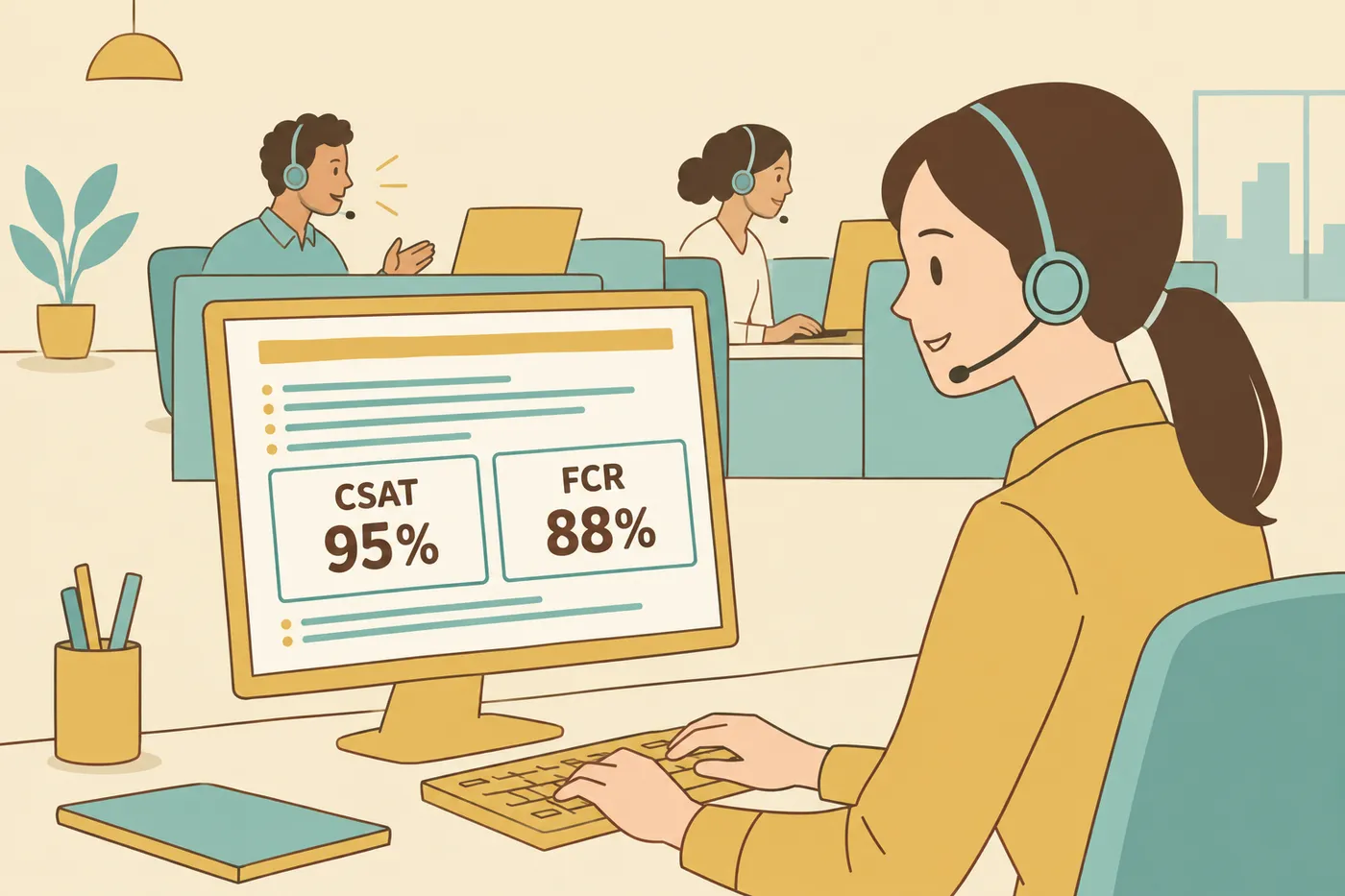
Service metrics that make a skill credible: CSAT, FCR, AHT, QA score
Support is one of the most measured jobs on earth, and that is an advantage: your dashboards already contain the proof your resume needs. A skill with a metric behind it survives skepticism. A skill without one is a claim.
| Metric | What it measures | A resume line that works |
|---|---|---|
| CSAT (customer satisfaction score) | Post-interaction survey rating, usually a percentage or a 5-point scale | "Maintained 96% CSAT across 1,200+ tickets per quarter, above team average" |
| FCR (first contact resolution) | Share of issues resolved without a follow-up contact | "Resolved 82% of tickets on first contact by widening my troubleshooting scope before replying" |
| AHT (average handle time) | Average length of a call or ticket, including wrap-up | "Cut AHT from 9 to 7 minutes while holding CSAT flat, by building personal macros for the top 10 issue types" |
| QA score | Internal audit of your interactions against a quality rubric | "Scored 95+ on monthly QA audits for 12 consecutive months" |
Two warnings. AHT alone is a trap: a low handle time with no quality metric next to it reads as "rushes customers off the phone," so always pair it with CSAT or QA. And only claim numbers your former manager could confirm on a reference call. If you never saw your CSAT, use volume instead, because "60+ tickets per day" is a real number you do know, and it is far better than a percentage you guessed.
Retail, call center, hospitality and SaaS ask for different things
"Customer service" covers four different jobs, and the skills each setting screens for barely overlap. A call center skills resume leads with metrics and telephony. A retail resume that leads with AHT confuses the reader. Match the emphasis to the setting before you polish a single bullet.
| Setting | What postings emphasize | Skills to lead with |
|---|---|---|
| Retail | In-person volume, returns and exchanges, register accuracy, add-on sales | POS systems by name, cash handling, returns processing, upselling |
| Call center | Metrics, schedule adherence, script compliance, typing speed | AHT and CSAT numbers, Five9 or your dialer, 50+ calls/day volume, WPM |
| Hospitality | Guest recovery, in-person composure, reviews, front-desk systems | Guest complaint recovery, property management systems, review-score impact |
| SaaS support | Written clarity, technical troubleshooting, documentation | Zendesk or Intercom, log reading and bug reproduction, knowledge base writing, engineering escalations |
If you are applying across two of these settings, keep one master resume with everything and spin a version per setting rather than writing one compromise document. A master resume makes that a ten-minute job instead of a rewrite.
Several short customer-facing jobs: stacking and compressing
Customer-facing careers often look like four jobs in three years: a retail season, a serving job, a call center stint, a promotion somewhere in the middle. Listed naively, that reads as job-hopping. Structured deliberately, it reads as range. Two moves fix it.
Stack roles at the same employer under one header. If you went from barista to shift lead at the same coffee shop, that is one entry with the employer on top, two title lines with dates underneath, and bullets concentrated on the senior role. The promotion becomes visible instead of looking like two more short jobs.
Compress the early, short roles into one grouped entry. Give your most recent one or two roles full bullets with metrics. Then collapse the rest into a single line-per-role entry titled something like "Earlier customer-facing roles, 2019 to 2021," listing employer, title and one clause each. The reader gets the continuity without wading through six thin entries, and you reclaim the space for the bullets that matter. The same logic applies to how far back a resume should go: old customer-facing roles earn a line, not a section.
Paste your own posting and see which skills it actually requires
The ranked list above is the pattern across many postings. The posting in front of you is the assignment, and it outranks the pattern every time. A retail posting that never mentions CSAT does not want a CSAT-led resume, no matter what any list says.
The manual version takes ten minutes: read the requirements section twice, mark every skill noun and tool name, then check each one against your resume, using the employer's exact wording where you honestly have the skill. If the posting says "conflict resolution" and your resume says "de-escalation," change yours; the human means the same thing, the filter does not. The full method is in how to pull resume keywords from a job description.
The faster version: duplicate your base resume for the job in Roleframe, paste the posting, and the fit report lists the exact keywords the posting requires, which ones your resume already covers, which are gaps, and an ATS score for that specific job. Remi, the career copilot in the editor, then helps you rewrite the weak bullets one at a time, and you approve every change before it lands, so every line stays something you can defend in the interview. That last part matters more than speed: a support hiring manager will probe your de-escalation story, and it had better be yours.
Frequently asked questions
- What are the top customer service skills to put on a resume?
The skills postings name most consistently are verbal and written communication, problem solving, hands-on experience with a helpdesk or CRM (Zendesk and Salesforce Service Cloud are named most often), multitasking across a high-volume queue, empathy, and de-escalation. Always check the specific posting before finalizing your list, because a retail posting and a SaaS support posting screen for different terms.
- How do I describe my customer service skills on a resume?
Twice, in two different forms. In the skills section, use the searchable noun in the posting's own wording: "de-escalation," "Zendesk," "omnichannel support." In the experience section, prove it with a behavior and a number: "Handled 50+ inbound calls per day, including escalations, at 96% CSAT." The skills section gets you past the filter, and the bullet convinces the human who reads it next.
- Should I list soft skills like patience and empathy?
Yes, because postings name them and filters search for them, but never as bare adjectives. Keep the word "empathy" in your skills section, then back it with one specific line in your experience: what you did for a frustrated customer and what happened as a result. A soft skill without evidence is the least believed line on any resume.
- How many skills should a customer service resume list?
Eight to twelve in the skills section is plenty. Prioritize the terms your target posting uses, put tools by exact name, and cut generic filler like "positive attitude" that no recruiter filters on. More examples of what to keep and what to swap are in our guide to resume skills section examples.
- Is customer service a hard skill or a soft skill?
It is a bundle of both. The tools (Zendesk, Five9, a POS system), the typing speed, and the metrics knowledge are hard skills you can test. De-escalation, empathy, and active listening are soft skills you demonstrate. Strong support resumes pair one of each in the same bullet: the tool or metric provides the proof, the soft skill provides the story.
- What customer service skills can I list with no experience?
Pull from any role where you dealt with people under pressure: retail seasons, serving, tutoring, front-desk volunteering, even moderating an online community. Add measurable transferables like typing speed, fluency in a second language, and any CRM or ticketing tool you have touched. Frame each with volume where you can: "served 100+ customers per shift" is evidence, even if the job title never said "customer service."


Turn your skills into proof.
A skills section helps most when your experience backs it up. In the editor, write each skill into a bullet about real work, then check the page against the posting before you send it.


