Active Listening Skills: Techniques, Examples and Practice
Learn active listening skills with observable examples, a worked dialogue, a practice plan, and ways to show the skill on your resume and in interviews.

On this page
Active listening means giving someone your attention, checking what they mean, and responding in a way that lets them confirm or correct your understanding. A paraphrase such as “The deadline is manageable, but the approval step worries you” makes that understanding visible.
This guide covers observable listening behaviors, a worked dialogue, an informal self-assessment, a practice plan, and ways to turn listening into resume and interview evidence.
What active listening means, and what it doesn't
Look for three things the other person can verify: you attended to the conversation, understood the substance and constraints, and responded with a useful paraphrase, question or summary.
Active listening is not a body-language test. Eye contact and visible enthusiasm are not prerequisites for understanding. Ask whether you can restate the concern accurately, and accommodate the communication preferences of the person you are speaking with.
It is also not a promise of better job performance. Use the techniques to check understanding, then evaluate what happened in the actual conversation. Agree a next step when one is needed, and follow through or explain why the requested action is not possible.
Active listening skills examples: behaviors, not adjectives
"Attentive" and "empathetic" are adjectives. A skill is something you can watch someone do. These are the core behaviors, each one observable in a real conversation:
- Open questions that hand the floor over: "What's blocking you right now?" instead of "So it's the vendor again?"
- Paraphrasing meaning, not parroting words: "So the deadline itself is fine, it's the approval step that worries you."
- Clarifying ambiguity before acting: "When you say soon, do you mean this week or this sprint?"
- Acknowledging the emotion when there is one: "You sound frustrated, and that makes sense given it's the third delay."
- Pausing instead of filling silence, which gives the speaker room to add the thing they were hesitating to say.
- Summarizing and agreeing a next step with an owner and a date, then inviting correction: "Anything I got wrong?"
- Ask whether the speaker wants ideas, a decision or simply a chance to explain before offering advice.
Those behaviors become career evidence when they leave a trace. The matrix below maps common work tasks to the listening action, the artifact it produces, and the follow-up question an interviewer is likely to ask about it. The artifact column helps you recall and explain what you actually did. Share work records only with permission; otherwise describe or redact them.
| Task | Observable listening action | Shareable artifact | Likely interview follow-up |
|---|---|---|---|
| Gathering requirements from a stakeholder | Ask open questions, then read each requirement and its constraint back before writing it down | A requirements note or ticket the stakeholder confirmed without major edits | "What did you do when two stakeholders wanted different things?" |
| Taking a shift or project handoff | Summarize the open items and who owns each, then ask the outgoing person to correct the summary | A handoff checklist or message thread where the summary was confirmed | "Tell me about a handoff that went wrong and what you changed afterward." |
| Handling a customer complaint | Restate the complaint and its impact on the customer before proposing any fix | A case note recording the restated concern and the agreed resolution | "How did you know the customer felt understood?" |
| Closing a team decision | State the decision, the owner and the date out loud, then invite objections before the meeting ends | Meeting notes or a decision log that attendees replied to and confirmed | "What happens when someone disagrees after the meeting?" |
| Receiving feedback from a manager | Paraphrase the feedback and ask one clarifying question before responding or defending | A follow-up message listing the specific changes you agreed to make | "Describe feedback you initially misread." |
Notice that every row ends in something checkable. Active listening is one branch of the broader skill family covered in our guide to communication skills, and the same rule applies across all of it: evidence beats adjectives.
A worked example: the delayed handoff
Here is the difference between assuming and checking, in a conversation about a late handoff between a project coordinator and a warehouse lead. Maya, Dev and the company are fictional; the dialogue is illustrative.
The assumption version. Dev says, "The handoff's late again." Maya replies, "Got it, I'll push the install to Monday." She has assumed "late" means the shipment hasn't arrived. She reschedules a crew, and finds out two days later the shipment arrived on time.
The checked version.
- Dev: "The handoff's late again."
- Maya: "When you say late, what's actually blocked right now?"
- Dev: "The fixtures cleared receiving fine. But QA hasn't signed off, so I can't release them to the floor."
- Maya: "So the holdup is the QA sign-off, not the shipment. If QA signs off by Thursday, can your team still release Friday?"
- Dev: "Friday morning, yes."
- Maya: "Here's what I have: fixtures are in, QA sign-off is the blocker, you release Friday morning if QA finishes Thursday. I'll chase QA today and confirm with you by 3. Anything I got wrong?"
- Dev: "One thing. Half the order came on a second truck that's still in transit, so Friday covers the first half only."
Three moves did the work. The clarifying question ("what's actually blocked?") replaced an assumption with a fact. The paraphrase ("the holdup is the QA sign-off, not the shipment") let Dev confirm Maya understood. And the checked summary surfaced a missed fact, the second truck, that the assumption version would never have caught. In this illustrative scenario, checking the details avoids rescheduling the whole crew on the basis of an incomplete assumption.
A quick self-assessment
This is an informal reflection exercise, not a validated assessment. After your next substantial work conversation, write down three things from your understanding of it. You can use notes or other accessibility supports as needed:
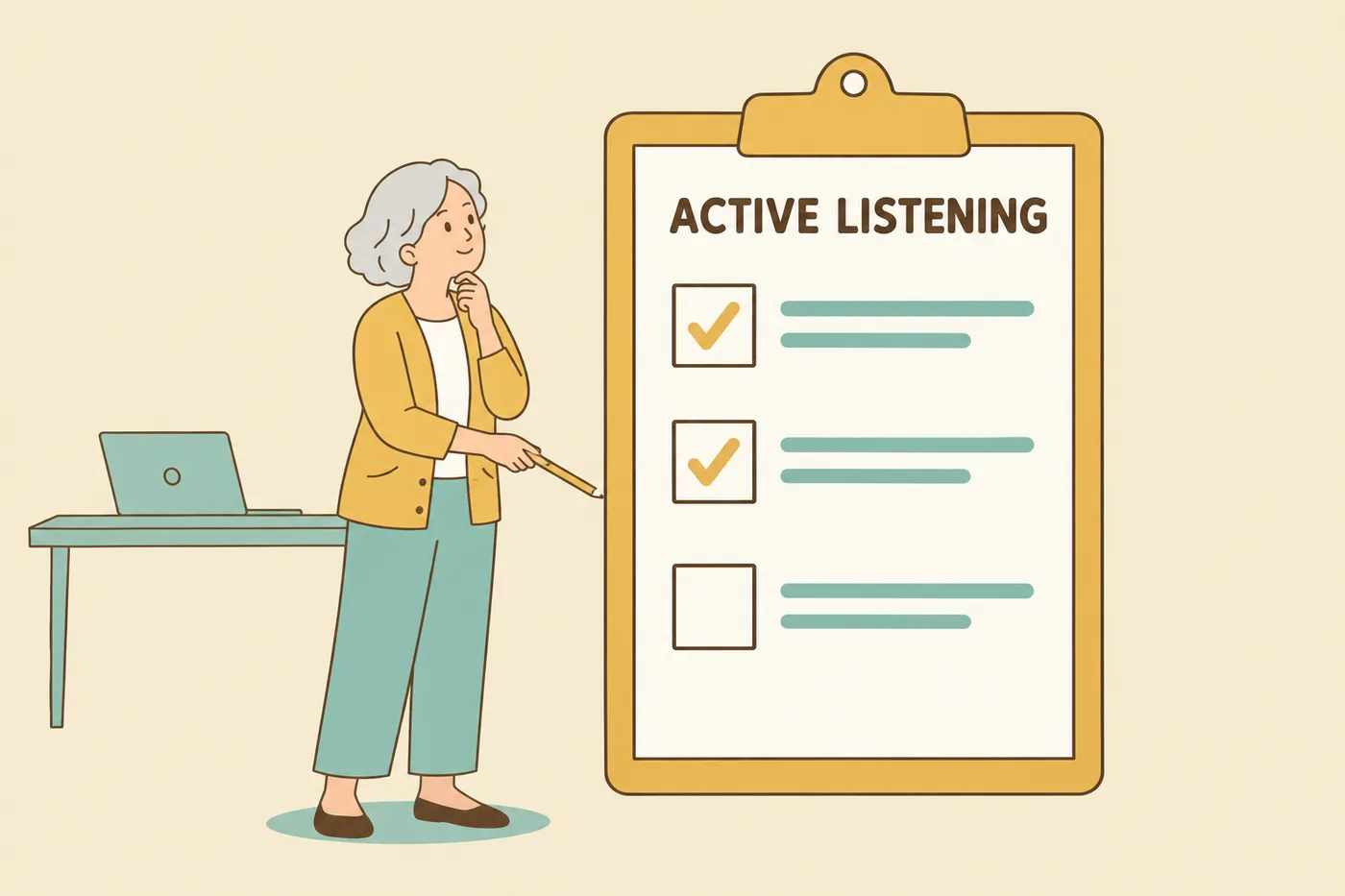
- The other person's main concern, in one sentence.
- The constraints they mentioned: deadlines, dependencies, budget, people.
- The next action, with an owner and a date.
Show your three lines to the person you spoke with and ask for corrections. A changed concern or a missing constraint identifies something to clarify; it does not diagnose why you missed it. Look for repeated gaps across several conversations and choose one behavior to practice.
How to improve: a repeatable practice plan
Listening improves with reps and correction, like any skill. The core exercise takes five minutes with any willing partner, a colleague, a friend, a study group.
- Your partner talks for two minutes about a real, recent situation: a complaint, a decision, a frustration. You don't interrupt except to ask clarifying questions.
- You summarize in under 30 seconds: their concern, the constraints, the next step they want.
- They correct the summary. Every correction is the data you came for.
- You restate the corrected version once, then swap roles.
- Next session, change the scenario type. Rotate through a complaint, an ambiguous request, and a disagreement, because each stresses a different behavior.
Try the exercise three times a week for three weeks, adapting the schedule to your workload. Keep a short log of what each correction caught. For another structured practice, the University of California, Berkeley’s Greater Good in Action active-listening guide describes paraphrasing, clarification, empathy and withholding premature advice, with a printable version.
If the conversation is rushed or you cannot give it attention, agree a better time where possible. In remote conversations, a short written summary can make unresolved points easier to spot. Close any agreed action with an update, even when the answer is that you checked and cannot make the requested change.
How to show active listening on a resume
Use the wording in the job description when it accurately describes your experience, then show the behavior in a bullet. Clarifying a requirement, confirming a handoff or resolving a misunderstanding gives the phrase “active listening” substance. The same approach applies to other soft skills on a resume.
Build bullets from the artifact column above. Each follows action, context and evidence. Square brackets mark facts only you can supply. Never fill a bracket with an invented number; describe a verifiable outcome in words if no measurement exists.
- Documented requirement: "Interviewed [number] stakeholders for [project], reading each requirement back for sign-off; final spec shipped with [number] change requests."
- Checked handoff: "Ran daily handoffs for a [size]-person team using a confirmed read-back summary; missed handoff items fell from [X] to [Y] per [period]."
- Resolved misunderstanding: "Resolved a recurring [billing/scope/scheduling] misunderstanding by restating the customer's concern and confirming the fix in writing, cutting repeat contacts on the issue to [number]."
- Speaker feedback: "Cited by [manager/client] in [review/survey] for accurately capturing requirements on [project], with [quote or rating] as the recorded feedback."
Here is the weak-to-strong rewrite in one line. Weak: "Strong active listening and communication skills." Strong: "Closed [number] escalated support cases by restating each customer's concern before proposing a fix; post-case satisfaction averaged [score], per [the team's CSAT dashboard]." The weak version could sit on anyone's resume. The strong version names a task, a behavior and a place the evidence lives.
In Roleframe’s resume editor, live checks can flag wording to review while you edit. Signed-in accounts have a limited free allowance for AI features. If you ask Remi for a rewrite, supply the facts and review the proposed changes before applying them; keep only claims you can support.
Interview evidence and common questions
Interviewers rarely ask "are you a good listener?" They ask behavioral questions where listening is the hinge: "Tell me about a time you misunderstood a request," "How do you handle an upset customer," "Describe a decision you changed based on feedback." Build one answer in advance around a real situation, the specific action you took, and a result or lesson someone could verify. The structure in our guide to STAR method interview questions fits this exactly: the situation sets up the ambiguity, your action is the clarifying question or checked summary, and the result is the artifact, the confirmed handoff, the approved spec, the resolved case.
Three boundaries keep the answer credible. Don't claim listening fixed everything; "I caught half the problem and missed the vendor dependency, which taught me to ask about upstream dependencies every time" is a stronger answer than a flawless story. Don't share confidential details to make the story vivid; "a key account" works as well as the client's name. And don't recite the six-components framework as your answer; interviewers want the incident, not the theory.
One placement rule ties the resume and interview together. If your evidence is strong enough to survive a follow-up question, it belongs in an experience bullet where the interviewer will find it and ask about it. If it isn't, it doesn't belong in the skills list either. The skills list is a promise of what your bullets will prove; a skill that appears only there, with no supporting bullet, reads as filler. For more prompts to rehearse against, the story-bank approach in our behavioral interview questions guide covers twenty of them.
Frequently asked questions
- What are the 6 components of active listening?
One practical six-part checklist is paraphrasing, asking clarifying questions, acknowledging feelings, showing attention in a way comfortable to both people, withholding judgment and avoiding premature advice. Berkeley’s published exercise also includes taking turns as a seventh step. These are practice prompts, not a universal scoring standard.
- Is there a PDF of active listening exercises for adults?
Yes. Berkeley’s Greater Good in Action active-listening practice provides a printable version and a PDF link. Its partner exercise covers paraphrasing, questions, empathy and taking turns.
- How can I practice active listening in a meeting?
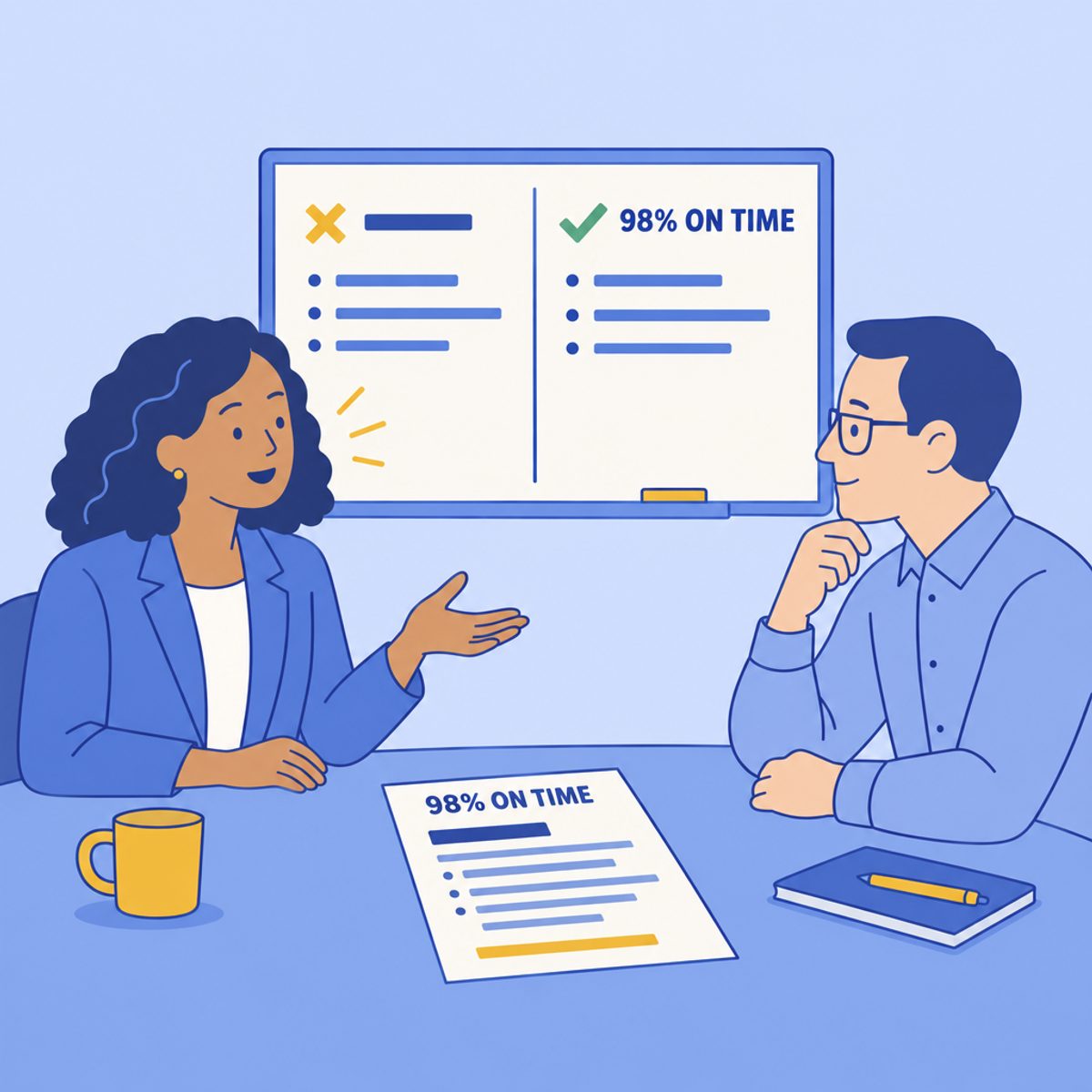
Ask one clarifying question, summarize the main concern in your own words, and invite a correction. For example: “I understand that the deadline works but the approval step is blocked. Is that accurate?” Then agree who will do what next, if action is needed.
- What are some good reflective listening exercises?
Try two informal exercises: paraphrase a partner’s account of a recent event and let them correct you; or tentatively name a feeling and its cause, then ask whether you understood correctly. A third person can observe which questions clarified the situation. These are practice activities, not validated tests.
- Should I put 'active listening' in my resume skills section?
You can include it when the posting asks for it and your experience supports it. Back the phrase with an example: a confirmed requirement, a clearer handoff or a resolved customer misunderstanding. A bare label is less informative than evidence of what you did.
- Does active listening actually improve job performance?
It can help you identify misunderstandings and clarify next steps, but it does not guarantee a performance result. Evaluate your own practice using specific evidence: whether the speaker confirmed your summary, which missing constraint you caught, and whether the agreed action happened.


Turn your skills into proof.
A skills section helps most when your experience backs it up. In the editor, write each skill into a bullet about real work, then check the page against the posting before you send it.


