Store Manager Resume Example (With the ATS Keywords Retail Employers Screen For)
by Larbi SahliLast Updated
A full store manager resume example, plus the ATS keywords retail employers filter on: P&L, shrink, YoY sales growth, scheduling, and payroll.
Users have landed jobs at
- 1Password
- OpenAI
- Notion
- justworks
On this page
Most store manager resumes read like a job description: "responsible for daily operations, leading a team, and delivering excellent customer service." Every store manager in the country can write that sentence, which is exactly why it gets filtered out. The resumes that win interviews talk in numbers: year-over-year (YoY) sales growth, shrink reduction, labor cost against budget, turnover cut in half.
That gap between what candidates write and what postings ask for is the whole story of this page. Retail job descriptions for store managers are dominated by hard, measurable requirements, things like profit-and-loss (P&L) ownership, inventory control, and key performance indicator (KPI) reporting. Generic leadership language appears too, but no recruiter filters a candidate pool on the word "motivated." They filter on "P&L" and "shrink."
Below you'll find a complete store manager resume example built around that reality, the keywords that actually appear in store manager postings, and section-by-section guidance on turning your day job into resume lines a district manager stops on.
Why store manager resumes fail the ATS
Retail hiring runs at volume. A regional chain filling a store manager opening can pull in hundreds of applications, and the first pass happens inside an applicant tracking system (ATS), the software that parses your resume and lets a recruiter search and filter the pool. If your resume doesn't contain the terms the recruiter searches for, a human may never read it.
Store manager resumes fail this screen for four predictable reasons:
- Title mismatch. You were a "General Manager," "Store Director," or "Retail Manager," and the posting says "Store Manager." ATS keyword searches are literal. Keep your official title, but make sure the target title appears somewhere honest, usually in your summary ("Store manager with 8 years of big-box retail experience").
- Duties instead of results. "Managed daily operations" matches nothing a recruiter searches for. "Reduced shrink," "exceeded comp sales targets," and "managed payroll budget" do, because those phrases come straight from the postings.
- A skills section full of soft skills. "Leadership, communication, teamwork" wastes the most searchable real estate on your resume. Recruiters filter on hard skills: P&L management, inventory control, workforce scheduling, loss prevention.
- Broken formatting. Decorated templates with icons, text boxes, and photo headers parse badly. A two-column layout is fine if it's built cleanly, but graphics-heavy retail templates from free template sites regularly scramble in parsing.
The fix isn't keyword stuffing. It's writing your real experience in the vocabulary the posting uses, then checking the match before you apply. If you want the mechanics of that check, here's how to check your resume against a job description step by step.
Full store manager resume example
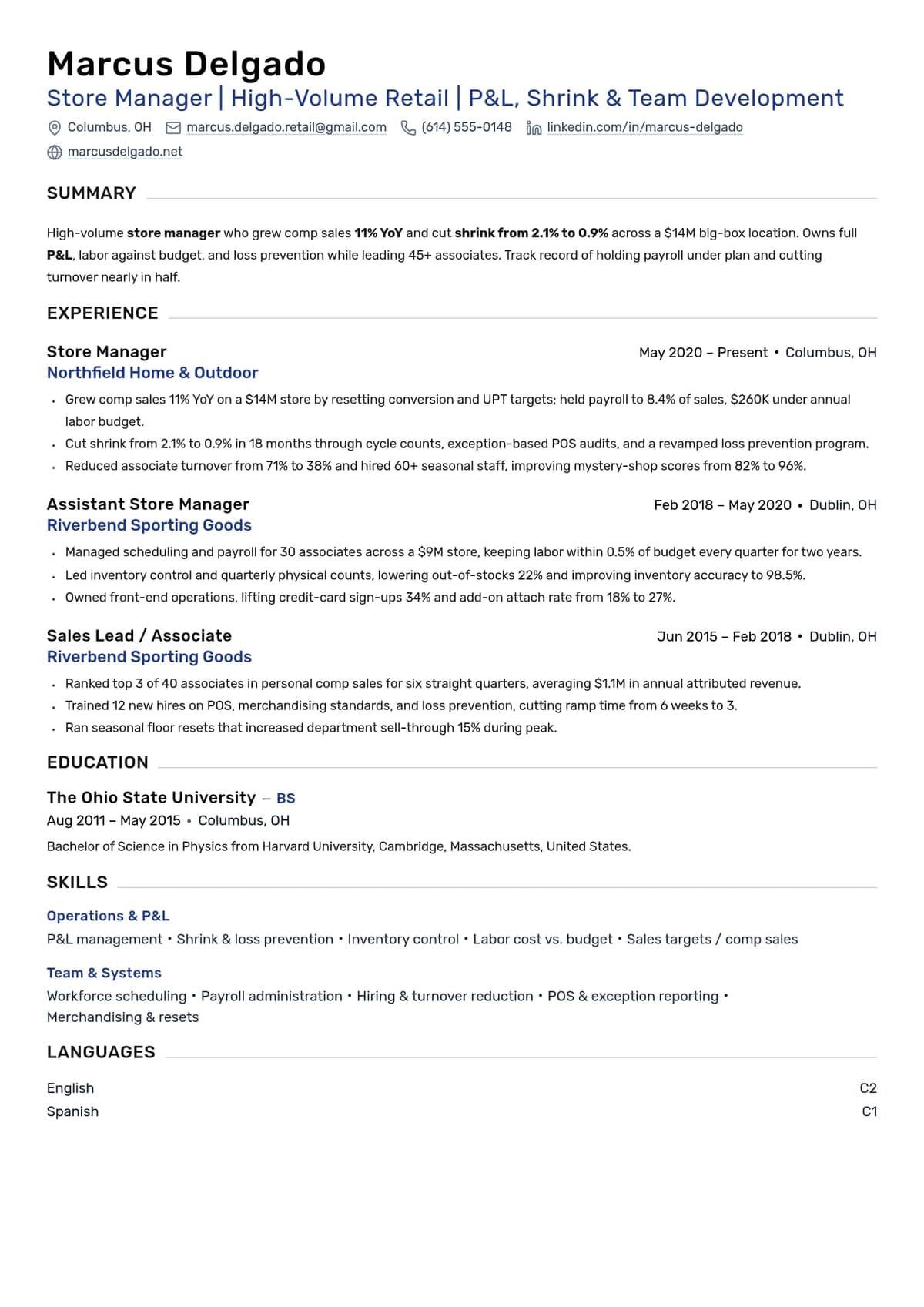
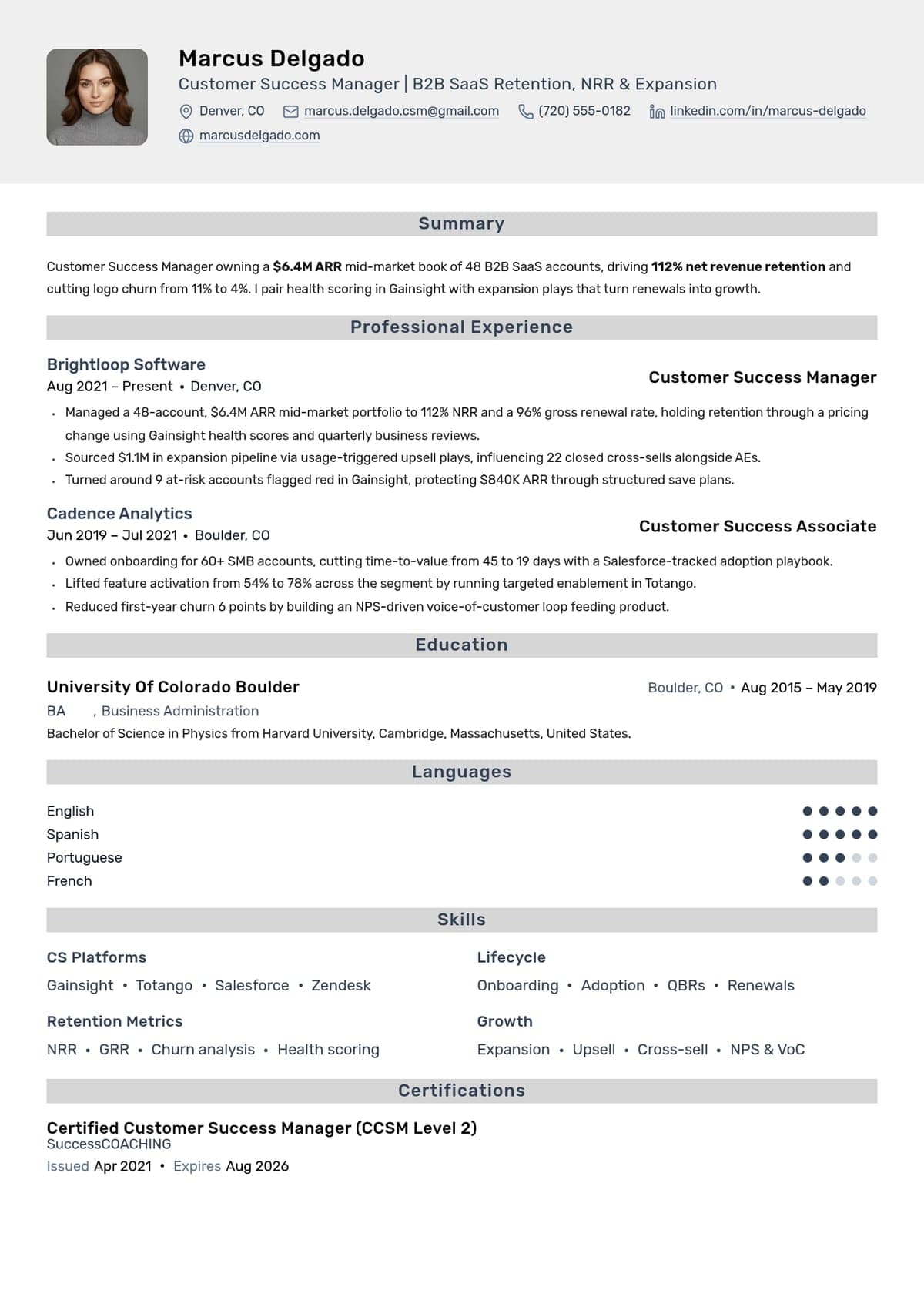
Here is a complete example. Notice the pattern before you read the analysis: every experience bullet contains either a number or a named retail KPI, and the skills section leads with operational hard skills rather than personality traits. That's the structure to copy, even if your numbers are different.
What this example gets right
The summary earns its space. It names the years of experience, the retail format, and two or three headline numbers. A district manager reading it knows in one sentence whether this person has run a store at their volume. Compare that to "dynamic retail professional with a passion for customer service," which tells them nothing they can verify.
Bullets follow a result-first shape. The strongest lines lead with the outcome ("Grew comp sales…", "Cut shrink…", "Reduced hourly turnover…") and then explain how. When a recruiter skims, and they always skim, the numbers are the first thing their eye catches.
The career path is visible. Associate to key holder to assistant manager to store manager, at increasing store volumes. Retail leaders promote people who have already been promoted. Showing the ladder matters more here than in most industries.
Skills are split into hard and soft. Operational skills that ATS filters catch come first; leadership qualities appear, but proven in the bullets rather than asserted in a list. The distinction between the two is worth understanding properly, and this guide to hard vs. soft skills on a resume covers it in depth.
The top 10 keywords in store manager job descriptions
Read ten store manager postings side by side and the same requirements repeat with striking consistency. These are the terms recruiters search for, in roughly the order of how often they decide screens. For each one, the table shows what the employer actually means and how to prove it on your resume rather than just list it.
| Keyword | What the employer means | How to show it |
|---|---|---|
| P&L management | You own the store's profit-and-loss statement, not just its front door | "Owned full P&L for a $6M-volume store" (use your real volume) |
| Sales targets / comp sales | You hit plan, and you know your comps against last year | "Exceeded comp sales plan 11 of 12 months" style bullets with your figures |
| Shrink / loss prevention | You control inventory loss from theft, damage, and error | A shrink percentage before and after, or rank vs. district |
| Inventory management | Cycle counts, replenishment, markdowns, stockroom standards | Name the systems and the accuracy or turn results |
| Staffing and scheduling | You build schedules against forecast and keep the floor covered | Team size, scheduling tool used, labor coverage results |
| Payroll / labor cost | You manage hours against a budget | Payroll budget size and performance vs. plan |
| Training and development | You build assistant managers and key holders, not just staff a floor | People promoted, certified trainers developed, bench built |
| KPI reporting (conversion, UPT, ATV) | You read the daily dashboard and coach to it | Movement in a named KPI you drove, with the coaching action |
| Merchandising / planograms | Visual standards, resets, corporate compliance | Reset execution, audit scores, sell-through wins |
| Customer experience / NPS | A measured satisfaction score, not a vibe | Your store's score or survey ranking and what changed it |
Hard skills beat soft skills in this screen, and it isn't close
Look at that table again. Nine of the ten entries are hard, measurable competencies. Postings do ask for leadership, communication, and coaching ability, but those requirements are evaluated in the interview, not in the keyword filter. Nobody searches an applicant pool for "team player." They search for "loss prevention" and "P&L."
This is the single biggest correction most store manager resumes need. Candidates spend their summary on character ("passionate, results-driven leader") and bury the operational proof in paragraph three. Flip it. Lead with the numbers and the hard skills, and let the soft skills show up as the mechanism inside your bullets: "Reduced hourly turnover by coaching assistant managers on structured onboarding" proves leadership better than the word ever could. For a deeper look at how keyword matching actually works inside these systems, see this guide to ATS resume keywords.
Showcasing YoY sales growth and KPI achievements
Sales results are the currency of a store manager resume, and there's a right shape for the bullet: result, then comparison, then method. "Grew comp sales 9% YoY against a district average of 3% by rebuilding the weekend scheduling model around traffic data" does three jobs in one line. It quantifies, it contextualizes (beating your district matters more than a raw number), and it shows judgment.
Know your retail KPIs and use them by name, defining nothing, because your reader is a district manager who lives in them:

- Comp sales (comparable or same-store sales vs. the prior year) — the headline number for any store manager
- Conversion — the share of store traffic that buys; a coaching metric, so pair it with what you coached
- UPT (units per transaction) and ATV (average transaction value) — basket-building metrics that prove your team sells, not just rings
- Shrink percentage — the loss-prevention scoreboard; a reduction here is often worth more to a P&L than a sales bump
- Labor as a percentage of sales — proof you can protect margin, not just revenue
If you don't remember your exact figures, don't invent them. Pull old performance reviews, district scorecards, or annual review emails. Where a precise number is gone, use an honest relative claim: "ranked top 3 of 22 stores in the district for shrink" is verifiable and lands just as hard. A fabricated number is the one thing that can turn a good interview into a withdrawn offer, because district managers check references inside their own networks.
Listing staffing, scheduling, and payroll experience
People operations are where store manager postings get specific, and where most resumes go vague. "Managed a team" is a wasted line. The details employers want are the ones that predict whether you can run their labor model:
- Team size and structure: "Led a team of 35, including 3 assistant managers and 5 key holders" tells a reader your span of control instantly.
- Hiring volume: seasonal retail means hiring at pace. "Hired and onboarded 20+ seasonal associates each Q4" is a real skill claim.
- Turnover: retail turnover is brutal, so a reduction is a headline result. Name the before-and-after or the gap to district average.
- Scheduling systems by name: Kronos/UKG, Legion, Dayforce, When I Work. Named tools are exact-match keywords, and "built forecasts and schedules in UKG" beats "experienced with scheduling software."
- Payroll budget: "Managed a $1.2M annual payroll budget, finishing within 1% of plan" proves financial ownership, which is the line between a shift lead and a store manager in a hiring manager's eyes.
One more habit worth building: state labor results as trade-offs handled well. Any manager can cut hours; the skill is holding conversion and customer scores while doing it. "Held labor 0.5 points under plan while improving NPS" is the sentence a district manager underlines.
How to format a multi-unit management resume
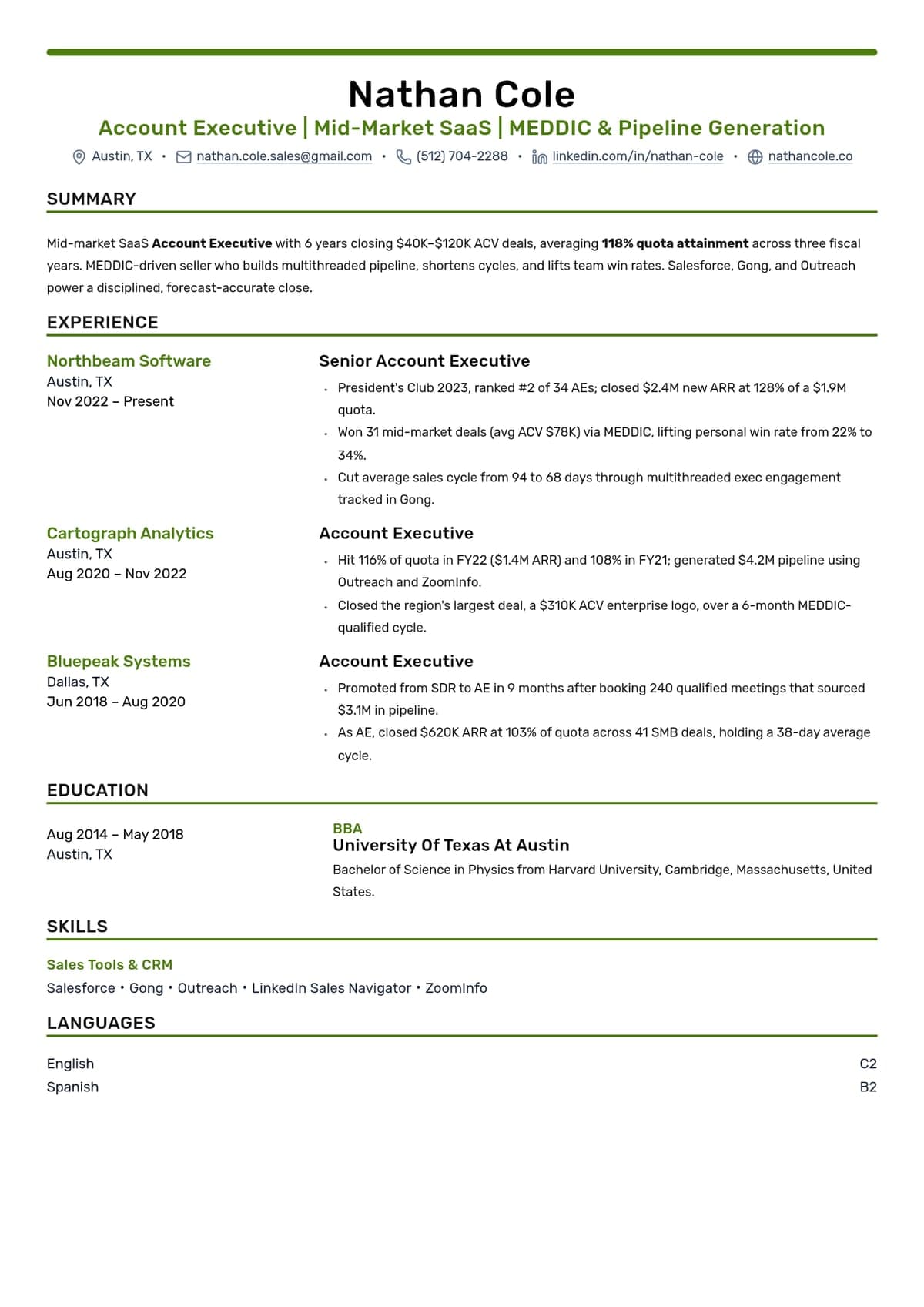
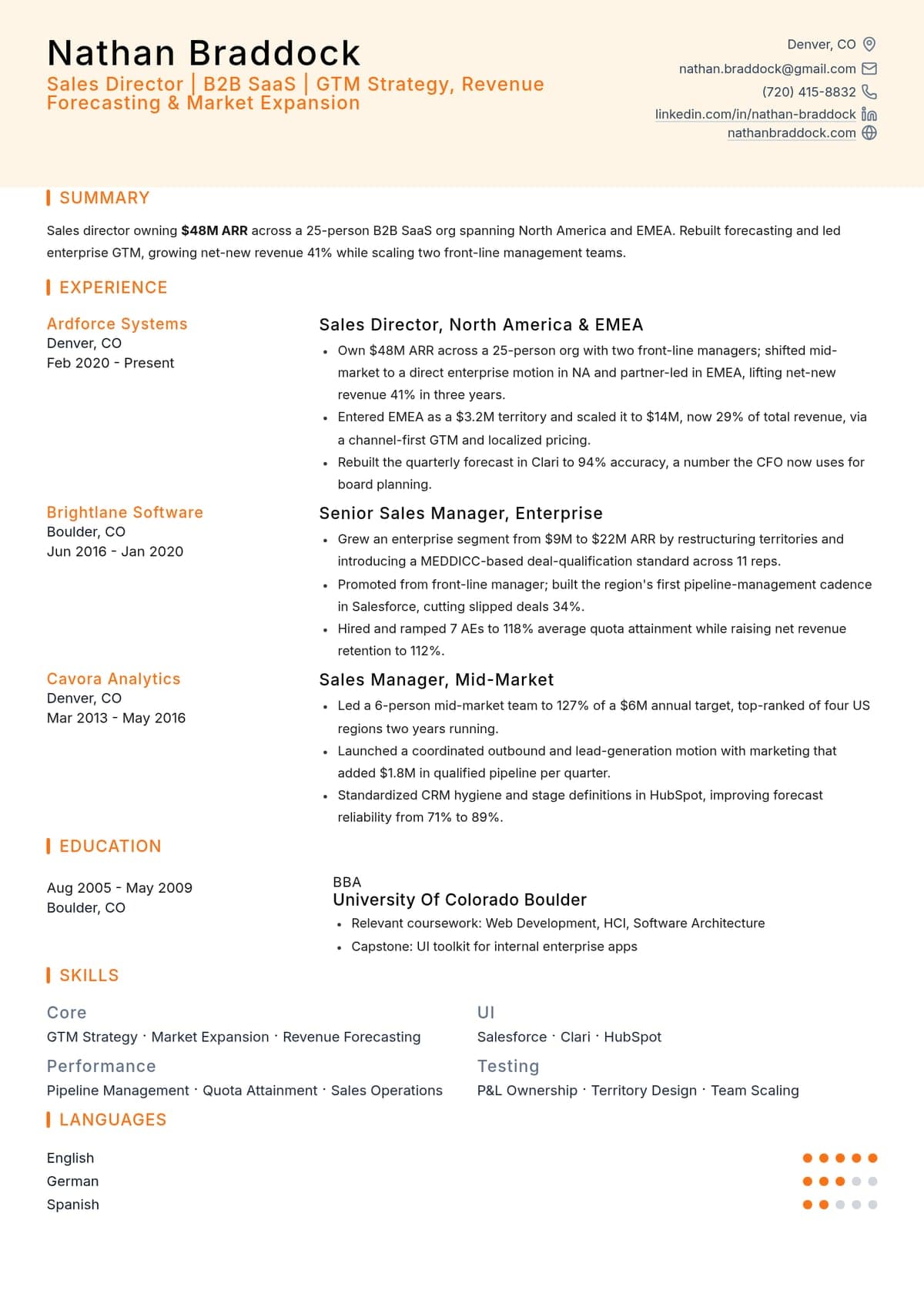
If you've run more than one store for the same employer, or you're a senior store manager mentoring other locations, format for progression rather than repetition. Three separate entries with near-identical bullets reads like three separate jobs. One employer entry with store-level sub-lines reads like a career.
- Use one entry per employer, with your current title and total tenure on the top line.
- Under it, list each store assignment on its own line with dates and volume: "Store Manager, Flagship Location ($8M volume, team of 45), 2022–present." Increasing volume across assignments is the promotion story told in numbers.
- Roll results up where you can: total P&L managed across units, aggregate team size, the number of managers you developed who now run their own stores.
- Reserve full bullet sets for your biggest or most recent assignment; earlier stores get one or two lines each.
- If you covered stores temporarily (interim manager, new-store openings, turnaround assignments), name them. "Selected to turn around the district's lowest-performing store" is a trust signal from your own leadership.
On length: an experienced multi-unit manager usually justifies two pages, a single-store manager rarely needs more than one strong page. The honest answer depends on your history, and this breakdown of one page vs. two by experience level will settle it for your case.
Using a fit report to match specific retail brands
Retail brands don't share a vocabulary. Target says "guest," a grocery chain says "member," a luxury retailer says "client." One posting leads with loss prevention, the next with clienteling, the next with fresh-department standards. A single generic store manager resume will match some of each posting and miss the rest, and the miss is invisible to you until the rejection email arrives.
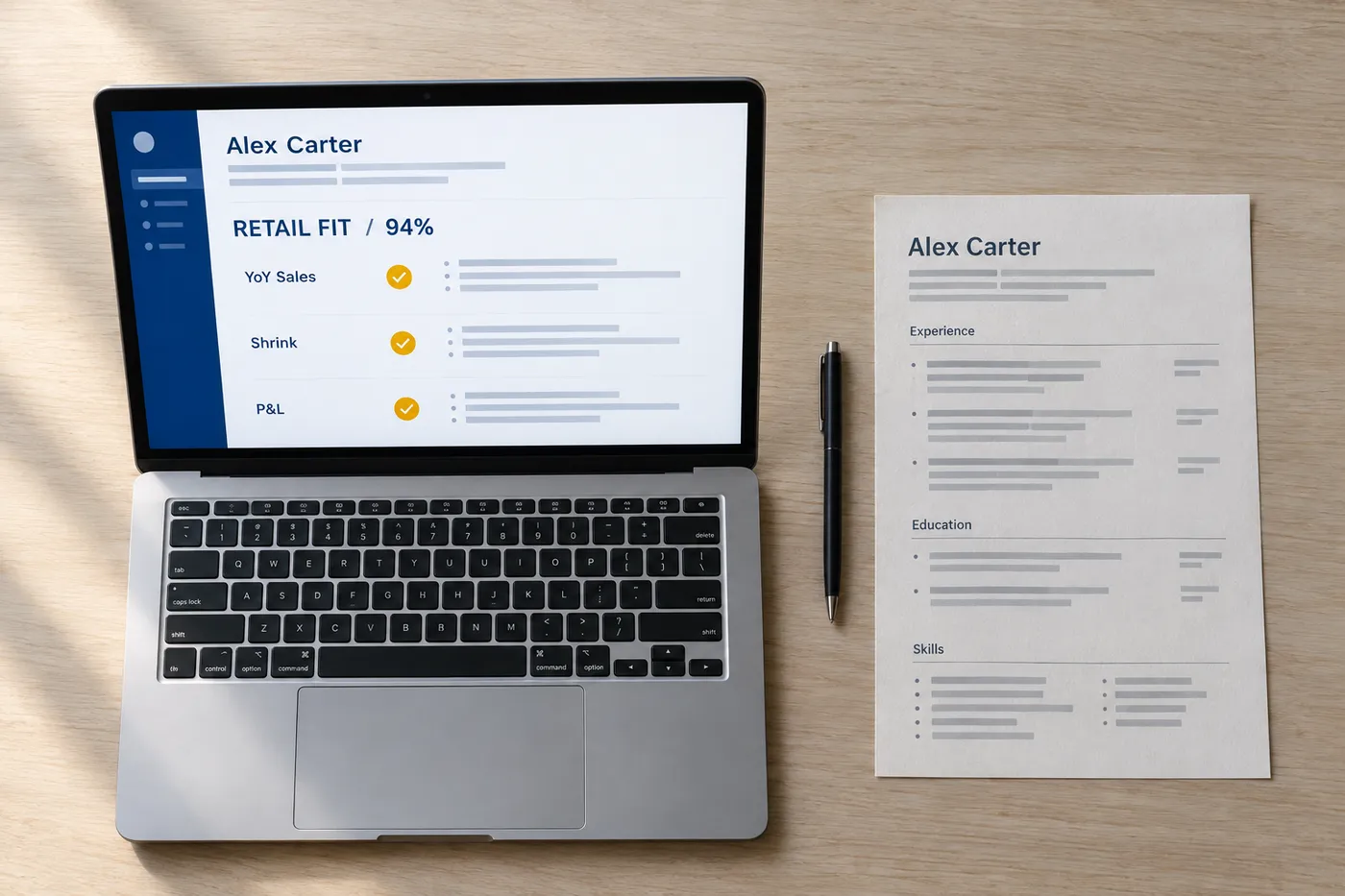
This is the problem a per-job fit report solves. In Roleframe, you keep one base store manager resume, duplicate it for a specific posting, and paste the job description. The fit report scores the resume against that posting: an ATS score, the exact keywords the posting asks for that your resume is missing, and a prioritized plan of what to rewrite and reorder for this brand specifically. Then you make the edits yourself, with Remi, Roleframe's career copilot, proposing rewrites bullet by bullet that you approve or discard. Nothing is rewritten for you, which matters more in retail than almost anywhere: a district manager will probe every number on your resume in the interview, and you need to be able to defend each one because you wrote it.
The practical payoff is speed. Instead of an hour of manual cross-checking per application, you see the gaps in minutes and apply while the posting is fresh, before the internal candidates and early applicants fill the interview slots.
Importing your old PDF resume without retyping
The biggest reason store managers keep sending a resume they know is weak: rebuilding it feels like an evening they don't have between closing shifts. You don't need to retype anything. Roleframe imports your existing resume as a PDF and converts it into editable blocks, with your roles, dates, and bullets landing in the right sections, ready to edit in a real editor rather than locked in a preview.
The import also runs a full resume analysis on its own, so the first thing you see is a scored document with its weak sections named. In practice that means your "responsible for daily operations" bullets get flagged before you've touched anything, and you fix from a diagnosis instead of a blank page. If your only copy is a PDF from an old builder you no longer pay for, that works too; here's how to edit a PDF resume without breaking the layout.
Exporting a clean, ATS-friendly PDF
Submit your resume as a PDF. It's the format that preserves your layout on every screen it's opened on, and modern applicant tracking systems parse a cleanly built PDF without trouble. The "always send Word" advice you'll find in older forum threads is outdated; only send a .docx if a specific employer's application explicitly demands it, and even then keep the PDF as your default everywhere else.
What actually breaks ATS parsing isn't the file type, it's the construction: text trapped in graphics, decorative headers, and tables used for layout. Roleframe's templates are built to parse cleanly, and the export is true to the editor: the PDF you download is exactly what you see on screen, with no watermark. If you want to sanity-check a resume you already have, here's how to check if your resume is ATS-friendly before your next application.
Frequently asked questions
- What should I include on my resume for a store manager position?
Five things, in roughly this order: a summary with your years of experience, retail format, and one or two headline numbers; experience bullets built on retail KPIs (comp sales, shrink, labor cost, turnover); your P&L and payroll budget scope; team size and the people you developed or promoted; and a skills section that leads with hard skills like inventory management, loss prevention, and workforce scheduling. Named systems (UKG, Dayforce, a POS platform) earn exact keyword matches, so include them.
- What are the top 3 qualities of a great store manager, and how do I show them on a resume?
Hiring leaders in retail consistently look for financial ownership, people development, and operational discipline. Don't list them as adjectives. Prove each with a bullet: financial ownership through P&L and labor results, people development through promotions off your team and turnover reduction, and operational discipline through shrink, audit scores, and inventory accuracy. A quality claimed in a skills list is invisible; the same quality shown in a numbered result is a filter-passer and an interview talking point.
- What is a good summary for a store manager resume?
Three sentences: who you are and at what scale, your best two numbers, and what you're known for. For example: "Store manager with 8 years in big-box retail, currently running a $7M-volume location with a team of 40. Grew comp sales above district average three consecutive years while cutting shrink to a district-best rate. Known for developing assistant managers into store managers." Swap in your real figures. The test of a good summary is whether a district manager could repeat it back after one read.
- I'm an assistant store manager. Can I use this example to apply for store manager roles?
Yes, with one adjustment: prove you already do parts of the job. Highlight keyholder responsibility, periods you ran the store during a manager vacancy, KPIs you personally owned (a department's sales plan, a shrink initiative, the schedule), and anyone you trained. Postings for store manager roles are often open to strong assistant managers, and the resumes that make that jump show manager-level metrics under an assistant-level title rather than asking the reader to take leadership on faith.
- Do I need a different resume for every retail brand I apply to?
You need one strong base resume and a tailored version per application, not a rewrite from scratch each time. Brands emphasize different things (loss prevention vs. clienteling vs. fresh standards) and use different vocabulary, so the tailoring is mostly reordering bullets and matching terms, which takes minutes once the base is solid. Keeping a master resume and spinning off per-job versions is the system that makes this sustainable across many applications.
- Should a store manager resume be in PDF or Word format?
PDF, as the default. It keeps your formatting intact everywhere, and current applicant tracking systems parse well-built PDFs cleanly. Use a .docx only if a specific application form explicitly requires it. What matters far more than file type is clean construction: standard section headings, real text rather than graphics, and no decorative elements that scramble in parsing.
Ready when you are
Send the tailored resume, not the generic one.
Paste a job posting and Roleframe scores your resume against it, then helps you close the gaps one approved edit at a time, so you apply while the role is still fresh.