Director of Human Resources Resume Sample With Scope Numbers
by Larbi SahliLast Updated
A director of human resources resume sample nesting four promotions under one employer, plus the scope numbers recruiters expect: FTEs, sites, benefits spend.
Users have landed jobs at
- 1Password
- OpenAI
- Notion
- justworks
On this page
People who hold the formal title Director of Human Resources usually grew into it. The typical career behind this resume is fourteen years at one employer and four titles, from generalist to director. The typical formatting mistake is the same every time: four separate entries with the same company name, each with its own date range, so a decade and a half of promotions reads like four medium-length jobs.
This page fixes that. Below is a complete director of human resources resume sample built around one nested company header, with the scope numbers a recruiter scans for at this level: full-time employees (FTEs) supported, sites, states, bargaining units, benefits spend, and the size of the HR team reporting to you. After the sample, I'll walk through the before and after of the experience block, settle the Director of Human Resources versus HR Director spelling question, and cover the sections where director resumes most often go soft: compliance, the HRIS rollout bullet, and board-facing work.
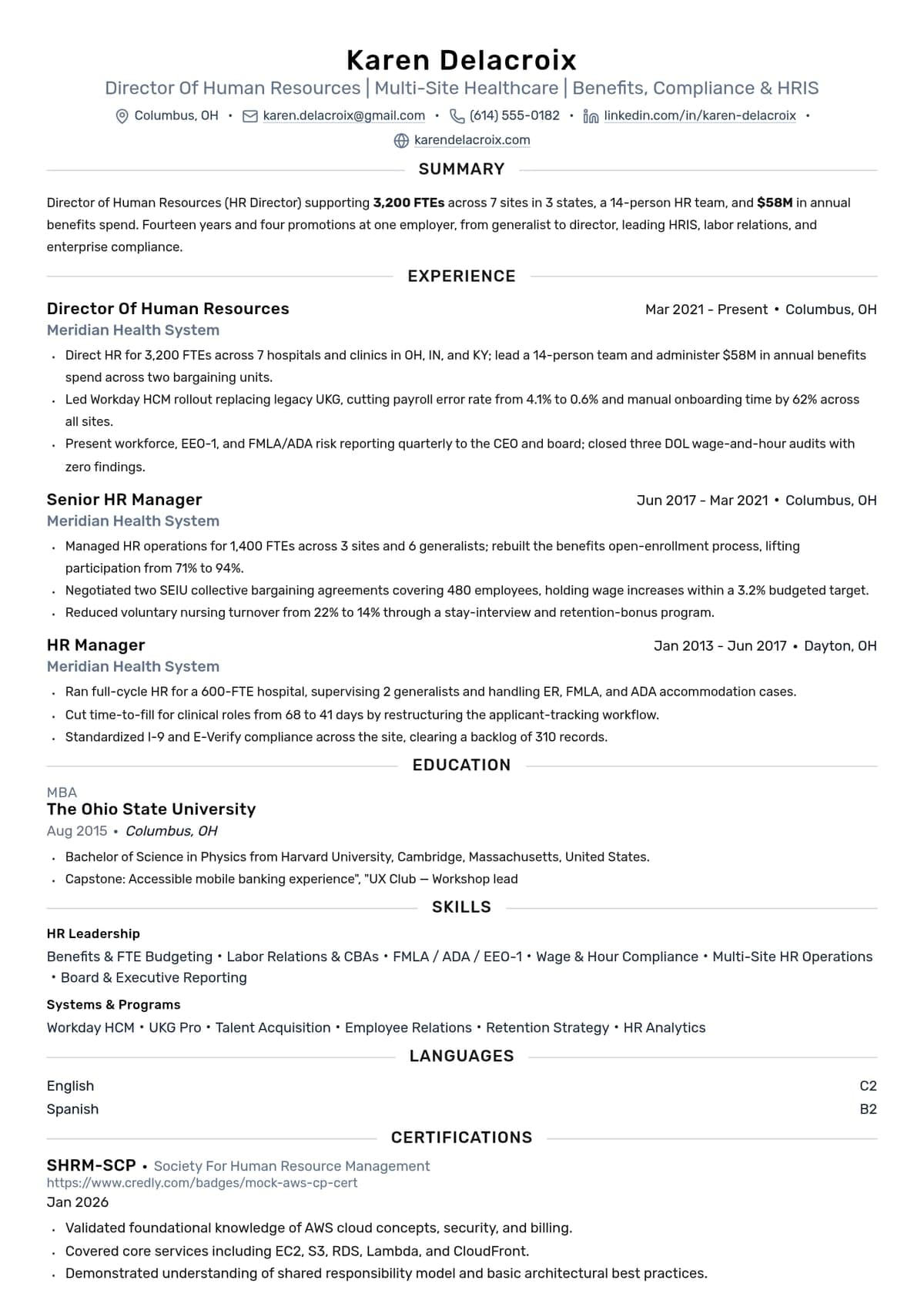
The sample: fourteen years, one employer, four titles
Read the experience block first. One company header carries the full date span, so the recruiter sees fourteen years of retention in a single line. The four titles sit nested underneath, each with its own dates, so the same fourteen years also reads as four promotions. The director title carries most of the bullets, and nearly every bullet has a denominator: how many employees, how many sites, how much spend.
Director of Human Resources or HR Director: which spelling goes at the top
Use both, in different places. Recruiters searching a resume database or an applicant tracking system (ATS) type literal strings, and the two phrasings do not match each other. A search for HR Director will not surface a resume that only ever says Director of Human Resources, and the reverse is also true. Job postings split between the two, with the formal long form more common at large employers and in healthcare, government, and education, and the short form more common everywhere recruiters type fast.
The rule that keeps you honest and findable at the same time:
- In the experience entry, use the exact title your employer gave you. A background check will surface the official title, so the entry is not the place to editorialize.
- In the headline under your name, use the phrasing of the roles you are applying to. If the posting says HR Director, your headline says HR Director.
- In the summary, work in the other variant once, naturally. A first line like "Director of Human Resources (HR Director) with 14 years in multi-site healthcare" covers both search strings without keyword stuffing.
If you want to check which strings a specific posting actually filters on, paste it into Roleframe and the fit report lists the exact keywords the posting asks for and which ones your resume already covers. Here's how to check your resume against a job description step by step.
The director of human resources resume summary: three lines, no adjectives
A director-level summary is three sentences. Line one is identity: title, years, industry. Line two is scope: the current numbers you own. Line three is one signature result, the thing you would open with in the interview. Skip the character references entirely; "strategic, results-driven HR leader" tells a recruiter nothing that "led HR for 2,400 FTEs across 11 sites" doesn't say better.
A shape that works: "Director of Human Resources (HR Director) with 14 years in multi-site healthcare. Currently lead HR for 2,400 FTEs across 11 sites in 6 states with a team of 12 and $38M in annual benefits spend. Led a full Workday HCM implementation and cut first-year nursing turnover by double digits." Swap in your numbers. The full method is in our guide to writing a professional summary, but at this level the formula is simply title, scope, win.
Nest four internal promotions under one company header
This is the single edit that changes how a long-tenure HR career reads. Four flat entries fragment your tenure into four date ranges, repeat the company name four times, and force the recruiter to do the math on whether this is loyalty or stagnation. One nested header does the math for them: fourteen years at the top, four promotions underneath.
| Before: four flat entries | After: one nested company header |
|---|---|
| Company name, Director of Human Resources, 2021–present (own entry, own bullets) | Company name, city, 2012–present, with one line of context: industry, headcount, footprint |
| Company name, Senior HR Manager, 2017–2021 (own entry, own bullets) | Director of Human Resources, 2021–present: five to six bullets, all scope and results |
| Company name, HR Manager, 2014–2017 (own entry, own bullets) | Senior HR Manager, 2017–2021: two bullets, the promotions-worthy wins only |
| Company name, HR Generalist, 2012–2014 (own entry, own bullets) | HR Manager, 2014–2017: one or two bullets |
| Company name appears four times; tenure reads as four separate jobs | HR Generalist, 2012–2014: one line, no bullets |
Two rules make the nested format work. First, bullets concentrate at the top: the director title gets the majority, and each step down gets fewer, because the recruiter is hiring the director, and the earlier titles exist to prove trajectory. Second, every title keeps its own date range on its own line. That matters for parsing: an ATS that reads a nested block attributes each role to its dates as long as the dates sit beside the title, so don't merge them into the header alone. If you're unsure how your version parses, run it through a free ATS check before you send it.
One more thing the nested header buys you: the context line. "Regional health system, 2,400 employees, 11 sites across 6 states" under the company name sets up every bullet that follows. Without it, "led HR for the organization" floats free of any scale.
Size the role: the six scope numbers recruiters look for
Director resumes fail on denominators more than on anything else. "Oversaw benefits administration" could describe a coordinator or a VP. The fix is to attach the number that establishes altitude, and at the director level there are six that matter.

| Scope number | What it proves | Where it belongs |
|---|---|---|
| FTEs supported | The size of the population you own. The single most important number on the page. | Summary, context line, and the first director bullet |
| Sites and states | Multi-site, multi-state complexity: different wage-and-hour rules, different leave laws, remote oversight. | Context line and any bullet about policy or compliance |
| Bargaining units | Labor relations exposure: negotiations, grievances, contract administration. | Its own bullet if you have them; a named skill if you support them |
| Benefits spend administered | Budget authority. A director who manages $38M in benefits spend negotiates with carriers, not just employees. | One bullet, paired with a result like renewal savings |
| HR staff reporting to you | People leadership, direct and indirect. Distinguishes a director from a very senior individual contributor. | Summary and the first director bullet |
| HR operating budget | Ownership of the function's own cost, separate from benefits spend. | One bullet, if you own it |
Scope numbers are denominators; they say how big the job was. They still need results next to them. "Led HR for 2,400 FTEs" is scope. "Led HR for 2,400 FTEs and cut annualized turnover from 31% to 22% in two years" is scope plus a result, and that's the bullet shape to aim for on the director title. Aim for one number per bullet minimum, and if a bullet genuinely has no number available, ask whether it earns its line.
Write compliance as risk removed, not tasks performed
Family and Medical Leave Act (FMLA) administration, Americans with Disabilities Act (ADA) accommodations, EEO-1 reporting, and wage-and-hour classification are table stakes at this level. Every candidate for a director role has done them, so listing them as duties adds nothing. What separates candidates is the outcome: risk that existed and then didn't. Write these bullets from the general counsel's chair, because that's who feels the value of your work.
- Weak: "Ensured FMLA compliance across all locations." Stronger: "Rebuilt leave administration across 11 sites after an internal audit flagged inconsistent FMLA tracking; zero findings in the subsequent Department of Labor review."
- Weak: "Managed ADA accommodation requests." Stronger: "Standardized the ADA interactive process across 6 states, cutting average accommodation resolution time and eliminating a backlog of open requests."
- Weak: "Responsible for EEO-1 reporting." Stronger: "Filed EEO-1 Component 1 reports on time across 3 legal entities for 8 consecutive years, with no amended filings."
- Weak: "Handled wage and hour compliance." Stronger: "Led an FLSA reclassification of 140 roles ahead of the overtime rule change, closing an exposure identified by outside counsel with no claims filed."
Notice what the strong versions have in common: a before-state that carried risk, an action you led, and an ending where the risk is gone. Audits with zero findings, charges that never materialized, backlogs cleared. If your compliance record includes a defended charge or a settled matter, you can still frame it, carefully, as containment: what you inherited, what it cost, and what the process you built prevented afterward.
The HRIS bullet: what to quantify after a Workday or UKG rollout
A human resources information system (HRIS) implementation is often the biggest project on a director's resume, and it usually gets the vaguest bullet: "Implemented Workday." Recruiters have read that line a thousand times, and it hides everything that made the project hard. Name the system, because Workday, UKG, ADP Workforce Now, and Dayforce are all strings recruiters search. Then quantify what you actually owned.
- Headcount migrated and entities consolidated: "migrated 2,400 employees across 3 legal entities from ADP to Workday HCM"
- Modules taken live: HCM core, payroll, benefits, time tracking, recruiting, talent
- Timeline against plan: on time, or how many months, and whether within budget
- Payroll accuracy after go-live: error rate, off-cycle runs eliminated, parallel-run results
- Self-service adoption: the share of transactions that moved out of HR's inbox
- What got retired: legacy systems decommissioned, vendor contracts consolidated, manual hours removed from the HR team's week
One honesty check before you write it. "Led the Workday implementation" means you owned the budget, the vendor, and the go-live decision. If you were the HR workstream lead under an IT program manager, say that, because it's still a strong line and it's the version you can defend in the interview. An implementation claim that collapses under two follow-up questions costs more than a modest one ever would.
Board and executive lines for a director who reports to the CEO or COO
If you report to the CEO or COO, the resume should say so plainly, because reporting line is a scope number too. The cleanest placement is the first director bullet or the title line itself: "Director of Human Resources (reporting to the COO)." Then back it with evidence that you operate at that altitude, which means lines about what the executive team and board consumed from you, in their language.

- Prepared quarterly workforce reporting for the board: turnover, engagement, vacancy cost, and pay-equity progress
- Built compensation committee materials for annual executive pay and incentive decisions
- Owned succession planning for VP-and-above roles, with named successors for every critical seat
- Ran HR due diligence and integration planning for an acquisition, including retention agreements for key staff
- Advised the CEO on org design through a restructuring, including the consultation and notification obligations that came with it
These lines matter double if you're targeting a senior director of human resources or VP role next, because the screening question at that level is whether you've already operated above your title. One genuine board-facing bullet outweighs three more bullets about open enrollment.
Where the MBA, SHRM-SCP, and labor relations coursework go
When fourteen years of experience carries the resume, credentials are confirmation, and they should take up confirmation-sized space. The SHRM Senior Certified Professional (SHRM-SCP) earns two placements: after your name in the header, where a human sees it in the first second, and in a certifications section near the end, where the ATS parses it as a credential. The header alone isn't enough, because some parsers read post-name letters as part of your name rather than as a certification. The full logic is in our guide to where to put certifications on a resume.
The MBA is one line under Education: degree, school, year if it's recent enough to include. No GPA, no coursework list. Labor relations coursework is the one exception to the no-coursework rule: if you're targeting a unionized employer and your hands-on bargaining experience is thin, a line like "Graduate coursework in labor relations and collective bargaining" under the MBA signals readiness for the part of the job the posting worries about. In every other case, leave coursework off, because at director level it reads as padding.
The two-page cut for a twenty-year career at one company
Two pages is the ceiling for a director resume, and a twenty-year, one-employer career will fight you for every line. The cut that works is a detail gradient: full detail for the current title, compressed detail for the last ten to twelve years, and a single line for everything before that.
Concretely, the first five years of a twenty-year run become one line under the nested header: "Earlier roles: HR Coordinator and HR Generalist, 2006–2011." No bullets. The company header keeps the full date span, 2006 to present, so your total tenure still reads at a glance and no employment gap appears where the detail stops. What you lose is nothing a hiring committee would have read anyway; nobody screening a director candidate makes the decision on generalist-era bullets. Our guide on how far back a resume should go covers the general rule, and the nested header is what lets a one-employer career follow it without looking like it's hiding something.
Page budget for the final document: summary and skills in the top third of page one, the director title's bullets filling the rest of it, prior nested titles and any second employer on page two, then certifications and education at the bottom. Save and send it as a PDF, so the layout the recruiter sees is the layout you built.
Frequently asked questions
- What is an HR director's job description, and how should it map to my resume?
A director of human resources owns the HR function for an organization or region: talent acquisition, compensation and benefits, employee relations, compliance, HR systems, and the HR team itself, usually reporting to a COO, CHRO, or CEO. Your resume should mirror that ownership structure, with at least one quantified bullet per area rather than ten bullets about the area you like most. If the posting emphasizes one domain, labor relations or an HRIS migration for example, that domain moves up in your bullet order for that application.
- What is a good summary for a director of human resources resume?
Three sentences: identity, scope, signature win. Name the title with both spellings, state your years and industry, give the numbers you currently own (FTEs, sites, team size, spend), and close with the one result you'd open the interview with. Cut every adjective that isn't doing work; "strategic" and "dynamic" survive on no recruiter's first pass.
- What is the 7-second rule for resumes?
It's the widely repeated recruiting shorthand that a recruiter's first pass over a resume lasts only a few seconds. Nobody is running a stopwatch, but the behavior behind it is real: the first read is a skim of titles, company names, date spans, and whatever numbers stand out. That's exactly why the nested company header and scope numbers matter, since they put fourteen years of growth and the size of your role into the skim path instead of burying them in paragraph four.
- What should a resume look like for a director position?
Reverse-chronological, two pages, a three-line summary with scope numbers, promotions nested under a single company header, and plain single-column formatting that parses cleanly. Skip photos, graphics, and skill bars, because they add nothing for a human and can confuse a parser. Export as PDF so the formatting arrives exactly as you built it.
- Should a director of human resources resume be one page or two?
Two. With ten or more years of experience, a one-page resume forces you to cut the scope and results that justify the title, and no recruiter expects a director to fit on one page. The real discipline is the two-page ceiling, which is what the detail gradient above is for. See our data-backed take on one page versus two by experience level.
- Should I write HR Director or Director of Human Resources on my resume?
Both, in different places. The experience entry uses your exact official title, since that's what a background check will confirm. The headline matches the phrasing of the postings you're targeting, and the summary works in the other variant once, so a recruiter searching either string finds you.


Ready when you are
Send the tailored resume, not the generic one.
Paste a job posting and Roleframe scores your resume against it, then helps you close the gaps one approved edit at a time, so you apply while the role is still fresh.