Account Executive Resume Example: Quotas, CRMs, and the ATS
by Larbi SahliLast Updated
A full account executive resume example, plus how to format quota attainment, which CRM keywords ATS filters scan for, and where MEDDIC belongs.
Users have landed jobs at
- 1Password
- OpenAI
- Notion
- justworks
On this page
Writing an Account Executive Resume That Closes
A sales recruiter reads your resume the way you qualify a lead: fast, against a checklist, looking for a reason to move on. On the first pass they want three things to surface without hunting. Your quota attainment. Your deal size and segment. The tools and methodology you sold with. If those don't appear in the top third of the page, the rest rarely gets read.
That is why the famous "seven second rule" gets quoted so often in sales hiring. Treat the exact number as folklore, but the behavior behind it is real: the first pass is a scan, and only resumes that survive the scan get a careful read. For an account executive (AE) resume, surviving the scan means numbers, not adjectives. "Consistent top performer" is an adjective. "117% of a $1.4M quota, ranked 3rd of 42 reps" is a fact a hiring manager can price.
One clarification before the example, because applicant tracking systems (ATS) care about it too: account executive and account manager are different jobs with different keywords. An AE closes new business; an account manager grows and retains existing accounts. If your experience leans toward renewals and expansion, the account manager resume example is the better starting point. This page is for closers.
Full Account Executive Resume Example (SaaS Focus)
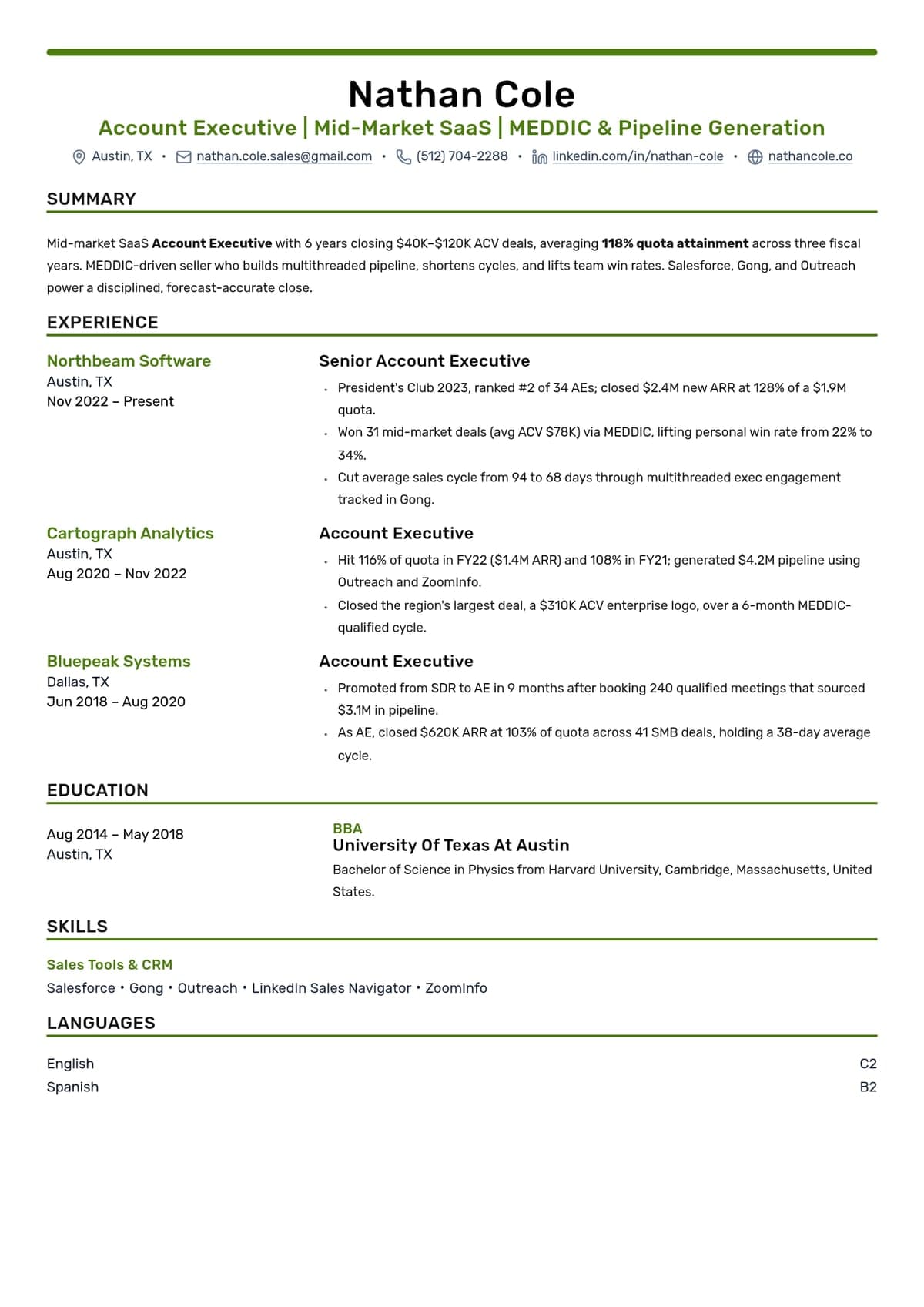
Here is what a strong mid-market SaaS account executive resume looks like when everything above is applied. Read the summary first, then the first two bullets of the most recent role. Notice that you can price this candidate, segment, quota, attainment, and methodology, before you finish the first screen.
Three things in this example are worth stealing directly.
- The summary is a qualification statement. Segment, deal size, attainment, method. No "results-driven sales professional," which describes every AE resume ever written and therefore describes none of them.
- Every bullet has a denominator. "Closed $1.1M in new ARR" is good. "Closed $1.1M in new ARR against a $950K quota" is better, because attainment only means something relative to the target.
- Tools are named exactly. "Salesforce" and "Gong" as literal strings, not "CRM and conversation intelligence platforms." Keyword filters match text, and a paraphrase matches nothing.
The CRM and Sales Tools Employers Actually Scan For
Across the account executive postings Roleframe's job-analysis engine reads for fit reports, Salesforce is the CRM named most often by a wide margin, especially in mid-market and enterprise roles. HubSpot shows up mostly in SMB and startup postings, where the whole go-to-market stack tends to run on it. That split matters more than it looks: naming only HubSpot on a resume aimed at an enterprise seat quietly signals the wrong segment, and vice versa. If you have genuinely used both, list both.
The CRM is only one of four tool categories that AE postings screen for. Here is how to think about them and how to put each on the page.
| Category | Tools employers name in postings | How to show it |
|---|---|---|
| CRM | Salesforce, HubSpot | Name the exact platform in your skills section, and show it in a bullet: "maintained forecast accuracy within 5% in Salesforce." |
| Sales engagement | Outreach, Salesloft, Apollo | Tie it to pipeline generation: sequences built, meetings booked, reply rates. |
| Conversation intelligence | Gong, Chorus | Use it as evidence of coachability: "used Gong call reviews to lift discovery-to-demo conversion." |
| Prospecting and data | LinkedIn Sales Navigator, ZoomInfo | Attach it to outbound results, not just familiarity: accounts sourced, self-generated pipeline. |
The honest answer to "which tools should I list" is always the same: the ones this specific posting names, provided you have actually used them. Postings vary, and guessing is unnecessary. Paste the job into Roleframe and the fit report shows the exact keywords that posting filters on and which ones your resume is missing, which turns tailoring from guesswork into a checklist. There is a longer walkthrough in how to check your resume against a job description.
One thing not to do: never list a tool you have not touched. Sales interviews probe tools hard, because a rep who fakes Salesforce hygiene on a resume will fake pipeline hygiene on the job. Interviewers know this and test for it.
How to Format Quota Attainment and Revenue Metrics
Quota numbers are the spine of an account executive resume, and most AEs format them badly. The pattern that works is result, then denominator, then context. Attainment percentage first, the quota it was measured against, and the ranking or environment that makes it impressive.
| Weak bullet | Strong bullet | Why it wins |
|---|---|---|
| Consistently exceeded sales targets | Hit 121% of a $1.2M annual quota in FY2024; 108% in FY2023 | A percentage without a quota is unverifiable; two years of data shows consistency instead of claiming it. |
| Closed large deals with enterprise clients | Closed $840K in new ARR across 14 deals ($60K average ACV), including two six-figure logos | Deal count plus average contract value (ACV) tells the hiring manager exactly what motion you run. |
| Strong pipeline generation skills | Self-sourced 40% of closed pipeline through outbound in Outreach and Sales Navigator | Self-sourced pipeline is the single strongest signal for a full-cycle AE role. |
| Improved win rates on the team | Lifted win rate from 22% to 31% after adopting MEDDIC qualification on all deals over $50K | Before-and-after numbers plus the mechanism reads like a rep who understands their own process. |
A few judgment calls that come up in every AE resume review I do:
- Missed a year? Don't hide it with vague language; recruiters notice suspicious gaps in a metric-heavy resume. Show the years you can defend, and if a miss had real context (territory carved mid-year, product pulled from market), be ready to explain it in the interview rather than on the page.
- No access to old numbers? Reconstruct honestly from offer letters, comp statements, or old forecast emails. Estimate conservatively and round down. An offer has been rescinded over an inflated attainment number more than once; reference checks in sales are unusually specific.
- Rankings beat percentages when quotas were soft. "Top 5 of 60 reps globally" survives scrutiny even if everyone was over 100% that year.
- Sales cycle and win rate are underused. "Average cycle of 45 days against a team average of 62" says velocity, which every VP of Sales is buying.
Adapting the Example for B2B and Enterprise Sales
An enterprise account executive resume tells a different story with the same grammar. The mid-market example above sells volume and velocity: many deals, short cycles, self-sourced pipeline. Enterprise sells depth: few deals, long cycles, and the political skill to survive them. If you are moving upmarket, rewrite the emphasis, not just the numbers.
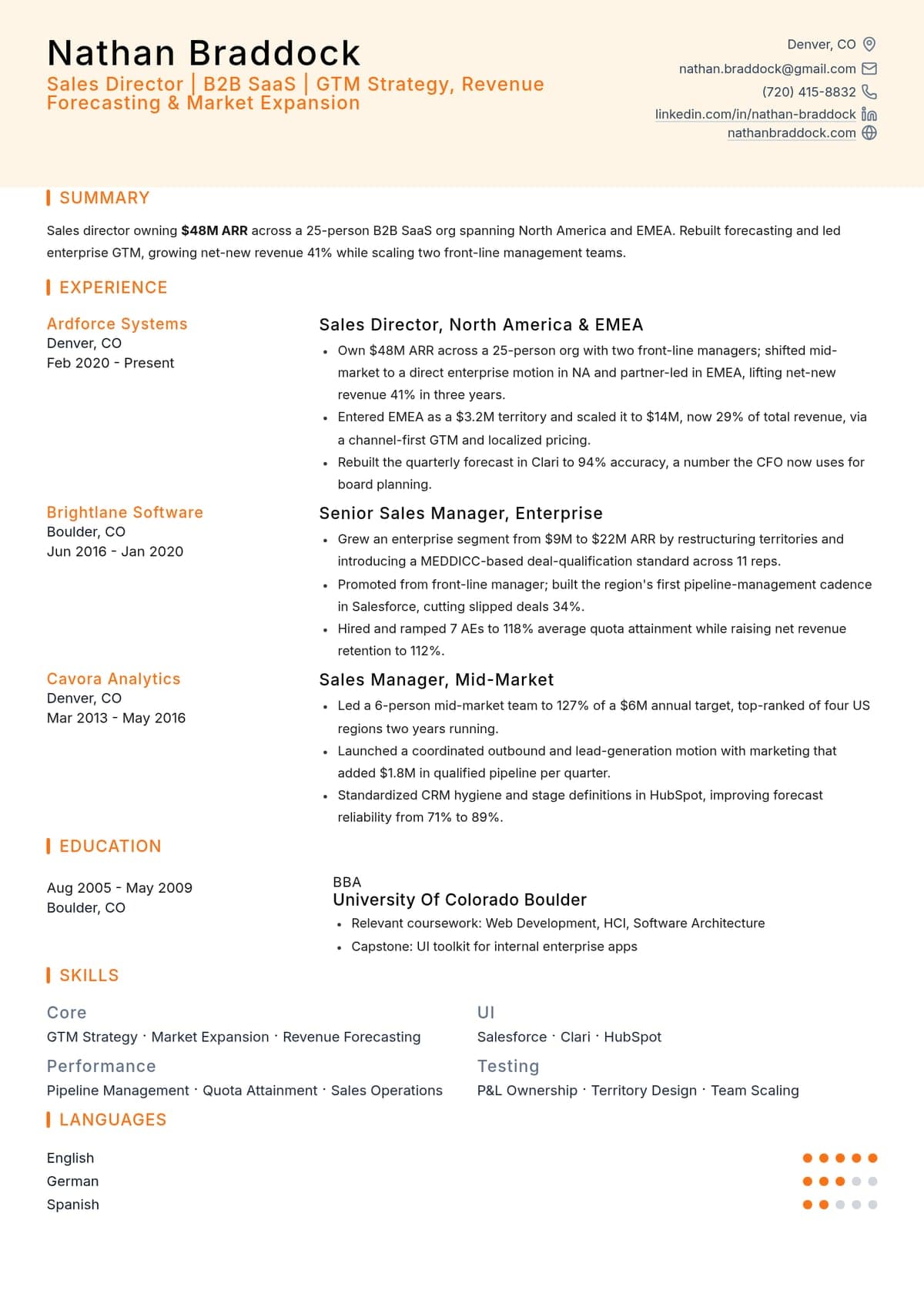
- Lead with deal complexity, not deal count. "Closed a $1.8M multi-year agreement over an 11-month cycle, multithreading across seven stakeholders including the CFO" beats any volume stat at this level.
- Name the buying process. Security reviews, procurement, legal redlines, proof-of-concept phases. Surviving these is the enterprise skill, and a resume that names them reads as someone who has actually been in the room.
- Show account strategy. Named-account lists, territory plans, land-and-expand results. If you grew an initial deal into a larger footprint, quantify the expansion.
- Executive access is a metric. "Built and maintained relationships with three C-level economic buyers" is a legitimate bullet in enterprise; it would sound like filler in SMB.
Junior AEs and SDRs moving into a closing seat run the same logic in reverse: lead with the numbers you do own (meetings booked against target, pipeline sourced, conversion to opportunity) and any closing exposure at all, even assisted deals. A junior account executive resume with real activity metrics beats a padded one every time.
Translating Sales Methodologies (MEDDIC, BANT) for the ATS
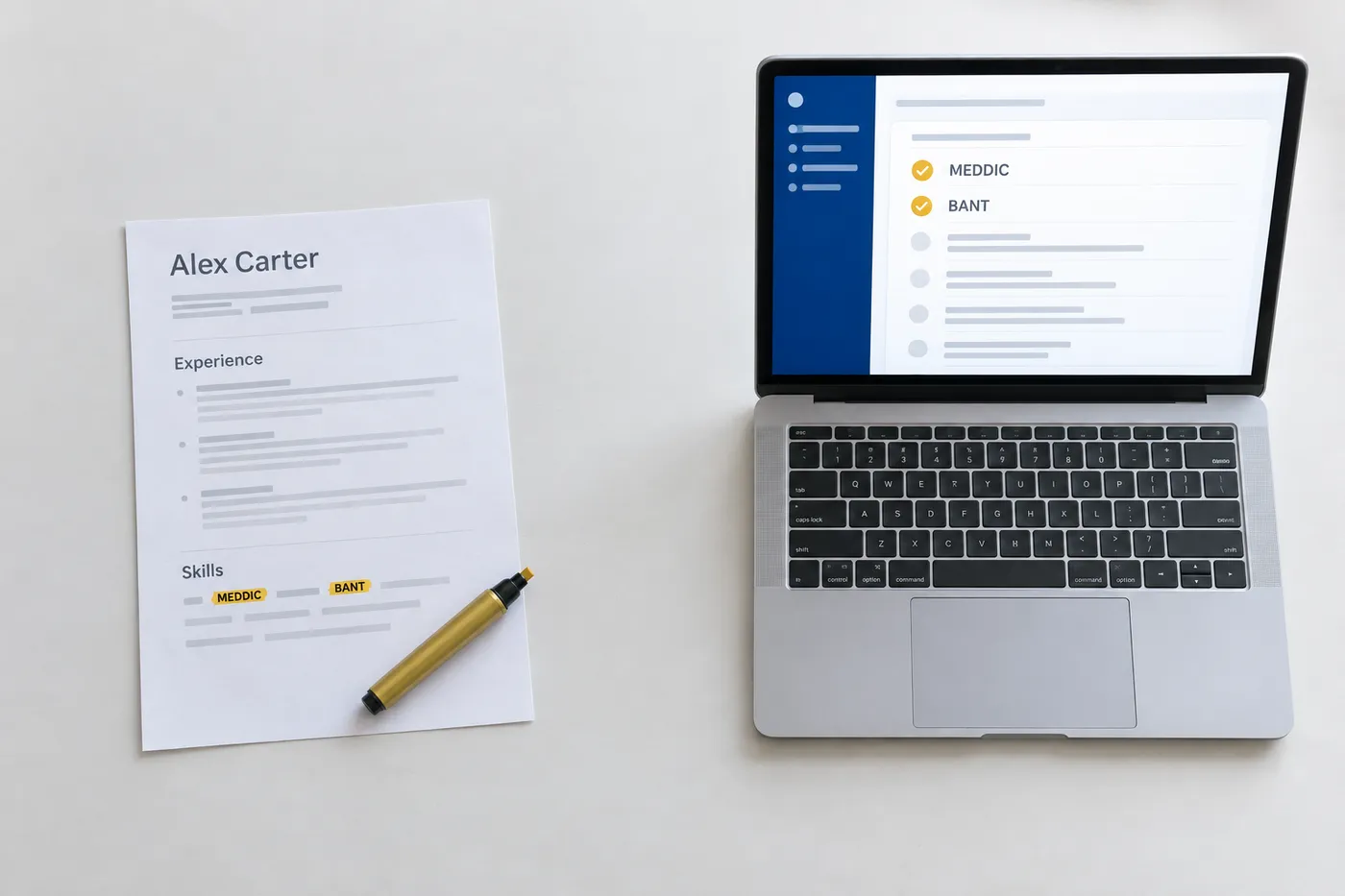
Sales methodologies are keywords with unusually strict matching, because they are acronyms. If the posting says MEDDPICC and your resume says MEDDIC, a literal keyword filter may not connect them, and a recruiter scanning fast may not either. Write the exact variant you were trained and certified in: MEDDIC (Metrics, Economic buyer, Decision criteria, Decision process, Identify pain, Champion), MEDDPICC if your org added Paper process and Competition, BANT (Budget, Authority, Need, Timeline), Challenger, SPIN, Sandler, or Command of the Message.
Methodologies belong in two places. In the skills section as the plain acronym, for the filter. And in at least one experience bullet showing application, for the human: "qualified all opportunities over $50K through MEDDIC, cutting late-stage slippage by a third." A methodology listed but never demonstrated reads like a course you attended once; a methodology in a bullet with a result reads like how you actually sell. There is a broader principle here that applies to every keyword on the page, covered in how ATS resume keywords actually work.
One warning: do not stack four methodologies in your skills section to cover every posting. Hiring managers read that as "trained in everything, disciplined in nothing." Pick the one or two you genuinely run deals with, and match the posting's language when it names one you know.
Using Remi to Tighten Your Sales Summary
The summary is where most AE resumes go generic, because it is the hardest section to write about yourself. The fix is mechanical: segment, deal size, attainment, methodology, in two or three lines. If any of those four is missing, the summary is doing less than it could. The full pattern, with examples across roles, is in how to write a professional summary.
This is also the one section where an AI assistant earns its keep, if it works the right way. In Roleframe, Remi, the career copilot, reads the fit report for the job you attached, sees which keywords the posting asks for that your summary is missing, and proposes a rewrite as a word-by-word diff. You see exactly what it would remove and add, and nothing changes until you approve it. That approval step is the point. A summary you did not write collapses in the first interview question, because "tell me about yourself" is essentially your summary read aloud. Remi drafts from your real numbers and the posting's real language; the words that ship are ones you signed off on and can say out loud.
Drag Your Biggest Wins to the Top
Section order on an AE resume is a forecasting decision: put the highest-probability material first. A rep with President's Club and three years of overattainment should not open with education, and a candidate whose best asset is a tool stack matching the posting exactly might pull skills above experience for that one application. The general logic by experience level is in the best resume section order, but for AEs the rule compresses to one line: whatever proves you close goes first.
Most resume builders make reordering painful enough that nobody does it, which is why most resumes ship in template order. Roleframe's editor treats sections as movable blocks: grab the handle on any section and drag it above another, into a column, or onto a different page, and it keeps its content, dates, and formatting. Moving your "Selected wins" block above your work history for an application that deserves it takes the same ten seconds it took to decide to.
Start With a Free Document-Grade Editor
You do not need to pay anyone to build this resume. Roleframe's editor is free to use with no account: every template, full layout control, drag and drop, and a PDF download with no watermark and no trial. If you already have a resume, upload the PDF and it comes back as editable blocks with an analysis attached, so the first thing you see is a scored document with its weak sections named rather than a blank page.
Submit as PDF, always. It is what preserves your formatting through every ATS and every hiring manager's screen, and it is what Roleframe exports. The only exception is an employer that explicitly demands another format, and even then, PDF is the version you keep as the source of truth.
Frequently asked questions
- What is the 7 second rule on a resume?
It is the common claim that recruiters spend only a few seconds on the first pass of a resume. Treat the exact number as folklore, but the behavior is real: the first read is a scan, not a study. For an account executive resume, that means quota attainment, deal size, and segment must be visible in the top third of the page, in the summary and the first bullets of your most recent role.
- What skills does an account executive need on a resume?
Four categories: closing evidence (quota attainment, ARR closed, win rate), pipeline generation (outbound, self-sourced pipeline percentage), tools (the exact CRM and sales engagement platforms the posting names, such as Salesforce, HubSpot, Outreach, or Gong), and a qualification methodology like MEDDIC or BANT. Soft skills like negotiation and discovery matter, but they should appear inside quantified bullets rather than as a list of adjectives.
- What is a good summary for an account executive resume?
Two to three lines covering segment, deal size, attainment, and methodology. For example: a mid-market SaaS AE running $40-80K ACV deals, with multi-year overattainment and MEDDIC qualification. Skip openers like "results-driven sales professional," which carry no information a hiring manager can act on. A summary beats an objective for anyone with closing experience; see summary vs. objective for the edge cases.
- What is an account executive's job description?
An account executive owns the closing motion: running discovery, demos, and negotiations to convert qualified opportunities into revenue, usually against a quota. Depending on the company, the role may also include outbound prospecting (full-cycle) or receive leads from a sales development team. It differs from an account manager, who grows and retains existing customers rather than winning new ones, and your resume keywords should match the side you actually work.
- Should an account executive resume be one page or two?
One page for most AEs under roughly ten years of experience; two pages is defensible for senior enterprise reps with long, complex deal histories worth detailing. The real constraint is density: every line should carry a number or a named tool. The general breakdown by experience level is in should a resume be one page or two.
- Should I include a year where I missed quota?
Don't volunteer a miss on the page, but don't create a suspicious gap in an otherwise year-by-year metric history either. Show the years you can defend, use rankings when raw attainment was weak ("top 20% of the team" can be true in a down year), and prepare an honest, contextual explanation for the interview. Fabricating attainment is the one unforgivable move; sales reference checks are specific, and offers get pulled over it.
- Should I submit my account executive resume as a PDF or a Word file?
PDF, unless the employer explicitly asks for something else. PDF preserves your layout through ATS parsing and on every screen a hiring manager opens it on, which matters for a metric-dense resume where alignment carries meaning. Roleframe exports exactly what you see in the editor as a PDF, so what the recruiter receives is what you built.
Ready when you are
Send the tailored resume, not the generic one.
Paste a job posting and Roleframe scores your resume against it, then helps you close the gaps one approved edit at a time, so you apply while the role is still fresh.