
Account Manager Resume Examples (Plus the CRM Keywords Employers Screen For)
by Larbi SahliLast Updated
Account manager resume examples with the CRM tools and retention keywords employers screen for, plus how to quantify quota, renewals, and revenue growth.

On this page
An account manager resume gets judged on one question: can this person keep revenue and grow it? Recruiters scan for a book of business, a retention or renewal number, quota attainment, and the CRM you worked in. If those four things are not visible in the top half of page one, the rest rarely gets read.
This guide shows you a complete account manager resume example, breaks down why each section works, and lists the CRM and sales tools that show up again and again in real account manager job postings. You will also get concrete patterns for quantifying quota and revenue, a summary formula built around retention and upselling, and industry-specific tailoring advice for B2B SaaS, agencies, finance, and more.
What Sales Recruiters Look For in an Account Manager Resume
Account management sits between sales and customer success, and recruiters read the resume for proof you can do both halves. The screen usually comes down to five signals, in roughly this order.
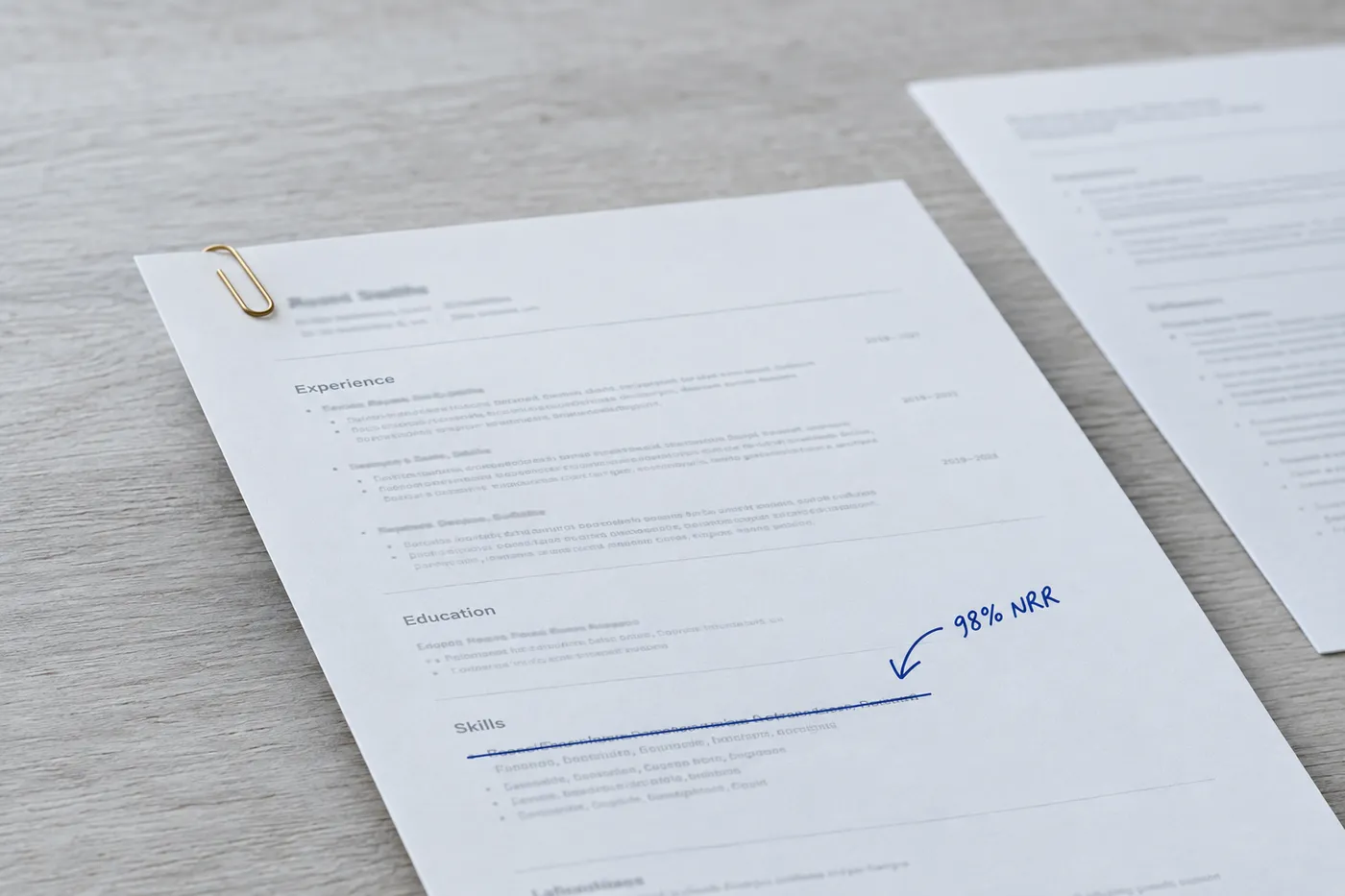
- Revenue ownership. The size of the book you managed, in dollars and account count. "Managed 40 mid-market accounts worth $3.2M in ARR" answers the first question a hiring manager has.
- Retention and renewals. Gross or net revenue retention, renewal rate, or churn reduction. This is the metric that separates account managers from pure hunters, and it is the one most resumes leave out.
- Growth on existing accounts. Upsell, cross-sell, and expansion revenue. Recruiters want evidence you grew accounts, not just kept them alive.
- Quota attainment. Percentage of quota hit, how many consecutive quarters or years, and rank against the team if you were near the top.
- Tools. The CRM in the posting, named exactly. A Salesforce shop filtering on "Salesforce" will not surface a resume that only says "CRM software."
Notice what is missing from that list: responsibilities. Every account manager "maintained client relationships" and "served as the main point of contact." Those lines are invisible because they appear on every competing resume. The signals above are outcomes, and outcomes are what get you the call. If you want the underlying method for finding the exact terms a given posting filters on, the approach in our guide to ATS resume keywords applies directly here.
Account Manager Resume Example: B2B SaaS
The example below is a mid-level account manager in B2B software, the most common flavor of the role and the one most postings describe. Look at how it front-loads a retention number in the summary, names the book of business in the first bullet of the current role, and pairs every relationship claim with a revenue outcome. That pairing is the whole trick: relationship-building on its own is a soft claim, but "grew the account" makes it a hard one.
Marcus Delgado
Account Manager | B2B SaaS | Retention & Expansion Revenue

Summary
Account manager holding 118% net revenue retention across a $6.4M mid-market book in B2B SaaS. Six years turning renewals into expansion through Salesforce and Gainsight-driven QBRs, adoption playbooks, and multi-threaded relationships. Hit or beat quota nine consecutive quarters while cutting logo churn from 14% to 6%.
EXPERIENCE
Senior Account Manager, Mid-Market
Own a $6.4M book of 38 mid-market SaaS accounts, running quarterly business reviews in Gainsight that lifted net revenue retention to 118% and hit 112% of a $1.9M expansion quota across nine straight quarters.
Multi-threaded champions and economic buyers to drive $840K in upsell and cross-sell, growing seat and module expansion 27% year over year.
Rebuilt at-risk playbooks in Salesforce, lifting gross renewal rate to 94% and cutting logo churn from 14% to 6%.
Account Manager
Managed 52 SMB and mid-market accounts worth $3.1M, closing 106% of renewal quota by sequencing outreach in Salesloft tied to HubSpot health scores.
Grew existing-account revenue $410K through structured upsell motions and executive alignment on renewal timing.
Reduced 90-day onboarding churn 22% by partnering with CS on adoption milestones.
Account Coordinator
Supported a $2.4M portfolio across two AMs, prepping renewal quotes and usage reports in Salesforce for 60+ accounts.
Flagged early churn signals from product data, contributing to a 9-point retention lift on the assigned segment.
Coordinated cross-sell handoffs that sourced $180K in qualified expansion pipeline.
EDUCATION
University of Colorado Boulder
BA
Bachelor of Science in Physics from Harvard University, Cambridge, Massachusetts, United States.
SKILLS
CRM & Sales Tools
Account Management
LANGUAGES
PROJECTS
Renewal Forecast Playbook
Program Lead
https://github.com/username/project
Built a Salesforce and Gainsight renewal-risk scoring model adopted by 14 AMs, improving forecast accuracy 19% and surfacing $1.2M in at-risk revenue a quarter early.
CERTIFICATIONS
Salesforce Certified Administrator
Validated foundational knowledge of AWS cloud concepts, security, and billing.
Covered core services including EC2, S3, RDS, Lambda, and CloudFront.
Demonstrated understanding of shared responsibility model and basic architectural best practices.
AWARDS
President's Club, Top Retention AM
Northpeak Software
Recognized for building a cloud-native AI productivity tool.
Why this example works, section by section
The summary sells retention first. It opens with the metric account manager hiring teams care about most, net revenue retention, then adds book size and quota history. Three sentences, three numbers, zero adjectives about being a "passionate relationship builder."
Experience bullets follow a scope-action-result shape. The first bullet under each role establishes scope: how many accounts, worth how much, in what segment. Everything after that is action plus result. A recruiter who reads only first bullets, and many do, still gets the full career story.
Tools live in the skills section and in the bullets. Salesforce appears in the skills list for the keyword filter, and again inside a bullet ("built renewal forecasting dashboards in Salesforce") for the human reader who wants proof you actually used it. Listing a tool twice this way is not stuffing; it is context.
It fits comfortably on one page. With five to six years of experience, one page is the right call. Two pages become defensible around eight to ten years or when you move into key account or strategic account territory. Our breakdown of one page vs. two by experience level covers where the line sits.
Key Account Manager Resume: What Changes at the Senior Level
A key account manager (KAM) resume is not a regular account manager resume with bigger numbers. The role changes shape, and the resume has to change with it. Key account postings ask for fewer accounts, deeper penetration, and executive-level relationships, so the same person applying to a KAM role should rewrite around four shifts.
- Depth over breadth. "Managed 8 strategic accounts worth $12M" beats "managed 60 accounts." Small account counts with large values signal you can handle complexity, multi-stakeholder buying committees, and long renewal cycles.
- Executive relationships, named by level. "Built quarterly business review cadence with VP and C-level sponsors at 8 enterprise accounts" is a KAM bullet. "Maintained strong client relationships" is not.
- Account planning as a discipline. Key account postings frequently ask for account plans, white-space analysis, and multi-year growth strategy. If you have done any of it, name it with those words, because that is what the filter searches for.
- Cross-functional leadership. KAMs pull in product, legal, finance, and delivery teams to serve one account. A bullet showing you led a cross-functional team to save or expand a strategic account carries more weight than another quota line.
One structural note: on a key account manager resume, consider a short "Selected Account Wins" subsection under your current role, two or three lines each naming the situation, what you did, and the revenue outcome. At this level, one saved $2M renewal tells a better story than ten generic bullets.
Top CRM and Sales Tools Employers Ask For
Across the account manager postings Roleframe's job-analysis engine reads, Salesforce is the CRM named most often, and by a wide margin. HubSpot shows up heavily in postings from smaller companies and agencies, while customer success platforms like Gainsight appear mostly in SaaS postings where the account manager owns renewals. The pattern that matters for your resume: postings name specific tools, and applicant tracking system (ATS) keyword filters match on the exact name, so "CRM experience" on your resume does not match a filter set to "Salesforce."

| Tool | Category | Where it shows up most | How to list it |
|---|---|---|---|
| Salesforce | CRM | The default across mid-market and enterprise postings in nearly every industry | Name it in skills, then show usage in a bullet (pipeline reports, renewal dashboards, opportunity management) |
| HubSpot | CRM / marketing platform | Startups, agencies, and SMB-focused companies | List it alongside Salesforce if you know both; many teams migrate between the two |
| Gainsight | Customer success platform | B2B SaaS roles where the AM owns retention and health scores | Pair it with a churn or NRR bullet, since that is why the employer wants it |
| Salesloft / Outreach | Sales engagement | Roles with an expansion or upsell quota | Mention it in a bullet about outbound cadences to existing accounts |
| Microsoft Dynamics | CRM | Enterprise, manufacturing, and companies deep in the Microsoft stack | Name the exact product; "Dynamics 365" matches filters that "Microsoft CRM" misses |
| LinkedIn Sales Navigator | Prospecting / research | Hybrid AM roles with a new-business component | One skills-line mention is enough unless prospecting was a core duty |
| Excel / Google Sheets | Reporting | Almost universal, often as "forecasting" or "account reporting" | Show it through a forecasting or QBR-prep bullet rather than a bare skills entry |
The practical rule: mirror the posting. If the job names Salesforce and you have Salesforce, it goes in your skills section spelled exactly that way. If the posting names a tool you have not used but you know a direct equivalent, say so honestly ("HubSpot CRM; familiar with Salesforce workflows") rather than claiming the tool outright. A tool claim you cannot back up collapses in the first screen call.
Writing a Summary Focused on Retention and Upselling
The summary is three sentences at the top of the page, and for account managers it should do three jobs: establish the segment and book size, prove retention, and prove growth. Adjectives do none of those jobs. Numbers do all three.
A formula that works: [Role and years] managing [book size and segment]. [Retention or renewal metric]. [Growth metric and quota history]. Two examples of the shape:
- "Account manager with 6 years in B2B SaaS managing a $3.2M mid-market book of 40 accounts. Sustained 118% net revenue retention over the last two years. Exceeded expansion quota 9 of the last 10 quarters through structured QBRs and cross-sell plays."
- "Key account manager with 9 years in logistics, owning 8 strategic accounts worth $14M annually. Renewed 100% of contracts over three cycles while growing account revenue 22%. Led cross-functional teams of up to 12 through complex multi-year renewals."
Notice neither example says "results-driven," "dynamic," or "passionate about client success." Those words fill space that a renewal rate should occupy. If you are unsure whether your top section should be a summary at all, our guide on writing a professional summary walks through the structure with more examples across seniority levels.
How to Quantify Quota Attainment and Revenue Growth
Sales roles are the easiest resumes to quantify and, oddly, most account manager resumes still read like job descriptions. The fix is mechanical. Take each vague bullet and ask: how much, how many, compared to what, over what period. Here is what that looks like in practice.
| Weak bullet | Quantified rewrite |
|---|---|
| Responsible for managing client accounts and ensuring satisfaction | Managed 35 mid-market accounts worth $2.8M ARR; maintained a 96% gross renewal rate across two fiscal years |
| Consistently met sales targets | Attained 100%+ of expansion quota for 8 consecutive quarters, ranking top 3 on a 14-person AM team |
| Identified upsell opportunities within existing accounts | Generated $640K in upsell revenue by mapping unused product modules against account goals during quarterly reviews |
| Reduced customer churn | Cut logo churn from 14% to 8% in one year by building an early-warning process on usage data flagged in Gainsight |
| Worked closely with clients to resolve issues | Recovered 4 at-risk accounts worth $1.1M combined by running executive escalation reviews with product and support leads |
Three rules for the numbers themselves. First, use real figures you can defend in an interview; a hiring manager will ask how the 118% NRR was calculated, and "I estimated it for the resume" ends the conversation. Second, if company policy or a small sample makes an exact dollar figure sensitive, use percentages and account counts instead. Third, anchor every number: "grew revenue 22%" means little without "on an $8M book" or "against a 10% team average."
If you genuinely cannot recover a metric, quantify the scope instead of the result. "Sole account manager for the company's 3 largest clients, representing roughly 40% of annual revenue" contains no performance number and still says plenty.
Soft Skills That Actually Matter (and How to Prove Them)
Account manager postings lean harder on relationship language than almost any other role. In the postings our job-analysis engine reads, phrases like "relationship building," "client retention," "stakeholder management," "cross-functional collaboration," "negotiation," and "customer-centric" recur constantly, often in the requirements section where filters look. That creates a trap: candidates copy the phrases into a skills list, and the list proves nothing.
The move that works is to keep the phrase, because the filter may search for it, but carry the proof in a bullet. "Negotiation" in a skills list is noise; "negotiated 14 renewals averaging a 6% price increase with zero logo churn" is evidence. Pair each soft-skill keyword with one bullet:
- Relationship building → multi-year renewal streaks, expansion within accounts, named stakeholder levels ("director and VP sponsors")
- Stakeholder management → number of stakeholders per account, buying-committee size, QBR cadence you ran
- Negotiation → renewal terms, price increases held, contract values, discount reduction
- Cross-functional collaboration → teams you pulled in (product, legal, finance) and the account outcome that resulted
- Communication → the artifact, not the adjective: QBR decks, account plans, executive briefings you owned
For a deeper look at where soft skills belong on the page and where they just take up space, see hard skills vs. soft skills on your resume.
Tailoring Your Account Manager Resume for Different Industries
Account management exists in nearly every industry, and each one weighs the signals differently. The core resume stays the same; the emphasis shifts. A few of the most common variants:
- B2B SaaS: lead with ARR, net revenue retention, and expansion revenue. Name the CRM plus a success platform (Gainsight, ChurnZero) if you used one. Churn reduction bullets carry the most weight here.
- Agency and advertising: lead with retainer value, client roster size, and scope growth ("expanded a $200K retainer to $450K by adding two service lines"). Client names matter if you can use them; anonymize by segment if you cannot.
- Banking and financial services: a "bank account manager" posting often means a portfolio or relationship-management role. Emphasize portfolio value, compliance awareness, and product cross-sell (lending, treasury, cards). Regulatory language from the posting belongs on the resume verbatim.
- Manufacturing and logistics: contract renewals, on-time delivery outcomes you influenced, and long sales cycles. Dynamics 365 and SAP references show up more here than Salesforce.
- Healthcare and pharma: territory or account portfolio value, formulary or procurement wins, and any compliance training. Named certifications go near the top if the posting requires them.
The honest way to do this per application is to read the posting first and let it set your emphasis, which takes discipline when you are applying to twenty roles. This is the specific problem Roleframe is built for: paste the posting, and the fit report on your tailored version shows your ATS score against that job, the exact keywords it filters on that your resume is missing, and a prioritized plan. Then Remi, the career copilot in the editor, helps you rewrite the bullets that need it, one proposal at a time, with you approving every change. Roleframe never rewrites the resume for you, which is the point; a bullet you approved is a bullet you can defend in the interview.
Build Your Account Manager Resume for Free
Start from the example on this page. Open Roleframe's free resume editor, no account and no card required, pick an ATS-friendly template, and rebuild your experience using the scope-action-result bullet shape above. If you already have a resume, upload the PDF and it comes back as editable blocks with a scored analysis, so you start from your weakest sections instead of a blank page.
When you export, save as PDF. It preserves your formatting exactly, every modern ATS parses it cleanly, and it is what Roleframe outputs; the PDF matches the editor pixel for pixel. Only send a Word file if an employer explicitly asks for one, and treat PDF as the default everywhere else.
Frequently asked questions
- What should I include on my resume as an account manager?
Five things, in the top half of page one: the size of your book of business (dollar value and account count), a retention or renewal metric, quota attainment, growth on existing accounts (upsell or expansion revenue), and the CRM you worked in, named exactly. Add a three-sentence summary built on those numbers, then experience bullets that pair actions with revenue outcomes. Skip the responsibilities-only bullets; every account manager "maintained client relationships," so the line carries no signal.
- What are the most important skills for an account manager resume?
The hard skills employers filter on: a named CRM (Salesforce most often, HubSpot for smaller companies), forecasting and pipeline reporting, contract renewals, and account planning. The soft skills postings ask for most are relationship building, stakeholder management, negotiation, and cross-functional collaboration. List the phrases for the keyword filter, but prove each one in a bullet, because "negotiation" in a skills list means nothing while a renewal bullet with a price increase and zero churn means everything.
- What are the main responsibilities of an account manager, and how do I show them?
The core of the role is owning a set of existing customer accounts: renewals, retention, growth through upsell and cross-sell, and being the client's main contact into the company. On the resume, show each responsibility as an outcome rather than a duty. "Owned renewals" becomes "renewed 96% of a $2.8M book across two fiscal years." The responsibility is implied; the result is what gets read.
- Should an account manager resume be one page or two?
One page through roughly seven or eight years of experience; two pages become defensible for senior, key account, or strategic account roles with a longer track record worth showing. Cut older roles to two or three bullets rather than padding to fill a second page. Our data-backed breakdown of one page vs. two pages covers the thresholds by experience level.
- Should I submit my account manager resume as a PDF or a Word document?
PDF, as the default. It locks your formatting so the recruiter sees exactly what you built, and modern applicant tracking systems parse it without trouble. Send a Word file only if a specific employer or portal explicitly requires one. Roleframe's editor exports a clean, ATS-friendly PDF that matches the editor exactly.
- How do I write an account manager resume without account management experience?
Translate adjacent experience into the metrics account manager hiring teams screen for. Customer success, inside sales, retail management, and client-facing support roles all produce retention, upsell, and relationship evidence; you just have to frame it that way. A support lead who "reduced escalations 30% for the company's top 20 accounts" has an account management bullet. Use a summary that names the target role and leads with your most transferable number.
- Is an account manager CV different from an account manager resume?
For jobs in the US, no; treat "CV" and "resume" as the same one-to-two page document built around the metrics in this guide. In the UK, Ireland, and much of Europe, "CV" is simply the standard word for that document, and the same structure applies. The multi-page academic CV is a different format and irrelevant for account management roles.


Ready when you are
Send the tailored resume, not the generic one.
Paste a job posting and Roleframe scores your resume against it, then helps you close the gaps one approved edit at a time, so you apply while the role is still fresh.