
Teacher Cover Letter Example (And How to Tailor Yours)
by Larbi SahliLast Updated
A real teacher cover letter example, plus the two phrases most applicants skip: classroom management and differentiated instruction. Tailor yours fast.

On this page
Principals read cover letters. That alone makes teaching unusual. In most industries the letter is a formality, but in K-12 hiring the person screening your application is often the same person who will supervise you, and they use the letter to answer one question: can I picture this person in front of my students?
Read a stack of teaching job postings and two phrases repeat more than any others: classroom management and differentiated instruction. They are also the phrases teacher applicants most often leave out of their letters, usually because candidates describe what they do without using the language the district searches and screens for. A letter that names both, with a real example behind each, immediately separates you from the pile.
This page gives you a complete teacher cover letter example, a breakdown of why each paragraph earns its place, and a practical process for adapting it to any school, grade level, or first-year situation.
Why a generic teacher cover letter gets ignored
A generic teacher letter reads like a personal statement from a credentialing program: a paragraph about a passion for education, a paragraph about believing every child can learn, a closing that thanks the committee for its time. Principals have read that letter hundreds of times. It tells them nothing about how you run a room on a Tuesday afternoon in November.
The problem compounds at the district level. Larger districts route applications through an applicant tracking system (ATS), the software that stores and filters candidates, and screeners search it for the exact competencies the posting names. If the posting asks for experience with differentiated instruction and your letter talks about "meeting students where they are," you said the same thing in words the search will never find.
The fix is specificity in two directions at once. Use the district's language for the competencies they screen for, and attach your own evidence to each one. "I use restorative practices and clear routines to keep a class of 28 on task" beats "I am passionate about creating a positive learning environment" every single time, and it takes the same number of words.
Elementary vs. high school: how your letter should change
The same teacher writing to an elementary school and a high school should produce two noticeably different letters, because the hiring principal is worried about different failure modes. An elementary principal wants to know you can manage a full day with the same 25 children and communicate with their parents. A high school principal wants subject-matter depth and evidence you can hold the attention of teenagers who would rather be anywhere else.
| What to emphasize | Elementary letter | High school letter |
|---|---|---|
| Classroom management | Routines, transitions, and behavior systems that work across a full day with one group | Engagement strategies for five different periods, and how you handle disengagement and phones |
| Instruction | Literacy and numeracy foundations, small-group rotations, differentiated instruction across wide skill gaps | Content expertise, course-level curriculum design, preparing students for AP, state exams, or graduation requirements |
| Relationships | Parent communication: newsletters, conferences, how you handle a difficult conversation | Student rapport, advisory or club sponsorship, counselor and department collaboration |
| Data | Reading levels, benchmark growth, intervention groups | Pass rates, exam scores, credit recovery, closing gaps for specific student populations |
| Extras that help | Specials collaboration, RTI/MTSS experience, ESL or special education endorsements | Coaching, extracurricular sponsorship, dual-credit or industry certifications |
Middle school sits between the two: emphasize management and engagement like an elementary letter, with the subject depth of a high school one. If the posting is for a specific program (dual language, IB, a Title I school with a heavy intervention focus), that program becomes the spine of your letter, whatever the grade level.
Teacher cover letter example: experienced educator
Here is what a strong letter from a working teacher looks like. Notice as you read it that every paragraph makes a claim and immediately backs it with something concrete: a number, a named practice, a specific program at the target school. Nothing in it could be copied into an application for a different school without editing, which is exactly the point.
Megan Caldwell
Upper-Elementary Teacher | Literacy & Math Intervention | Restorative Classroom Management
Cover Letter
Dear Hiring Manager,
Last spring, 22 of my 26 fourth-graders finished the year reading at or above grade level, up from 11 in September, and my class posted an average of 1.4 years of math growth on the i-Ready diagnostic. That is the work I want to keep doing at Willow Creek Elementary, and your posting for a fifth-grade teacher is exactly the fit I have been hoping to find.
I hold a Colorado Professional Teacher License with endorsements in Elementary Education (K-6) and Culturally and Linguistically Diverse Education. Over six years I have built a classroom that runs on clear, co-created routines paired with restorative practices, so instructional time is protected and conflicts become conversations rather than office referrals; my referral rate dropped 60% the year I introduced daily community circles.
Differentiated instruction is the core of how I teach. In a class spanning a second- to sixth-grade reading range, I run four small-group rotations built from running-record and exit-ticket data, meeting each group at its level while keeping the whole class moving toward the same standard. Your school's commitment to project-based, standards-aligned learning is precisely the environment where that approach thrives.
I would welcome the chance to walk you through my literacy block and student growth data in person, and to hear where your team most needs support this year.
Warm regards,
Megan Caldwell

Teacher cover letter example: first-year teacher
A first-year teacher writes the same letter with different evidence. You do not have benchmark data from your own classroom yet, so the raw material comes from student teaching, and student teaching gives you more than most new graduates realize. You planned units, ran a room solo for weeks, differentiated for real students with real IEPs (individualized education programs), and got observed and coached. That is evidence, and it belongs in the letter with the same specificity an experienced teacher would use.
Adapt the example above for a first-year application with these substitutions:
- Replace the opening career summary with your strongest student-teaching outcome: "During my 16-week placement in a 4th-grade classroom, I planned and taught a full literacy block for 26 students, including small-group instruction for six students reading below grade level."
- Name your management training explicitly. If your program trained you in a specific framework (responsive classroom, PBIS, restorative practices), say so, then describe one moment where you applied it under pressure.
- Use your cooperating teacher's feedback as third-party evidence: "My cooperating teacher noted that my transitions and routines held up even on days she was out of the room."
- Lead with your certification status and expected date if the license is still in process. Principals hire pending licenses all the time, but only when the timeline is stated plainly.
- Show hunger for the specific school, since you cannot show tenure. Mention the school's program, its student population, or its instructional model, and connect it to why you trained the way you did.
What a first-year letter must never do is apologize. "Although I lack experience" is a sentence that has cost more new teachers interviews than any typo. The principal knows you are a new graduate. The posting was probably budgeted for one. Your job is to show that your training was rigorous and your judgment is sound, and apologizing does the opposite of both.
Breaking down the example: why it works
Four decisions carry the example above, and they are the ones to steal for your own letter.
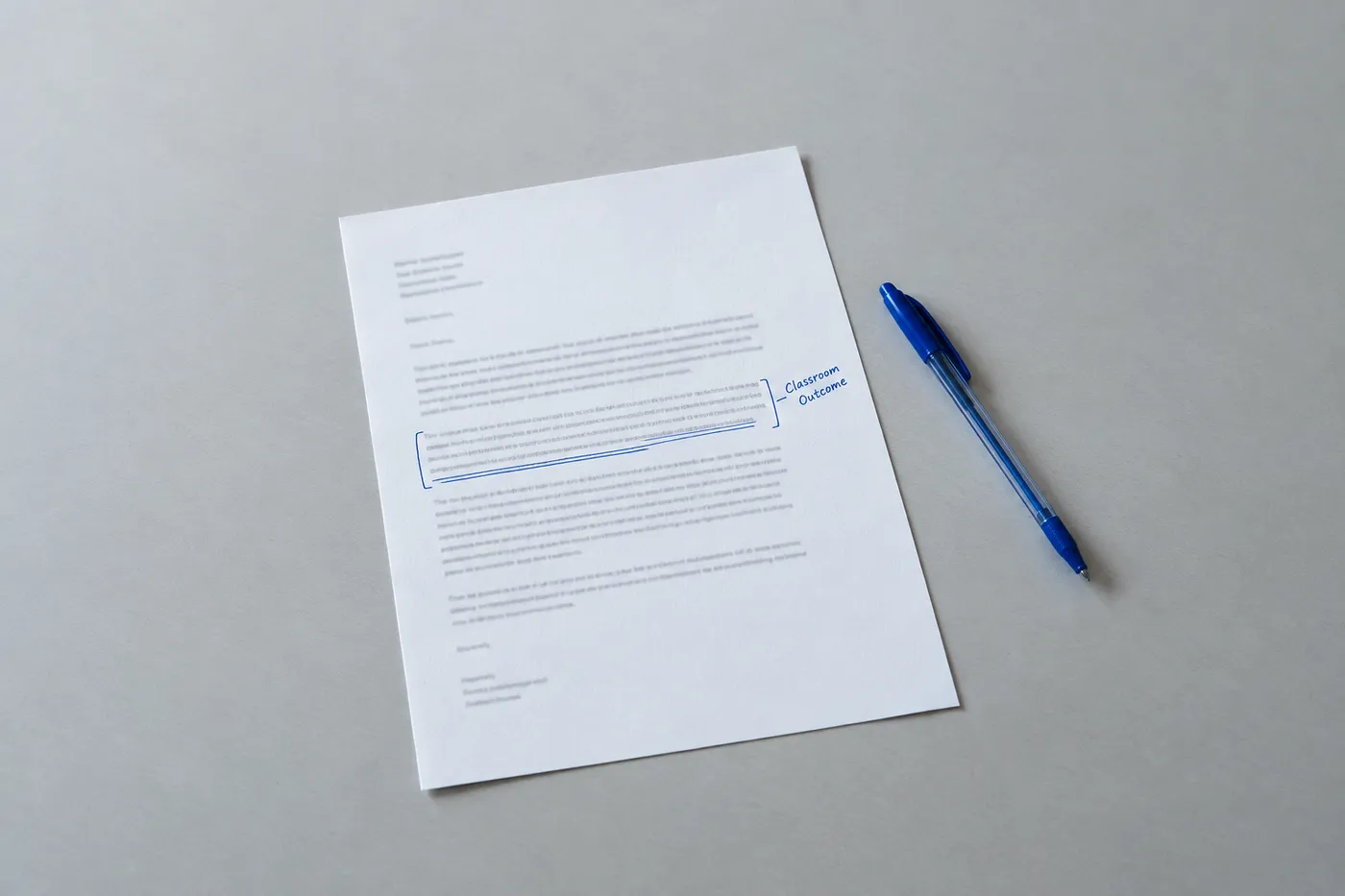
It opens with an outcome, not an application announcement
"I am writing to apply for the open teaching position" wastes the most valuable sentence in the letter on information the principal already has. The example opens with the candidate's strongest result and her license status. Within two sentences the reader knows she is qualified, effective, and worth reading further. Front-load your best fact the same way.
Every competency comes with a scene attached
The letter never says "strong classroom management skills." It describes the routines and the restorative approach, then shows what they produced. A principal can interrogate a scene in an interview; they can do nothing with an adjective. If a sentence in your draft contains a skill with no example within a line of it, that sentence is not finished.
It mirrors the posting's language without parroting it
When the posting asks for differentiated instruction, the letter uses that exact phrase once, wrapped in the candidate's own evidence. That is the balance to aim for: the screener's search finds the term, and the human reader finds proof. Repeating the phrase three times reads as keyword stuffing and principals notice.
It proves the letter was written for this school
One sentence referencing the school's actual program does more than three paragraphs of enthusiasm. It signals that if you put this effort into the application, you will put it into the job. Find that detail on the school's website, in its improvement plan, or in the posting itself, and make it load-bearing rather than decorative.
How to highlight classroom management and differentiated instruction
These two competencies deserve their own section because they are the most requested and the most fumbled. Teaching postings ask for them constantly, and applicants respond with paraphrases: "positive learning environment" instead of classroom management, "individualized support" instead of differentiated instruction. The paraphrase feels more natural to write, and it is invisible to the district's screening search. Matching the posting's exact terms is the same discipline that applies to resume keywords, and it matters just as much in the letter.
For classroom management, the formula is system plus proof. Name the framework or the routines you actually use, then show what they produce. Weak: "I maintain a well-managed classroom." Strong: "I run tight morning routines and use restorative conversations instead of escalating referrals; last year my class logged the fewest office referrals in my grade level." The second version is checkable, and checkable is what wins interviews.
For differentiated instruction, the formula is range plus mechanism. State the spread of learners you taught, then how you reached them. Weak: "I differentiate instruction for diverse learners." Strong: "My 5th-grade class spanned reading levels from 2nd to 8th grade; I ran three rotating small groups daily and used choice boards so every student worked at the right challenge level." Curriculum design fits the same pattern: name what you built (a unit, a scope and sequence, a new elective), who it served, and what changed because of it.
One paragraph per competency is enough. The letter's job is to earn the interview where you can go deeper, and a one-page letter with two vivid paragraphs beats a two-page letter with six flat ones.
Address state certification and licensure up front
Certification is a pass/fail filter, so settle it in the first paragraph. A district cannot legally put an unlicensed teacher in most classrooms, which means the screener's first scan of your application is for the license. Make them hunt for it and you risk landing in the wrong pile before anyone reads your evidence.
State it plainly and completely: the license type, the state, and any endorsements that match the posting. "I hold a Texas Standard Certificate in Core Subjects EC-6 with an ESL supplemental" answers the question in one sentence. If you are applying across state lines, name your reciprocity status or where you are in the transfer process; principals handle out-of-state licenses routinely and only get nervous when the situation is vague. Same for pending licenses: "I complete my certification program in May and sit for the content exam in March" is a hireable sentence, silence is not.
Endorsements are tiebreakers, so match them to the school. An ESL, special education, or gifted endorsement can decide an otherwise even race, especially in schools with large populations those endorsements serve. Mention the one the posting cares about in the letter, and make sure your resume lists all of them in a place screeners expect. Our guide on where to put certifications on a resume covers the placement logic.
Find what the school actually needs before you write
The tailoring advice above has one practical bottleneck: knowing which terms and priorities the posting actually contains. Reading a job description carefully takes time, and after ten applications the postings blur together. This is the part worth systematizing.
This is what Roleframe is built for. Paste the school's posting against your resume and you get a fit report: a match score, the exact keywords the posting uses that your materials are missing, and a prioritized plan of what to change. For teaching roles, the missing keywords are usually the ones this article has been hammering. Applicants describe their management style and their differentiation in their own words, and the report shows the posting's words sitting uncovered. Once you can see that "classroom management" or "differentiated instruction" appears in the posting and nowhere in your materials, the fix takes two minutes instead of never happening.
The report also surfaces the school-specific details that make a letter feel written rather than assembled: the program names, the student population, the instructional priorities the district chose to put in writing. Those become your "why this school" paragraph.

Drafting your letter with Remi: from base resume to final draft
A cover letter drafted from your actual resume beats one generated from a blank prompt, because the raw material is real. Generic AI letter tools ask you three questions and produce the same enthusiastic template every other applicant using that tool submits. We wrote about why most AI cover letter generators fail, and the short version is that they invent when they have nothing to work with, and an invented classroom anecdote will collapse in your interview.
Remi, Roleframe's career copilot, works differently because it starts with more. On a tailored version of your resume it can read the job posting you attached, the fit report with its keyword gaps, and your actual experience section. The draft it produces pulls from your real classroom history and works the posting's terms in where your experience genuinely supports them. If the posting asks for differentiated instruction and your resume shows small-group rotation work, the draft connects the two; if your resume shows nothing relevant, it cannot fake it, which is the behavior you want.
The draft is a starting point you edit, and you should edit it. Sharpen the opening outcome, check every claim against what you can defend in an interview, and add the one school-specific detail no tool can know, like the conversation you had at the job fair or the program you watched their students present. Ten minutes of editing on a grounded draft beats an hour of staring at a blank page, and the letter still sounds like you because the facts in it are yours.
Next steps: pair your letter with a tailored teaching resume
The letter and the resume get read together, so they need to make the same argument. If your letter leads with classroom management and reading growth, your resume's top bullets should show the same strengths; a mismatch reads as one of the two documents being borrowed. Start with our teacher resume examples, which cover the templates and the ATS keywords districts search for, and align the two documents before you submit either.
Two mechanical points that trip up teachers every hiring season. First, submit both documents as PDF unless the district's portal explicitly demands otherwise; a PDF preserves your formatting exactly, while other formats can reflow and break on the screener's machine. Second, keep a copy of each version you send. Districts move slowly, and when a principal calls in October about a letter you wrote in June, you want to know exactly what they read.
Frequently asked questions
- What is a good cover letter for a teacher?
A good teacher cover letter is one page, addressed to the principal by name when you can find it, and built around evidence rather than enthusiasm. It opens with your strongest measurable outcome and your license status, gives one concrete paragraph each on classroom management and instruction, and includes at least one detail proving it was written for this specific school. Every skill it claims comes with an example the principal could ask about in an interview.
- What should I write in a cover letter for a teacher position?
Cover five things: your certification (state, license type, endorsements), a specific student outcome you drove, how you manage a classroom with a named approach or system, how you differentiate instruction with a real example, and why this particular school. Use the posting's own terms for the competencies it names, since district screeners search for those exact phrases. Skip the paragraph about your lifelong passion for education; principals have read it a thousand times and it carries no information.
- What five things should every cover letter include?
For teaching: your license and endorsements stated in the first paragraph, one quantified result, evidence of classroom management, evidence of differentiated instruction or curriculum work, and a school-specific reason you applied. That covers the pass/fail screen (certification), the competency screen (the two most-requested skills), and the human read (proof you chose this school on purpose).
- What are the most common teacher cover letter mistakes?
The five that cost interviews: opening with "I am writing to apply for" instead of your strongest fact, describing skills in paraphrases the district's screening search will not match, burying or omitting your certification status, sending the identical letter to every school with only the name swapped, and apologizing for limited experience. Each one is fixable in a single editing pass once you know to look for it.
- How do I write a teacher cover letter with no experience?
Treat student teaching as experience, because it is. Describe the placement with specifics: grade level, number of students, what you taught solo, how you handled behavior, and any feedback from your cooperating teacher. State your certification timeline plainly if the license is pending. Never apologize for being new; the school posted a role that new graduates apply to, and your job is to show your training was rigorous, not to pre-excuse it.
- How long should a teacher cover letter be?
One page, and closer to three-quarters of it: roughly four paragraphs. Principals screening dozens of applications reward letters they can absorb in under a minute. If you are cutting material to fit, keep the certification line, the quantified outcome, and the school-specific detail, and cut general statements about your philosophy first.
- Should I send my teacher cover letter as a PDF?
Yes. A PDF renders identically on every machine, so the formatting the principal sees is the formatting you approved. Other file formats can reflow depending on the reader's software and fonts. The only exception is a district portal that explicitly requires a different format, and even then use PDF everywhere the system accepts it.
- How do I explain a gap in my teaching career in the cover letter?
Briefly, factually, and without apology: one sentence naming the reason and one pointing forward to what you bring back to the classroom. Principals care far more about whether your license is current and your practice is sharp than about the gap itself. Our guide on explaining an employment gap in your cover letter walks through the exact phrasing.


Ready when you are
Send the tailored resume, not the generic one.
Paste a job posting and Roleframe scores your resume against it, then helps you close the gaps one approved edit at a time, so you apply while the role is still fresh.