Sales Manager Cover Letter Examples (That Close the Interview)
by Larbi SahliLast Updated
Sales manager cover letter examples with quota framing, hard vs. leadership skill balance, and a section-by-section guide to writing your own.

Users have landed jobs at
- 1Password
- OpenAI
- Notion
- justworks
On this page
A sales manager cover letter gets judged the way you judge a rep's outbound email: does it know who it's talking to, does it lead with something concrete, and does it earn the next meeting. Most don't. The typical letter opens with enthusiasm, lists responsibilities, and closes with hope. A hiring VP reads it in twenty seconds and learns nothing they couldn't have guessed from the job title.
You already know how to pitch. The problem is that most sales managers treat the cover letter as an HR formality instead of what it actually is: a one-page proof that you can sell, and that you can make other people sell. This page shows you a full example, breaks down why each paragraph works, and covers the two variants that trip people up most, the regional consumer role and the inside sales team lead role.
The #1 mistake in sales manager cover letters: ignoring quota
Read ten sales manager cover letters and eight of them contain no numbers at all. They say "led a high-performing team," "exceeded targets consistently," and "drove revenue growth." Every one of those phrases is a claim without evidence, and a sales leader reading them knows exactly what that means, because it's what a rep says when the pipeline review is going badly.
Quota attainment is the currency of this job. A letter that names it, "my team finished at 112% of a $4.8M number," is instantly more credible than a letter that gestures at it, even if the number is merely good rather than spectacular. Hiring managers for sales leadership roles are themselves quota carriers or former quota carriers. They trust specifics and discount adjectives.
Three numbers belong in almost every sales manager cover letter:
- Team attainment under your management: the percentage against quota, ideally across more than one period, so it reads as a pattern rather than a lucky quarter.
- A growth or turnaround delta: what changed after you arrived. New-rep ramp time cut, win rate up, a territory that went from missing to making plan.
- Scale context: team size, quota size, deal size, or territory revenue, so the reader can calibrate whether your experience maps to theirs.
If your attainment history has a rough patch, context beats omission. "We finished at 84% in a year the company repriced mid-cycle, then rebuilt the playbook and hit 108% the following year" is a leadership story. A letter with no numbers at all just reads as a rough patch you're hiding.
Example 1: the B2B enterprise sales manager
The example below is written for an enterprise software sales manager applying to lead a team selling six-figure deals on long cycles. Notice three things as you read it. It opens with a team result, a number, before it says anything about passion or fit. It names the operating stack, the CRM and the sales methodology, in the same breath as the leadership evidence, because the posting asks for both. And it closes like a seller closes: with a specific, low-friction next step rather than "I hope to hear from you."
Why the opener works
The first sentence carries a team number and a timeframe. That does two jobs at once. It proves the core qualification before the reader has decided whether to keep reading, and it signals that the writer thinks in results, which is the single trait every sales leadership posting is screening for. Compare that to the standard opener, "I am excited to apply for the Sales Manager position," which spends the most valuable sentence on the page confirming something the applicant tracking system (ATS) already knows.
Why the middle works
The body paragraphs alternate between leadership proof and operational proof. One paragraph shows people outcomes: who was hired, how they were coached, what changed in their numbers. The next shows system outcomes: forecast accuracy, pipeline discipline, methodology adoption. That alternation matters because sales manager postings ask for both, and most letters only deliver one. A former top rep tends to write only about deals. A career manager tends to write only about process. The letter that covers both reads like someone who has actually run a revenue team.
Why the close works
The final paragraph proposes something concrete: a conversation about a specific challenge named in the posting. It does what a good rep does at the end of a discovery call, which is to make the next step easy and specific. "I'd welcome the chance to walk you through how I'd approach ramping the new mid-market pod" gives the reader a reason to reply. "Thank you for your consideration" gives them a reason to file the letter and move on.
Example 2: what changes for a regional consumer sales manager
A regional sales manager cover letter in consumer goods or retail distribution is a different pitch, and copying the enterprise SaaS framing will hurt you. The buyer here cares about territory, not deal size. Your evidence should shift accordingly.
- Lead with territory revenue and door count, not deal size. "Grew a 4-state territory from $12M to $16M across 300+ retail accounts" is the shape of number this reader trusts.
- Name distribution wins: new accounts opened, shelf space gained, sell-through improvement, distributor relationships managed. These are the fast-moving consumer goods (FMCG) equivalents of enterprise pipeline metrics.
- Show field leadership: ride-alongs, route planning, managing reps you see twice a month rather than twice a day. Remote coaching is a distinct skill and regional postings screen for it.
- Address the travel and multi-market reality directly. A sentence that shows you've run a dispersed team preempts the hiring manager's biggest doubt about candidates coming from a single-office background.
The structure stays the same: numbers first, leadership and operations alternating in the middle, a specific close. Only the evidence changes.
Example 3: what changes for an inside sales team lead
The inside sales or sales development team lead letter is the one where activity metrics finally belong on the page. In an enterprise letter, dials and emails per day would read as junior. Here, they're the operating reality, and the hiring manager wants to see that you can manage them without burning out the floor.
- Quantify ramp: how fast your new hires reached full productivity, and what you changed in onboarding to get there. Ramp time is the metric inside sales leaders are judged on most.
- Show conversion, not just volume. Meetings booked to opportunities created, or SDR-to-AE handoff quality, proves you manage outcomes rather than dials.
- Name the tooling. Inside sales postings list the engagement stack explicitly, and a letter that mentions the same tools, whatever they are at your shop, matches the screen.
- Include a retention or culture data point if you have one. Inside sales teams churn, and a lead who kept a team together is solving the hiring manager's most expensive problem.
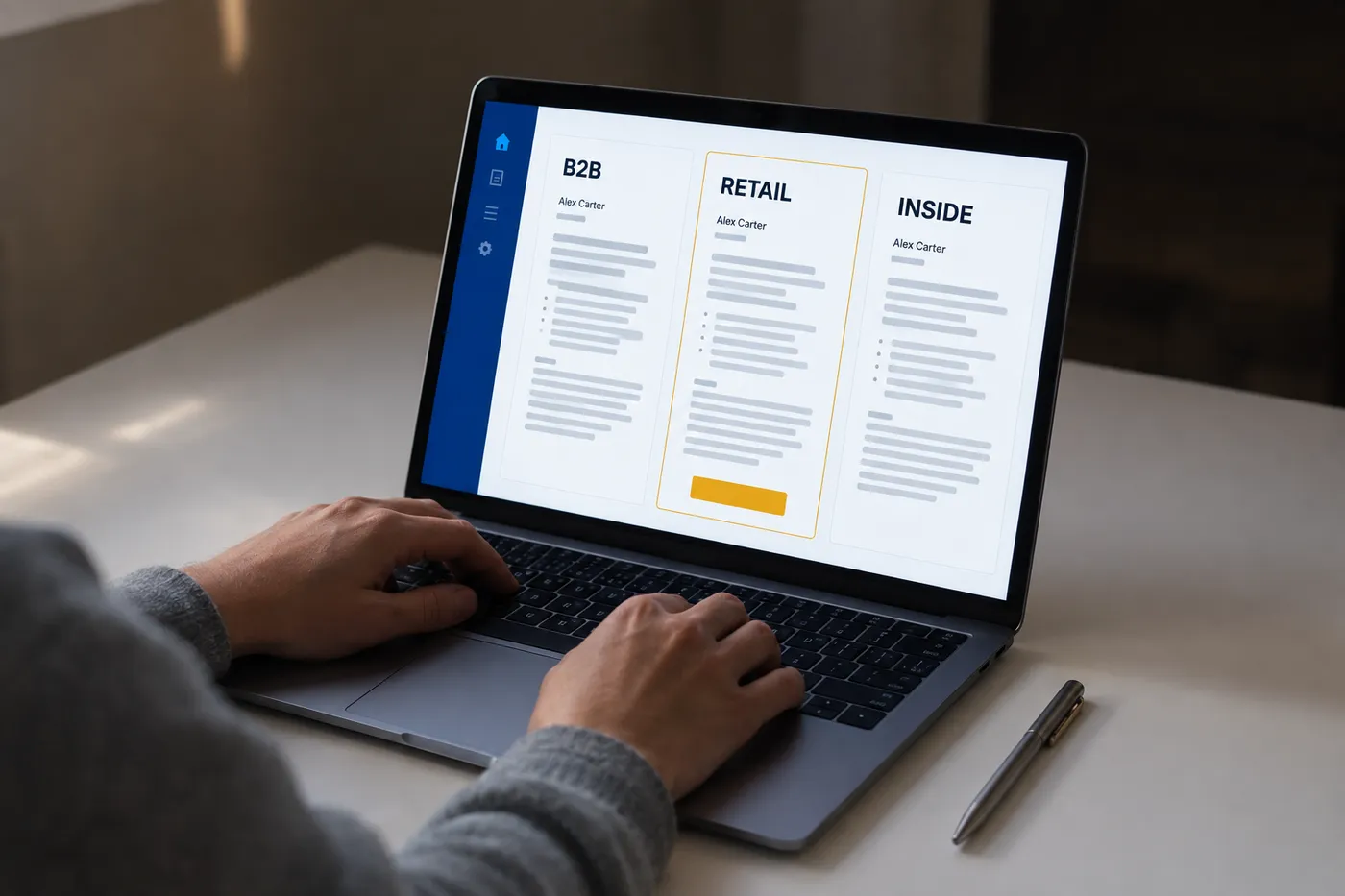
The three variants at a glance
| B2B enterprise | Regional consumer | Inside sales lead | |
|---|---|---|---|
| Lead metric | Team quota attainment on large deals | Territory revenue growth and account count | Ramp time and meeting-to-opportunity conversion |
| Hard skills to name | CRM, sales methodology (e.g., MEDDIC), forecast accuracy | Distribution, sell-through, trade promotion, territory planning | Engagement tooling, cadence design, pipeline hygiene |
| Leadership proof | Coaching reps through complex, multi-stakeholder deals | Managing a dispersed field team across markets | Onboarding at volume, retention, floor culture |
| Biggest mistake | Writing about your own deals instead of the team's | Using SaaS metrics a retail buyer doesn't value | Listing activity volume with no conversion outcome |
How to frame your team's revenue growth honestly
Team results raise an attribution question that individual-contributor letters never face: how much of that growth was you? Hiring managers ask it silently while reading, and the letters that survive are the ones that answer it before it's asked.
The frame that works is baseline, intervention, result. State where the team was when you took over, name the one or two things you changed, then give the outcome. "I inherited a team at 71% of plan, rebuilt the qualification stage around a shared framework, and we closed the year at 104%" attributes the result to a decision you made, which is far more convincing than claiming the number outright.
Two honesty rules. First, use "we" for the result and "I" for the decision. "We hit 118%" plus "I redesigned territory coverage" reads as a leader; "I hit 118%" for a team number reads as a credit-taker, and sales hiring managers have finely tuned detectors for that. Second, never inflate a number you'll be asked to defend. A sales leadership interview will drill into every figure in your letter, deal by deal, and a number that wobbles under questioning costs more than a modest number ever would.
The skill split postings actually ask for: Salesforce and MEDDIC on one side, leadership on the other
Read a stack of sales manager postings and a pattern shows up fast: they ask for two different kinds of proof at once. There's a hard-skill layer, the CRM (usually Salesforce or HubSpot), a named methodology like MEDDIC, Challenger, or Sandler, forecasting, and pipeline management. Then there's a leadership layer: hiring, coaching, performance management, cross-functional work with marketing and revenue operations. The posting weights both, and the recruiter's keyword screen usually includes terms from both.
Most cover letters fail this split in one direction. Former top reps write letters full of methodology and deal mechanics with no evidence they can develop people. Career managers write about coaching culture and one-on-ones with no sign they can run a forecast. The fix is mechanical: make sure your letter contains at least one sentence of hard-skill proof and one sentence of people proof, and that each carries a specific noun the posting uses. If the posting says MEDDIC and your letter says "structured qualification," you understood the requirement and still missed the keyword. The same logic applies on your resume; the split between hard and soft skills is one recruiters screen for explicitly.
Match the company's sales cycle before you write a word
A letter that talks about "driving urgency and closing fast" sent to a company running nine-month enterprise cycles tells the reader you didn't study their business. The reverse is just as damaging: methodical, committee-selling language sent to a high-velocity transactional shop. Sales cycle mismatch is the quiet killer in sales leadership applications, because it signals your instincts were trained in the wrong environment.
The posting tells you the cycle if you read it like a seller reads a prospect. Deal size, buyer titles, the methodology named, whether the team is field or inside, and words like "land and expand" or "velocity" all point one direction. Mirror it. An enterprise posting should get a letter about multi-threading, forecast discipline, and coaching reps through long cycles. A transactional posting should get ramp speed, conversion rates, and volume management.
This is the part worth doing with a tool rather than by eyeball. Paste the posting into Roleframe and the fit report reads it the way a senior recruiter would: it identifies the role archetype and seniority, scores your resume against it, and lists the exact keywords the posting asks for that you haven't covered, methodology terms and CRM names included. You'll know before drafting whether this company speaks MEDDIC or Sandler, Salesforce or HubSpot, and your letter can speak the same language. The same gap-checking logic applies to the resume you attach; here's how to check your resume against a job description before you send it.
Drafting with Remi: assertive tone without arrogance
Sales manager letters have a narrow tonal window. Too soft and you don't sound like someone who can hold a team accountable to a number. Too aggressive and you sound like the manager whose reps quit. The line between the two is evidence: an assertive claim backed by a figure reads as confidence, while the same claim without one reads as bravado. "I build teams that beat plan" is arrogant on its own and credible the moment it's followed by "three consecutive years, most recently at 109% of a $6M number."
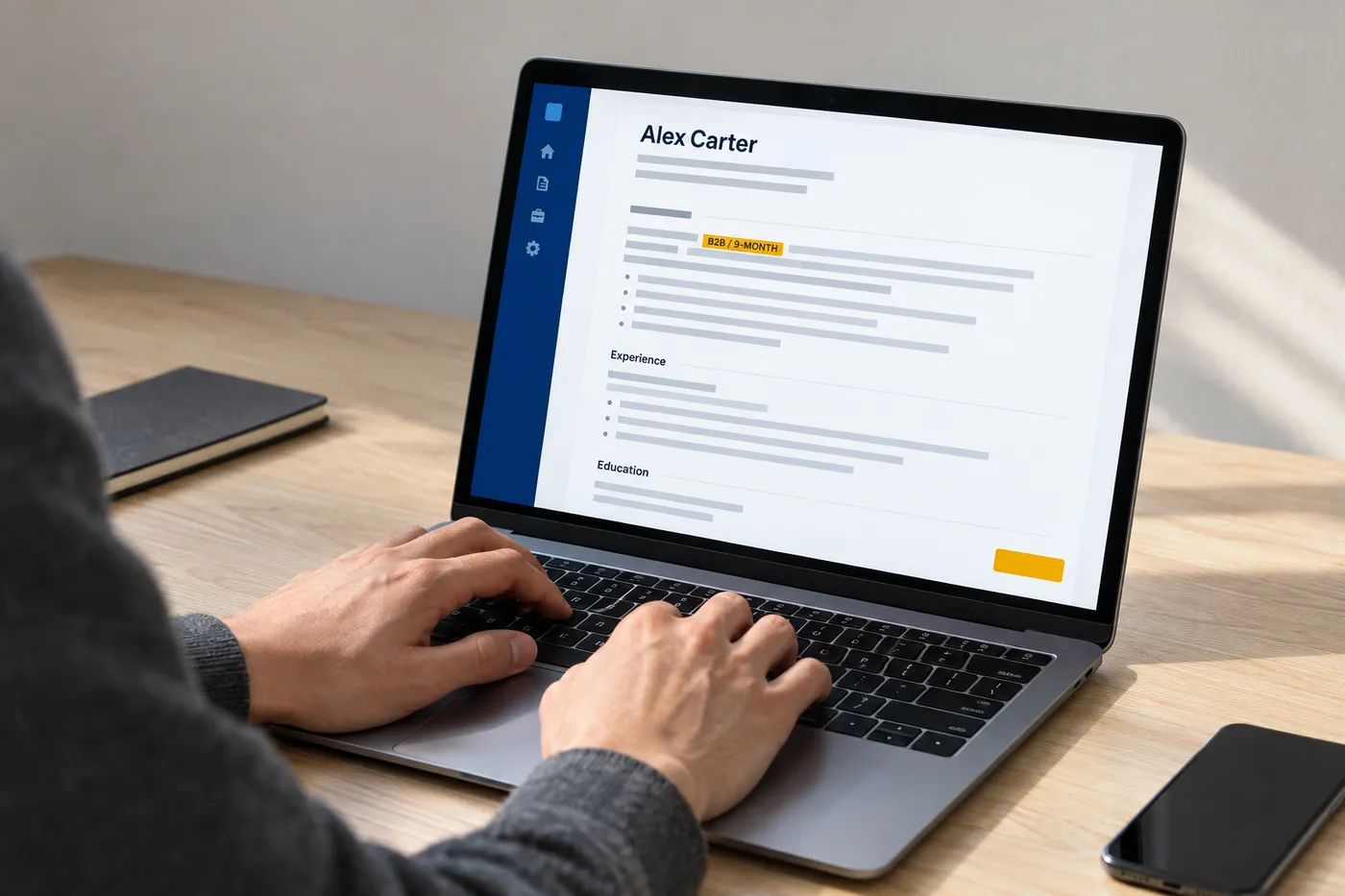
This is where drafting with Remi, Roleframe's career copilot, beats a blank page or a generic AI chat. Remi drafts a job-specific cover letter grounded in what's actually on your resume and in the posting attached to your tailored version, so your real quota attainment, your real team size, and your real ramp numbers land in the draft instead of the placeholder confidence a generic tool produces. Then you edit, and every change Remi proposes arrives as a word-by-word diff you approve or discard. Nothing ships that you didn't sign off on, which matters here more than in most professions: a sales leadership interview is a live audit of your letter, and you need to be able to defend every figure in it. Generic AI drafts fail exactly this test, which is why most AI cover letter generators produce letters that read like everyone else's.
Formatting your cover letter for maximum impact
Formatting won't win you the interview, but it can lose you one. The rules for a sales manager letter are short.
- One page, always, and ideally three-quarters of it. Three to five paragraphs. A sales leader who can't pitch in a page is telling the reader something.
- Match your resume's header, font, and name formatting so the two documents read as one application.
- Address a person if the posting or LinkedIn gives you one, the hiring manager or VP of Sales. "Dear Hiring Manager" is acceptable; "To Whom It May Concern" is not.
- Name the company and the role in the first two sentences, and reference something specific to their business, a market, a product motion, a stated challenge, at least once.
- Send it as a PDF unless the application system explicitly demands otherwise. PDF preserves your layout on every machine that opens it. Name the file with your name and the role, not "coverletter_final_v3.pdf".
Skip the gimmicks. No P.S. lines, no "I'll call you Thursday at 2pm," no mock purchase orders. Sales hiring managers have seen every one of them, and the candidates who rely on them are usually compensating for a letter with no numbers in it.
Next steps: prepping for the sales leadership interview
A strong letter sets up questions, and you should walk in ready for the ones it invites. Every number you cited will be probed: how the quota was set, what the team looked like when you arrived, which deals carried the year. Beyond the audit, sales leadership interviews cluster around a predictable set: walk me through your forecasting process, tell me about a rep you turned around and one you managed out, how do you run a pipeline review, and how you'd attack this territory in your first 90 days.
Prepare each answer as a structured story with a situation, the action you took, and a measurable result. The STAR method maps cleanly onto sales leadership questions because the result is always a number you already have. And have your salary expectations answer ready early; sales leadership processes tend to raise compensation in the first conversation, since on-target earnings structure is part of the role itself.
The letter got you the meeting. The same discipline that built it, specifics over adjectives, team results with your decision visible inside them, wins the room.
Frequently asked questions
- What five things should a sales manager cover letter include?
A quantified team result in the opening sentence, the scale of what you managed (team size, quota, territory), at least one hard-skill proof point such as your CRM and sales methodology, at least one people-leadership proof point such as hiring or coaching outcomes, and a specific close that proposes a next step. If your letter covers those five, it beats the majority of what hiring managers receive.
- What is a powerful opening sentence for a sales manager cover letter?
One that carries a team number and a timeframe. "Last year my team of nine closed 112% of a $5M quota, our third consecutive year over plan" does more work than any expression of enthusiasm. Open with the result the job exists to produce, then connect it to the company you're writing to in the second sentence.
- What are the most common sales manager cover letter mistakes?
Five show up constantly: no numbers anywhere, writing about your own deals instead of your team's results, restating the resume paragraph by paragraph, generic enthusiasm that never mentions anything specific about the company, and a passive close like "thank you for your consideration." The quota omission is the most damaging, because the reader assumes you're hiding a miss.
- What is a good professional summary for a sales manager?
Two to three lines pairing scale with results: years of sales leadership, team size, quota size, and attainment, plus one differentiator such as a turnaround or a methodology rollout. It belongs on your resume, and the cover letter then expands on it rather than repeating it. See our full guide on writing a professional summary for worked examples.
- Can I write a sales manager cover letter with no management experience?
Yes, and the letter has to do the promotion argument your title can't. Lead with your individual attainment record, then surface every leadership-adjacent proof you have: mentoring new reps, running team enablement sessions, covering for your manager, owning a segment's forecast. Frame the application as a natural next step backed by evidence, and be direct about the ambition. Sales hiring managers respect a candidate who asks for the bigger job with numbers in hand.
- Should I send my sales manager cover letter as a PDF or a Word document?
PDF. It locks your formatting so the letter looks identical on every device, and every mainstream applicant tracking system parses it fine. Use a Word file only if a specific employer's application form explicitly requires it, which is rare. Roleframe exports both your resume and cover letter as clean, matching PDFs.
- How long should a sales manager cover letter be?
Under one page, and three to five paragraphs is the sweet spot. Hiring managers skim on the first pass, so your strongest number needs to sit in the first two lines. If the letter runs long, cut the paragraph about your passion for the industry first; it's the one carrying the least evidence.


Ready when you are
Send the tailored resume, not the generic one.
Paste a job posting and Roleframe scores your resume against it, then helps you close the gaps one approved edit at a time, so you apply while the role is still fresh.