IT Engineer Cover Letter: Example With Uptime and Ticket Numbers
by Larbi SahliPublished
A complete IT engineer cover letter example with uptime, ticket, and migration numbers, plus proof paragraphs for infrastructure, network, and cloud roles.
Users have landed jobs at
- 1Password
- OpenAI
- Notion
- justworks
On this page
Most IT engineer cover letters are a tool inventory. Active Directory, Exchange, VMware, SQL Server, a line about years of experience, and a closing paragraph that could be signed by anyone. The hiring manager already has your resume for the tool list. The letter exists to answer a different question: what happened to the systems you ran while you ran them?
That question has numbers for answers. Availability. Monthly ticket volume and how fast you cleared it. How many users, sites, and endpoints you supported. What you migrated, how big it was, and how long it was down. An IT engineer letter built on those figures reads like it was written by someone who has carried a pager, because it was. A letter built on tool names reads like a job description fed through a thesaurus.
This page gives you a complete letter to work from, written the first way. Below it, you'll find the swappable middle paragraphs for infrastructure, network, cloud, and end-user computing roles, and the reasoning behind every choice, so you can rebuild the letter around your own environment instead of copying mine.
The example: an infrastructure engineer letter that leads with results
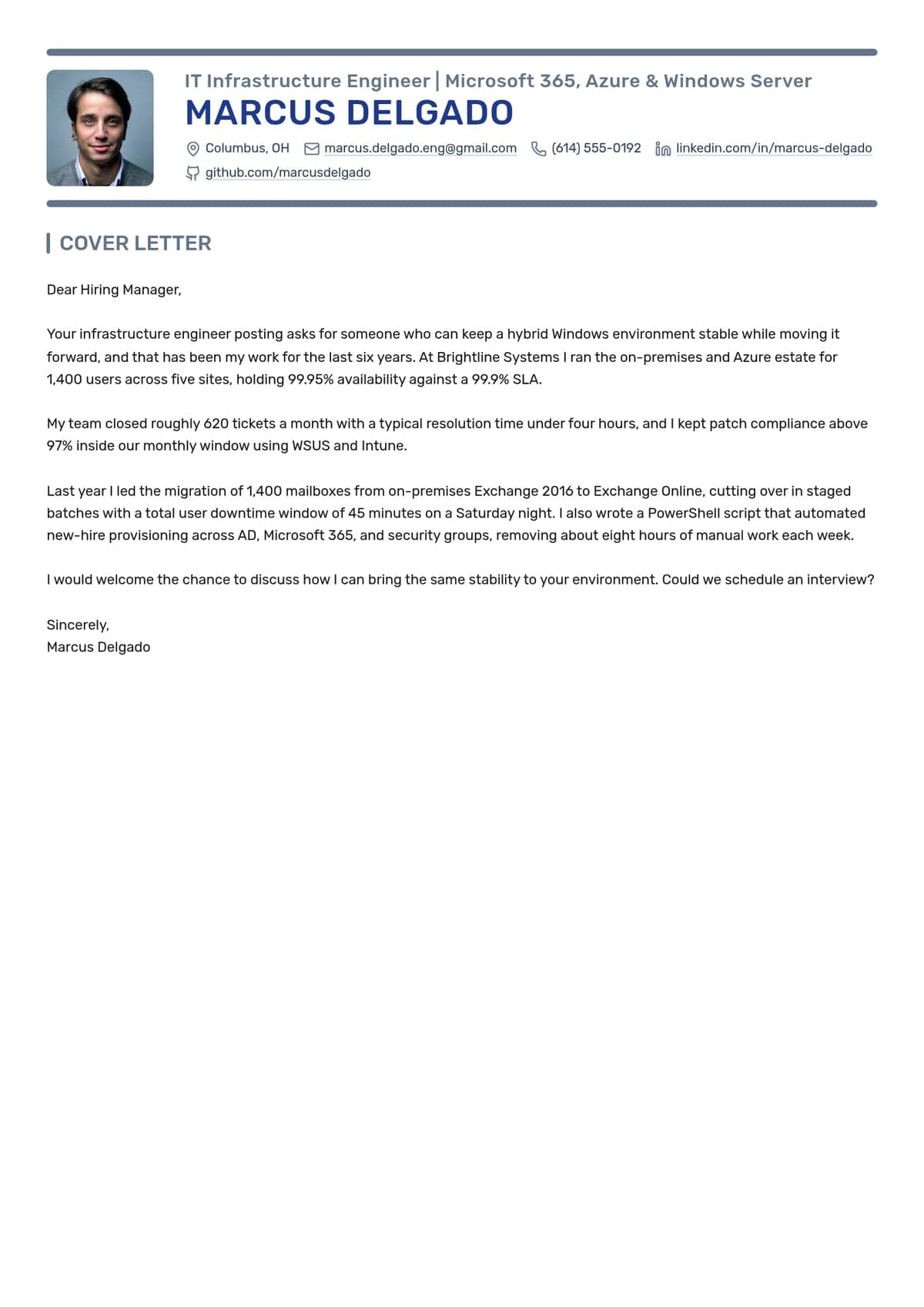
The letter below comes from a fictional infrastructure engineer with six years across Microsoft 365, Azure, and on-premises Windows networks. Read it once for the shape before you read it for the content: a specific opening tied to the company, one paragraph of measured operational results, one migration with its scope and downtime window, one line each on automation and security, and a closing that asks for the interview. Under a page, no tool dump, every claim checkable.

IT Infrastructure Engineer | Microsoft 365, Azure & Windows Server
Marcus Delgado
Cover Letter
Dear Hiring Manager,
Your infrastructure engineer posting asks for someone who can keep a hybrid Windows environment stable while moving it forward, and that has been my work for the last six years. At Brightline Systems I ran the on-premises and Azure estate for 1,400 users across five sites, holding 99.95% availability against a 99.9% SLA.
My team closed roughly 620 tickets a month with a typical resolution time under four hours, and I kept patch compliance above 97% inside our monthly window using WSUS and Intune.
Last year I led the migration of 1,400 mailboxes from on-premises Exchange 2016 to Exchange Online, cutting over in staged batches with a total user downtime window of 45 minutes on a Saturday night. I also wrote a PowerShell script that automated new-hire provisioning across AD, Microsoft 365, and security groups, removing about eight hours of manual work each week.
I would welcome the chance to discuss how I can bring the same stability to your environment. Could we schedule an interview?
Sincerely,
Marcus Delgado
Notice what's missing. No paragraph explaining what an infrastructure engineer does. No sentence about being a passionate team player. No list of every product touched since 2019. Each paragraph exists because it moves the hiring manager one step closer to booking a call, and everything else got cut.
Read the posting first: which IT engineer do they want?
"IT engineer" is five jobs wearing one title, and the posting tells you which one it is through the duties list, not the title line. Get this wrong and the strongest letter in the world argues the wrong case. A posting that spends three bullets on firewalls and VLANs wants your network story first, even if your resume is broader than that.
| Role flavor | Duty phrases that give it away | Lead your letter with |
|---|---|---|
| Infrastructure / systems | Windows Server, Active Directory, virtualization, backups, storage | Availability of the server estate you ran, plus VM and server counts |
| Network | Firewalls, switching, VLANs, VPN, SD-WAN, Cisco or Fortinet by name | Sites connected, a network change that cut outages or latency |
| Cloud | Azure, AWS, Entra ID, IaC, Terraform, cost optimization | A workload you moved to or built in the cloud, with cost or reliability outcome |
| End-user computing | Intune, endpoint management, imaging, M365 support, device lifecycle | Endpoints managed, rollout numbers, ticket deflection from self-service |
| Generalist (smaller company) | A bit of everything: helpdesk through servers, often solo or two-person IT | Breadth with scale: users and sites supported end to end, on your own |
Your middle paragraphs are modular. Write one proof paragraph for each flavor you can honestly claim, keep them in a notes file, and assemble the letter per application. The example above is the infrastructure version. For a network-heavy posting, the migration paragraph becomes a firewall replacement or an SD-WAN rollout across your sites. For a cloud posting, it becomes the Entra ID or Azure migration. Same skeleton, different evidence.
If you're aiming at network roles specifically, the network engineer resume example shows how the same principle applies to the resume that travels with this letter.
The numbers an IT hiring manager actually reads for
IT is one of the most measurable jobs in any company, which makes an unmeasured IT letter conspicuous. The manager reading your letter runs their own environment on these same metrics, so seeing them in a candidate's letter signals someone who thinks in outcomes rather than tasks.
- Availability: the uptime of the environment you were responsible for, stated plainly. If you tracked it against a target, say both.
- Ticket volume and resolution time: how many tickets your team or queue handled per month, and the typical or average time to resolve. A drop you caused is even better than a level you maintained.
- Patch compliance: the percentage of endpoints or servers patched within your window. This one doubles as a security signal.
- Scale: users, sites, endpoints, servers, and VMs supported. Scale is the fastest way for a reader to place you. Supporting 2,000 users across 12 sites is a different job than supporting 80 in one office, and neither is better; the reader just needs to know which one you did.
- Project outcomes: what a migration, rollout, or consolidation fixed or saved, in hours, tickets, or dollars, if your company measured it.
If you never tracked these numbers, your tooling did. Ticketing systems, remote monitoring and management (RMM) platforms, and Microsoft 365 admin reports all keep this history. Pull a six-month report before you write a single sentence. Honest approximations are fine and normal ("roughly 400 tickets a month," "about 1,200 endpoints"); invented precision is not, because the follow-up interview question will find it.
One caution: claim the level that was yours. If the whole team held 99.9% availability, write "our team maintained," not "I maintained." Managers hire from these letters and then sit across from you. The claim that survives that meeting is the one scoped correctly.
The migration paragraph: scope, downtime window, outcome
Every working IT engineer has moved something. Mailboxes to Exchange Online, servers into a hypervisor cluster, on-premises Active Directory to Entra ID, a server room into Azure, a phone system to Teams. This is the paragraph that separates an engineer from an operator, so give it real estate and structure it in four beats.
- What moved: the workload, named specifically. "Migrated our on-premises Exchange 2016 environment to Exchange Online" beats "led a cloud migration."
- How much: the count. Mailboxes, servers, VMs, sites, terabytes. This is where scale lives.
- The downtime window: how long users felt it. "Completed the cutover over a weekend with under two hours of user-facing downtime" is the sentence a hiring manager rereads, because downtime is what they get yelled at about.
- What it fixed or saved: the retired hardware, the licensing consolidated, the backup times cut, the office that finally stopped losing its VPN every Monday.
One migration told fully outperforms three mentioned in passing. If you've done several, pick the one closest to what the posting describes and save the rest for the interview.
Security and change management in two lines
Security no longer belongs to a separate team in the reader's head; it's table stakes for any infrastructure role. You don't need a paragraph, just two lines that prove you operate like an adult: an MFA rollout with its user count, backups you actually test-restored rather than merely scheduled, least-privilege access you enforced, changes that went through approval instead of straight to production on a Friday.
The trap here is framework inflation. Do not claim ISO 27001, SOC 2, HIPAA, or NIST experience unless you genuinely worked under that framework, prepared evidence for its audits, or implemented its controls. "Maintained tested backups with quarterly restore drills" is modest and credible. "Ensured ISO 27001 compliance" from someone who once read a policy PDF collapses in the first five minutes of a technical interview, and it takes the true parts of your letter down with it.

Scripting and automation: evidence, not a skills list
"Proficient in PowerShell" tells the reader nothing, because everyone writes it. What lands is one automation with its before and after: the manual process, the script that replaced it, and the time or tickets it removed. PowerShell for the Microsoft estate, Bash or Python for Linux and glue work, Terraform if the posting leans infrastructure-as-code.
The shape is one sentence: "Wrote a PowerShell onboarding script that provisions the account, licenses, groups, and mailbox in one run, cutting new-starter setup from about 45 minutes of manual clicks to under 5." That single line does more than a skills paragraph, because it shows you notice repetitive work and kill it, which is the trait the manager is actually hiring for. If your automation avoided tickets rather than saving minutes, say that instead: recurring alerts that stopped firing, password resets that moved to self-service.
Certifications and platforms: name them exactly as the posting does
Applicant tracking system (ATS) keyword filters and skimming recruiters both match on exact strings, so mirror the posting's names. If it says "Microsoft 365," don't write "O365." If it says "Entra ID," don't write "Azure AD," even though you and the hiring manager both know they're the same directory. When your experience predates a rename, write it as "Entra ID (formerly Azure AD)" once and use the current name after that.
Certifications need the same care, with one extra step: confirm the current name on the vendor's own certification page before you submit. Vendors rename and retire credentials regularly, and Microsoft in particular has restructured its certification line more than once. A letter citing a retired exam name reads as either stale or padded, and neither helps you. CompTIA, Cisco, and cloud provider certifications belong in the letter only if the posting asks for them or they're directly relevant; otherwise they live on the resume. For placement on the resume side, see where to put certifications on a resume.
On-call and outages: one sentence that builds trust
Hiring managers for infrastructure roles are hiring the person who answers when things break at 2 a.m. One sentence about a real incident earns more trust than a paragraph about being detail-oriented: what failed, what you did, and who you kept informed while you did it. "When our primary file server's storage array failed on a Saturday, I restored from the previous night's backup within four hours and sent status updates to department heads every 45 minutes until we were back" covers technical competence and communication in one breath.
The communication half matters as much as the fix. Most outage damage is reputational, and the engineer who updates stakeholders during an incident is the one the manager stops worrying about. Pick an incident that resolved well and that you can walk through step by step, because a good interviewer will ask you to.

Adjusting the letter for senior roles, or for a move up from support
For a senior IT engineer role
The metrics stay, but the frame shifts from executing to deciding. A senior letter should show at least one design decision you owned and defended: why you chose the architecture, what tradeoff you accepted, what it cost or saved. Add the human scope too, if you have it: engineers you mentored, vendors and contracts you managed, budget you influenced. "Standardized three acquired offices onto one network stack, which cut our vendor contracts from five to two" is a senior sentence; "configured switches at three offices" is not, even when they describe the same weeks of work. If people leadership is the bigger part of the target role, the IT manager resume examples show how that framing carries through the whole application.
For a move from IT support into engineering
Your letter's job is to prove you already do engineering work under a support title. Lead with the project work that went beyond the queue: the Intune rollout you ran, the script that automated your own ticket categories, the server maintenance you took over. Ticket metrics still belong in the letter, but frame them as the problem you engineered away rather than the workload you endured. "Identified that a third of our monthly tickets were password resets and deployed self-service reset, cutting queue volume by a quarter" is an engineering story told from a support seat. If you're still weighing which title to target, the IT support specialist cover letter examples show the support-side framing for comparison.
Before you send: check it against the posting, export as PDF
Read the posting one more time with the finished letter beside it and check five things. Does the opening name the company and a reason specific to it, one that couldn't be pasted into another application? Does your first proof paragraph match the flavor of IT engineer the duties list describes? Do the posting's top three requirements each get answered somewhere, in its own vocabulary? Is the letter under a page? Does the closing ask for the interview instead of trailing off into "I look forward to hearing from you"?
The letter and the resume travel together, so check the pair, not just the letter. In Roleframe, you paste the posting, duplicate your base resume for it, and get a fit report showing your ATS score and the exact keywords the job asks for that your resume is missing. It also drafts a job-specific cover letter from your resume, which you edit line by line before anything goes out. Every claim stays yours, which matters more in IT than most fields, because every number in this letter is one technical interview away from being verified.
Export the finished letter as a PDF. It preserves your formatting on every machine and parses cleanly in the tracking systems that store it, and it's what Roleframe exports. Match the header (name, phone, email, location) to your resume exactly, so the two documents read as one application.
Frequently asked questions
- How do I write a cover letter for an IT position?
Open with the company and the specific role, then spend the middle on measured results: the availability you maintained, the tickets you cleared and how fast, the users and endpoints you supported, and one migration or project with its scope and downtime window. Close by asking for the interview. Keep it under a page and match its evidence to the flavor of IT the posting describes, since infrastructure, network, cloud, and end-user roles each read for different proof.
- What are 5 common cover letter mistakes?
For IT roles specifically: repeating your resume's tool list instead of showing what happened while you ran those tools; opening with a generic line that fits any company; claiming compliance frameworks you never actually worked under; writing more than a page; and closing without asking for anything. The tool-list mistake is the most common, because the templates most engineers copy are built that way.
- Can I use ChatGPT to write a cover letter?
As a first-draft tool, cautiously. Generic AI tools don't know your uptime numbers, ticket volumes, or migration scope, so they produce fluent letters with no evidence in them, and hiring managers now recognize the pattern. If you use one, feed it your real metrics and rewrite the output in your own words. There's a fuller breakdown of why most tools fail at this in our guide to AI cover letter generators that work from your resume.
- How long should an IT engineer cover letter be?
Under one page, and closer to 250-350 words. Hiring managers skim letters between other work, and a letter with three tight paragraphs of evidence outperforms a full page of prose. If cutting to that length feels impossible, you're probably narrating your whole career instead of proving the three things this posting asks for.
- How is an IT engineer cover letter different from a software engineer one?
The evidence type. A software engineer proves impact through what they built and shipped; an IT engineer proves it through what they kept running and what they moved without breaking it. Availability, ticket metrics, patch compliance, and migration downtime windows are the IT engineer's equivalent of a developer's shipped features. If you straddle both, our software engineer cover letter examples show the other framing.
- Do I need a cover letter if the posting marks it optional?
For IT engineering roles, yes, send one. Applicant volume is high and resumes for these roles look alike: similar certifications, similar tool lists, similar titles. A half-page letter with a real uptime figure and a migration story is one of the few cheap ways to separate yourself, and "optional" often just means the tracking system doesn't enforce the upload.
- Should I include numbers I only remember approximately?
Yes, stated as approximations. "Roughly 400 tickets a month" and "about 1,200 endpoints" are credible and normal; nobody expects audited figures in a cover letter. Pull what you can from your ticketing system and admin reports first, then round honestly. What you should never do is invent precision, because a decent interviewer will ask how you measured it.
Write yours on the same template.
Every example here is built on a template you can open in the editor. Keep the structure that works and put your own story in it, or let Roleframe draft a first version from your resume and the job posting.


