IT Manager Resume Examples and the Leadership Keywords Employers Screen For
by Larbi SahliLast Updated
IT manager resume examples plus the keywords employers actually screen for: budgeting, vendor management, ITIL, and how to quantify cost savings.
Users have landed jobs at
- 1Password
- OpenAI
- Notion
- justworks
On this page
Most IT manager resumes fail for the same reason: they read like a senior sysadmin's resume with "Manager" pasted into the title. Pages of VMware, Cisco, and Azure, and almost nothing about the budget you owned, the vendors you managed, or the team you ran. The hiring manager reading it is trying to answer one question, can this person run IT as a business function, and a wall of technology names doesn't answer it.
Read a stack of real IT Manager postings and the pattern is hard to miss. The requirements that repeat across nearly every posting are business requirements: budget planning and forecasting, vendor and contract management, ITIL-aligned service delivery, stakeholder communication. Specific technologies vary from company to company; the leadership expectations barely change at all. Your resume needs to reflect that ratio.
This guide walks through a full IT manager resume example, shows how to adapt it for an infrastructure focus versus a service desk and operations focus, and covers the keywords that get resumes past the applicant tracking system (ATS) and in front of a human.
What Employers Look for in an IT Manager Resume
An IT manager sits between two audiences, and both of them read your resume. The recruiter or ATS screens for keywords and structure. The hiring manager, usually an IT director or CIO, reads for evidence that you can own outcomes: uptime, cost, delivery, and people.
Concretely, they are checking for five things, in roughly this order:
- Scope. How big was your world? Team size, number of users or sites supported, budget owned, number of vendors managed. A resume without scope numbers forces the reader to guess, and they guess low.
- Cost discipline. Budget forecasting, license consolidation, contract renegotiation. Money saved or spend controlled is the most legible achievement an IT manager can show.
- Service delivery. SLA performance, uptime, ticket resolution times, and whether you ran anything ITIL-aligned. This is the operational proof that things worked under your watch.
- Delivery of change. Migrations, implementations, rollouts. Not that they happened, but that you led them, on what timeline, and what they cost or saved.
- People leadership. Hiring, mentoring, retention, performance management. One or two concrete signals beat a paragraph of adjectives.
Notice what is not on that list: an exhaustive technology inventory. Technical credibility matters, but on a management resume it is table stakes, not the argument. The argument is scope plus outcomes.
Format-wise, keep it simple: reverse-chronological, a strong summary, a compact skills section, and clean single-column or lightly structured layout that any ATS can parse. If your formatting is fighting you, start from an ATS-friendly resume format and build up.
IT Manager Resume Example: Infrastructure Focus
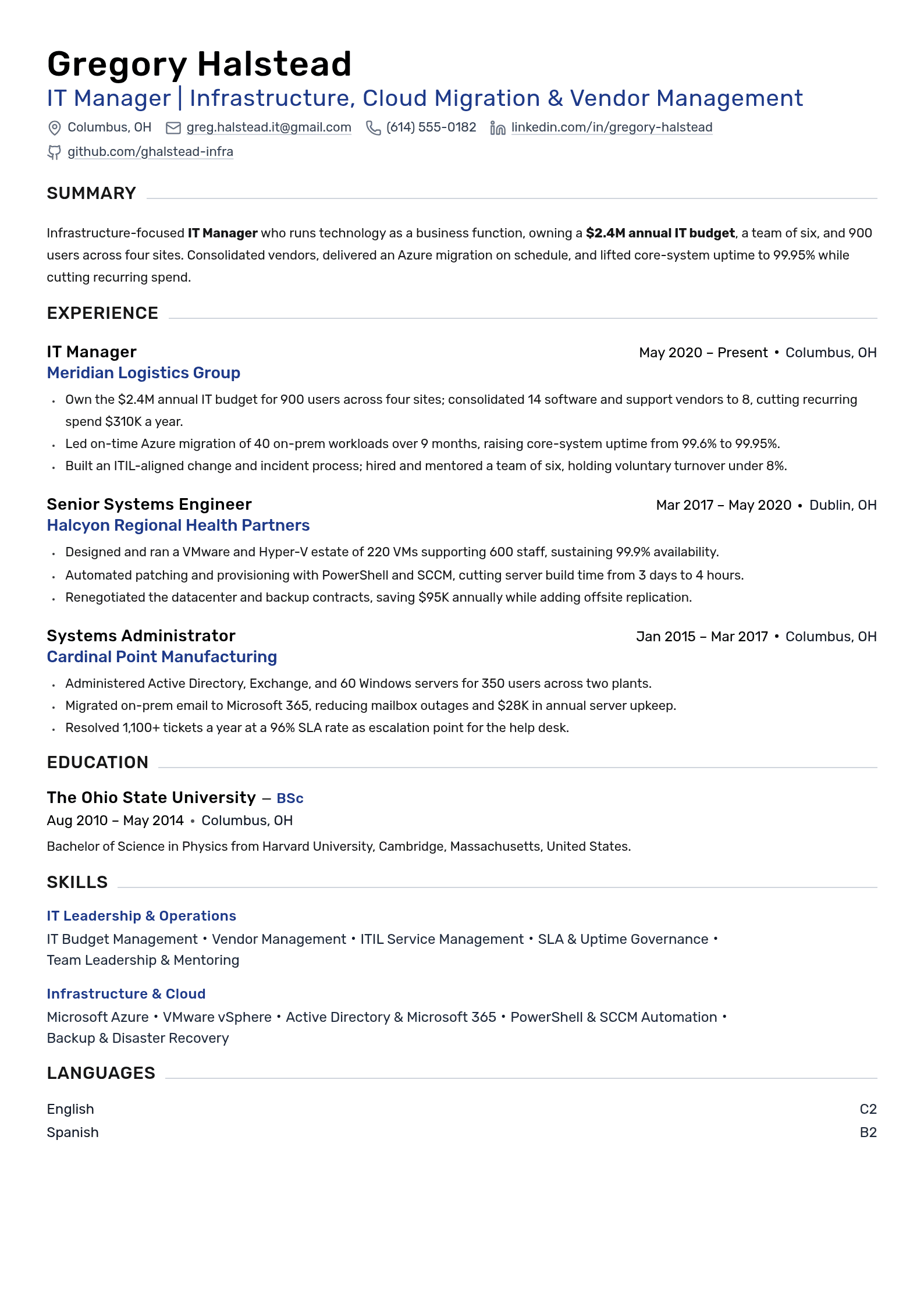
Here is what that looks like in practice. This example is built for an infrastructure-focused IT manager role: someone who owns servers, networks, cloud environments, and the team that keeps them running. As you read it, watch where the numbers sit. The budget, the team size, and the cost savings appear in the first half of the page, because that is the half that gets read.
A few things worth stealing from the example above.
The summary leads with scope, not passion. Team size, budget, and years of experience in the first sentence. No "results-driven technology leader passionate about innovation." A hiring manager has seen that sentence a thousand times and it carries zero information.
Every role has at least one money bullet. A renegotiated contract, a consolidated license stack, a cloud spend reduction. Even if the number is modest, it proves you think about IT as a cost center you are responsible for, which is exactly the mindset the job requires.
The technical skills are curated, not dumped. Eight to twelve technologies that match what infrastructure postings actually name, cloud platforms, virtualization, networking, backup and disaster recovery, security tooling. Listing forty technologies dilutes the twelve that matter and signals you haven't read the posting.
The promotion is visible. Moving from engineer to manager inside one company is one of the strongest signals on an IT management resume. Show it as two entries under one employer so the trajectory is unmissable.
IT Manager Resume Example: Service Desk and Operations Focus
The same person applying to a service desk or IT operations management role should not send the same resume. The employer's anxiety is different. An infrastructure hire is judged on uptime and project delivery; a service desk hire is judged on user experience, ticket metrics, and process. The raw material of your experience may overlap heavily, but the emphasis has to shift.
Here is how the two versions differ, section by section:
| Resume element | Infrastructure focus | Service desk & operations focus |
|---|---|---|
| Headline / target title | IT Manager – Infrastructure & Cloud | IT Manager – Service Desk & Operations |
| Summary emphasis | Budget owned, uptime, migration delivery | Users supported, SLA performance, CSAT, team size |
| Top bullet in current role | A quantified cost saving or migration win | A ticket-metric win: resolution time, first-contact resolution, backlog reduction |
| Metrics to feature | Uptime %, cloud spend reduction, project timelines | Tickets per month, SLA compliance, satisfaction scores, escalation rates |
| Keywords to feature | Cloud migration, disaster recovery, network infrastructure, capacity planning | Incident management, ITSM, service desk, knowledge base, SLA management |
| Certifications to lead with | ITIL, cloud certifications (Azure, AWS) | ITIL first, then HDI or ITSM tooling credentials |
ITIL appears in both columns, and that is not an accident. The Information Technology Infrastructure Library framework is the shared vocabulary of IT service management, and postings on both sides of this split ask for it by name. If you hold an ITIL certification, it belongs where the posting's requirements say it belongs, often near the top. If you are unsure where, this guide on where to put certifications on a resume covers the placement logic.
The practical takeaway: maintain one master resume with everything, then cut a focused version per application. Trying to serve both audiences with one document produces a resume that wins neither. The base resume and tailored versions approach exists for exactly this problem.
Top IT Management Keywords: Budgeting, Vendor Management, and ITIL
Here is the finding that should reshape how you write this resume. When you analyze real IT Manager job postings the way an ATS keyword filter does, the terms that recur most consistently are not technologies. They are business and leadership terms. Budget management shows up in posting after posting. Vendor management shows up in posting after posting. ITIL shows up by name. Meanwhile any single technical platform, a specific hypervisor, a specific firewall vendor, a specific monitoring tool, appears in only a slice of postings, because every company's stack is different.
That asymmetry has a direct consequence for keyword strategy. The business keywords are the safe, high-return bets: they match a large share of the roles you will apply to. The technical keywords are per-job bets: they only pay off when they match that specific posting, which is why they need checking against each job rather than guessed once. More on that mechanic in ATS resume keywords: stop guessing and start matching.
The keywords below are the ones worth building into your resume, with the honest way to earn each one. A keyword you can't back with a bullet is a liability in the interview, not an asset in the screen.

| Keyword | Why it gets screened | How to prove it, not just list it |
|---|---|---|
| IT budget management / budget forecasting | IT managers own spend; recruiters filter for candidates who have actually held a budget | Name the figure you owned or influenced and one decision you made with it (reallocation, forecast accuracy, cuts) |
| Vendor management | Most IT departments run on vendors; contract and relationship skills are assumed at this level | A renegotiation, a consolidation, an RFP you ran, or an SLA you enforced with a vendor |
| ITIL / ITSM | The default service-management framework; often a hard requirement or strong preference | List the certification if you hold it; otherwise reference ITIL-aligned processes you ran (incident, change, problem management) |
| Team leadership / people management | Separates managers from senior engineers with the same technical history | Team size, direct vs. indirect reports, hires made, and one development or retention outcome |
| Stakeholder management | IT managers translate between technical teams and business leadership | A bullet where you presented to, negotiated with, or delivered for a non-IT executive or department |
| SLA management | The measurable definition of "IT works here" | An SLA compliance figure, or a before/after on response or resolution times |
| Project management / implementation | IT managers deliver change, not just operations | A named implementation or migration with timeline, budget, and outcome |
| Cybersecurity / security compliance | Security has become a line-manager responsibility, not just a specialist one | Audits passed, frameworks implemented (e.g., access controls, incident response plans), training rolled out |
| Disaster recovery / business continuity | Boards ask about it; postings increasingly require it | A DR plan you built or tested, with recovery-time results if you have them |
| Cloud migration | The most common change initiative in current postings | What moved, from where to where, on what timeline, and what it did to cost or reliability |
Use these terms in context, in your bullets, not just in a skills list. ATS filters find keywords anywhere in the document, and human readers trust a keyword attached to an outcome far more than one floating in a comma-separated list. For the split between what belongs in bullets versus the skills section, see hard skills vs. soft skills on your resume.
How to Quantify Cost Savings and System Implementations
"Reduced costs and improved efficiency" is the most common bullet on IT manager resumes and the least useful. It makes a claim with no evidence, and a reader who has seen it fifty times this week skips it. The fix is mechanical: attach a number, a baseline, or a timeframe to every achievement bullet you can.
Before and after, same achievement:
- Before: Managed vendor relationships and reduced software licensing costs.
- After: Consolidated 14 SaaS contracts across three departments into a single vendor agreement, cutting annual licensing spend by 22% and reducing renewal admin to one cycle per year.
- Before: Led migration to cloud infrastructure.
- After: Led 9-month migration of 40+ on-prem servers to Azure, delivered on schedule and under budget, retiring a data center lease and improving recovery-time objectives from days to hours.
The after versions aren't longer because they use fancier words. They are longer because they contain facts: counts, percentages, timelines, and consequences. Those are your numbers from your career, and no example page can supply them for you. What it can supply is the checklist of where to look.
- Budget: total owned or influenced, variance against forecast, spend reduced or reallocated
- Vendors: number of contracts managed, savings from renegotiation or consolidation, SLA penalties avoided
- Team: headcount, hires, promotions from within, retention through a difficult period
- Service: uptime percentage, SLA compliance, mean time to resolution, ticket volume handled, satisfaction scores
- Projects: users or sites affected, timeline vs. plan, budget vs. plan, measurable post-launch outcome
- Risk: audit results, incidents reduced, recovery objectives met in DR tests
Two honesty rules. First, if you don't remember the exact figure, use a defensible approximation ("roughly 20%", "a six-figure annual contract") rather than a precise-sounding invention. Second, only claim numbers you can walk through in an interview, because a good interviewer will ask how you measured it. Keep each role to a tight set of bullets; this breakdown of how many bullet points per job gives sensible ranges by seniority.
Balancing Technical Acumen with Business Strategy
The trap runs in both directions. Too technical, and you read as a senior engineer who wants a manager's salary. Too business-heavy, and an IT director wonders whether you can still evaluate an architecture decision or call out a vendor's nonsense. The resume has to show both, and the ratio should follow the posting.
A workable rule: business outcomes in the bullets, technical credibility in the context. "Led migration of 40+ servers to Azure" carries the technical signal (you understand cloud migration at a real scale) inside a delivery claim (you led it, it landed). You rarely need a bullet that is purely technical; you often need bullets where the technology is the setting and the outcome is the point.
For the skills section, split it. A "Leadership & Operations" line with budget management, vendor management, ITIL, stakeholder communication, and team development. A "Technical" line with the platforms the posting names. This makes both signals scannable in two seconds, which is about what the section gets.
Seniority changes the mix too. A junior IT manager or team-lead-stepping-up resume can lean more technical, because the employer expects hands-on work to continue. A senior IT manager resume should be almost entirely outcomes and strategy, with technology present as context. If your management history is long, note that the oldest purely technical roles can be compressed hard; here is how far back a resume should go.

Using Roleframe's Fit Report for IT Leadership Roles
Everything above tells you what IT Manager postings ask for in general. But the posting in front of you is specific: one company's stack, one team's problems, one hiring manager's wish list. The gap between your resume and that posting is where applications quietly die.
This is the part Roleframe automates without taking the pen out of your hand. Duplicate your base resume for the job, and the fit report reads the posting the way a senior recruiter would: it scores your resume against it, lists the exact keywords the role screens for and which ones you are missing (this is where "ITIL" or "vendor management" missing from your document shows up in black and white), and gives you a prioritized plan of what to rewrite and reorder for this specific role. Then you make the edits yourself, with Remi, the career copilot, suggesting rewrites bullet by bullet and you approving every change. Nothing lands on the document that you didn't sign off on, which matters for exactly the reason covered above: every claim on an IT manager resume gets tested in the interview.
For a leadership role, that last point is the whole game. A machine-written resume full of impressive-sounding claims you can't defend is worse than a modest one you can. The fit report tells you where the gaps are; the words that close them stay yours.
Import Your Current Resume as a PDF
You almost certainly have a resume already, and nobody wants to retype ten years of history into a new tool. You don't have to. Export your current resume as a PDF from wherever it lives, upload it to Roleframe, and it comes back as editable blocks: roles, dates, and bullets in the right places, in a real editor rather than a locked preview. The import runs a full analysis on its own, so the first thing you see is a scored document with its weak sections named, which for most IT manager resumes means the missing scope numbers and the technology-heavy bullets flagged before you've touched anything.
From there, the workflow is the one this article describes: fix the base resume once, then spin a tailored version per posting. And when you send it, send a PDF. It preserves your formatting exactly, every mainstream ATS parses it cleanly, and it is what Roleframe exports. Send a Word file only if a specific employer explicitly demands one, and treat PDF as the default everywhere else.
Frequently asked questions
- How should I write a resume for an IT Manager position?
Lead with scope and outcomes: team size, budget owned, users supported, and one or two quantified wins in your summary. Give every role a money bullet (savings, spend control, contract wins) and a delivery bullet (migration, implementation, rollout with timeline). Keep the technical skills list curated to what the posting names, use reverse-chronological format, and tailor a version per application rather than sending one generic document.
- What are the responsibilities of an IT manager, and which belong on a resume?
Typical responsibilities include managing the IT team, owning the budget, managing vendors and contracts, overseeing infrastructure and service delivery, leading projects, and handling security and compliance. On the resume, responsibilities alone are weak; convert each one into an outcome. "Responsible for vendor management" says little. "Consolidated 14 vendor contracts, cutting licensing spend 22%" says everything.
- What skills should an IT manager have on a resume?
The skills postings screen for most consistently are business and leadership skills: budget management and forecasting, vendor management, ITIL or ITSM knowledge, stakeholder communication, team leadership, and project delivery. Pair those with a short technical set matched to the posting, cloud platforms, networking, security tooling, backup and disaster recovery. Split the skills section into a leadership line and a technical line so both read at a glance.
- What is the best format for an IT manager resume?
Reverse-chronological, with a summary up top, a compact two-part skills section, and clean single-column or lightly structured layout that parses well in an ATS. Save and submit as a PDF: it locks your formatting and every mainstream ATS handles it. Only provide a Word file if an employer explicitly asks for one, and even then keep PDF as your default everywhere else.
- Should an IT manager resume be one page or two?
Two pages is normal and expected for a management role with eight or more years of history; cramming a real leadership track record onto one page usually deletes the evidence that gets you interviews. One page can still work for a first-time manager. The data-backed breakdown is in should a resume be one page or two.
- Do I need an ITIL certification to get an IT manager job?
It is rarely a hard blocker, but it appears in postings often enough that not having it costs you keyword matches and occasionally a screen. If you hold it, list it prominently. If you don't, reference the ITIL-aligned processes you actually ran, incident management, change management, problem management, so the framework vocabulary is on the page honestly. The foundation-level certification is a reasonable investment if you are targeting service-management-heavy roles.
- How is a senior IT manager resume different from a junior one?
Mostly in the ratio of strategy to hands-on work. A junior IT manager or new team lead can show ongoing technical contribution alongside early leadership signals like mentoring or running a small project. A senior IT manager resume should be nearly all outcomes: budget scale, multi-team or multi-site scope, vendor portfolio, and strategic initiatives, with technology as context rather than content. Compress or cut purely technical roles older than roughly ten years.
- Can I use the same resume for IT manager and IT project manager roles?
Not the same version, no. The overlap is real, both need delivery and stakeholder bullets, but project manager postings screen for methodology terms, delivery metrics, and portfolio scale, while IT manager postings screen for budget, team, and service operations. Keep one master resume and cut a focused version for each. For the project-side keywords, see the project manager resume examples.


Ready when you are
Send the tailored resume, not the generic one.
Paste a job posting and Roleframe scores your resume against it, then helps you close the gaps one approved edit at a time, so you apply while the role is still fresh.