Network Engineer Resume Examples & Required Certifications
by Larbi SahliLast Updated
Two network engineer resume examples, plus the certifications and protocols (CCNA, CCNP, BGP, OSPF) recruiters screen for and where to put them.
Users have landed jobs at
- 1Password
- OpenAI
- Notion
- justworks
On this page
A network engineer resume gets screened twice before anyone who knows what a routing table is ever reads it. First a recruiter, or the applicant tracking system (ATS) they rely on, scans for exact tokens: CCNA, CCNP, BGP, OSPF, SD-WAN, Palo Alto. Then a hiring manager skims for scope: how many sites, how many devices, what happened when something broke. A resume that survives both passes looks different from the one most engineers write.
The most common failure I see in this field is a resume that reads like a device inventory. Twenty acronyms in a skills section, then bullets that say "managed network infrastructure" with no scale, no protocols named in context, and certifications buried on page two under a 2012 associate degree. The recruiter can't verify the certs fast enough, and the hiring manager can't tell a branch-office admin from an engineer who has run BGP at the edge of a real network.
This guide fixes both problems. You'll get a full network engineer resume example for an enterprise infrastructure role, guidance on adapting it for cloud and hybrid positions, the keywords that show up again and again in real postings, and the placement rules for certifications, which in this field matter more than in almost any other.
The Anatomy of a Winning Network Engineer Resume
Network engineering is one of the few fields where the standard section order should change. For most professionals, experience goes first. For network engineers, certifications and core skills should sit at the top of page one, above or immediately below the summary, because they are the first thing both the ATS filter and the recruiter look for. Engineers on r/networking give newcomers exactly this advice, and they're right: don't make anyone hunt for your CCNP.
Here is the order that works for a mid-level or senior network engineer:
- Header: name, phone, email, city and state, LinkedIn. No street address needed.
- Professional summary: 2-3 lines naming your years of experience, your strongest vendor stack, and one quantified outcome.
- Certifications: every current cert with issuer and year, plus in-progress certs marked as such.
- Technical skills: grouped by category (routing and switching, security, monitoring, automation, cloud), not one alphabet-soup paragraph.
- Experience: reverse chronological, 3-6 bullets per role, each anchored to scale or outcome.
- Education: degree, school, year. Brief, unless you're entry level.
Two structural notes before the example. Keep the layout simple: single column for the experience section, standard headings, no text boxes or graphics that confuse parsers. A clean layout is not the same as an ugly one; see how to make a resume ATS-friendly without ruining the design. And length: an engineer with seven or more years of experience earns two pages. A new CCNA holder does not.
Network Engineer Resume Example: Enterprise Infrastructure
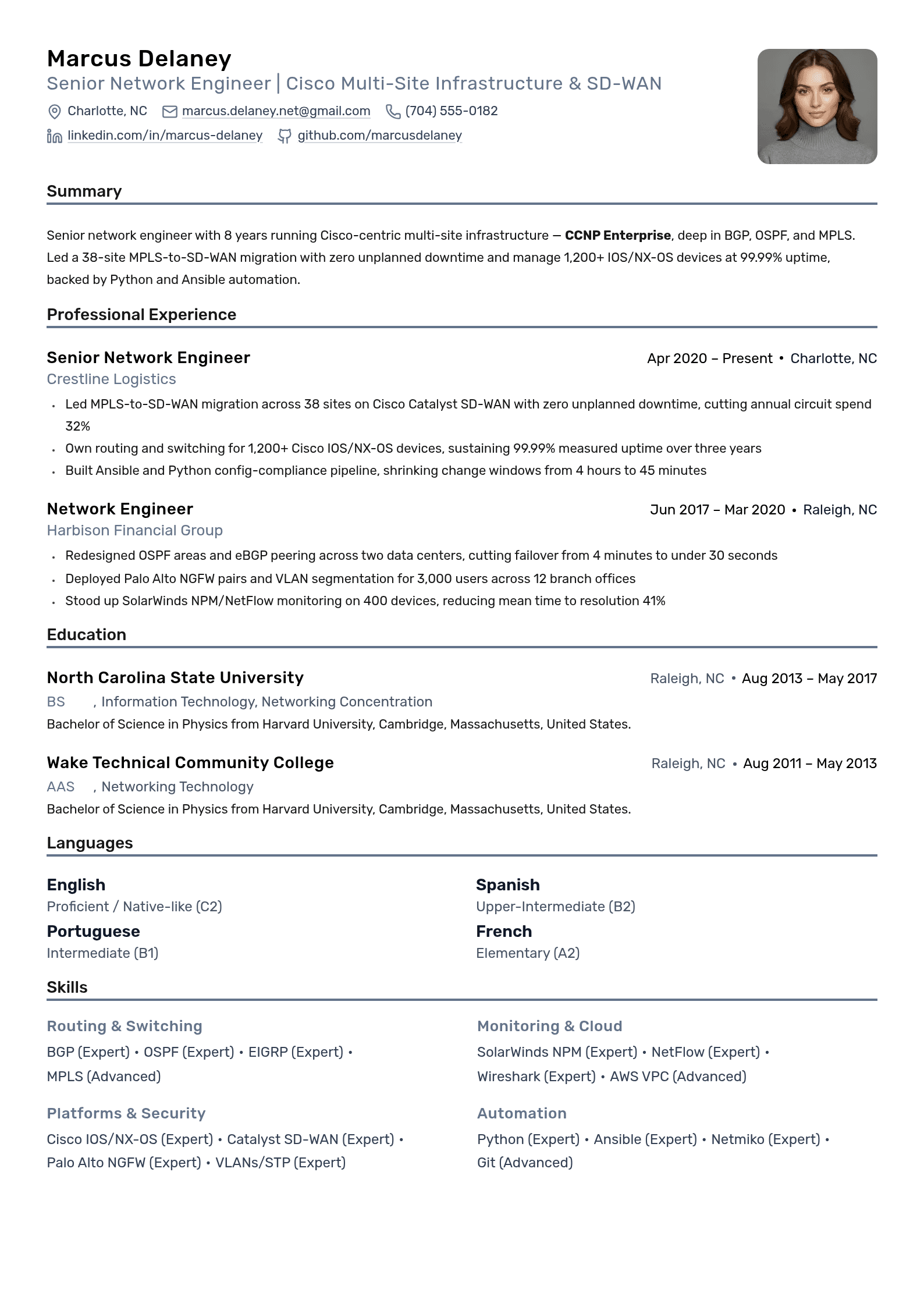
This first example is the classic enterprise profile: a mid-to-senior engineer running Cisco-heavy infrastructure across a multi-site corporate network. Notice three things as you read it. The certifications sit high on page one where a recruiter finds them in seconds. The skills section names protocols and platforms, not vague categories like "networking." And every experience bullet carries a number: site counts, device counts, uptime, or the measurable result of a migration.
Marcus Delaney
Senior Network Engineer | Cisco Multi-Site Infrastructure & SD-WAN

Summary
Senior network engineer with 8 years running Cisco-centric multi-site infrastructure — CCNP Enterprise, deep in BGP, OSPF, and MPLS. Led a 38-site MPLS-to-SD-WAN migration with zero unplanned downtime and manage 1,200+ IOS/NX-OS devices at 99.99% uptime, backed by Python and Ansible automation.
Professional Experience
Senior Network Engineer
Led MPLS-to-SD-WAN migration across 38 sites on Cisco Catalyst SD-WAN with zero unplanned downtime, cutting annual circuit spend 32%
Own routing and switching for 1,200+ Cisco IOS/NX-OS devices, sustaining 99.99% measured uptime over three years
Built Ansible and Python config-compliance pipeline, shrinking change windows from 4 hours to 45 minutes
Network Engineer
Redesigned OSPF areas and eBGP peering across two data centers, cutting failover from 4 minutes to under 30 seconds
Deployed Palo Alto NGFW pairs and VLAN segmentation for 3,000 users across 12 branch offices
Stood up SolarWinds NPM/NetFlow monitoring on 400 devices, reducing mean time to resolution 41%
Education
North Carolina State University
BS
Bachelor of Science in Physics from Harvard University, Cambridge, Massachusetts, United States.
Wake Technical Community College
AAS
Bachelor of Science in Physics from Harvard University, Cambridge, Massachusetts, United States.
Languages
Skills
Routing & Switching
Platforms & Security
Monitoring & Cloud
Automation
Projects
Campus Wireless Refresh
Replaced 300 legacy access points with Cisco Catalyst 9120s across 6 buildings, lifting wireless throughput 3x with zero business-hours outages
NetOps Automation Toolkit
Open-source Netmiko and Ansible playbook library for bulk IOS config audits, adopted internally to validate 1,200 devices nightly in under 20 minutes
Certificates
CCNP Enterprise (CCNA earned 2018)
Validated foundational knowledge of AWS cloud concepts, security, and billing.
Covered core services including EC2, S3, RDS, Lambda, and CloudFront.
Demonstrated understanding of shared responsibility model and basic architectural best practices.
Awards
IT Excellence Award
Recognized for building a cloud-native AI productivity tool.
Why this example works, section by section
The summary earns its three lines. It names the years, the stack, and a result. "Network engineer" alone tells a recruiter nothing; "network engineer with CCNP and eight years running multi-site Cisco environments" tells them you clear the bar for the interview list before they've read a single bullet.
Certifications are a section, not a footnote. Each cert appears with its full name, the acronym, the issuer, and the year. That triple format matters because you don't know which token the recruiter searches: some type "CCNP," some type "Cisco Certified." Writing "Cisco Certified Network Professional (CCNP) Enterprise, Cisco, 2024" matches both.
The skills section is grouped, and every item is a real search term. "Routing: BGP, OSPF, EIGRP, MPLS" reads instantly and matches keyword filters. A flat 30-item list forces the reader to parse it; grouped categories let them verify your coverage in one glance.
The bullets prove scope. "Managed network infrastructure" could describe a home lab. "Maintained 200+ Cisco switches and routers across 14 sites at 99.9% availability" describes a job only an engineer at that level has done. Scale is the hardest thing to fake and the first thing hiring managers check.
Network Engineer Resume Example: Cloud & Hybrid Focus
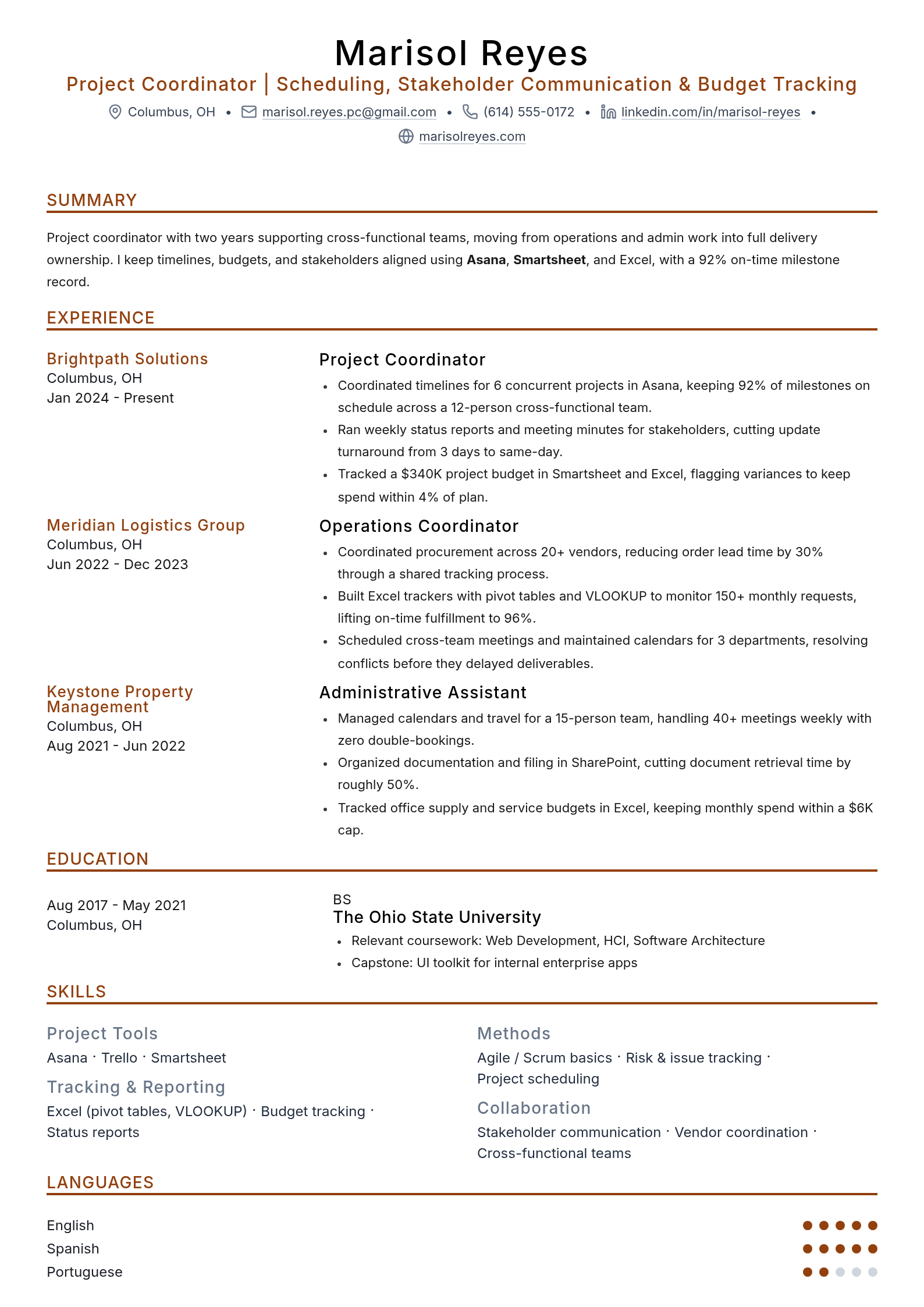
If you're targeting cloud networking or hybrid infrastructure roles, don't send the enterprise resume unchanged. The hiring manager for a hybrid role is buying a different risk profile: they need someone who understands BGP and knows what a VPC peering mess looks like at 2 a.m. The core structure stays identical. What shifts is the emphasis.
| Resume element | Enterprise infrastructure emphasis | Cloud & hybrid emphasis |
|---|---|---|
| Summary | Multi-site Cisco environments, uptime, scale of hardware estate | Hybrid connectivity, cloud migrations, infrastructure as code alongside traditional routing |
| Certifications to lead with | CCNP, CCNA, vendor security certs (Palo Alto PCNSE, Fortinet NSE) | Cloud networking specialties (AWS Advanced Networking, Azure Network Engineer Associate) next to CCNP, not instead of it |
| Skills groupings | Routing/switching, firewalls, wireless, monitoring | Cloud networking (VPC, Transit Gateway, ExpressRoute, Direct Connect), automation (Terraform, Ansible, Python), then core routing |
| Bullet focus | Device counts, site counts, availability, hardware refresh projects | Migration outcomes, hybrid connectivity builds, cost or provisioning-time reductions from automation |
| Projects worth surfacing | Campus redesigns, SD-WAN rollouts, datacenter upgrades | Datacenter-to-cloud migrations, landing zone network design, VPN/Direct Connect architecture |
One warning for career-stage cloud converts: do not delete your traditional networking experience to look "more cloud." Hybrid roles exist precisely because companies still run physical networks, and the engineer who can troubleshoot OSPF adjacency and write the Terraform for the transit gateway is rarer than either specialist. Keep both visible; reorder so the cloud work leads.
Practically, this means maintaining two versions of your resume rather than one compromise document. Keep a master resume with everything, then spin off a tailored version per target. The base resume plus tailored variants approach saves you from re-deciding what to cut for every application.
Top Network Engineering Keywords from Real Job Postings
Network engineering postings are unusually consistent in their vocabulary, which makes keyword matching both easier and less forgiving. Cisco terms dominate: CCNA and CCNP appear in postings far more often than any other vendor certification, and Juniper (JNCIA, JNCIP, Junos) shows up mostly in service provider and large-enterprise listings. Among protocols, BGP and OSPF are the two that recruiters filter on most, with MPLS and EIGRP close behind in enterprise roles and SD-WAN climbing fast as companies retire MPLS circuits.
Here are the terms worth auditing your resume against, and how to place each one so it actually counts:

| Keyword | Category | How to place it |
|---|---|---|
| BGP | Routing protocol | In skills AND in a bullet with context: peering, route filtering, or a migration where you touched it |
| OSPF | Routing protocol | Skills section plus at least one bullet; "designed OSPF areas for a 14-site WAN" beats a bare listing |
| EIGRP | Routing protocol | Skills section; common in Cisco-heavy enterprise postings |
| MPLS | WAN technology | Skills plus any migration bullet; MPLS-to-SD-WAN stories are gold right now |
| SD-WAN | WAN technology | Name the platform too: Cisco Catalyst SD-WAN (Viptela), Meraki, Fortinet, or VeloCloud |
| CCNA / CCNP | Certification | Certifications section with full name, acronym, issuer, year; add to your header line if the posting requires it |
| JNCIA / Junos | Certification / OS | Include when targeting service providers or Juniper shops; skip if you've never touched Junos |
| Cisco IOS / NX-OS | Network OS | Skills section under platforms; NX-OS signals datacenter experience specifically |
| Palo Alto / Fortinet / ASA | Security | Skills plus a firewall policy, migration, or segmentation bullet |
| VPN / IPsec | Security | Skills section; quantify in a bullet if you built or migrated site-to-site tunnels |
| VLAN / STP / switching | Layer 2 | Skills section; assumed at senior level, screened at junior level |
| Python / Ansible | Automation | Skills plus one bullet showing what the automation replaced (manual config pushes, audits) |
| AWS / Azure networking | Cloud | VPC, Transit Gateway, ExpressRoute, Direct Connect; essential for hybrid roles |
| Wireshark / SolarWinds | Monitoring & analysis | Skills section; a troubleshooting bullet that names the tool is stronger |
Two placement rules make the difference between a keyword that counts and one that doesn't. First, write both the acronym and the expansion on first use: "Border Gateway Protocol (BGP)." You can't predict which form the filter searches. Second, a keyword that appears only in your skills section is weak evidence; a keyword inside a quantified bullet is proof. The strongest resumes hit important terms in both places. For the general method, see how ATS resume keyword matching actually works.
Guessing which of these a specific posting weights is the slow part. If you paste the posting into Roleframe, the fit report lists the exact keywords that job asks for, which ones your resume already covers, and which are gaps, so you're editing against a checklist instead of a hunch.
Where to Put CCNA, CCNP, and Other Certifications
For network engineers, the answer is simple: a dedicated Certifications section on page one, above your experience or directly beside your skills. This field is certification-driven in a way most tech roles are not. Postings frequently list CCNA or CCNP as a hard requirement, which means recruiters screen for the cert before they read a single job bullet. Burying it after experience, or worse, inside an education section, costs you the seconds you can least afford to lose.
Format each entry the same way:
- Full name, acronym, issuer, year: "Cisco Certified Network Professional (CCNP) Enterprise, Cisco, 2024"
- In-progress certs are worth listing, clearly labeled: "CCNP Security (in progress, exam scheduled Q3 2026)". Never imply you hold a cert you don't.
- Expired certs: list only if you're actively renewing or the cert is rare, and mark the status. A silently expired CCNP that surfaces during a background check reads as dishonesty, not history.
- If a posting names a cert as required, add the acronym to your header line next to your name or title: "Jordan Reyes, CCNP". That's the one place a recruiter cannot miss it.
Prioritize within the section too. Lead with the cert that matches the job: CCNP first for a senior enterprise role, the AWS Advanced Networking specialty first for a cloud role, PCNSE first for a firewall-heavy security posting. The general placement logic, including when certifications should not lead, is covered in where to put certifications on a resume.
Highlighting Hardware vs. Software-Defined Networking
The industry is mid-transition, and your resume needs to signal where you sit on the curve. Traditional hardware skills (racking, cabling, CLI configuration on IOS and Junos, hardware refresh projects) still fill the majority of postings. But software-defined networking (SDN) terms, SD-WAN platforms, and automation tooling are what separate candidates for the better-paid roles, because they signal you can manage a network as code rather than one box at a time.
Handle the split like this:
- Keep hardware fundamentals visible but compact. "Cisco Catalyst and Nexus platforms, IOS/NX-OS" in your skills section covers it; you don't need a bullet about racking switches unless you're entry level.
- Name SDN platforms specifically: Cisco ACI, VMware NSX, Cisco Catalyst SD-WAN, Meraki. "SDN experience" as a phrase is too vague to match a filter or convince a manager.
- Give automation its own skills group: Python, Ansible, Terraform, NETCONF/RESTCONF, Git. Even modest scripting deserves a line, because most applicants for hardware-heavy roles have none.
- Prove automation in a bullet with the before-and-after: "Wrote Ansible playbooks to standardize configs across 180 switches, replacing manual per-device changes and cutting change windows from hours to minutes." The contrast is the point.
- Don't overstate. Claiming Terraform expertise from one tutorial collapses in the first technical screen. If a claim on the page can't survive a whiteboard question, cut it or soften it.
If you're a hardware engineer worried about the shift: one honest automation bullet, backed by a real script you can talk through, does more for you than a skills section stuffed with tools you've only read about.
How to Describe Network Migrations and Upgrades
Migrations are the strongest material a network engineer has, because they compress everything a hiring manager wants to see into one story: planning, risk management, execution under a change window, and a measurable end state. Most engineers waste them with bullets like "performed network upgrades." That sentence contains no evidence.
A migration bullet needs four ingredients: what moved, at what scale, how you kept it safe, and what improved. Compare:
- Weak: "Responsible for MPLS to SD-WAN migration."
- Strong: "Led migration of 42 branch sites from MPLS to Cisco Catalyst SD-WAN over six months, sequencing cutovers in overnight change windows with zero unplanned outages and reducing per-site circuit costs."
- Weak: "Upgraded core network hardware."
- Strong: "Replaced end-of-life Catalyst 6500 core with Nexus 9000 pair in a live datacenter, using a phased VLAN migration and rollback plan; completed with 11 minutes of scheduled downtime against a 4-hour window."
The safety mechanism is the detail managers read closest. Anyone can move traffic; the engineer who mentions the rollback plan, the pilot site, or the pre-cutover config audit is the one who has actually carried a pager. If a migration went sideways and you recovered it, that can be a bullet too. "Diagnosed asymmetric routing introduced during firewall migration and restored full service within the change window" shows more competence than a suspiciously perfect track record.
Keep it to 3-6 bullets per role, with migrations and incidents taking the top slots. If you're unsure how much detail each job deserves, the guidance in how many bullet points per job applies directly here: recent, relevant roles get the depth, older ones get compressed.
Drag and Drop Your Sections to Put Certifications First
Everything above comes down to one structural move most resume builders won't let you make: putting certifications and skills above experience. Rigid form-based builders lock you into their section order, and moving a section usually means retyping it. That's how engineers end up with a CCNP on page two.
Roleframe's editor treats section order as your call. Grab the handle on any section, drag it where the argument says it should go (certifications to the top, skills beside them, experience below), and the block keeps its content, dates, and formatting. It's a move, not a delete-and-retype. The editor is free to use with no account, and the PDF you download matches the layout exactly, which matters because PDF is the format you should be submitting; it's the only way to guarantee the recruiter sees the structure you designed. For the reasoning behind different orders at different career stages, see the best resume section order for your experience level.
Frequently asked questions
- Will AI replace network engineers?
Not in any timeframe worth planning your career around. Automation is changing the work: manual per-device configuration is shrinking while design, security, cloud connectivity, and automation engineering grow. The realistic risk isn't replacement, it's that engineers who refuse to script get outcompeted by engineers who do. Adding Python, Ansible, and one automation bullet to your resume addresses the trend directly.
- What do L1, L2, and L3 network engineer mean?
They're support tiers, not OSI layers. L1 handles first-line triage: monitoring alerts, basic connectivity checks, ticket routing. L2 handles configuration changes and deeper troubleshooting on switches, routers, and firewalls. L3 handles escalations, root-cause analysis, and design or architecture work. On a resume, don't rely on the tier label alone; describe the actual scope, since one company's L2 is another's L3.
- How do I list CCNA on my resume?
In a dedicated Certifications section on page one, formatted as "Cisco Certified Network Associate (CCNA), Cisco, 2024." Use both the full name and the acronym so you match either search term. If the posting lists CCNA as required, also add it to your header line next to your name. Never list it under Education; recruiters look for a Certifications heading.
- What skills does a network engineer need on a resume?
Routing protocols (BGP, OSPF, EIGRP), switching and VLANs, firewall platforms (Palo Alto, Fortinet, Cisco ASA), VPN/IPsec, WAN technologies (MPLS, SD-WAN), monitoring tools (SolarWinds, Wireshark), and increasingly automation (Python, Ansible) and cloud networking (AWS VPC, Azure networking). Group them by category rather than one long list, and back the most important ones with a quantified bullet in your experience section. The split between technical and interpersonal skills matters too; see hard skills vs. soft skills on a resume.
- Should a network engineer resume be one page or two?
Two pages is normal and expected past roughly five years of experience, because certifications, a grouped skills section, and quantified project bullets legitimately need the space. Entry-level engineers should stay on one page. The full breakdown by experience level is in should a resume be one page or two.
- Should I list expired certifications like an old CCNA?
Only if you're actively renewing (label it "renewal in progress") or the certification is rare enough to be a talking point. Either way, mark the status honestly. Listing an expired cert without a date invites the assumption it's current, and that discovery during verification damages your credibility more than the missing cert ever would.
- Does a home lab belong on a network engineer resume?
For entry-level and junior candidates, yes, and it can carry real weight: a lab with routing between virtual devices, a small SD-WAN setup, or Ansible-managed configs proves hands-on ability that a CCNA alone doesn't. Give it one or two specific bullets under a Projects section. For senior engineers, professional experience should do that work; drop the lab unless it demonstrates a skill your jobs haven't, such as automation.


Ready when you are
Send the tailored resume, not the generic one.
Paste a job posting and Roleframe scores your resume against it, then helps you close the gaps one approved edit at a time, so you apply while the role is still fresh.