Product Designer Resume Example (And Why Plain Formatting Wins the ATS Screen)
by Larbi SahliLast Updated
A complete product designer resume example, plus why cleanly parsed text resumes with portfolio links beat over-designed PDFs in ATS screens.

Users have landed jobs at
- 1Password
- OpenAI
- Notion
- justworks
On this page
Designing a Resume for Product Design Roles
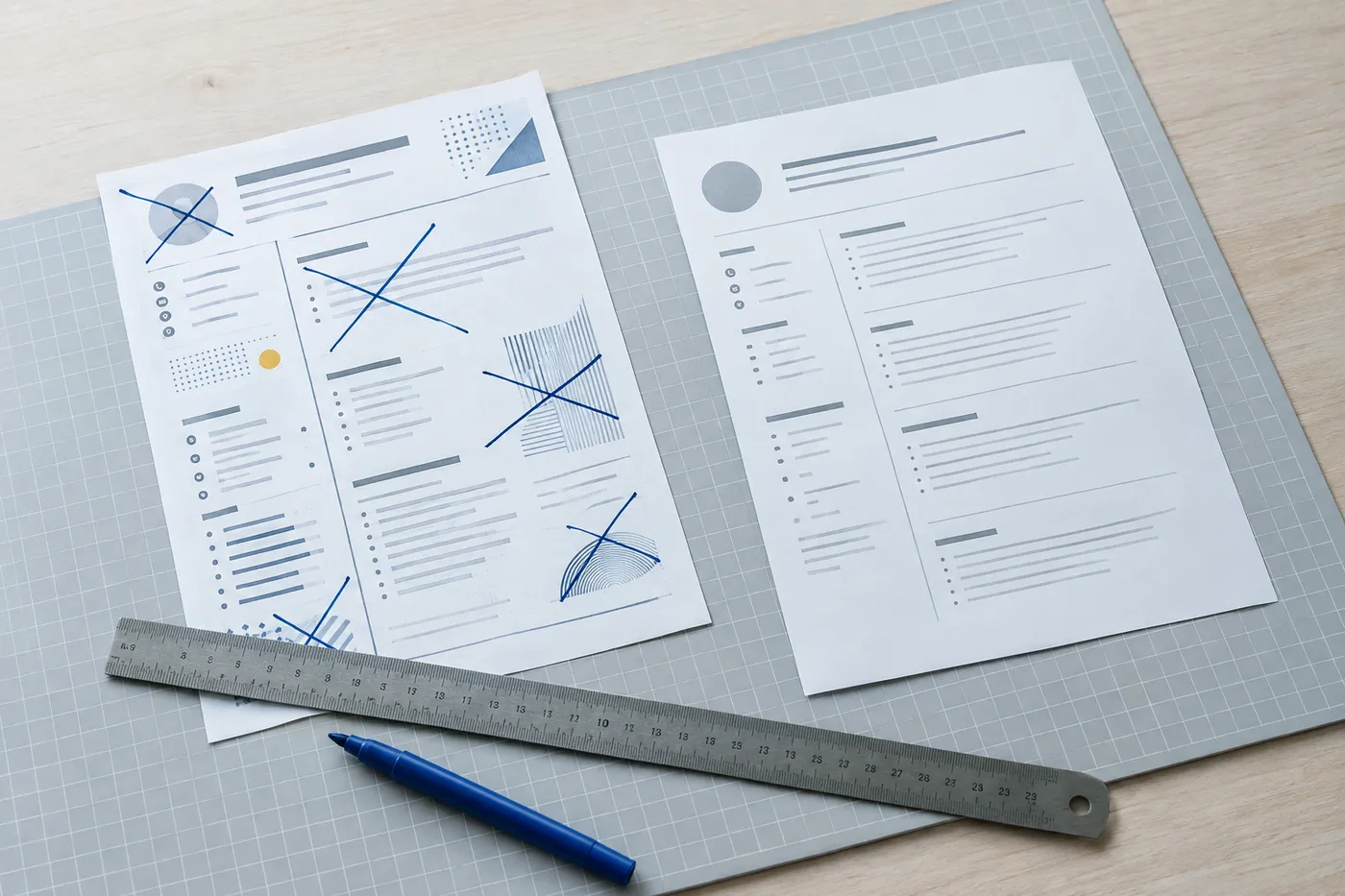
The most common mistake on a product designer resume is treating the resume as a design exercise. Two-column layouts built in Figma, custom icon sets, skill bars, a personal logo in the header. It looks great on a screen, and then an applicant tracking system (ATS) tries to read it and gets a scrambled wall of text with your dates detached from your job titles.
Here is the uncomfortable truth of design hiring: your resume is not your portfolio. Nobody hires a product designer off a resume. The resume has exactly one job, to survive the ATS parse and the recruiter's first skim well enough that someone clicks your portfolio link. Every design decision on the document should serve that job, and most decorative ones actively work against it.
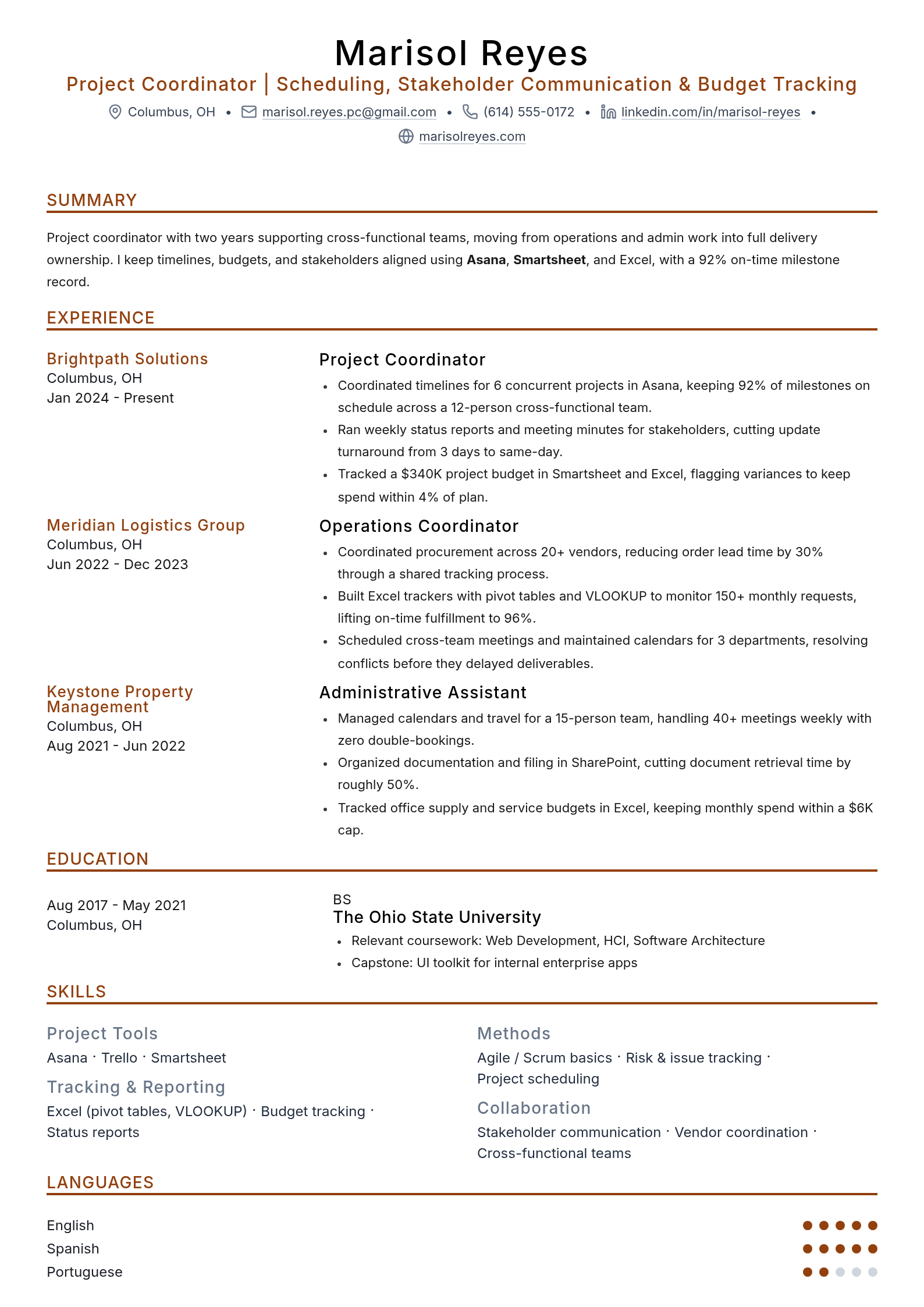
This page gives you a complete product designer resume example built for that reality, then walks through each section: the summary, the experience bullets that show your process from research to handoff, the skills section, the portfolio link, and how to adjust the whole thing for different kinds of tech companies.
Why Clean Formatting Beats Overly Designed Resumes
The pattern shows up every time you compare how design resumes actually parse: text-first resumes with a clear portfolio link get through initial ATS screens intact, while heavily graphical PDFs come out mangled. The reason is mechanical, and once you understand it, the fix is obvious.
Most ATS parsers read a PDF top to bottom, left to right, as a stream of text. A two-column layout gets read across both columns at once, so your skills list interleaves with your work history. Text placed inside an image or exported as vector shapes is invisible to the parser entirely. Skill bars and star ratings parse as nothing, which means the skills they represent parse as nothing. Custom fonts embedded as outlines can turn your entire resume into an empty document as far as the software is concerned.
A recruiter searching the ATS for "Figma" or "usability testing" will never see the resume where those words live inside a graphic. The candidate never learns why they were rejected. They just watch applications disappear, conclude the market is brutal, and redesign the resume to be even more visually distinctive. It is the one profession where the instinct to polish makes the problem worse.
The fix costs you nothing as a designer. A single-column layout, real selectable text, standard section headings (Experience, Skills, Education), and one accent color at most. Your visual craft belongs in the portfolio, where a human with a browser will actually see it. If you want the full checklist of what breaks parsers, the guide to making a resume ATS-friendly without ugly design covers it in detail.
One test worth doing before you send anything: open your PDF and try to select and copy the text. If you can copy your job titles, dates, and bullets and paste them into a plain text file in roughly the right order, a parser can read them. If the paste comes out jumbled or half-missing, the ATS sees the same mess.
Writing a UX/UI Focused Professional Summary
Your summary is three lines that answer three questions: what kind of designer are you, what evidence backs that up, and what kind of product work are you looking for. Recruiters skim it to decide whether the rest of the page is worth reading, so lead with the strongest fact you have.
A weak summary describes personality: "Passionate, detail-oriented product designer who loves solving problems." Every applicant says this, and it filters nothing. A strong summary describes scope and outcomes: years of experience, the type of products (B2B SaaS, consumer mobile, marketplace), the parts of the process you own, and one concrete result.
Compare these two:
- Weak: "Creative product designer passionate about crafting beautiful, user-centered experiences across web and mobile."
- Strong: "Product designer with 5 years in B2B SaaS, owning end-to-end design from user research through developer handoff. Redesigned the onboarding flow at my last company, which lifted activation measurably within one quarter. Deep in Figma, design systems, and usability testing."
The second version gives the recruiter a role archetype, a seniority signal, a process claim, and a result to ask about in the interview. That last part matters: every line of your summary should be something you can expand on for five minutes when someone asks. For more patterns, see the full guide on writing a professional summary.
One product-design-specific note: name your product domain. "Designed a checkout flow for a payments platform" tells a hiring manager far more than "designed user flows." Domain familiarity is often the deciding factor between two otherwise similar designers.
Structuring Your Experience: From Research to Handoff
Hiring managers for product design roles are screening for one thing above all: do you own the full process, or do you execute mockups someone else specified? Your experience bullets should answer that without the reader having to guess. The reliable way to do it is to make each role tell the research-to-handoff arc.
For each position, aim for four to six bullets that collectively cover:
- Discovery and research: user interviews, usability studies, analytics review, or competitive analysis you ran or contributed to, and what decision the research changed.
- Definition: how you translated findings into flows, wireframes, or journey maps, and who you aligned with (product managers, engineers, stakeholders).
- Design and prototyping: the fidelity you worked at, the tools (Figma, prototyping tools), and design system work if you did any.
- Validation: usability testing, A/B tests, or beta feedback loops, and what you changed as a result.
- Handoff and shipping: specs, developer collaboration, QA of the built product, and what happened after launch.
You will not hit all five in every role, and you should not force it. But if none of your bullets mention research and none mention what happened after launch, you read as a production designer regardless of your title. That reading costs you interviews for product roles.
Structure each bullet as action, method, outcome. "Redesigned the mobile checkout flow after usability testing surfaced a drop-off at address entry; the new flow shipped in Q3 and reduced abandonment." Where you have real numbers, use them. Where you do not, name the direction of the change and the mechanism, and be ready to discuss the specifics in the interview. A vague number you cannot defend is worse than no number.
Keep it to one bullet per project maximum unless the project was genuinely large. Recruiters skim; a role with twelve bullets reads slower than a role with five sharp ones. If you are unsure where to cap it, there is a practical answer in how many bullet points per job on a resume.
Top ATS Keywords for Product Designers
Recruiters search the ATS by keyword before they read anything. If the exact term is not on your resume as selectable text, you are not in the search results, no matter how strong the underlying work is. These are the terms that recur across product design postings and that recruiter filters most commonly target, grouped by where they belong on the page.
| Keyword | Where it belongs | Why it gets searched |
|---|---|---|
| Product design / Product designer | Title line and summary | Recruiters search the exact role name; "UX designer" alone can miss product design filters |
| Figma | Skills section and at least one experience bullet | The default tool filter for design roles; its absence is often an automatic pass |
| User research | Experience bullets | Separates product designers from visual designers in recruiter searches |
| Usability testing | Experience bullets | A validation-skills filter; hiring managers want evidence you test, not just design |
| Prototyping | Skills and bullets | Covers interactive and high-fidelity prototype work across tools |
| Wireframing | Skills or bullets | Still a common search term, especially at agencies and mid-size companies |
| Design system(s) | Bullets, if you contributed to or maintained one | A seniority and scale signal; common in senior product designer postings |
| Interaction design | Skills or summary | Broad craft term that some postings use instead of UX/UI |
| User flows / journey mapping | Bullets | Signals definition-phase ownership |
| Accessibility / WCAG | Skills or bullets | Increasingly filtered for, especially at larger companies and in regulated industries |
| A/B testing | Bullets | Signals data-informed design; common in growth-focused postings |
| Cross-functional collaboration | Bullets (shown, not just named) | Appears in nearly every posting; prove it with a PM or engineering example |
| Developer handoff | Bullets | Confirms you ship, not just mock |
| UX/UI design | Summary or skills | Catches searches that use the combined term rather than "product design" |
Two rules for using this list. First, mirror the posting's exact phrasing: if the job says "user testing" and your resume says "usability studies," a literal keyword filter can miss you, so use the posting's term and keep yours as a second mention. Second, every keyword must be attached to real work. A skills section stuffed with terms you cannot discuss is a fast way to fail the interview that the keyword got you. The longer piece on ATS resume keywords explains how to match terms to a specific posting without stuffing.
Where and How to Link Your Design Portfolio
The portfolio link is the single most important line on a product designer resume, and it belongs in the header, next to your email and phone number. Write it as a plain, readable URL in selectable text: janedoe.design or janedoe.com/work. This matters for two audiences at once. The parser stores it as text tied to your record, and the recruiter skimming a printed or exported copy can still type it in.
Common ways designers break this:
- Hiding the link behind an icon or a button graphic. Parsers cannot read images, and many ATS views strip hyperlinks, leaving nothing.
- Writing "Portfolio" as hyperlinked text with no visible URL. Same failure: strip the link and the word "Portfolio" points nowhere.
- Using a long tool-generated URL with a random string. It survives parsing but looks temporary; a short custom domain reads as a professional who maintains their presence.
- Linking a password-protected site without including the password on the resume. If your case studies are under NDA-driven protection, put the password right next to the link.
Mention the portfolio a second time where it earns it: a bullet like "full case study at janedoe.design/checkout" under your strongest project tells the reader exactly which piece of the portfolio backs which claim. One targeted pointer beats hoping they browse.
And make sure the portfolio holds up its end. The resume's job is to earn the click; the portfolio's job is to show process depth on two or three projects rather than thumbnails of twelve. A recruiter who clicks through and finds only polished final screens will draw the same conclusion as one who never clicked at all.
Listing Figma, Prototyping, and User Testing Skills
Skip the skill bars. A four-out-of-five-stars rating for Figma tells a hiring manager nothing (four out of five relative to what?) and tells the ATS literally nothing, because graphics do not parse. List skills as plain text, grouped so a skimming recruiter can find what they filter for in seconds.
Three groups work well for product designers:
- Design and prototyping: Figma, FigJam, prototyping (interactive, high-fidelity), design systems, responsive web design, mobile design (iOS/Android patterns).
- Research and validation: user interviews, usability testing, A/B testing, survey design, analytics tools you actually use, journey mapping.
- Collaboration and delivery: developer handoff, design specs, agile/sprint rituals, design critique facilitation, accessibility (WCAG).
Keep the list honest and short. Fifteen tools reads as padding; eight skills you can demonstrate reads as focus. Tools you touched once in a bootcamp do not belong here, because interviewers pick skills off this list to probe. And the strongest version of any skill claim is not in the skills section at all. "Usability testing" in a list is a keyword match; "ran six moderated usability sessions that killed a feature before we built it" in a bullet is evidence. Aim to have every skill in the list backed by at least one bullet above it. There are more before-and-after patterns in resume skills section examples.
Customizing Your Resume for Different Tech Companies
A product designer applying to a seed-stage startup, a design-mature scale-up, and a big tech company is effectively applying for three different jobs that share a title. One resume cannot make all three arguments well.
The emphasis shifts like this:
- Early-stage startups want range. Lead with breadth: end-to-end ownership, shipping fast with imperfect information, doing your own research because there was no researcher, touching brand and marketing design when needed.
- Scale-ups and design-mature companies want depth and systems thinking. Lead with design system contributions, cross-team consistency work, and how your design decisions moved a metric the business tracks.
- Big tech wants process rigor and collaboration at scale. Lead with research-informed decisions, accessibility work, alignment across multiple teams, and evidence you can defend design choices to senior stakeholders.
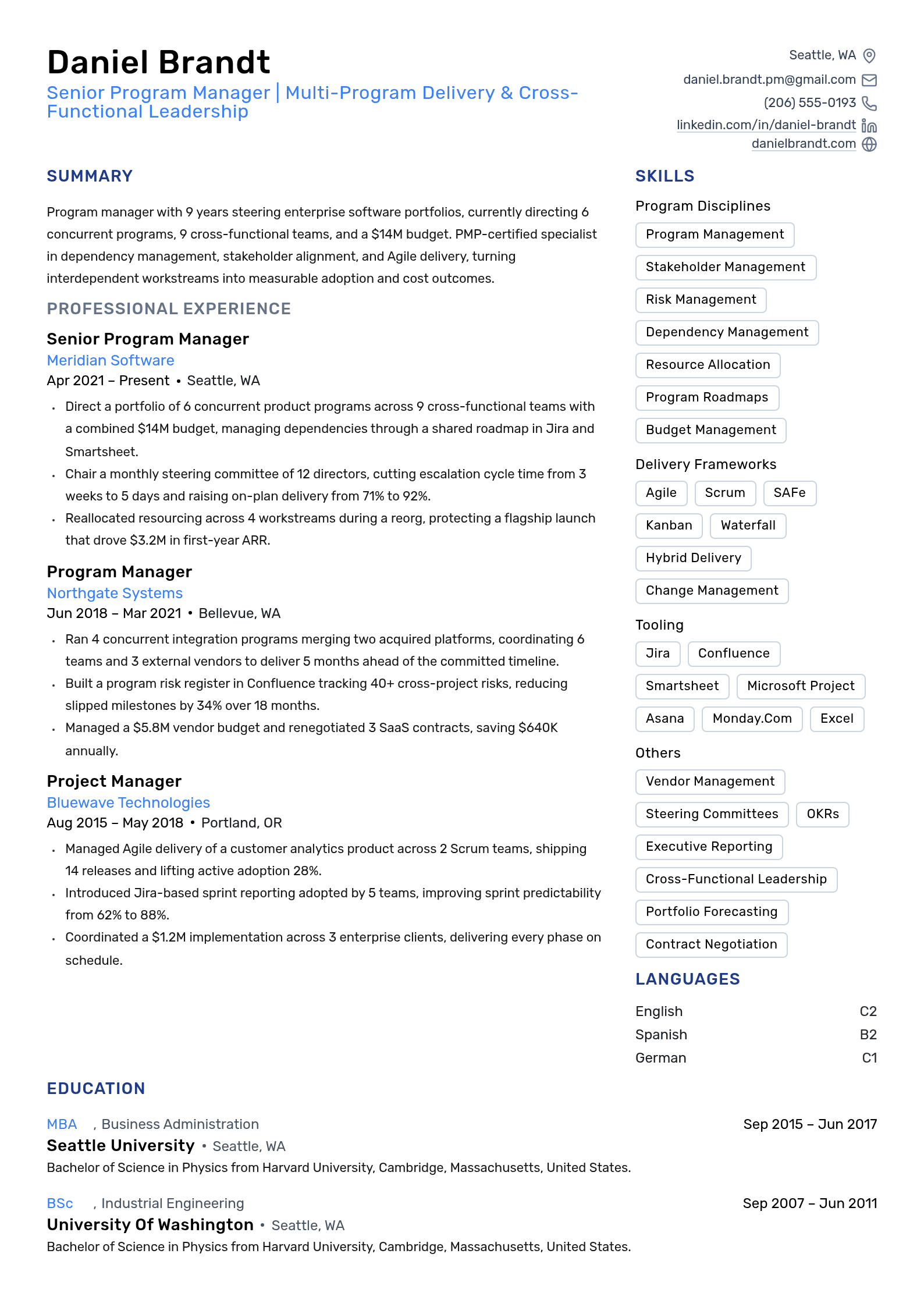
The mechanics of doing this without chaos: keep one master resume per target (say, "product designer, B2B SaaS") and spin off a tailored version for each application, so the master never degrades into a compromise document. The reasoning behind that setup is covered in why you need a base resume and tailored versions.
The hard part is knowing what a specific posting actually filters for, and that is where guessing wastes hours. In Roleframe, you duplicate your base resume for a job, paste the posting, and get a fit report: an ATS score against that posting, the exact keywords it asks for that your resume is missing, and a prioritized plan of what to rewrite. Then you make the edits yourself, with Remi, the career copilot, proposing bullet-level rewrites you approve one at a time. Nothing gets on the page that you did not sign off, which matters when an interviewer asks you to defend a line.
Frequently asked questions
- Should a product designer resume be one page or two?
One page for most designers up to roughly senior level, two pages if you have a decade of experience or significant leadership scope. The resume is the trailer; the portfolio is the film, so depth belongs there. The data-backed breakdown by experience level is in should a resume be one page or two.
- Should I design my resume in Figma?
You can build it in Figma, but export it carefully and test the result. Figma PDF exports frequently render text as vector outlines, which makes the entire document unreadable to an ATS. After exporting, try to select and copy the text; if you cannot, neither can the parser. A text-based editor with a clean template is the safer default, and the visual expression of your craft belongs in your portfolio.
- Does a graphical resume ever help a product designer?
Almost never in an application pipeline. The first reader is software that cannot see graphics, and the second is a recruiter spending seconds looking for titles, tools, and a portfolio link. A decorated resume slows both down. The exception is a direct handoff to a hiring manager outside any ATS, and even then, a clean resume plus a strong portfolio outperforms a decorated resume with the same portfolio.
- How do I write a product designer resume with no experience?
Treat projects as experience. Case studies from a bootcamp, redesign projects, volunteer or freelance work all count if you present them with the same research-to-handoff structure as a job: the problem, the research you did, the design decisions, and the outcome or learning. Lead with a Projects section above Education, keep the portfolio link prominent, and make sure each project on the resume has a full case study behind the link.
- What's the difference between a UX designer resume and a product designer resume?
Mostly emphasis, and it matters for keyword filters. Product designer postings stress end-to-end ownership, business outcomes, and collaboration with product managers; UX designer postings often weight research and interaction craft more heavily. Use the title the posting uses, and include both terms somewhere on the page (for example, "product designer" in your title line and "UX/UI design" in skills) so recruiter searches on either phrasing find you.
- Should my resume match my portfolio's visual branding?
Light consistency is fine: the same name treatment, one shared accent color. Full brand carryover with logos, custom illustration, or a matching layout system is where parsing starts to break. Think of the resume as the plain-text README for your portfolio. The consistency that hiring managers actually notice is in the content, whether the projects on the resume match the case studies behind the link.
- How should a senior product designer resume differ from a mid-level one?
Seniority shows up as scope, so shift the bullets from tasks to influence: design system ownership across teams, mentoring other designers, setting direction with product leadership, and metrics tied to work you drove rather than executed. The format stays identical. Senior designers are screened through the same ATS and the same recruiter skim as everyone else, so the case for clean, parseable formatting only gets stronger with the salary on the line.

Ready when you are
Send the tailored resume, not the generic one.
Paste a job posting and Roleframe scores your resume against it, then helps you close the gaps one approved edit at a time, so you apply while the role is still fresh.