Technical Writer Resume Example & ATS Keyword Guide
by Larbi SahliLast Updated
A full technical writer resume example, plus the ATS keywords and tools (API documentation, Markdown, MadCap Flare) employers actually screen for.

Users have landed jobs at
- 1Password
- OpenAI
- Notion
- justworks
On this page
Technical writers face a strange irony in hiring: you get paid to make complex information clear, and then a recruiter gives your own document about seven seconds on the first pass. If your resume buries the docs you shipped under vague duty statements, you fail the exact test the job exists to solve.
The fix is specific. A technical writer resume wins on three things: the documentation types you own (API references, user guides, release notes), the toolchain you work in (Markdown, Git, MadCap Flare, DITA), and evidence that your writing changed a number somewhere, usually support tickets, onboarding time, or developer adoption. This guide walks through a complete technical writer resume example, then breaks down every section, including the applicant tracking system (ATS) keywords that recruiter filters actually scan for in technical writing postings.
What Makes a Great Technical Writer Resume
The strongest technical writer resumes read like good documentation: front-loaded, scannable, and specific about scope. Hiring managers for these roles are often documentation leads or engineering managers, and they screen for three signals in order.
First, documentation types by name. "Wrote technical documentation" tells a reviewer nothing. "Wrote and maintained REST API reference documentation for 40+ endpoints" tells them exactly where you fit. Postings ask for specific deliverables, so your resume should name them: API documentation, user guides, admin guides, release notes, knowledge base articles, SDK documentation, runbooks, or installation manuals.
Second, the toolchain. Technical writing has split into camps. Docs-as-code teams live in Markdown, Git, and static site generators. Enterprise and hardware teams run structured authoring in MadCap Flare, DITA, or Oxygen XML. A recruiter filtering applications is checking whether your tools match theirs, and a resume that lists "Microsoft Word" as its headline tool signals you haven't worked in a modern docs team.
Third, outcomes. Documentation exists to reduce something: support tickets, time-to-first-call for an API, onboarding time for new users. The writers who get interviews connect their docs to one of those reductions, even roughly. "Cut ticket volume for the billing module after rewriting the self-serve help center" beats a paragraph about your attention to detail.
One more thing that separates technical writers from every other role: the portfolio. Your resume's job is partly to get someone to click your portfolio link, so that link needs to be in the header, working, and pointed at samples you're allowed to share. More on that below.
Technical Writer Resume Example
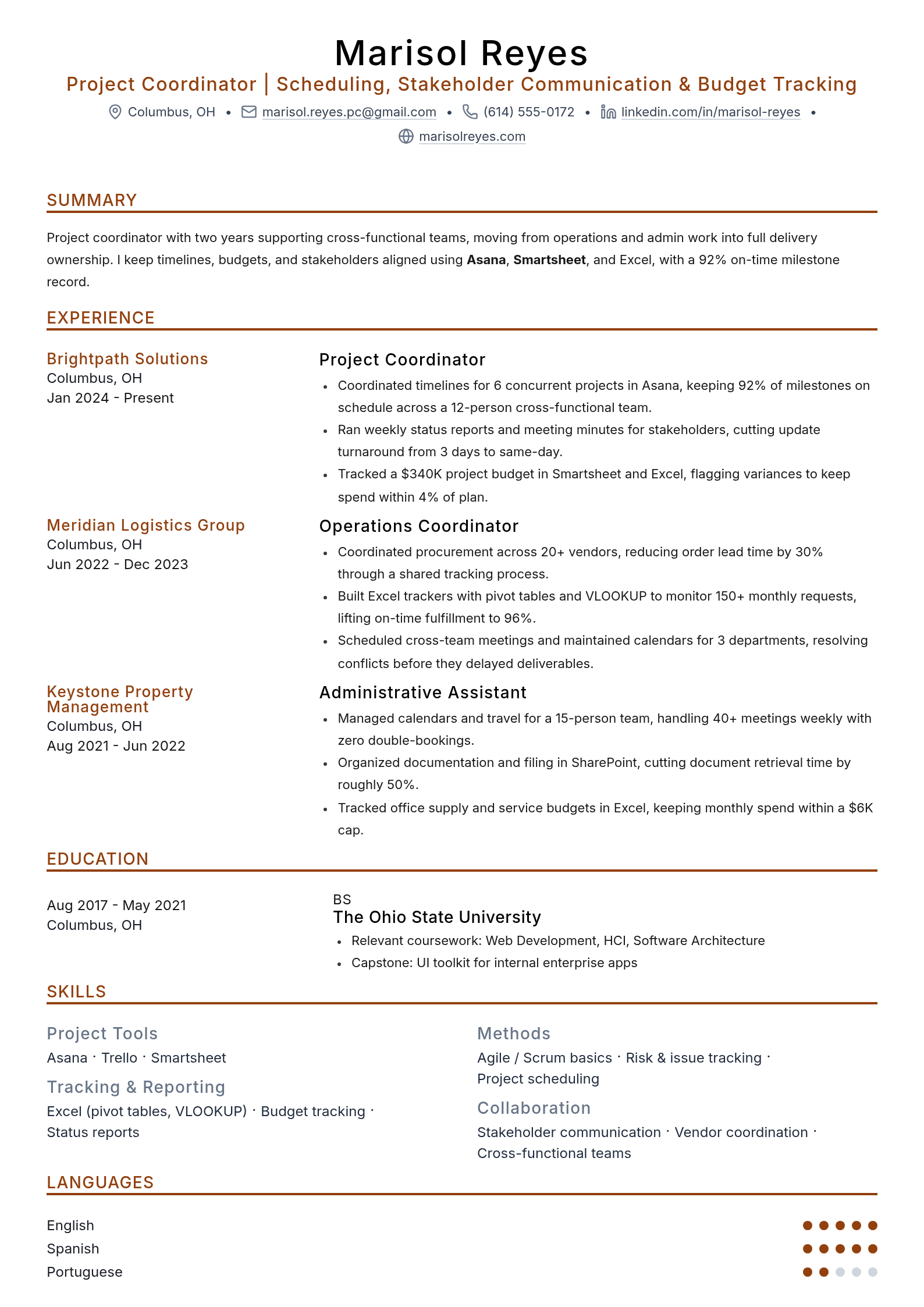
Here is a complete example for a mid-level technical writer in software. Notice how it names documentation types in the first line of the summary, puts the toolchain where a filter will find it, and ties bullets to measurable outcomes rather than responsibilities.

Marissa Halvorsen
Technical Writer | API Documentation & Developer Guides
Summary
Technical writer specializing in developer documentation with five years at SaaS companies. I build docs-as-code pipelines in Markdown and Git, run SME interviews with engineers, and ship API references and user guides that cut support load and speed developer onboarding.
Professional Experience
Technical Writer
Rewrote REST API documentation and SDK guides in Markdown, cutting API-related support tickets 34% across 12,000 developer accounts
Built a docs-as-code pipeline with Git and a static site generator, reducing publish time from 2 days to under 20 minutes
Ran weekly SME interviews with 9 backend engineers to ship release notes on every biweekly deploy
Documentation Specialist
Authored 40+ user guides and a searchable Confluence knowledge base, lifting self-service resolution from 41% to 68%
Standardized all docs to the Microsoft Style Guide, cutting editorial review cycles by roughly 30%
Migrated legacy help content into structured Markdown, reducing developer onboarding time from three weeks to nine days
Education
University of Colorado Boulder
BA
Bachelor of Science in Physics from Harvard University, Cambridge, Massachusetts, United States.
University of Washington
Certificate
Bachelor of Science in Physics from Harvard University, Cambridge, Massachusetts, United States.
Languages
Skills
Documentation
Tools
Projects
OpenPay API Reference
Documented an open-source payments API in Markdown with runnable examples, adopted by 600+ developers and reducing integration questions on the issue tracker.
DocsFlow Contribution Guide
Wrote the contribution and style guide for an open docs-as-code project, standardizing pull requests and cutting review turnaround by half.
Certificates
Certified Professional Technical Communicator (CPTC) – Foundation
Validated foundational knowledge of AWS cloud concepts, security, and billing.
Covered core services including EC2, S3, RDS, Lambda, and CloudFront.
Demonstrated understanding of shared responsibility model and basic architectural best practices.
Awards
Docs Impact Award
Recognized for building a cloud-native AI productivity tool.
Treat this as a pattern, not a template to copy word for word. The structure transfers: niche in the summary, deliverables named in every role, tools in a dedicated skills section, portfolio in the header. The content has to be yours, because every claim on it is something an interviewer can probe.
Choosing the Right Resume Format for Technical Writing
Use reverse-chronological format. Technical writing is an experience-driven hire, and reviewers want to trace your progression: what you documented, for whom, with which tools, and how the scope grew. A functional (skills-first) format hides that progression and reads as if you're hiding something, which recruiters have learned to assume you are.
Two situations justify a variation. Career changers coming from engineering, support, QA, or teaching can use a hybrid format: a short skills-and-tools block up top, then reverse-chronological experience with the writing-adjacent work pulled forward in each role's bullets. And freelancers should group client work under a single "Freelance Technical Writer" entry with per-client sub-bullets, rather than listing eight three-month engagements that look like job-hopping.
On length: one page for under roughly five years of experience, two pages once your project list genuinely earns it. Senior writers with a decade across API docs, localization, and docs tooling should not compress that into one page and lose the keywords a filter needs. The one page vs. two pages question has a real answer by experience level, and for technical writers it leans two pages earlier than most roles because deliverables and tools take space to name.
Keep the layout clean for parsing: standard section headings, no text boxes, no multi-column skill grids that scramble in an ATS. If you want the mechanics, the guide to ATS-friendly resume formatting covers what breaks parsers and what doesn't. Export and submit as PDF, which preserves your formatting exactly as you built it.
Writing a Professional Summary That Highlights Your Niche
The summary's one job is to name your niche in the first sentence. "Technical writer with 6 years of experience" is a wasted line. "Technical writer specializing in developer documentation for SaaS APIs" tells the reviewer in three seconds whether to keep reading, and for the right role, the answer is yes.
A working formula for technical writers: niche + years + primary deliverables + toolchain + one outcome. Three sentences, no adjectives about yourself. Compare:
- Weak: "Detail-oriented technical writer with excellent communication skills and a passion for making complex topics simple."
- Strong: "Technical writer with 6 years documenting REST APIs and SDKs for B2B SaaS products. Own end-to-end docs in a docs-as-code workflow (Markdown, Git, Docusaurus), from SME interviews to publication. Rewrote the developer onboarding guide at my last role, which cut time-to-first-API-call for new integrators."
The weak version could belong to any of a thousand applicants. The strong version could only belong to one kind of writer, and it repeats the exact terms a filter scans for. If you're targeting a different niche, swap the nouns: "documenting medical devices to FDA and IEC 62304 requirements" or "hardware installation and service manuals in MadCap Flare" do the same work. For more patterns, see how to write a professional summary.
How to Describe API Documentation and User Guides in Your Experience Section
Most technical writer bullets fail the same way: they describe the activity instead of the artifact and its effect. "Responsible for creating documentation" is an activity. A hiring manager wants the artifact (what you shipped), the scope (how big, for whom), and the effect (what changed because it exists).
A bullet formula that works for documentation
Structure each bullet as deliverable + scope + method + outcome. You won't always have all four, but aim for three. Examples across common deliverables:
- API documentation: "Wrote and maintained OpenAPI-based reference docs for 60+ REST endpoints, working from engineer interviews and source code; support tickets tagged 'API confusion' dropped by roughly a third in the following two quarters."
- User guides: "Rebuilt the admin user guide (120+ topics) in MadCap Flare with task-based structure, replacing a monolithic PDF; the guide became the top self-serve resolution path in support analytics."
- Release notes: "Owned release notes for a biweekly release cycle, coordinating with 4 product teams to translate Jira tickets into customer-facing language before each ship date."
- Knowledge base: "Audited and rewrote 200+ knowledge base articles against a new style guide, retiring duplicates and adding search-optimized titles based on failed-search reports."
Only use numbers you can defend. If you don't know the ticket reduction, say what you can verify: "cited by the support team as the main driver of falling ticket volume for that module." Qualitative but concrete beats a number you made up, because interviewers ask follow-up questions and a hollow metric collapses fast.
Show the process, not just the prose
Documentation managers hire for process as much as writing. Weave in the parts of the job that juniors don't know exist: interviewing subject-matter experts (SMEs), running docs through review cycles, testing procedures against the actual product, managing docs in version control, and maintaining a style guide. A bullet like "Established a docs review workflow in GitHub pull requests, getting engineering sign-off on technical accuracy before publication" signals seniority in one line.
Keep it to three to five bullets per role, strongest first. The bullet count guidance applies here as everywhere: recent roles get more, older roles compress.
Top ATS Keywords for Technical Writers
When Roleframe's job-analysis engine reads a technical writing posting, the requirements cluster into a predictable set: documentation types, authoring tools, and process terms. Recruiters filter on these because they're the fastest proxy for fit. The pattern across software documentation roles is consistent: API documentation and Markdown-based, docs-as-code workflows dominate the software side, while structured authoring terms (DITA, MadCap Flare, XML) dominate enterprise and hardware postings.
Here are the keywords that come up again and again, grouped by how they're used in postings. Match the exact phrasing of the posting you're applying to, because a filter searching "API documentation" won't credit "documented APIs" split across a sentence.
| Keyword / phrase | Where it shows up | How to earn it on your resume |
|---|---|---|
| API documentation | Nearly every software technical writer posting | Name the API type (REST, GraphQL) and spec format (OpenAPI/Swagger) in an experience bullet |
| User guides / user manuals | Software and hardware roles alike | State the audience (end users, admins, field techs) and topic count or scope |
| Markdown | Docs-as-code and developer docs roles | List it in skills and show it in context: "authored in Markdown, published via Docusaurus" |
| Git / GitHub / version control | Developer documentation and docs-as-code teams | Describe your PR-based review workflow, not just the tool name |
| MadCap Flare | Enterprise software, hardware, regulated industries | Name the projects: single-sourcing, conditional text, PDF and HTML5 outputs |
| DITA / structured authoring / XML | Enterprise and hardware documentation | Mention the CMS or editor (Oxygen XML, a CCMS) alongside DITA |
| Confluence | Internal docs and agile software teams | Pair it with what you organized: spaces, templates, governance |
| Release notes | SaaS roles with regular ship cycles | State the cadence and how many teams you coordinated with |
| SME interviews / subject-matter experts | Almost universal in postings | Show it as method: "working from SME interviews and hands-on product testing" |
| Style guide (Microsoft Style Guide, Chicago) | Mid to senior roles | Name the guide you follow or the one you wrote and enforce |
| Knowledge base | Support-adjacent and SaaS roles | Include the platform (Zendesk, Intercom) and article volume |
| SDK / developer documentation | Developer-facing product roles | Name the languages your samples covered, even if you don't code daily |
| Agile / Jira | Software teams embedding writers in sprints | One bullet on working within sprint cycles covers it |
Don't stuff all of these into your resume. A filter match gets you read by a human, and a human spots keyword salad instantly. Include the terms you can back with a story, in the exact phrasing the posting uses. For the general method, this guide to ATS resume keywords covers how matching actually works and where writers overdo it.
This is also the tedious part of applying that's worth automating the honest way: paste a specific posting into Roleframe and the fit report shows which of that job's keywords your resume already covers and which are gaps, so you're editing against the real posting instead of a generic list like the one above.
Listing Tools: Markdown, MadCap Flare, Git, and What to Skip
Your skills section should read like a docs team's actual stack, organized so a reviewer can find their tools in two seconds. Group by function rather than dumping an alphabetical list:
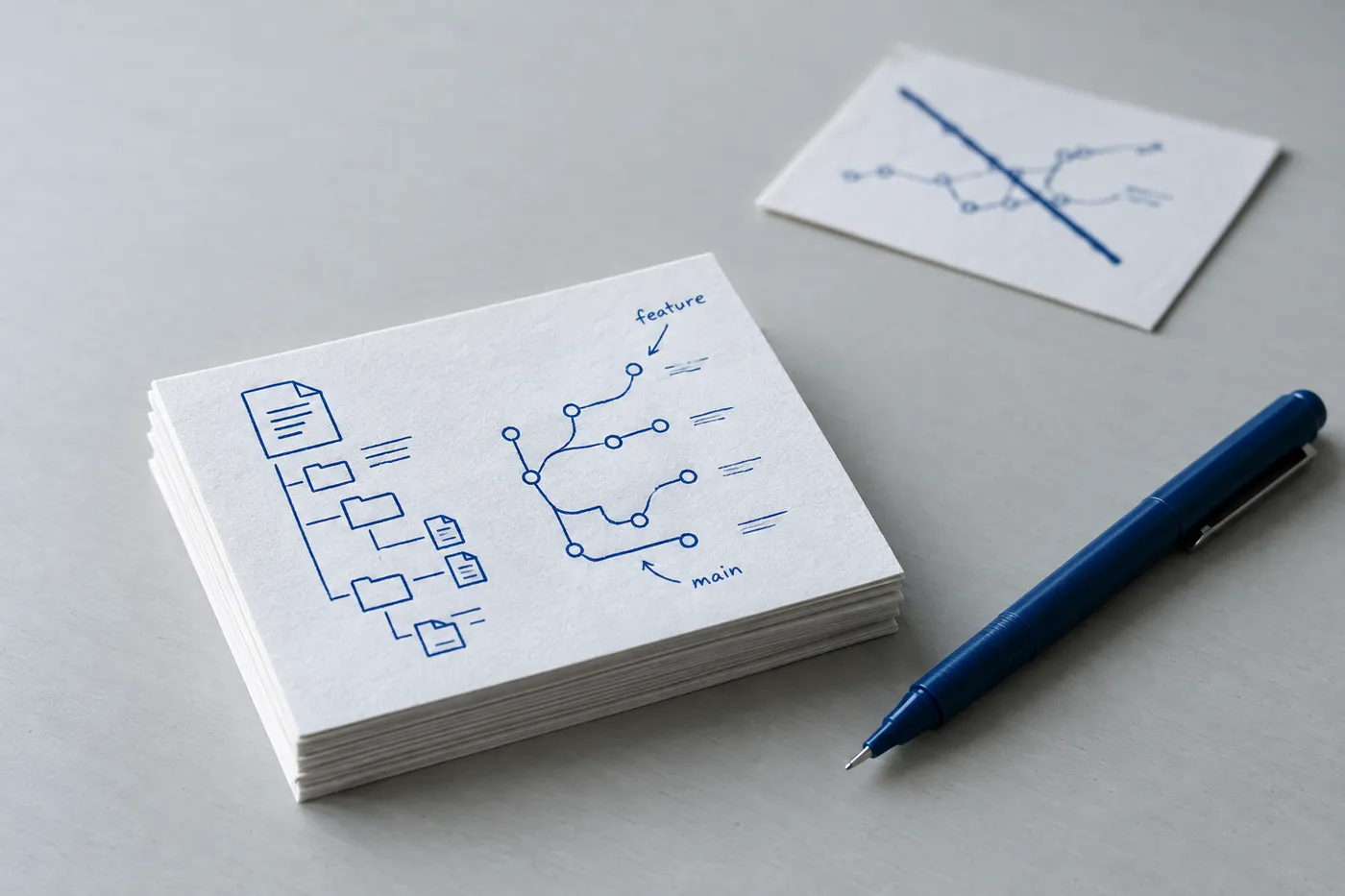
- Authoring and publishing: Markdown, MadCap Flare, DITA/Oxygen XML, Docusaurus or another static site generator, Confluence
- Version control and workflow: Git, GitHub or GitLab, pull-request reviews, Jira
- API and developer tooling: OpenAPI/Swagger, Postman, basic HTML/CSS, familiarity with a language like Python or JavaScript for reading code samples
- Visuals and capture: Snagit, Camtasia, Figma (for reading design specs), diagramming tools
- Standards: Microsoft Style Guide or Chicago, accessibility basics, localization-ready writing
Three judgment calls worth making deliberately. Skip Microsoft Word as a headline skill. Every applicant has it, no filter screens for it in software roles, and leading with it dates you. If a government or defense posting explicitly requires Word-based deliverables, list it there and only there. List Git even at basic proficiency if you're targeting software, because docs-as-code teams treat it as table stakes; be honest about depth ("Git for docs workflows: branching, PRs, merge reviews") rather than implying you administer repos. Don't list both DITA and docs-as-code as your core stack unless you've genuinely worked in both, since they imply different careers and an interviewer will test the one you're weaker in.
For deciding what makes the cut and what gets swapped per application, these skills section examples show the keep-vs-swap logic in practice.
How to Include a Portfolio Link on Your Resume
A technical writer resume without a portfolio link is a menu without prices. Put the link in your header, next to your email and LinkedIn, as a clean clickable URL. Not buried in the summary, not "portfolio available upon request," which reads as "I don't have one" (the same reason 'references available upon request' died).
What the link should point to, in order of preference: a personal site with three to five curated samples, a GitHub profile if your docs live in public repos, or a Google Drive folder with clearly named PDFs as a fallback. Curate hard. Five strong samples spanning your claimed deliverables (one API reference, one user guide, one conceptual piece) beat twenty screenshots.
Two problems every working writer hits. NDA'd work: never post proprietary docs. Instead, write a sanitized sample that demonstrates the same skill, or describe the project in a case-study format ("documented an internal billing API; here's a redacted excerpt of the structure") with your employer's permission, or document an open-source project's API to show the skill on public material. Public docs without attribution: if your published docs don't carry your byline, link them anyway and state your role precisely: "sole writer for sections X and Y." Interviewers verify this in conversation, and precision here builds trust.
Test the link from an incognito window before every application. A permissions-locked Drive folder has ended more technical writer candidacies than any typo.
Tailoring Your Resume for Software vs. Hardware Roles
Software and hardware documentation roles filter on different vocabularies, and one generic resume serves neither. This is the strongest argument for keeping a base resume and tailoring a version per application, which the base-and-variants approach makes routine instead of painful.
For software and SaaS roles
Lead with developer-facing deliverables and the docs-as-code stack: API documentation, SDK guides, release notes, Markdown, Git, static site generators, Confluence, Jira. Emphasize working inside agile sprints and reading code well enough to verify samples. If you've contributed docs to open source, that's a first-page bullet: it's verifiable, public proof of both writing and Git fluency.
For hardware, manufacturing, and regulated industries
Lead with structured authoring and compliance: installation and service manuals, DITA, MadCap Flare, XML, single-sourcing, illustrated parts documentation, and any standards you've written to (ISO documentation requirements, FDA submissions for medical devices, MIL-STD formats for defense). These employers also weigh hands-on verification, so bullets about testing procedures against physical products, working with CAD-derived illustrations, or coordinating with field engineers land hard. Defense-adjacent roles may mention clearance eligibility; if you hold or held one, state it in the header line.
The swap list
Between the two, you're typically swapping: the summary's niche sentence, the order of your skills groups, which two bullets lead each role, and the samples your portfolio link highlights. That's a twenty-minute edit per application, not a rewrite. Keep the master untouched and edit the copy, so a hardware-flavored edit never bleeds into your next SaaS application.
Frequently asked questions
- What should I include on my resume as a technical writer?
Five things, in this order of importance: the documentation types you've produced by name (API docs, user guides, release notes, knowledge base articles), your toolchain (Markdown, Git, MadCap Flare, DITA, Confluence), outcomes your docs drove (reduced support tickets, faster onboarding), your process skills (SME interviews, review workflows, style guide enforcement), and a working portfolio link in the header. A summary that names your niche in the first sentence ties it together.
- What are 5 examples of technical writing?
The five you'll most often be hired to produce: API and SDK documentation for developers, user guides and manuals for end users, release notes and changelogs, knowledge base and help center articles, and standard operating procedures or runbooks for internal teams. Others that appear in postings include white papers, installation guides, and regulatory submission documents. Name the specific types you've written on your resume, because postings filter on them.
- Can ChatGPT write my technical writer resume?
It can draft one, and the draft will sound like every other applicant's, which is a real problem in a field where the resume is a writing sample. Generic AI tools don't know which claims you can defend, and an invented metric on a technical writer's resume is disqualifying the moment an interviewer probes it. A better division of labor: you supply the facts and the judgment, and use AI for targeted edits you review line by line. That's how Remi works inside Roleframe: it proposes rewrites grounded in the job posting and your actual history, and nothing changes until you approve it.
- What are the responsibilities of a technical writer?
The core loop: gather information from subject-matter experts, source code, and hands-on product use; structure it for a defined audience; write and edit it to a style guide; run it through technical review; publish it in the team's toolchain; and maintain it as the product changes. Depending on the team, the role can extend into information architecture, docs tooling, localization coordination, and measuring documentation effectiveness through support and search analytics. Your resume bullets should mirror this loop, not just the writing step.
- How do I write a technical writer resume with no experience?
Build the evidence first, then write the resume around it. Contribute documentation to an open-source project, document a public API as a portfolio piece, or write a user guide for software you know well. On the resume, lead with a skills-and-tools section, list these projects as real experience with real bullets, and mine adjacent work (support, QA, teaching, engineering) for documentation-shaped accomplishments like writing internal guides or onboarding materials. A junior candidate with three strong public samples beats one with a certificate and no portfolio.
- Should a technical writer resume be one page or two?
One page for roughly the first five years, two pages once your deliverables and toolchain genuinely need the space. Technical writers earn a second page earlier than most roles because naming documentation types, tools, and projects takes room, and cutting them costs you keyword matches. Never pad to fill a second page; a tight page and a half is fine.
- Do I need a portfolio if my best work is under NDA?
Yes, and this is solvable. Write sanitized samples that demonstrate the same skills as your NDA'd work, document an open-source project's API, or create a short case study describing a confidential project's structure and outcome without proprietary content. Never post actual proprietary documentation. In interviews, describe the NDA'd work verbally and precisely; hiring managers in this field understand the constraint and respect candidates who handle it correctly.

Ready when you are
Send the tailored resume, not the generic one.
Paste a job posting and Roleframe scores your resume against it, then helps you close the gaps one approved edit at a time, so you apply while the role is still fresh.