Cover Letter for an IT Student: Entry-Level Example and Lab Lines
by Larbi SahliPublished
A complete cover letter for an IT student, with swappable paragraphs for a home lab, booked certifications, course labs, and an apprenticeship version.
Users have landed jobs at
- 1Password
- OpenAI
- Notion
- justworks
On this page
An IT student replaces job experience with proof of operation: a home lab that stays up, a certification exam that is booked with a date, a course lab that produced something running, and any system you already keep alive for other people. A cover letter built on those four things beats one built on enthusiasm every time, because it shows the hiring manager the thing they are actually buying: someone who has kept a system running and fixed it when it broke.
Most student cover letter guides are written for no field in particular, so they tell you to "highlight relevant coursework" and leave you staring at a module list. This page does the opposite. Below is a complete letter written by a final-year IT student for a junior IT technician role, then a paragraph-by-paragraph breakdown of where each proof point goes and how to swap in your own: your lab, your certs, your campus support job, your apprenticeship version.
A complete cover letter for an IT student
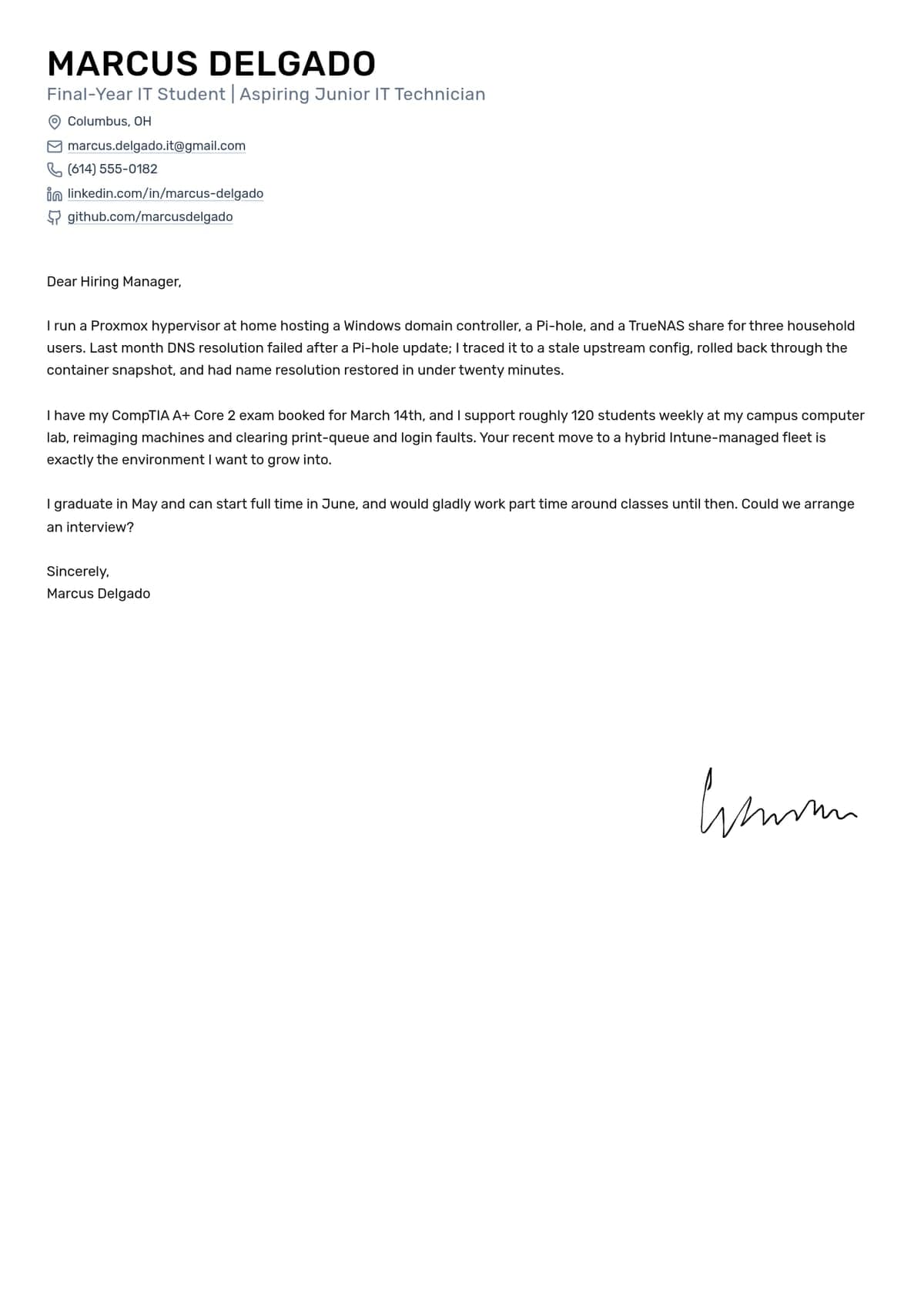
Read the letter below as a structure, not a script. The opening names the company and the role and leads with the strongest concrete proof. The middle paragraphs each carry one verifiable claim tied to a line in the posting. The close states availability in one sentence and asks for the conversation. Nothing in it could have been written by a student applying to a marketing job, which is exactly the test your letter has to pass.
Marcus Delgado
Final-Year IT Student | Aspiring Junior IT Technician
Dear Hiring Manager,
I run a Proxmox hypervisor at home hosting a Windows domain controller, a Pi-hole, and a TrueNAS share for three household users. Last month DNS resolution failed after a Pi-hole update; I traced it to a stale upstream config, rolled back through the container snapshot, and had name resolution restored in under twenty minutes.
I have my CompTIA A+ Core 2 exam booked for March 14th, and I support roughly 120 students weekly at my campus computer lab, reimaging machines and clearing print-queue and login faults. Your recent move to a hybrid Intune-managed fleet is exactly the environment I want to grow into.
I graduate in May and can start full time in June, and would gladly work part time around classes until then. Could we arrange an interview?
Sincerely,
Marcus Delgado

What an IT hiring manager looks for before you have a job title
The person reading a junior technician application is usually the person you would work for: an IT manager or a senior technician who is tired of tickets. They are not scanning for polish. They are scanning for evidence that you can troubleshoot without hand-holding, that you have touched real systems, and that you will not need three months of supervision before you can close a password reset on your own.
Before you have a job title, four kinds of proof carry that message. In rough order of weight for a technician role:
- A home lab. Anything you built and keep running: a hypervisor, a domain controller, a Pi-hole, a NAS. It proves you do this unpaid, which is the strongest signal a student can send.
- Certifications, earned or booked. CompTIA A+ or Network+ with a real exam date tells the reader you are serious about the exact skills the role uses.
- Course labs and capstone work. Not the module name, the artifact: the network you configured, the script you wrote, the database you designed.
- Informal support work. The campus computer lab shift, the club whose website you keep up, the family business whose five machines you maintain. Users and devices count even without a payslip.
Your letter needs two or three of these, each in its own short paragraph, each tied to a requirement in the posting. It does not need all four. A letter that tries to cram in everything reads like a resume with sentences around it, and the resume already exists. If you want to see how the same proof points sit on the resume side, the student resume examples show the layout for education-first candidates.
Turning a home lab into one specific paragraph
"I have a home lab" is a claim. "I run Proxmox on a used Dell OptiPlex with a pfSense firewall, a Pi-hole for DNS, and a Windows Server VM where I practice Active Directory" is evidence. The difference is that the second version can be probed in an interview, and hiring managers know it. Name the hypervisor. Name the services. Name the hardware if it makes the story better, and a rescued office desktop usually does.
The strongest lab paragraph includes a failure. Something broke, you diagnosed it, you fixed it, and ideally you changed something so it would not break the same way again. That one sentence does more work than any adjective, because troubleshooting under uncertainty is the actual job of a junior technician. A DNS misconfiguration that took your whole network down, a full disk that killed a VM, a botched update you had to roll back: any of these works, told plainly in two sentences.
Structure the paragraph in three moves: what you run, one thing that broke and how you fixed it, and the line in the posting it maps to. If the posting mentions Active Directory, your Windows Server VM is the bridge. If it mentions networking, your VLAN setup or firewall rules are. Pick the mapping the posting asks for and cut the rest; the lab tour belongs in the interview, not the letter.
Certifications: earned, booked, or in progress. Never implied
State certification status in exactly one of three ways: earned (with the year), booked (with the exam date), or in progress (with the expected completion). "Working toward CompTIA A+" with no date reads as "thought about it once." "CompTIA A+ Core 1 passed, Core 2 booked for March" reads as a plan being executed. The second candidate gets the interview.
Never let phrasing imply an exam you have not passed. "Trained in CCNA-level networking" next to a Cisco logo on your resume will be read as a CCNA, and the moment an interviewer discovers it is not one, everything else in your application becomes suspect. IT is a field where credentials get verified, sometimes automatically.
Check the exact certification name and exam code on the issuer's live page before you write it, because vendors rename and retire exams regularly. CompTIA, Cisco, Microsoft, and AWS all publish current exam pages; the name your course materials use may be a version behind. Writing a retired exam code signals that your knowledge of the field is secondhand, which is the opposite of what the certification paragraph is for. On the resume side, where to put certifications depends on how central they are to the posting; in the letter, one sentence with the honest status is enough.
Coursework and capstone work that reads like work
Course codes mean nothing to an employer. "IT 340: Network Administration" tells the reader you enrolled in something. "Configured a three-site network with VLANs, DHCP, and inter-site routing in Packet Tracer, then rebuilt it on physical switches in the lab" tells them what you can do on Monday. Always describe the artifact, not the enrollment.
Three kinds of coursework translate directly into a technician letter:
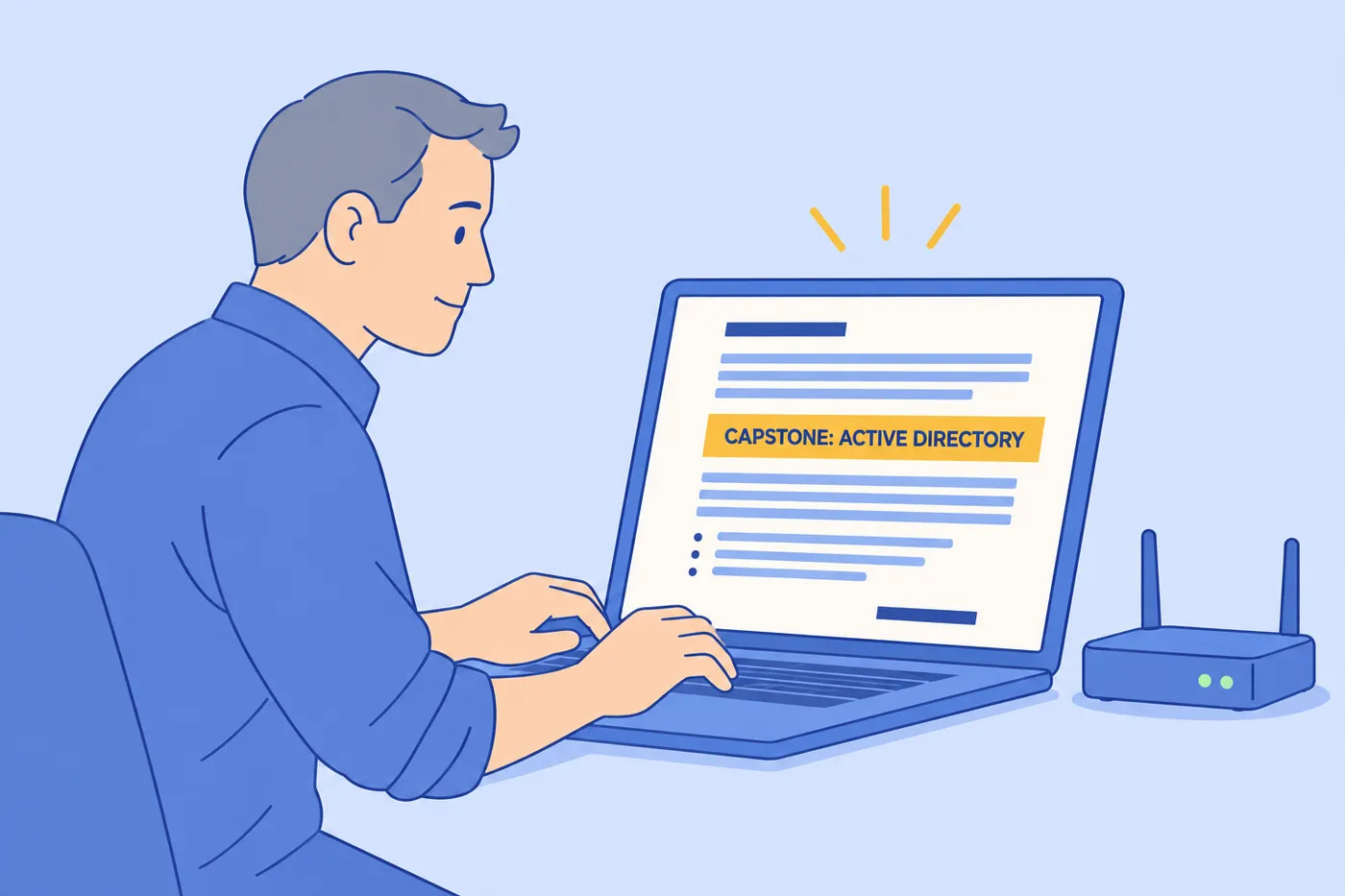
- A networking lab: what you configured, at what scale, with what tools, and whether it was simulated or on real hardware.
- A script: a PowerShell script that automates user provisioning, a Bash script that rotates backups, a Python script that parses logs. Name the language and the task it removed.
- A database or cloud assignment: the schema you designed, the service you deployed, the access controls you set up.
Pick the one that matches the posting and give it three sentences. If your program had a capstone, that is usually the strongest candidate because it involved scope, deadlines, and often a team, which is the closest thing to work a degree produces. There is a separate guide on listing a capstone project on your resume; in the letter, lead with the outcome and connect it to one requirement, then stop.
Informal support experience counts, so count it
If you have ever been the person people come to when the printer dies, you have support experience. The campus computer lab job, the student society whose website and email you run, the family shop whose point-of-sale machines you keep working, the charity whose donated laptops you reimaged: all of it is IT work, and all of it belongs in the letter if it maps to the role.
The trick is quantifying it. "Helped with computers at my parents' business" is invisible. "Maintained six workstations, a shared NAS, and the Wi-Fi for a twelve-person office, including a full malware cleanup and a move to scheduled backups" is a support role in everything but title. Count the users. Count the devices. Name one incident you resolved. Numbers are what turn a favor into experience.
This paragraph often lands harder than the coursework one, because it proves the soft half of support work: dealing with frustrated non-technical people. If the posting mentions customer service or end-user support, this is the paragraph that answers it. For a sense of how that framing scales up in a full-time role, the IT support specialist cover letter examples show the same structure with a job title attached.
Linking a GitHub, lab write-up, or portfolio
A link in a cover letter is a promise. Only make it if the click delivers. A GitHub profile with three real repositories, each with a README that explains what the project does and how to run it, strengthens your application. A profile with two forks and an empty tutorial folder weakens it, because the reviewer now has evidence that your claims outrun your work.
Before you link anything, audit it as a stranger. Pin your best two or three repositories. Write or fix the READMEs. Delete or hide the abandoned experiments. If your best work is a home lab rather than code, a short write-up works just as well: a page describing your lab's architecture, a network diagram, and one incident post-mortem. Reviewers rarely read past the first screen, so put the strongest thing at the top.
In the letter itself, the link gets one sentence, anchored to a claim: "the provisioning script and my lab write-up are on my GitHub." Do not paste a bare URL into a paragraph; put the full link in your header alongside your email. The guide on including a GitHub link on a resume covers the formatting details, and the same rules apply to the letter.
The apprenticeship and graduate scheme version
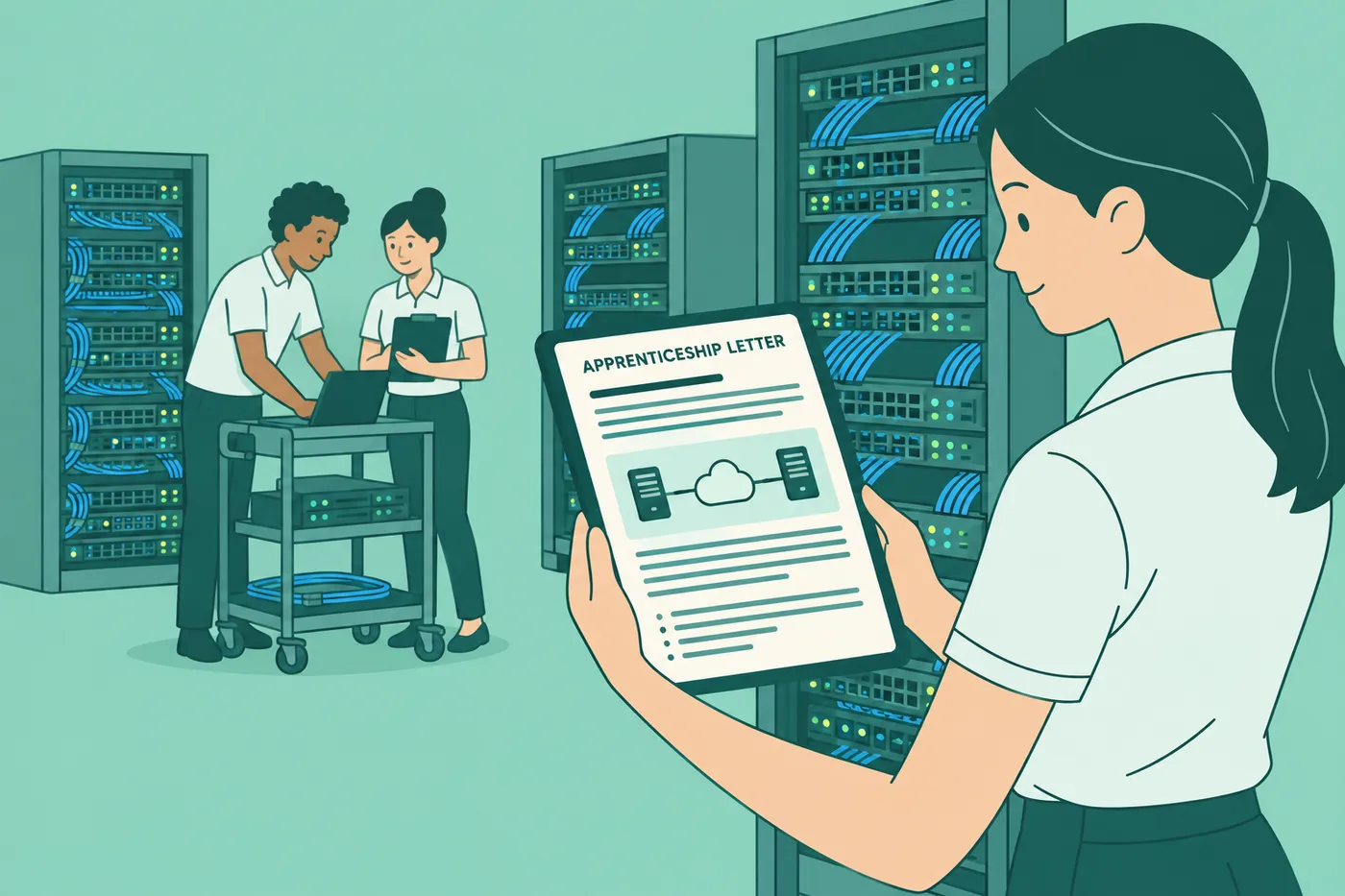
A cover letter for an IT apprenticeship changes at the opening and the closing, and stays the same in the middle. The proof paragraphs, the lab, the certifications, the informal support work all carry over unchanged, because an apprenticeship assessor is looking for the same thing a hiring manager is: evidence you will stick with the technical work.
The opening changes because the scheme, not the job, is the thing you are applying to. Name the scheme exactly as the employer names it, and say why the apprenticeship structure specifically suits you, not just why IT does. Employers running apprenticeships lose money on candidates who quit halfway, so commitment is the quality they screen hardest for. One sentence on why you chose earning-while-learning over a different route does more than a paragraph of enthusiasm.
The closing changes because schemes have intakes and eligibility rules. Answer eligibility only if the posting asks, and verify the requirement on the scheme's live page before you do, because age limits, residency rules, and prior-qualification restrictions vary by country and by program and they change between intake years. If the posting says nothing about eligibility, say nothing; volunteering "I confirm I meet the eligibility criteria" reads as boilerplate. State that you can commit to the full duration and the stated schedule, and give your available start against their intake date.
One closing line: graduation, start date, availability
Every IT student letter needs one sentence that answers the scheduling questions before the reader has to ask them: when you graduate, when you can start, and whether you can work full time or around classes. Something like: "I graduate in May and can work twenty hours a week around classes until then, moving to full time from June 1." That single line saves the hiring manager an email, and saved effort is remembered.
Put it in the final paragraph, right before the ask. And do make the ask. "I would welcome the chance to talk about the role" is fine; "thank you for your consideration" alone is a letter that trails off. The close should contain the availability line, one sentence of interest in this specific company, and a direct request for an interview. Three sentences, done.
Swap table: your situation, your paragraph
The example above is one student's version. Here is how each proof paragraph swaps for your own material, and the phrasing that kills each one.
| What you have | The paragraph it becomes | The mistake that kills it |
|---|---|---|
| A home lab | Hypervisor, services, and one failure you diagnosed and fixed, mapped to a line in the posting | "Passionate about technology" with no named systems |
| A certification booked | Exact cert name and exam code from the issuer's live page, with the exam date | Phrasing that implies the exam is already passed |
| A course lab or capstone | The artifact: what you configured, wrote, or deployed, and the result | Listing course codes and module titles |
| Informal support work | Users and devices counted, plus one incident you resolved | "Helped with computers" with no numbers |
| A GitHub or lab write-up | One sentence anchoring the link to a claim, with the profile cleaned up first | Linking a profile full of forks and empty tutorial repos |
Check the letter against the posting, then export a PDF
Before you send anything, run five checks against the actual posting. Is the letter under a page, ideally three or four short paragraphs? Does the opening name the company and the role in the first two sentences? Does at least one line show you know something specific about this employer that is not on their homepage banner? Is it free of stock phrasing that could open any letter to any company? And does the close ask for something concrete, with your availability stated?
A letter that fails the company-detail check or the stock-phrasing check is the letter everyone else sent. Those two checks are where students lose interviews, because the temptation to reuse one letter across twenty applications is strong and the reader can smell it in the first paragraph.
This is where Roleframe fits the workflow honestly. Duplicate your base resume for the posting and you get a fit report: an applicant tracking system (ATS) score, the exact keywords the posting asks for that your resume is missing, and a prioritized plan. Roleframe then drafts a cover letter from your resume for that specific job, which you edit until every claim is one you can defend, with Remi, the career copilot, proposing changes you approve line by line. Nothing goes out that you did not sign off on, which matters more in IT than most fields, because technical claims get tested in the interview. The same check-your-resume-against-the-posting habit applies to the letter: every requirement the posting lists should have an answer somewhere in your application.
Export the finished letter as a PDF. PDF preserves your formatting exactly on every screen it is opened on, and modern ATS software reads text-based PDFs cleanly. Send a Word file only if the posting explicitly demands one, and default back to PDF everywhere else. Roleframe's editor exports a PDF that matches what you see on screen, so what the hiring manager opens is what you approved.
Frequently asked questions
- How do I write a strong cover letter as an IT student?
Lead with your strongest concrete proof: a home lab, a booked certification, or a course lab that produced something running. Give each proof point its own short paragraph tied to a specific line in the posting, quantify any informal support work with user and device counts, and close with one sentence covering graduation date, start date, and availability. Keep it under a page and cut anything that could appear in a letter to a different company.
- What five things should a cover letter include?
The company and role named in the opening two sentences; one specific reason you want this employer rather than any employer; two or three paragraphs of concrete evidence matched to the posting's requirements; your availability, including graduation and start dates for a student; and a direct ask for an interview. Contact details go in the header, matching your resume exactly.
- Can I use ChatGPT to write my cover letter?
Use it to draft, never to send. A raw AI letter is generic by construction and hiring managers who read hundreds of them recognize the cadence quickly. Worse, it will happily imply certifications you do not hold. If you use AI, feed it your real lab details, your honest cert status, and the actual posting, then rewrite the output until every claim is one you can defend in an interview. Roleframe takes the safer route: it drafts from your own resume for the specific job and you approve every edit.
- What should a cover letter look like in 2026?
One page or less, three to four paragraphs, a plain readable font, and the same header as your resume. No photo, no elaborate design, no objective statement. Sent as a PDF unless the employer explicitly asks otherwise. The formatting expectations have barely moved in a decade; what has changed is that generic letters are cheaper to produce than ever, so specific detail about the employer and verifiable technical claims are worth more than they used to be.
- Do I need a cover letter if the posting marks it optional?
For an entry-level IT role, yes. You have no job title to carry the application, so the letter is where your home lab, booked certification, and informal support work get explained. "Optional" filters for candidates willing to do slightly more than the minimum, which is exactly the trait a junior technician role screens for. A focused half-page beats no letter and beats a padded full page.
- Should I mention my GPA in the cover letter?
Usually no. For a technician role, a working lab and a booked exam outrank a grade average, and the letter has limited space. Mention it only if the posting sets a GPA requirement or you are applying to a graduate scheme that screens on it. On the resume the calculus is similar; the guide on whether to put your GPA on your resume covers the cutoffs.
- What changes in a cover letter for an IT apprenticeship?
The opening and the closing. Open by naming the scheme exactly as the employer does and explaining why the apprenticeship route specifically suits you, since assessors screen hardest for candidates who will finish. Close by confirming you can commit to the full duration and schedule, and address eligibility only if the posting raises it, after verifying the current rules on the scheme's live page. The middle proof paragraphs stay the same.
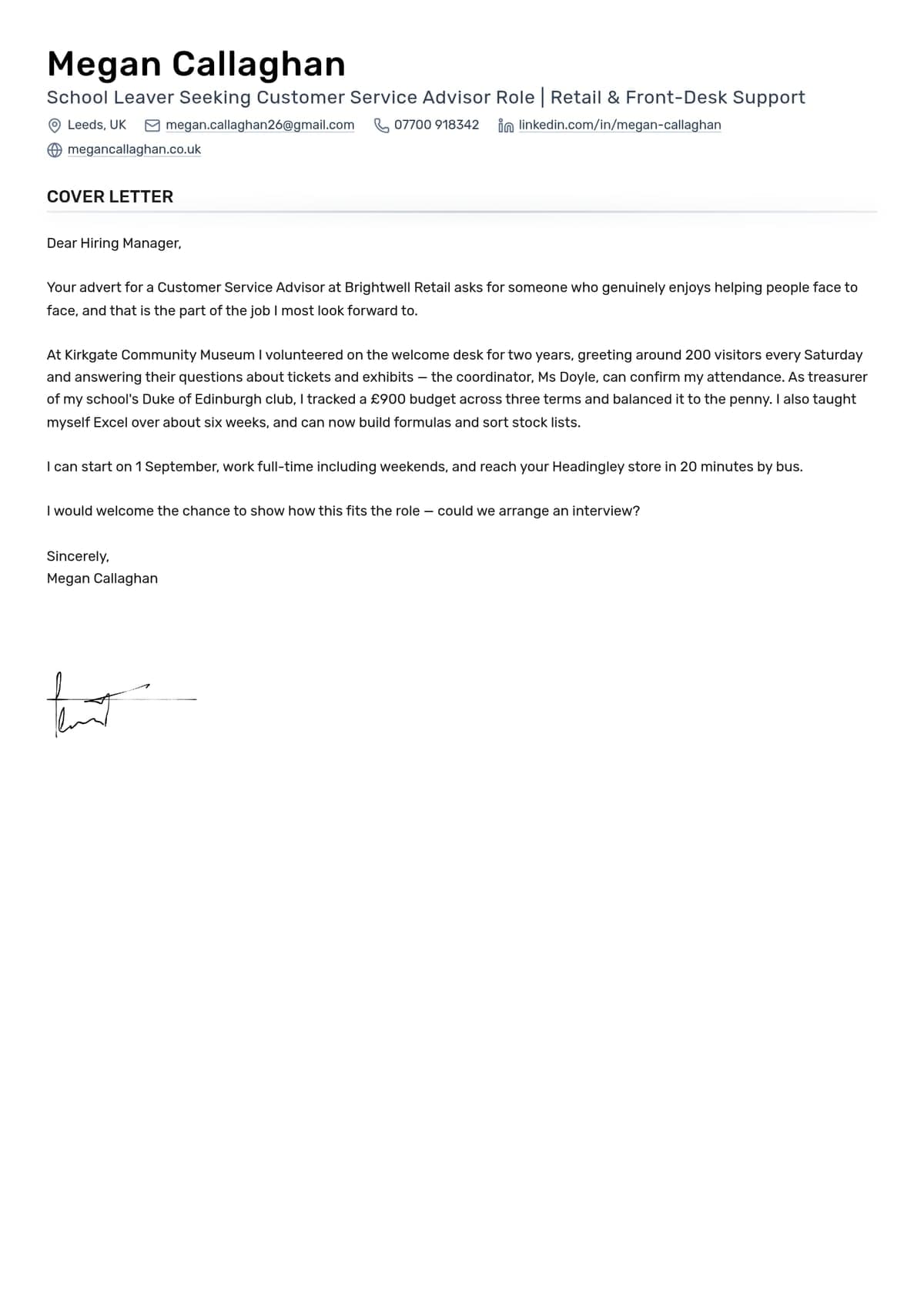
Write yours on the same template.
Every example here is built on a template you can open in the editor. Keep the structure that works and put your own story in it, or let Roleframe draft a first version from your resume and the job posting.


