
Administrative Assistant Cover Letter: Examples and a Writing Guide That Proves You're Organized
by Larbi SahliLast Updated
A full administrative assistant cover letter example, plus how to prove skills like Excel and QuickBooks in context instead of just listing them.

On this page
An administrative assistant cover letter is a work sample. The job is professional written communication, so the hiring manager reads your letter the way she'd read an email you sent on her behalf to a board member. A vague, templated letter doesn't just fail to help; it actively suggests you'd write vague, templated emails for her too.
That's why admin cover letters get read more often than cover letters in most other fields. An engineer's letter might get skipped in favor of a GitHub profile. Yours is the closest thing to a live demonstration the hiring manager gets before the interview.
This guide gives you a complete administrative assistant cover letter example, shows how to adapt it for a corporate office versus a small business, and covers the part almost every template skips: how to prove software proficiency and organizational skill in sentences, instead of pasting a comma-separated list of tools into paragraph two.
What a cover letter actually does in administrative hiring
For most admin openings, the resume answers "can this person do the job" and the cover letter answers "do I want this person in my office every day." Office managers hire admins they'll work beside constantly. Tone, judgment, and attention to detail carry more weight here than in almost any other role.
Three things follow from that. First, a typo is disqualifying. Not embarrassing, disqualifying, because proofreading is literally in the job description. Second, generic openers ("I am writing to express my interest in the position of...") read as a form letter, and admins who send form letters are assumed to handle correspondence the same way. Third, the letter should sound like a competent professional email: warm, direct, and short. Under a page, ideally 250 to 350 words.
The letter also does one job the resume can't. A resume bullet says "managed calendars for three executives." A cover letter can tell the thirty-second version of the story: what was chaotic before you arrived, what you changed, and what ran smoothly afterward. That narrative is what makes an office manager think "this person could fix my inbox problem," and it's the thing static templates never deliver.
Administrative assistant cover letter example: corporate office
The example below is written for a corporate admin role supporting multiple executives. Notice what it does with software. Outlook, Excel, and expense tools show up inside accomplishments, not in a list. That's the pattern to steal, and we'll break down exactly why it works in the sections that follow.
Adapting the same letter for a small business
A small business admin letter makes a different argument. In a 12-person company there's no travel department, no IT help desk, and no facilities team. You are all of them. The office manager reading your letter wants range and self-direction, where a corporate reader wants depth and polish under volume.
Keep the structure of the example above and change three things. Swap the multi-executive scheduling story for a breadth story, something like handling the front desk, vendor invoices in QuickBooks, and event logistics in the same week. Address the owner or office manager by name; in a small business, "Dear Hiring Manager" stings more because finding the right name takes one visit to the company's website. And say something specific about the business itself. A small employer can tell instantly whether you know what they do, and most applicants make it obvious they don't.
One more adjustment: small businesses often list bookkeeping-adjacent tasks in admin postings. If you've touched invoicing, accounts payable, or QuickBooks at any level, say so plainly and describe what you did with it. If you haven't, don't fake it. Point instead to something adjacent you learned fast, like an expense system or a CRM, and say you learned it in your first month.
What makes these letters stand out to office managers
Strip away the wording and the strong examples share four traits. These are the traits worth checking your own draft against before anything else.
- One concrete, preferably quantified win in the first paragraph. "Managed calendars for three VPs and cut double-bookings to near zero" beats any adjective about being detail-oriented.
- Tools mentioned inside accomplishments, never as a bare list. The letter proves proficiency by showing the tool doing something.
- Language mirrored from the posting. If the ad says "executive support" and "travel coordination," those exact phrases appear naturally in the letter.
- A tone that sounds like well-written business email. No stiff formality, no exclamation points, nothing that reads like it came from a template site.
What sinks admin letters is just as consistent: restating the resume bullet by bullet, opening with "I am writing to apply for," claiming to be a "detail-oriented team player" with no evidence, and running past one page. An office manager screening forty applications gives your letter well under a minute. Every sentence that doesn't earn its place costs you a stronger one.
How to prove software proficiency without just listing tools
This is where most administrative assistant cover letters fall flat, and it's the easiest thing to fix. Roleframe's job-analysis engine reads real admin postings every day, and the same tools come up again and again: the Microsoft Office suite (Outlook and Excel above all), Google Workspace, QuickBooks, expense platforms like Concur, video conferencing tools, and increasingly a CRM such as Salesforce. Employers name these tools because they filter on them. Recruiters and applicant tracking systems (ATS, the software that screens applications before a human sees them) both scan for them.
So yes, the tool names need to appear. But a list proves nothing, because everyone lists them. The candidates who get callbacks put each tool inside a sentence with an outcome attached. Here's the difference in practice.

| Tool employers ask for | Weak mention (a list) | Strong mention (in context) |
|---|---|---|
| Microsoft Outlook | Proficient in Microsoft Outlook | Managed shared calendars for three executives in Outlook, resolving conflicts before they reached the principals |
| Microsoft Excel | Advanced Excel skills | Built an Excel tracker for office supply spend that flagged reorders automatically and cut rush orders |
| QuickBooks | Familiar with QuickBooks | Processed 60+ vendor invoices a month in QuickBooks and reconciled them against purchase orders |
| Concur (or similar) | Experience with expense software | Handled expense reports for a 15-person team in Concur, cutting reimbursement turnaround from weeks to days |
| Google Workspace | Knowledge of Google Workspace | Migrated the team's meeting-notes system to shared Google Docs so action items stopped living in email threads |
| Salesforce / CRM | Salesforce experience | Kept client records current in Salesforce and prepped account summaries before every sales call |
The rule: one tool, one sentence, one outcome. You won't fit every tool from the posting into the letter this way, and you shouldn't try. Pick the two or three the posting emphasizes most and contextualize those. The full list belongs on your resume's skills section, where the ATS will find it. Our administrative assistant resume guide covers exactly which skills to put there and how.
The same principle applies to organizational skill, the trait every admin posting asks for and every applicant claims. "Highly organized" is an assertion. "Inherited a filing backlog of eight months and cleared it in six weeks while covering the front desk" is proof. Any time you catch yourself writing an adjective about yourself, replace it with the incident that would make someone else use that adjective.
Addressing the specific needs of the job description
Two admin postings can look interchangeable and want different people. One is really a scheduling job, one is really a bookkeeping job, one is really a front-of-house hospitality job wearing an admin title. Your letter should answer the posting in front of you, and the posting tells you how if you read it in a particular way.
- Find the repeated theme. Whatever the posting mentions more than once (calendars, travel, invoices, event support) is the pain point. That theme goes in your first paragraph.
- Pull the top two or three requirements and match each to a specific thing you've done. Not "I have experience with this," but the actual instance.
- Mirror the posting's vocabulary. If they say "executive support," don't say "assisting leadership." Recruiters skim for their own phrases, and so does their software.
- Note anything unusual, like a specific industry, a bilingual requirement, or a named tool, and address it directly if you can. Unusual requirements are where most applicants are silent, so a single sentence there stands out.
Matching the posting's language matters on the resume even more than in the letter, because that's the document ATS filters actually score. If you want the full method for finding and placing those terms, our guide to ATS resume keywords walks through it.
One honest caveat. If the posting asks for something you genuinely don't have, like three years of experience when you have one, don't hide from it and don't apologize for it. Address the strongest adjacent evidence and move on. The same approach works for gaps in your history; we've written a full guide on explaining an employment gap in a cover letter without sounding defensive.
Check your resume against the posting before you write the letter
The letter and the resume travel together, and the resume is what gets scored first. Before you polish a paragraph about your Excel trackers, it's worth knowing whether your resume even mentions Excel where the ATS will look.
This is what Roleframe is built for. Duplicate your base resume for the admin job you're targeting, paste the posting, and you get a fit report: an ATS score against that specific posting, the exact keywords the job asks for that your resume is missing, and a prioritized plan of what to change. For admin roles that usually means the report surfaces the tools and duties the posting weights, so you know which two or three deserve a story in your cover letter and which just need to be present on the resume. Roleframe doesn't rewrite anything for you; it shows you the gaps and you make the edits, which means every claim in both documents is one you can back up in the interview.
Using Remi to draft a letter that complements your resume
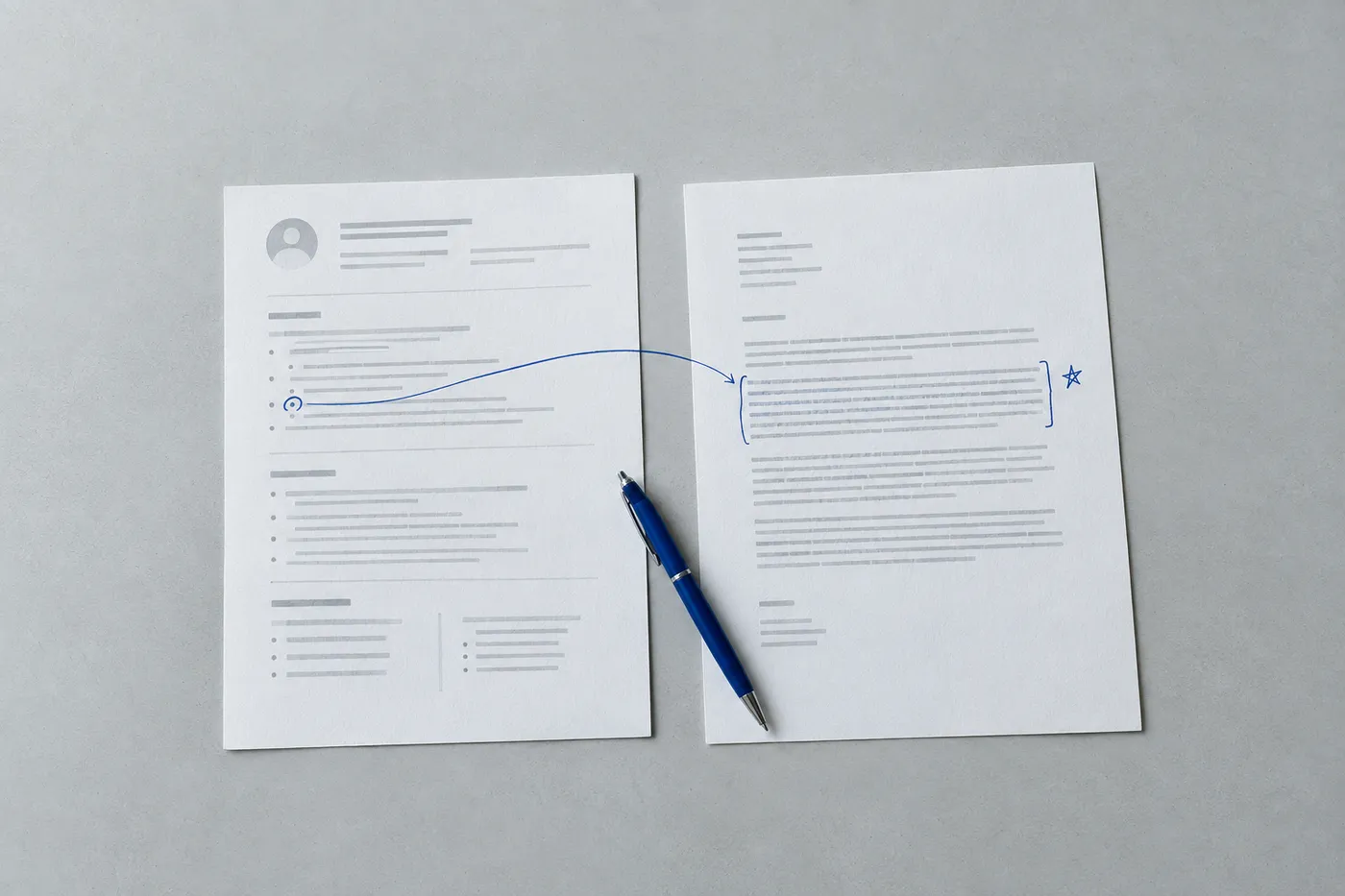
The most common cover letter failure is repetition: the letter restates the resume in paragraph form, and the reader learns nothing new. A good letter picks one or two stories off the resume and expands them, then adds what the resume can't hold, like why this company and what you're like to work with.
Remi, Roleframe's career copilot, drafts a job-specific cover letter from your actual resume and the posting attached to it, then hands it to you to edit. Because it starts from your real experience and the real job description, the draft opens with your strongest relevant story instead of "I am writing to apply." It's a draft, deliberately. You rewrite it in your own voice, tighten it, and approve every change, so the letter that goes out sounds like you and not like the same AI letter the other forty applicants sent. If you've read enough machine-written applications, you know why most AI cover letter generators fail: they generate from nothing and it shows.
Formatting your cover letter for professionalism
Formatting is judged harshly in admin hiring because formatting documents is part of the job. The good news is the target is simple.
- One page, always. Aim for 250 to 350 words in three or four paragraphs.
- Match your resume's header exactly: same name treatment, same font, same contact line. The two documents should look like a set.
- A clean, standard font at a readable size, 10.5 to 12 points, with normal margins. No graphics, no photo, no decorative borders.
- A real greeting with a real name whenever you can find one. "Dear Ms. Alvarez" beats "Dear Hiring Manager," which beats "To Whom It May Concern" by a mile.
- Sign off with "Sincerely" or "Best regards" and your full name. Skip the scanned signature image.
- Save and send it as a PDF, named professionally: Firstname-Lastname-Cover-Letter.pdf. PDF preserves your formatting on every screen it's opened on. Only send another format if the employer explicitly asks for it.
If you're pasting the letter into an application form field instead of uploading it, strip the address block and date and start at the greeting. Form fields mangle layout, so the plainer the better there.
Final review: ready to apply
Before you hit submit, run the letter through this pass. Every item here maps to something office managers actually screen out on.
- Read it aloud once. Anywhere you stumble, a reader will too. Rewrite that sentence.
- Check the company name and the hiring manager's name character by character. A wrong company name from a reused letter is the most common self-inflicted rejection in admin applications.
- Confirm the first paragraph contains a specific, ideally quantified accomplishment, not a statement of interest.
- Confirm your two or three key tools appear inside outcome sentences, and that they match what the posting emphasizes.
- Delete any sentence that just restates a resume bullet without adding a story or context.
- Proofread separately for its/it's, their/there, and manger/manager. Spellcheck passes all of those.
- Export as PDF, open the PDF itself, and read it one final time in the form the employer will see.
Frequently asked questions
- What is a good example of a short cover letter for an administrative assistant?
Three paragraphs, around 200 words. Paragraph one names the role and leads with your strongest relevant win, something like reducing scheduling conflicts or clearing an invoice backlog. Paragraph two matches two requirements from the posting to specific things you've done, with tools named in context. Paragraph three says why this company and asks for the conversation. Short works when every sentence is specific; it fails when brevity is achieved by staying vague.
- What are the most common cover letter mistakes for admin roles?
Five come up constantly: reusing a letter with the wrong company name still in it, opening with "I am writing to apply" instead of an accomplishment, restating the resume instead of expanding one story, listing software instead of showing it in use, and typos, which are fatal in a role where proofreading is a core duty. Fixing just the first and last of these puts you ahead of a surprising share of applicants.
- What are the top skills to highlight in an administrative assistant cover letter?
Organization, written communication, and calendar or time management, in roughly that order, because those are the themes admin postings repeat most. The catch is that claiming them means nothing; every applicant does. Prove each with an incident: the filing backlog you cleared, the executive email you drafted, the triple-booked calendar you untangled. One proven skill outweighs five asserted ones.
- How do I write a strong cover letter for an office assistant position?
The same way as for an administrative assistant, with one shift in emphasis. Office assistant roles usually lean toward front-of-house and general support, so weight your letter toward reliability, breadth, and people skills: covering reception, handling deliveries and vendors, keeping supplies and shared spaces running. Lead with a concrete example of keeping an office moving during a busy or short-staffed stretch.
- How do I write an administrative assistant cover letter with no experience?
Borrow evidence from wherever you organized things: coordinating shifts in a retail job, managing a student club's calendar and budget, handling scheduling for a family business. The skills transfer directly, so present them as admin work by another name. Name the tools you already know, like Google Workspace or Excel, in context, and say plainly that you learn new systems fast, with an example of one you picked up quickly. Don't apologize for the missing job title; the reader can see your resume.
- Do administrative assistant jobs really read cover letters?
More than most jobs do. The hiring manager is often the office manager or an executive assistant, someone who reads and writes correspondence all day and treats your letter as a sample of the emails you'd send on their behalf. Skipping the letter, or sending an obvious template, forfeits the one place you can demonstrate the core skill of the job before the interview.
- Should my cover letter repeat what's on my resume?
No. The resume is the inventory; the letter is the story. Pick one or two resume items that match the posting's biggest need and expand them with context the resume can't hold: what was broken, what you did, what changed. Then add what only a letter can say, like why this company specifically. If a sentence in your letter adds nothing beyond a bullet the reader just saw, cut it.


Ready when you are
Send the tailored resume, not the generic one.
Paste a job posting and Roleframe scores your resume against it, then helps you close the gaps one approved edit at a time, so you apply while the role is still fresh.