How to Get an Internship: Timeline, Resume, and Where to Apply
by Larbi SahliLast Updated
How to get an internship: apply August to October for finance and big tech summer roles, January to March elsewhere, via campus portals, fairs, and referrals.
On this page
For a summer internship, apply from August to October of the year before in finance, accounting, and at large tech companies, and from January to March of the same year in most other fields. Apply to many postings at once through your campus portal, career fairs, and referrals, and send a one-page resume tailored to each posting, saved as a PDF.
When to apply for summer internships, by field
Internship recruiting runs on two calendars, and applying on the wrong one is the most common way strong students miss out. Finance, accounting, and large tech companies fill summer seats in the fall of the year before, sometimes earlier. Most other employers post in winter and spring for the same summer.
Here is the pattern by field, based on how structured recruiting programs actually run:
| Field | When to apply for a summer internship | How recruiting works |
|---|---|---|
| Investment banking and finance | A year or more ahead; sophomore spring for junior-summer analyst seats | Structured programs with fixed classes; applications open earliest of any field and interviews follow fast |
| Accounting (Big Four and regional firms) | August to October of the year before | Fall campus recruiting tied to career fairs; offers often go out before winter break |
| Large tech companies | August to October, with some postings into winter | Popular programs open in early fall and close when they hit application volume, not on the posted date |
| Engineering (mechanical, civil, industrial) | September to November | Fall career fairs drive most hiring; many offers come directly from fair conversations |
| Marketing, media, and communications | January to March | Winter and spring postings with faster decisions and smaller intern classes |
| Nonprofits, government, and small companies | February to April, some later | Spring and rolling hiring; many decide a few weeks before the start date |
Two things make these windows tighter than they look. Many programs review applications on a rolling basis, so a posting with a December deadline may have filled its interview slots by late October. And the biggest-name programs close early when volume spikes. Treat the open date as your real deadline and apply within the first two weeks a posting is live.
If you are reading this in spring and the fall deadlines for your field have passed, skip to the backup-plan section at the end. You still have real options for this summer, and you can run the full timeline next cycle.
Where to find internship openings
Use every channel at once rather than picking one. Each channel reaches a different set of employers, and the overlap is smaller than you would expect.
- Handshake or your campus portal: the recruiting platform most US colleges use. Postings here are gated to your school, so you compete against hundreds of students instead of tens of thousands. This should be your default first stop.
- Career fairs: for accounting, engineering, and many large tech and finance employers, the fall fair is the recruiting event. Bring printed resumes, get recruiter names, and apply online the same day you talk to them.
- Company career pages: search for a company's "early careers" or "university recruiting" page directly. Many firms post there before, or instead of, the big job boards.
- Professors: they have research roles of their own and industry contacts who email them asking for students. Tell the professors in your major what you are looking for. This channel is invisible on every job board.
- Alumni: search your school on LinkedIn, filter by company or field, and send short, specific messages asking for a 15-minute conversation. Alumni respond at far higher rates than strangers.
- LinkedIn and general job boards: useful for volume and for fields without campus pipelines, but expect the most competition here. Filter by "internship" and posting date, and prioritize postings less than two weeks old.
A practical target: a running list of 30 to 50 postings across these channels, applied to in batches, rather than five dream applications sent once. Internship hiring is a numbers game on both sides, and the students who get offers treat it that way.
How to get an internship with no experience or as a freshman
Internship postings rarely require prior internships. They require evidence that you can show up, learn fast, and produce something. Students read "experience preferred" and self-reject; recruiters reading intern resumes expect thin ones and are looking for any proof of work.
That proof can come from places you already have:
- Class projects with a named deliverable: a market analysis, a working app, a research paper, a design portfolio piece. If you built or analyzed something real, it belongs on your resume as a project.
- Part-time jobs, any part-time jobs. A retail or food-service role proves reliability, customer handling, and often cash or inventory responsibility. Recruiters hiring interns rate this higher than students do.
- Volunteering with responsibility: running a fundraiser, managing a nonprofit's social account, coordinating an event. Treat it exactly like a job on the resume.
- Club roles: treasurer, event lead, section editor. A title plus one concrete result reads as leadership.
- Self-directed work: a personal coding project, a blog with real posts, a small freelance gig. In tech especially, this can outweigh everything else on the page.
The freshman and sophomore path
Most structured internship programs target juniors, but there is a real path for first- and second-year students. Banks and consulting firms run early insight and discovery programs, often one to five days long, that feed their junior-year pipelines; several large tech companies run internship programs built specifically for first- and second-year students. Search company early-careers pages for "first year" and "sophomore" directly, because these programs are poorly indexed on job boards.
Two more freshman-friendly routes: research assistant roles with professors, who care about interest and reliability rather than class year, and small local employers, who do not run formal programs and will take a capable student who emails them in March. A freshman-year internship at a 12-person local firm sets up the sophomore application to a bigger name better than an empty summer does.
Fitting part-time jobs, clubs, and class projects on one page
A student resume is one page, education first. Put your degree, school, and expected graduation date at the top, add relevant coursework if it matches the posting, and include your GPA when it is strong enough to help.
The hard part is combining three part-time jobs and two clubs without the page reading like a list of shifts. The fix is selection, not compression. Give each job two or three bullets, and make every bullet a transferable outcome rather than a duty. A barista who "trained four new hires and handled closing cash counts" has written something a recruiter can use; "made coffee and cleaned machines" has not. Numbers exist in these jobs, so use them: customers per shift, order volume, cash handled, people trained.
Class projects get their own Projects section with the deliverable named and one line on your specific contribution. Clubs go under Leadership and Activities: role, organization, one result each. Skills go last, and they should echo the posting you are sending this version to. For full layouts at each stage, see our student resume examples from high school to final year.
Save and submit as a PDF. It is the one format that looks the same on the recruiter's screen as it did on yours.
Tailor your resume to every posting
Internship postings draw enormous application volume, and recruiters cut it down by searching and filtering on keywords inside their applicant tracking system (ATS), the software that stores every application. If the posting says "data analysis in Excel" and your resume says "worked with spreadsheets," you lose that search even though you have the skill.
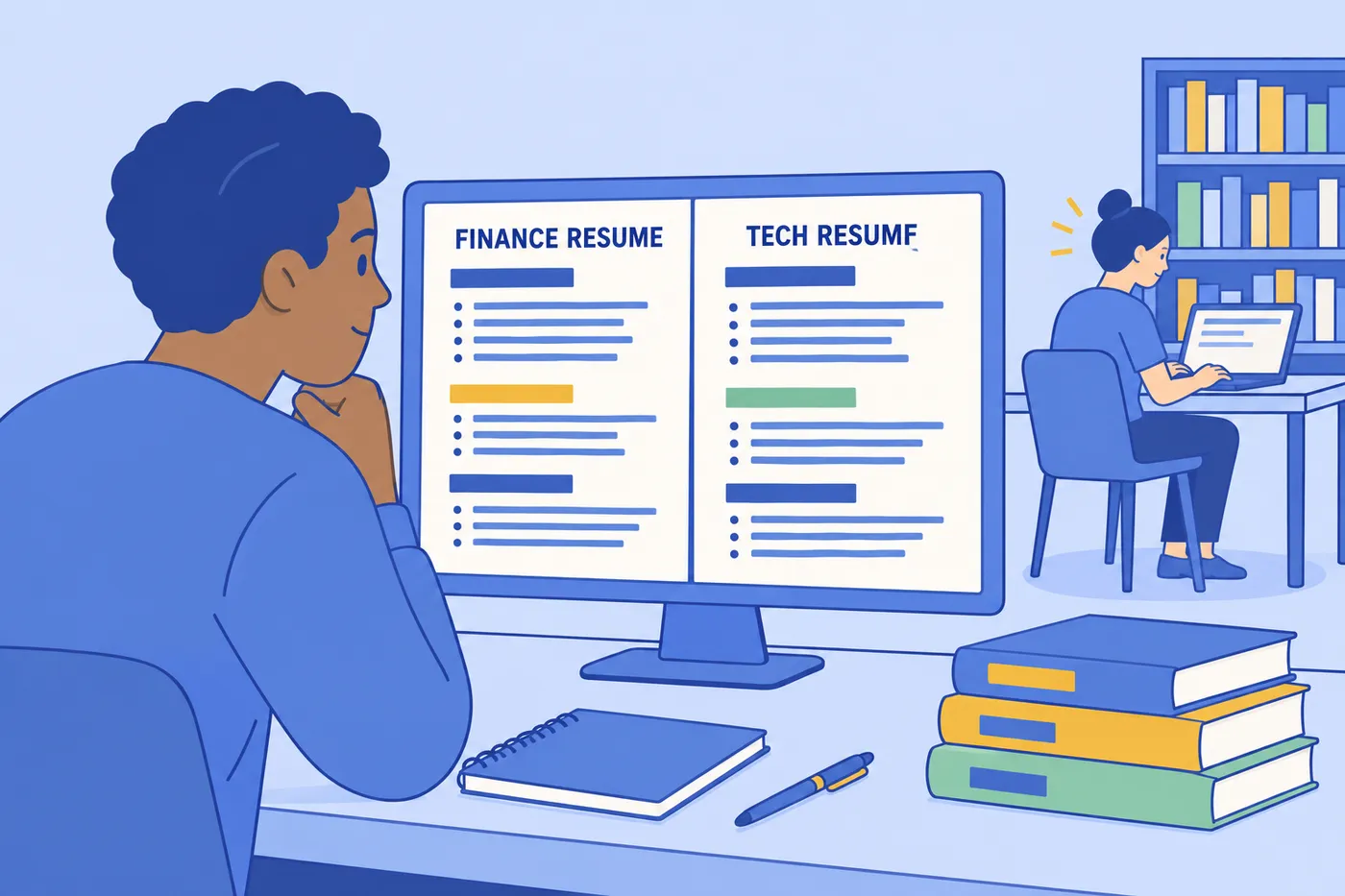
The method is mechanical. Pull the nouns from the posting, the tools, skills, and named methods, and mirror the ones that are truthfully yours in your bullets and skills section. Our guide on pulling resume keywords from a job description walks through it line by line, and you can check your resume against a job description to see the gaps directly.
Doing this by hand for 30 postings is the slow part, which is where Roleframe fits. You keep one base resume, duplicate it for each posting, and get a fit report showing your ATS score and the exact keywords the posting asks for that your version is missing. Then you make the edits yourself, with Remi, the career copilot, suggesting rewrites bullet by bullet that you approve or discard. You stay the author of every line, which matters when an interviewer asks about one.
Referrals, cold emails, and when a cover letter is actually required
A referral moves your application from a pile of thousands into a short list a human reads, and getting one is more ordinary than it sounds. Message alumni at target companies, ask for 15 minutes to hear about their path, and at the end of a good conversation ask directly: "Would you feel comfortable referring me for the summer internship?" Most people who take the call will say yes, and many companies pay employees for referrals, so you are doing them a favor too.
For small employers with no posted internship, cold email works better than any portal. Five sentences: who you are, one specific thing you admire about their work, what you can do for them this summer, one piece of proof (a project, a class, a job), and a direct ask for a conversation. Small firms hire interns they were emailed by; they rarely post.
Cover letters are required less often than students fear. Many internship postings mark them optional, and nonprofits and some finance programs are the main fields that still insist. When a posting requires one, write it for that posting in three short paragraphs, and never send a template. Our internship cover letter examples across five fields show what a strong one looks like at student length.
Internship interviews: what to expect and how to prepare
Intern interviews are mostly behavioral, and the interviewer knows you are a student. They are not testing your career; they are testing whether you can describe your own work clearly. The STAR method, Situation, Task, Action, Result, is the structure for that, and your class projects and part-time jobs supply the stories. "Tell me about a time you handled a difficult deadline" is answerable with a group project that fell apart two weeks before submission, and answered that way it lands. Our guide to the STAR method in interviewing shows how to build five or six of these stories in advance.
Prepare specifically for the standard openers: tell me about yourself, why this company, why this field. Then layer on the technical screen your field runs:
- Tech: coding screens on data structures and algorithms, usually one or two rounds. Practice on a timer; the format is learnable and the questions repeat in kind.
- Finance: markets questions and technical basics like walking through a valuation or the three financial statements. Banking interviews expect this even from interns.
- Accounting: mostly behavioral, plus fundamentals from your intro courses. Firms hire for fit and train the rest.
- Engineering: coursework fundamentals applied to practical problems, plus detailed questions about any project on your resume. Know your own projects cold.
- Marketing and communications: expect a portfolio conversation or a light case, like how you would promote a product to students. They want structured thinking, not the right answer.
No internship by spring: what to do instead
If it is April and nothing has landed, the goal changes from "get an internship" to "have something real on the resume by September." All of these count, and all of them are still available in spring:
- Micro-internships: short, paid, project-based assignments for companies, often two to four weeks. Small scope, but a real employer and a real deliverable for your Projects section.
- Research assistant roles: professors staff summer research late, and funded positions exist on most campuses. Ask directly; these are almost never posted.
- Externships: short job-shadowing stints, from a day to a few weeks. Less depth than an internship, but a network and a line of exposure to the field.
- Related part-time or seasonal work: a summer bank teller job for a finance student, a camp leadership role for a future teacher, retail with a keyholder responsibility. Framed in the posting's language next fall, it works.
- Self-directed projects: in tech and design especially, a shipped personal project can outweigh a mediocre internship. Pick something finishable in eight weeks and finish it.
One summer without a brand-name internship does not close doors. A summer with nothing to show for it costs you a fall of explaining. Pick one of the five and start it this week.
Frequently asked questions
- How do you qualify for an internship?
Most internships require current enrollment in a degree program and a graduation date inside a stated range. Beyond that, the bar is lower than students assume: some postings add a GPA minimum or restrict by class year or major, and most ask for coursework and skills rather than prior work experience. Read the qualifications line by line, and remember that "preferred" items are not requirements. If you meet the hard requirements and roughly half the preferences, apply.
- What is the best way to get an internship?
The combination that works is a referral, a tailored resume, and an early application. Ask alumni and club contacts for referrals at target companies, mirror each posting's own keywords in your resume, and apply within the first two weeks a posting is live, since many programs review on a rolling basis. Run volume alongside it: your campus portal limits the competition to your own school, which makes it the highest-percentage channel most students have.
- Am I screwed if I have no internships?
No. Employers hiring interns expect thin resumes, and employers hiring new grads accept substitutes: research assistant work, part-time jobs with real responsibility, class and capstone projects, club leadership, and short project-based work. What actually hurts is a blank page and a generic application. Build evidence somewhere this semester, put it on the resume with concrete outcomes, and frame it in each posting's language.
- Is a 3.3 GPA good for internships?
A 3.3 clears the stated minimum on most internship postings that have one, so include it. The main exceptions are highly competitive finance and consulting programs, which often expect more and may ask for a transcript. If your major GPA is stronger than your overall, you can list the major GPA and label it clearly. For the full decision, see when a GPA on your resume helps and when it hurts.
- When should I apply for summer internships?
August to October of the year before for finance, accounting, and large tech companies; September to November for engineering programs that recruit at fall career fairs; January to March for marketing, nonprofits, government, and most small companies. Investment banking runs earliest of all, with applications opening more than a year before the internship starts. In every field, apply early in the window, because rolling review means late applications compete for seats that are already filling.
- How do you get an internship in high school?
Formal high school internship programs are rare, so go where the process is informal: local businesses, hospitals, museums, libraries, and nonprofits, plus summer programs run by nearby universities. A short, specific email to a small employer explaining what you can do for them beats any portal at this age. Structured volunteering counts as experience too. Treat whatever you land like a job on your resume, with a role, dates, and one or two concrete results.
Keep reading
More from Roleframe



Ready to start your new resume?
Writing a resume takes time, and even a polished one can miss what a hiring manager is looking for. Roleframe helps you build a clear, ATS-safe resume in minutes and tailor it to the job you want.


