ATS Meaning: What an Applicant Tracking System Actually Does
by Larbi SahliLast Updated
ATS means applicant tracking system: the software that stores, sorts, and ranks your resume before a recruiter reads it. Follow one application through it.

On this page
ATS stands for applicant tracking system: the software employers use to collect and organize job applications. When you apply online, the ATS parses your resume into a database record that recruiters search, filter, and rank. It rarely rejects anyone on its own. Recruiters do the rejecting; the ATS decides which resumes they see first.
That last sentence is the part most definitions skip, and it changes how you should write your resume. The system is not a robot judge scoring you against a rubric. It is a searchable database with a workflow attached. The rest of this page follows one application through that database, step by step, so you can see exactly where resumes get lost and where they get found.
What happens to your file after you click apply
Say you apply for a project manager role at a mid-size company. Here is the realistic path your file takes, in order.
Step 1: The parse
The moment you upload your resume, the ATS converts it from a document into structured data: name, contact details, job titles, employers, dates, skills, education. This is called parsing, and it is the step your formatting can break. Text placed in tables, text boxes, or the header and footer of the page often gets scrambled or dropped, because parsers read the text layer of the file in sequence. A clean single-column PDF with standard section headings parses reliably; a heavily designed layout is a gamble. If you want the specifics, the guide on ATS-friendly resume formatting covers what breaks parsers and what doesn't.
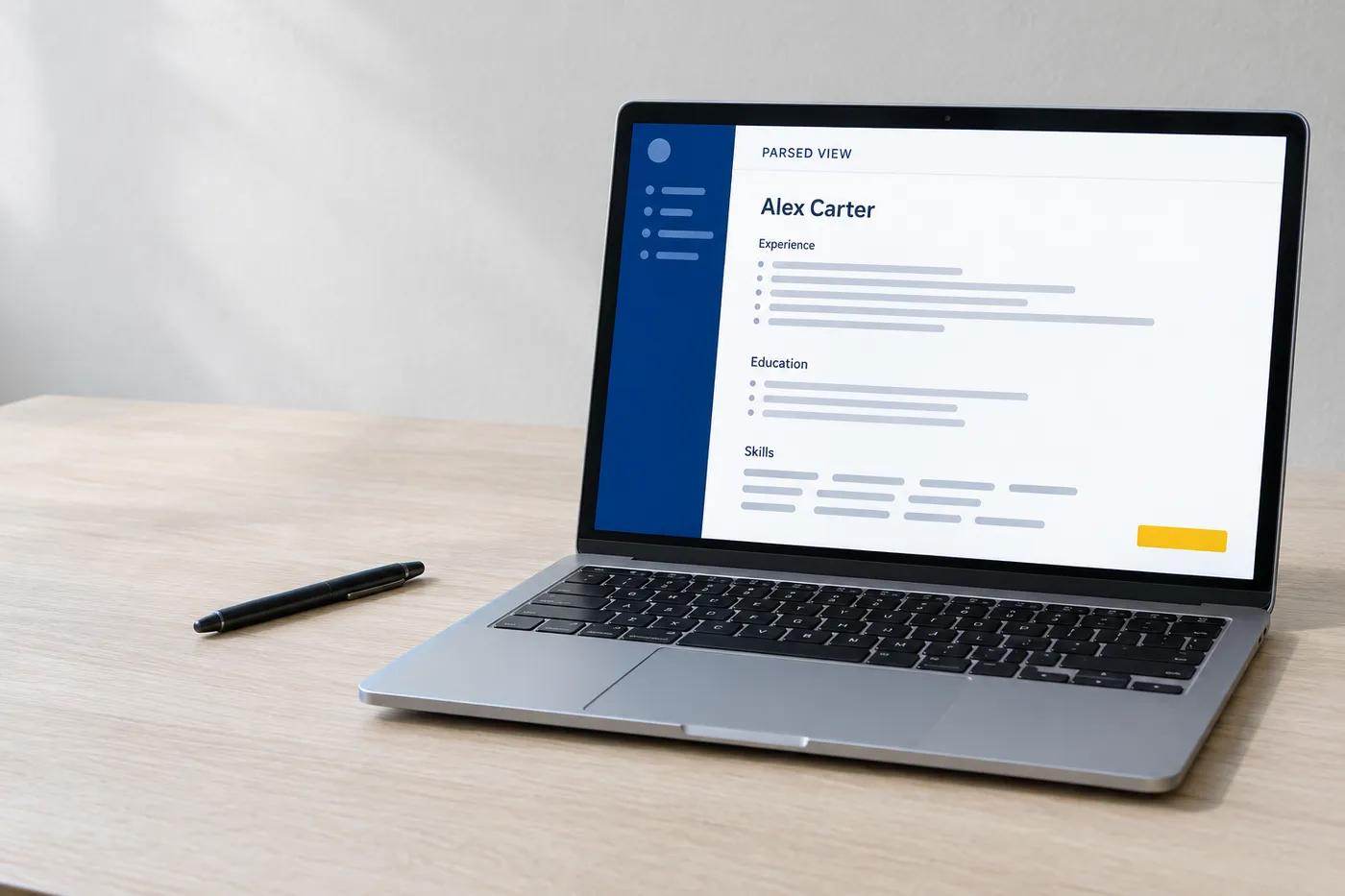
Many systems show you the parsed result and ask you to correct it. That screen is a gift. It is the only time you see your resume the way the recruiter's search index sees it, so fix every scrambled field before submitting.
Step 2: Knockout questions
Next come the application-form questions: are you authorized to work in this country, do you hold the required license, can you work on-site. These are called knockout questions, and they are the one place in the pipeline where genuine automatic rejection happens. Answer "no" to a hard requirement and the system dispositions your application before any human involvement.
This is where the "the ATS rejected me" story usually starts. It is almost never a keyword algorithm. It is a yes/no question the employer configured, and the rule is doing exactly what a human screener would do, only faster.
Step 3: You become a record in a pipeline
Your application now sits in the requisition for that job, in a stage usually called "New" or "Applied," alongside every other applicant. Nothing is judging you here. Your file waits until a recruiter opens the requisition, which for a popular posting can mean sitting behind hundreds of other records. Applying early matters for a mundane reason: recruiters review in batches, and roles sometimes fill from the first batch.
Step 4: Search, filter, and rank
Here is the step that gives "ATS keywords" their meaning. A recruiter working a stack of applicants does not read them all in order. They filter by knockout answers and location, then search the parsed text for the terms that define the role: "PMP," "stakeholder management," "Agile," a specific tool, a specific certification. Resumes containing those terms surface; resumes that describe the same experience in different words do not.
Some systems also show a match or relevance rank against the job description. Recruiters treat it as a sorting aid, not a verdict, but a sorting aid decides who gets read first, and being read first is most of the game. This is why mirroring the posting's exact language works: not because you are fooling software, but because you are matching the search terms a human will type. The ATS keyword lists by job title show what those terms look like across common roles.
Step 5: The human skim
The resumes that survive filtering get a fast first-pass read, typically seconds per resume, scanning for title, current employer, tenure, and evidence of the core requirement. Pass that skim and you move to a "Review" or "Screen" stage, where the ATS schedules the recruiter call, logs interview feedback, and generates the emails you receive. Fail it and you are dispositioned with a reason code, which triggers the automated rejection you get three weeks later. The system also keeps your record, so a strong resume that missed one role can resurface when a recruiter searches the database for the next one.
Who uses an ATS
Assume every online application goes through one. Nearly all large employers run an ATS, and most mid-size companies do too, because tracking applicants by email and spreadsheet collapses past a handful of open roles. Even small businesses often use one without calling it that: the built-in applicant management on job boards is a lightweight ATS.
Employers use them for reasons that have little to do with screening you out. An ATS posts the job to multiple boards at once, keeps every candidate interaction in one place, coordinates interviewers, and produces the compliance records that hiring regulations require. The keyword search that job seekers worry about is one feature among dozens, and for the employer it is mostly a way to find good candidates in a large pile, not a wall to keep them out.
What an ATS does not do
Most of the fear around these systems comes from claims that are five to fifteen years out of date. Worth clearing up directly.
- It does not auto-reject you for missing keywords. Keyword gaps make you invisible in search and low in rank, which is bad enough. But the rejection decision, outside knockout questions, is made by a person.
- It does not choke on PDFs. Modern parsers handle standard text-based PDFs well. The real parsing risks are scanned image files, tables, text boxes, and content in headers and footers, in any file format. Save as PDF and keep the layout simple.
- It does not reward tricks. White-text keywords and stuffed skill lists show up plainly in the parsed profile view, and a recruiter who spots them dispositions you for it. The parsed text is exactly what they read.
- It does not judge design. The system never sees your fonts or colors, only the text layer. Design matters at the human skim, not the parse, which is why a clean readable layout wins twice.
- It does not share a blacklist across companies. Each employer's ATS is its own database. A rejection at one company is not visible to another. Recruiters at the same company can see your past applications there, which is one more reason never to inflate a resume.
The four systems you will meet most
ATS platforms feel different to apply through, and recognizing them tells you something about the employer and the process. These four cover most of what an active job seeker will encounter.
| System | Where you'll see it | What you'll notice as an applicant |
|---|---|---|
| Workday | Large enterprises: banks, retailers, healthcare systems, Fortune 500 generally | You create an account per company, and the application runs several pages. Its resume parser pre-fills your work history, so correct every field it gets wrong before submitting. |
| Greenhouse | Tech companies and startups, from seed stage to large | Short, single-page applications with custom questions. Greenhouse is built around structured interviews, so expect a defined multi-stage process if you advance. |
| Lever | Startups and mid-size tech companies | The fastest apply of the four, often just a resume upload and a few fields. Lever doubles as a sourcing database, so recruiters there actively search old applicants for new roles. |
| iCIMS | Large and mid-size employers across industries, common in healthcare, logistics, and retail | Longer application forms and heavy use of knockout and screening questions. Answer them carefully; they carry more weight here than your resume's design ever will. |
You will also run into Taleo, an older Oracle system still common at large legacy employers, and SuccessFactors at companies running SAP. Both reward the same things: simple formatting, exact keyword matches, and patience with long forms.
How to pass an ATS without gaming it
"How to beat the ATS" is the wrong frame, because the system is not your opponent; the recruiter's search box is your audience. What works is straightforward.
- Mirror the posting's exact terms. If the job says "stakeholder management" and your resume says "cross-functional alignment," you will not surface in that search. Use the posting's phrasing where it honestly describes your work.
- Spell out acronyms once. Write "certified public accountant (CPA)" so you match a search for either form.
- Keep the structure standard. Conventional headings (Experience, Skills, Education), reverse-chronological dates, one column, no tables or text boxes. Submit as PDF.
- Put keywords in context. A skill named inside an accomplishment bullet reads as evidence; the same skill alone in a list reads as a claim. Recruiters weigh the first far more.
- Check before you send. The honest test is comparing your resume against the specific posting, not against generic advice.
That last step is the one most people skip because it is tedious by hand. Paste the posting into Roleframe and the fit report does it for you: an ATS score for that specific job, the exact keywords the posting asks for that your resume is missing, and a prioritized plan for what to change. You make the edits yourself, which is the point; a keyword you cannot back up in an interview is worse than a gap. There is also a fuller walkthrough of how to check if your resume is ATS friendly if you want to run the audit manually first.
Frequently asked questions
- What does ATS stand for?
In hiring, ATS stands for applicant tracking system, the software employers use to collect, store, search, and manage job applications. The acronym has unrelated meanings in other fields, which is why search results for it look chaotic: an automatic transfer switch in electrical work, against the spread in sports betting, and the American Thoracic Society in medicine.
- Can an ATS reject my resume automatically?
Only through knockout questions, the yes/no items on the application form about work authorization, licenses, location, and similar hard requirements. Answer against a requirement and the system dispositions you without human review. Keyword matching does not auto-reject; it determines whether your resume surfaces when a recruiter searches and how high it ranks, and the recruiter makes the actual decision.
- What is an ATS resume?
An ATS resume, or ATS-friendly resume, is one formatted so the parsing step reads it correctly: a single column, standard section headings, no tables or text boxes, no content in headers or footers, saved as a text-based PDF. It also uses the job posting's exact terminology so it matches recruiter searches. It does not need to be ugly; it needs to be machine-readable. The guide on making your resume ATS-friendly without ugly design shows how to do both.
- What are ATS keywords for a resume?
ATS keywords are the terms recruiters type into the system's search bar to surface candidates: skills, tools, certifications, and job titles pulled from the posting's requirements. They matter because a resume that describes the right experience in the wrong words never appears in the search results. Take them from the specific job description first, and use keyword lists by job title to catch the standard terms for your role.
- What does ATS mean legally?
In US law, ATS most often refers to the Alien Tort Statute, a 1789 law unrelated to hiring. In a hiring context, the legal angle is compliance: employers keep ATS records partly to document that their process meets equal-opportunity and record-keeping requirements, which is one reason companies insist every applicant go through the system rather than emailing a resume directly.
- What does ATS mean in electrical and medical contexts?
In electrical work, an ATS is an automatic transfer switch, a device that moves a building's load to backup power when the main supply fails. In medicine, ATS usually refers to the American Thoracic Society, and in older usage to anti-tetanus serum. Neither has anything to do with resumes; they just share the acronym.
- Do keyword tricks like white text beat the ATS?
No, and they backfire. The recruiter reads the parsed text of your resume, so hidden white-text keywords appear in plain sight in their view, and a resume stuffed with unsupported skills reads as exactly that. The reliable approach is duller: mirror the posting's real terms where they honestly describe your experience, and put them inside accomplishment bullets where a human skim will find evidence, not just claims. You can check your resume against the job description to find which legitimate terms you are missing.
Keep reading
More from Roleframe


Ready when you are
Send the tailored resume, not the generic one.
Paste a job posting and Roleframe scores your resume against it, then helps you close the gaps one approved edit at a time, so you apply while the role is still fresh.