What to Wear to an Interview: Dress Codes by Industry
Choose interview clothes for the employer and setting, with outfit examples, video checks, budget options, and guidance on access and religious dress.

On this page
Start with the interview instructions, then choose clothes that fit the setting and let you sit, move, and speak comfortably. If the dress code is unclear, ask: “What do candidates usually wear, and will there be a site tour or practical task?”
Expectations differ by employer, role, location, and country. Harvard’s attire guide recommends checking the organization’s culture and considering comfort. The outfits below are starting points to adapt, not tests of your professionalism or rules about gender.
| Setting | Outfit starting point |
|---|---|
| Formal office interview | A suit or coordinated jacket-and-trouser, skirt, or dress outfit with comfortable shoes. |
| Business casual office | Trousers, chinos, a skirt, or a dress with a shirt, blouse, or knit; add a jacket if useful. |
| Explicitly casual workplace | Neat trousers or jeans if confirmed appropriate, with a clean shirt or top. |
| Hands-on workplace or site visit | Clothes and footwear that meet the employer’s safety instructions; ask about protective equipment. |
| Video interview | An outfit suited to the role; test how the color and pattern appear with your camera and background. |
Interview dress codes, translated into actual clothes
Employers use these labels differently. If the invitation uses one, ask for an example if you are unsure. Choose the combination that works for your body, identity, access needs, and the activities planned.
Business formal
A matching suit is one option. A coordinated dress or separates with a jacket may also fit the employer’s expectations. A plain shirt or blouse and comfortable, well-maintained shoes complete the outfit. Ask whether a tie or any particular formality is expected rather than assuming it is compulsory.
Business professional
This often overlaps with business formal. A jacket with tailored trousers, a skirt, or a structured dress can be a useful starting point. Because the label is not standardized, the employer’s examples are more informative than trying to place it on an exact ladder of formality.
Business casual
Possible combinations include chinos with a collared shirt, tailored trousers with a knit, or a dress with a cardigan. A blazer is an optional layer. Choose footwear you can comfortably use for the journey and any walking involved.
Fit matters in a practical sense: check that you can sit, reach, and move without continually adjusting the outfit. There is no universal required skirt length, heel height, or gender-specific combination. Use the employer’s guidance and your own comfort to narrow the choices.
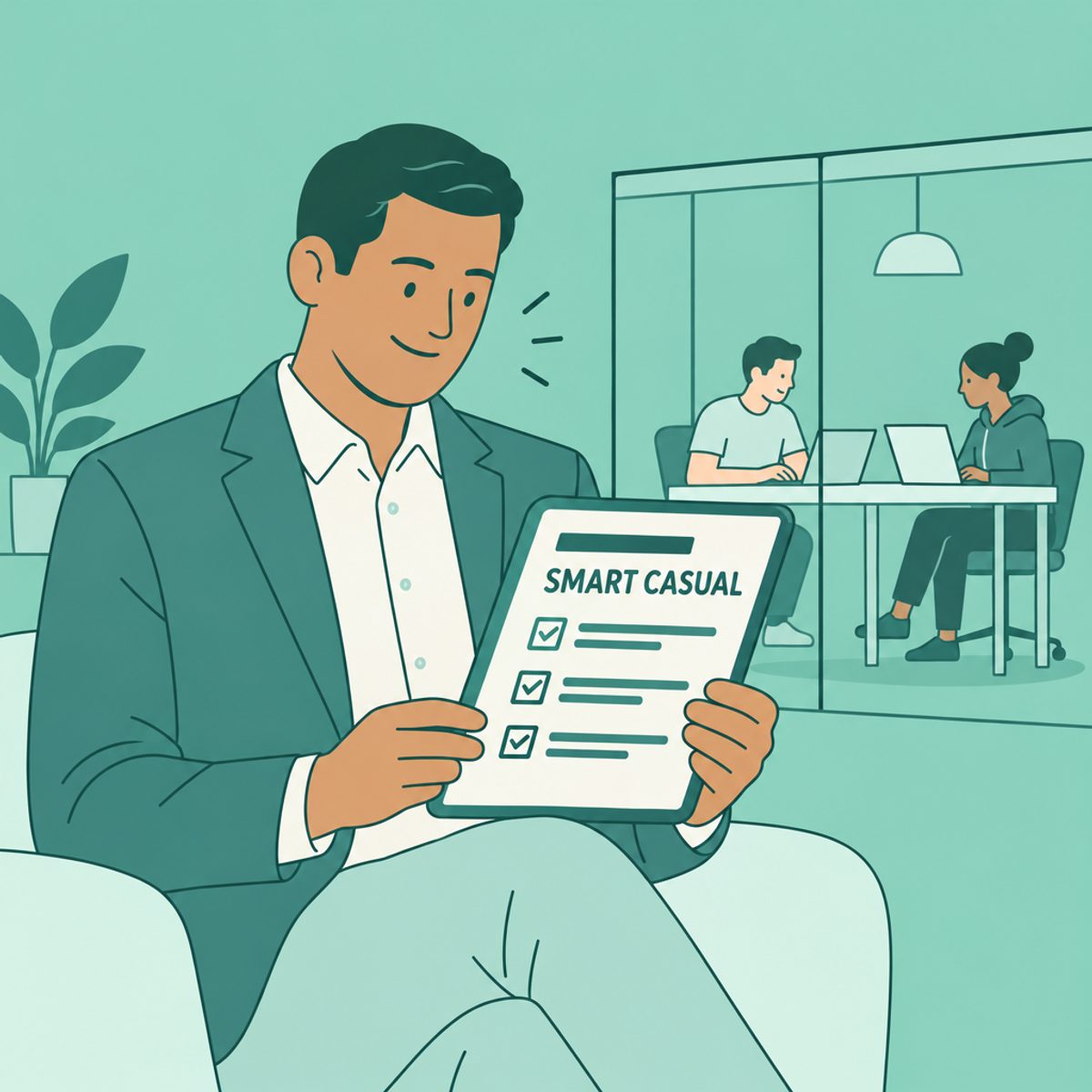
Smart casual
For an explicitly casual interview, neat jeans and a shirt or simple top may be appropriate. Ask before relying on that interpretation. If you prefer trousers or a jacket, you can wear them without assuming a slightly more formal outfit will be judged negatively.
How to dress for an interview, by industry
Use these examples to prepare questions about the setting. Company photos can provide clues, but event photographs may not show normal workwear or interview expectations. The recruiter or organizer can confirm what the day involves.
Law, banking and client-facing consulting
For a formal, client-facing setting, consider a suit or coordinated outfit with a jacket. Ask whether the interview itself follows that dress code. A bank’s branch role, technical team, and executive interview may have different expectations.
Tech and startups
Trousers or chinos with a shirt, knit, or blouse are practical options to discuss with the recruiter. A startup’s casual website photos do not establish an interview rule, and wearing a suit does not automatically signal poor fit. Prioritize the specific invitation over the industry stereotype.
Healthcare
Ask whether the visit is a meeting, a unit tour, or a practical assessment. Office-style clothes may suit a conversation, while a clinical visit may involve footwear, hygiene, or uniform instructions. Do not assume scrubs or ordinary closed shoes satisfy a site’s requirements.
Schools and government offices
A shirt or knit with trousers, a skirt, or a dress can work for many settings, with a jacket if requested or preferred. Ask about classroom demonstrations, outdoor activities, security screening, or other tasks that affect the outfit.
Retail, hospitality and fast food
For a conversation with a manager, clean trousers or chinos and a shirt or neat top are useful starting points. A trial shift or kitchen visit may require different clothing and footwear. Ask what the employer will provide and what you should bring.
Creative roles
You can express personal style while keeping the outfit comfortable for the interview. A color, jacket, or accessory you enjoy is optional; a plain outfit does not demonstrate a lack of creativity. Let your portfolio and answers explain your work.
Trades, warehouses and manufacturing
Confirm whether you will enter a workshop, warehouse, or production area. Ask specifically about footwear, loose clothing, jewelry, and protective equipment. Ordinary closed shoes are not necessarily safety footwear. Follow confirmed site requirements and raise any access or accommodation needs in advance where possible.
Video interviews: dress for the camera
Choose a complete outfit you would be comfortable wearing if you stand or adjust the camera. Test the view beforehand: sit where you will interview and check whether your clothes blend into the background or a pattern looks distracting on screen.
Use the same camera, lighting, and microphone when testing if possible. Check that your face is visible and that you can hear and be heard. You do not need to buy new clothes because of a general rule about colors; use the actual camera image to decide.
For a phone interview, wear whatever helps you feel comfortable and prepared. The important checks are a reliable connection, a usable space, and access to your notes.
What not to wear to a job interview
Check for practical distractions and any requirements in the invitation:
- Stains, loose fastenings, or garments that need constant adjustment. Choose something you can comfortably wear for the full visit.
- Strong fragrance, especially if the site requests a fragrance-free environment.
- Jewelry or accessories that repeatedly hit a microphone or interfere with a practical task.
- Clothing with offensive text or images. Check any site-specific restrictions.
- Footwear or loose clothing that does not meet the safety instructions for a tour or assessment.
- An unfamiliar outfit you have not tried while sitting, walking, or using your usual mobility aids.
These checks help reduce distractions; they are not a way to predict the interview outcome. Clothing is one preparation detail alongside understanding the role and planning your examples. See our interview preparation guide.
Grooming and the small things
Prepare clothes in the condition you want them, and test the layers you will need for the weather. Carry notes and documents in whatever bag or folder works for you. Leave time to remove a coat or change footwear if necessary.
Start with what you already own. Borrowing or buying secondhand may help if you need another item, but an expensive outfit is not a prerequisite. Check local employment services, community organizations, or your college career center for clothing support and eligibility; availability varies.
Religious dress, head coverings and mobility aids
Religious dress, hairstyles, disability-related equipment, and mobility aids should not be treated as things you need to hide to look professional. Choose clothes that work with them and with your own comfort.
Where a stated requirement creates a conflict, ask the organizer about an accommodation. In the United States, EEOC religious-accommodation guidance explains duties of covered employers and the current undue-hardship standard. Its ADA applicant guidance addresses disability-related access needs. These are different legal frameworks, and coverage and outcomes depend on the circumstances; local laws may provide additional protections.
A practical request might be: “The invitation mentions a site tour. I use a mobility aid; could you confirm an accessible route and any footwear requirements?”
The night-before checklist
Prepare the outfit and logistics ahead of time so they do not compete with your interview preparation.
- Try the complete outfit, including footwear and any layers you need. Check that you can sit and move comfortably.
- Check the condition of the clothes and any practical requirements for the site.
- Set out your bag, notes, and anything the employer asked you to bring.
- Save the interviewer’s contact details and confirm any access arrangements.
- Plan travel with a buffer and follow the requested check-in time. For video, test the link and equipment beforehand and be ready for the scheduled start.
For the rest of your preparation, use the interview preparation plan and consider questions about the role. Listen during the interview so you can follow up on what remains unclear.
Leave time to prepare your examples
Once the outfit and logistics are ready, focus on explaining your experience and learning about the role. If your resume needs an update for future applications, you can work on it in the Roleframe resume builder. Check the finished file before submitting it.
Frequently asked questions
- What should a woman wear to a casual interview?
Choose from the same practical options available to any candidate: trousers, a skirt, or a dress with a shirt, knit, blouse, or other suitable top. Use the employer’s guidance, your comfort, and the planned activities rather than a fixed gender rule.
- Can you wear jeans to an interview?
They may be appropriate when the employer confirms a casual setting. For an unclear dress code, ask or choose another comfortable option. A site visit may have safety requirements separate from formality.
- What should you avoid wearing to a job interview?
Avoid clothing that conflicts with confirmed safety instructions, offensive messages, and items that distract you through discomfort or constant adjustment. Check fragrance guidance and test accessories with a microphone if interviewing online.
- How early should I arrive for an interview?
Follow the employer’s check-in instructions and plan enough travel time for delays. If you arrive much earlier, wait nearby when practical. For video, test the technology before the meeting and be ready at the agreed start time.
- What are the 5 C's of interviewing?
There are different versions of this mnemonic, so do not treat it as a universal scoring framework. Prepare relevant examples, listen to the questions, communicate accurately, and check whether the role fits your needs.
- What is the biggest red flag to hear when being interviewed?
Ask follow-up questions if the responsibilities, pay, or process are unclear. Pressure to decide immediately or an unexpected request to pay money deserves careful verification. Assess the actual situation rather than relying on a single phrase as a universal signal.
- What should I wear to a fast food interview?
For a meeting, clean trousers or chinos with a shirt or neat top may work well. If the visit includes kitchen access or a practical task, ask about clothing, footwear, and hygiene requirements first. Follow the specific employer’s instructions.
Ready to start your new resume?
Writing a resume takes time, and even a polished one can miss what a hiring manager is looking for. Roleframe helps you build a clear, ATS-safe resume in minutes and tailor it to the job you want.


