How to End a Cover Letter: 21 Closing Lines You Can Adapt
How to end a cover letter without sounding stiff: 21 closing lines sorted by situation, a sign-off table, what goes after your name, and the P.S. rule.


On this page
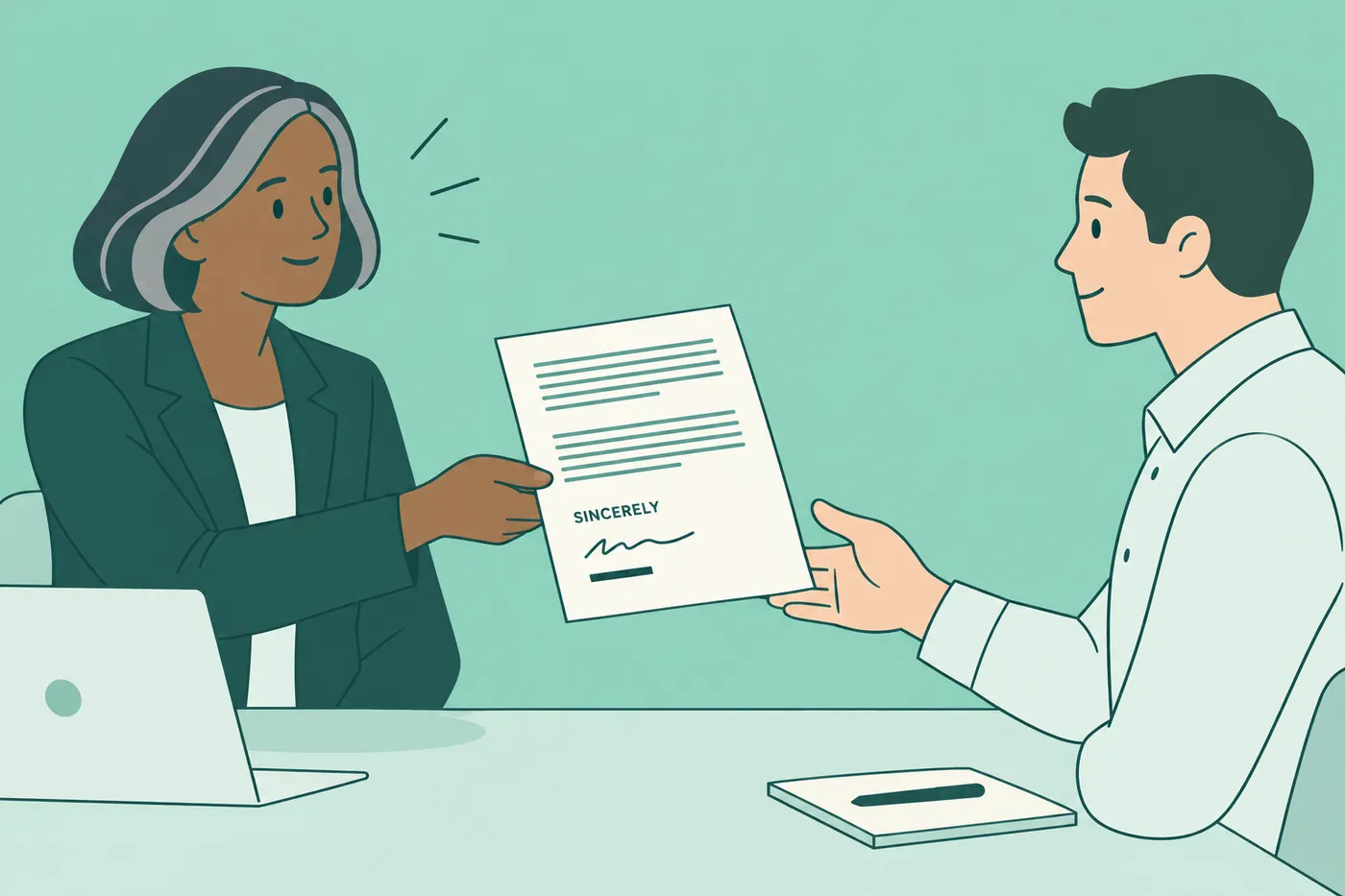
The closing paragraph of a cover letter has three jobs, and it should do all of them in two or three sentences. Restate your fit in one line tied to the posting. Ask for the next step, usually an interview or a call. Thank the reader. Below that goes a sign-off such as Sincerely or Best regards, a comma, and your typed name.
Here is the whole thing for Maya Torres, a fictional customer success manager applying to a healthcare software company whose posting stresses enterprise renewals:
“Cutting churn from 14% to 6% across a 90-account book is the closest match I've seen between my last two years and a job posting. I'd welcome an interview to talk through how that playbook applies to your enterprise renewals, and I'm free any weekday after 2 p.m. Eastern. Thank you for your time.”
Sincerely,
Maya Torres
Not every hiring manager reads the cover letter, but the ones who do tend to remember how it ends. A closing that names the employer's actual need and makes one clear ask reads like a person wrote it. “I look forward to hearing from you” reads like a template, and template language is exactly what recruiters have learned to discount. Everything below is built on that difference, with 21 closings sorted by situation so you can adapt the one that matches yours.
Build the closing paragraph line by line
Meet Sam Ruiz, a fictional logistics coordinator applying for a transportation planner role at a regional grocery chain. The posting mentions route optimization in its first requirement and again under responsibilities, so that is the thing the closing has to touch.
Here is the closing most applicants write.
“I believe my skills and experience make me a strong candidate for this position. I hope you will consider my application. Thank you for your time and consideration.”
Nothing in it is wrong, and nothing in it is Sam. Every other applicant could have written the same three sentences. Now the rebuild, one line at a time.
The fit line. One sentence that ties your strongest relevant result to the requirement the posting stresses most. For Sam that means route work, so the line is concrete and slightly hard to write, which is the point. “Rerouting 60 weekly truckloads around a three-month bridge closure without missing a delivery window is the kind of problem your posting leads with.”
The ask. A confident request for the next step, with availability attached so saying yes takes one email instead of three. “I'd welcome an interview to talk through how I'd approach your network redesign, and I'm free any afternoon this week or next.”
The thanks. Short, and last. “Thank you for your time.”
Three sentences, each earning its place. The fit line answers why you, the ask answers what happens next, and the thanks closes the door politely instead of leaving it swinging.
7 effective ways to end a cover letter
Every closing below is two or three sentences, written for a fictional applicant in a specific situation. None of them can be pasted into another letter unchanged, and that is deliberate. The specificity is what makes them work, so swap in your own numbers, dates, and names before you borrow one.
1. The direct interview ask
The default for most applications. Use it when your fit is already visible on the resume and the closing just needs to convert interest into a meeting. The trick is anchoring the ask to one result, so the interview has an agenda before it is scheduled.
- “The lifecycle emails I rebuilt at Fernway Outfitters lifted repeat-purchase revenue 18% in two quarters, and your posting asks for exactly that kind of retention work. I'd welcome an interview to talk through how I'd approach your post-purchase flows. Thank you for your time.” (an email marketing specialist applying to an outdoor gear retailer)
- “I closed the monthly books in five days at a company with twice your transaction volume, and I'd like to show you how. Could we set up a call next week? Thank you for considering my application.” (a staff accountant applying to a mid-size distributor)
- “Your team supports 400 employees across three offices, which is the scale I handled at Brightline Health while keeping average ticket resolution under four hours. I'd value the chance to interview and walk you through how. Thanks for your time.” (an IT support specialist applying to a regional insurer)
2. Tie back to the employer's biggest need
Use this when the posting telegraphs its pain. A system migration mentioned three times, a metric described as flat, a new location opening, a backlog nobody owns. Naming that need in the closing shows you read the posting as a problem to solve, and a closing that connects the employer's stated goal to a concrete achievement of yours is far more credible than a template sign-off.
- “Your posting mentions the Workday migration three times, and I've taken two HRIS cutovers live without a missed payroll. If migration risk is the hard part of this hire, that's the conversation I'd most like to have in an interview. Thank you for reading.” (an HR operations analyst applying to a hospital network)
- “You're opening a second location in the spring, and I've taken two restaurants from buildout to profitable inside a year. I'd welcome an interview to talk through how I'd hire and train the opening team. Thank you for your consideration.” (a general manager applying to an independent restaurant group)
- “The posting says organic traffic has been flat for a year. I grew a comparable B2B blog from 30,000 to 110,000 monthly sessions in 14 months, and I'd like to show you the 90-day plan I'd run for you. Thanks for your time.” (an SEO specialist applying to a logistics software company)
3. Lead with availability and a start date
For shift work, part-time roles, and any application where a notice period could become a silent objection. Scheduling is the first practical question a hiring manager has about these roles, so answer it before they ask. There is a full worked example in our part-time job cover letter guide, including the availability line.
- “I'm available weekday evenings and all day on weekends, which covers the closing shifts your posting says are hardest to fill. I'd be glad to interview any weekday after 3 p.m. Thank you for your time.” (a part-time sales associate applying to a garden center)
- “I'm required to give four weeks' notice at Mercy General, so I could be on your unit by early March. I'm happy to interview on my days off, usually Tuesdays and Fridays. Thank you for considering me.” (a med-surg RN applying to a step-down unit)
- “I can work any of your three shifts, including the overnight your listing flags as understaffed, and I could start within a week of an offer. Mornings work best for an interview. Thanks for your time.” (a warehouse associate applying to a fulfillment center)
4. The relocation closing
An out-of-state address is a reason to skip you unless the closing removes it. Name the move date, make clear the move is certain, and offer interview logistics that cost the employer nothing. Our relocation cover letter example shows the full letter this closing belongs to.
- “I'm moving to Denver on June 1 to be closer to family, so the relocation is happening with or without this role. I'll be in town April 14 through 18 and would be glad to interview in person then, or by video any time before. Thank you.” (a paralegal relocating from Phoenix)
- “My lease in Chicago ends August 31 and I've already arranged housing in Austin. I can interview by video on a day's notice and will cover my own travel for a final on-site. Thank you for your consideration.” (a project coordinator relocating for a construction firm role)
- “My spouse's transfer brings us to Raleigh in October, and I'm targeting a start in the first week of November. I'd welcome a video interview now and can be on site with two weeks' notice. Thanks for reading.” (a dental hygienist relocating from Ohio)
5. Name the referral again
The referral usually appears in the opening line and then vanishes. Repeating the name at the close, with the specific thing that person can vouch for, bookends the letter and gives the reader an internal source to check before the interview. Only do this with the referrer's blessing.
- “As Dana Okafor mentioned when she passed along my resume, we shipped the Meridian launch together, and she can speak to how I handle a deadline. I'd welcome an interview to cover the rest. Thank you.” (a product marketer referred by a former teammate now at the company)
- “Marcus Lee suggested I apply after we co-taught summer school for two years, and he knows this department well enough that I trust his read on the fit. I'd be glad to interview whenever suits your schedule. Thank you for your time.” (a high school teacher referred by a current faculty member)
- “Priya Raman told me this role needs someone who can own the carrier relationships she watched me manage at Coastline Logistics for three years. I'd like the chance to walk you through that work in an interview. Thanks for considering me.” (a logistics account manager referred by a former colleague)
6. The career changer closing
A career changer's closing restates the transferable proof in the new field's language, because the reader will not do that translation on your behalf. State the old experience, then the equivalence, with enough confidence that the reader hears an argument rather than an apology. The career change cover letter example shows how the whole letter builds to this line.
- “Eight years of writing lesson plans that held the attention of 30 teenagers at a time is instructional design under harder conditions than most corporate training faces. I'd welcome an interview to show how that maps to your onboarding program. Thank you.” (a teacher moving into learning and development)
- “Coordinating supply movements for a 600-person battalion is your distribution scheduling problem with worse weather and no second chances. I'd be glad to interview and connect that experience to the role requirement by requirement. Thank you for your consideration.” (an Army logistics officer moving into civilian operations)
- “Ten years of filing clean copy on deadline means I can deliver the two posts a week your content calendar needs without anyone chasing me. I'd like to talk about what newsroom habits do for pipeline numbers. Thanks for your time.” (a journalist moving into content marketing)
7. The student or graduate closing
With little work history, the closing offers the proof you do have and makes it effortless to check. A portfolio, a writing sample, a professor who will take a call. Offering evidence is a stronger move than promising enthusiasm, which every other graduate is already promising.
- “My capstone project, a demand-forecasting model built for a local food bank, is the closest thing I have to work experience, and I'd be glad to walk you through the code in an interview. The GitHub link is under my signature. Thank you.” (a data analytics graduate applying for a junior analyst role)
- “Professor Alvarez, who supervised my honors thesis on municipal bond pricing, has offered to serve as a reference, and I can send the thesis on request. I'd welcome an interview at your convenience. Thank you for considering me.” (a finance senior applying to an analyst program)
- “I've attached two clips from my internship at the county paper and can send samples on any beat you'd like to see. I'd be grateful for the chance to interview. Thank you for your time.” (a journalism student applying for a communications assistant role)
Cover letter sign-offs: which to use and which to skip
The sign-off is the lowest-stakes decision in the letter, which is exactly why an odd one stands out. Pick from the safe column and spend your energy on the paragraph above it.
| Sign-off | Verdict | Why |
|---|---|---|
| Sincerely | Use | The default. Right for any industry, any seniority, in a PDF or an email. |
| Best regards | Use | A shade warmer than Sincerely. Good for email and for companies with a casual voice. |
| Kind regards | Use | Common and safe. Reads slightly British to some US readers, which harms nothing. |
| Respectfully | Use with care | Fits government, military, and legal contexts, or a letter to someone senior. Stiff everywhere else. |
| Thank you | Use | Works when the closing paragraph made an ask without saying thanks. Do not double up with a thanks sentence right above it. |
| Thanks! | Skip | The exclamation mark undercuts a formal document. |
| Cheers | Skip | Reads like a Slack message, and this is not one. |
| Take care | Skip | Warm but personal. Wrong register for a first contact with a stranger. |
| Love, or anything with an emoji | Never | No exceptions, including applications to companies with playful brands. |
The mechanics are the same whichever you pick. A comma after the sign-off, your typed name on the next line, nothing between them in a digital document. On a printed letter, leave three or four blank lines between the sign-off and the typed name and sign by hand in that space. In a PDF you upload to an application portal, the typed name alone is correct. A scanned signature image adds nothing a recruiter or an applicant tracking system (ATS) needs, and image-heavy PDFs occasionally parse worse.
What goes after the sign-off
It depends on where the letter lives. In a PDF attached to an application, your typed name is the last line, because your contact details already sit in the letter's header. In an email where the letter is the body, there is no header, so the block under your name carries your phone number and email address, plus a LinkedIn or portfolio link if it strengthens your case. Keep that block to three or four short lines. A ten-line signature with logos and inspirational quotes buries the letter above it.
Should you add a P.S.?
A P.S. is one extra proof point placed after your name, and it works because the eye lands on it even when the letter gets skimmed. It earns its place when the point is specific and genuinely did not fit the letter's argument. Something like “P.S. The onboarding guide your team published in January uses the same three-tier structure I built at Harwick. Happy to compare notes.” tells the reader you did homework the other applicants did not.
It fails when it restates enthusiasm, which is where it turns into a sales-letter gimmick. “P.S. I'm so excited about this role!” subtracts from everything above it. My rule is simple. Use a P.S. in an email body, where it reads naturally, and skip it in a formal PDF. And if the point is strong enough to be a P.S., first ask yourself why it is not in the letter.
Five closing mistakes, each with a rewrite
1. Hedging. The weak version reads “I hope you will consider me for this role.” Hope hands the decision away and invites the reader to adopt your doubt. The rewrite makes the same request with a spine. “I'd welcome an interview to talk through how I'd cut your average onboarding time.”
2. The pushy follow-up promise. “I will call you on Monday to schedule an interview” claims control of a calendar that is not yours, and it creates a small dread in the reader instead of interest. State availability and let them pick. “I'm available for an interview any afternoon next week, at whatever time works for your team.”
3. Repeating the resume. A closing that re-lists your titles and skills wastes the last thing the reader sees on information they already have. Replace it with one forward-looking line about their problem, which the resume by design does not contain. “Your posting says the audit backlog is six months deep, and clearing backlogs like that was most of my last job.”
4. A closing longer than the opening. A five-sentence close reads like a second letter and signals you could not decide what mattered. Cut to the fit line, the ask, the thanks. Any sentence doing none of those jobs goes.
5. No ask at all. “Thank you for your time and consideration” as the entire close is polite, and it requests nothing, so it tends to get nothing. Put the ask directly before the thanks. “I'd welcome an interview to walk through the numbers above. Thank you for your time.”
The three strongest single lines in the bank
If you want one good ending sentence rather than a whole framework, these three lines from the closings above do the most work per word.
- “I'm moving to Denver on June 1 to be closer to family, so the relocation is happening with or without this role.” It kills the out-of-state objection in one sentence, without asking for sympathy.
- “Coordinating supply movements for a 600-person battalion is your distribution scheduling problem with worse weather and no second chances.” It does the career changer's translation work for the reader, confidently.
- “If migration risk is the hard part of this hire, that's the conversation I'd most like to have in an interview.” It names the employer's real fear and volunteers to discuss it, which almost no applicant does.
What they share is a specific, checkable claim aimed at the employer's situation rather than the applicant's feelings. Any line built that way will outperform any line built from enthusiasm.
The golden rules of ending a cover letter
Seen from the closing's side, three rules cover everything. Prove fit with one specific line aimed at the requirement the posting stresses most. Make one confident ask and attach the availability that makes yes easy. Claim nothing you cannot defend out loud, because the closing is the line an interviewer is most likely to quote back to you. That last rule matters more now that screening software sits in front of human readers, since the same specific, posting-relevant language that persuades a person is what keyword-based filters respond to, and stuffed or borrowed language fails with both.
After you hit send
The closing's job ends when the letter goes out. Chasing the employer is a separate skill with its own timing and its own wording, and doing it well matters more than doing it fast. When you reach that stage, the guide on how to follow up on a job application covers when to write and what to say, with email templates.
Write the closing next to your resume
The fit line only works if it points at a result that is actually on your resume, because an interviewer will put the two documents side by side. The practical fix is to write the closing with the resume open next to it. In Roleframe, a tailored resume version carries a fit report for the specific posting, including the keywords it screens for and the ones you are missing, and the cover letter is drafted against that same job for you to edit. The closing's fit line and the resume's strongest bullet end up as the same claim in two registers, which is exactly what you want a hiring manager to notice. If you would rather test a tool before creating an account, our guide to finding a free cover letter generator with no sign-up covers what to check.
Frequently asked questions
- What is a good ending sentence for a cover letter?
One that pairs a specific, defensible claim with a clear ask. For example, “I'd welcome an interview to talk through how I'd bring your average ticket resolution under four hours, and I'm free any weekday afternoon.” Avoid ending on “I look forward to hearing from you” alone. It makes no ask and could close any letter ever written, which is exactly the problem.
- What are 7 effective ways to end a cover letter?
Sorted by situation, the seven that cover nearly every applicant are the direct interview ask, tying back to the employer's biggest stated need, leading with availability and a start date for shift or part-time work, the relocation closing with a move date, naming your referral again, the career changer closing that restates transferable proof, and the student closing that offers a portfolio or references. Pick the one that matches your situation, then make it specific enough that it could not appear in anyone else's letter.
- What are 5 common cover letter closing mistakes?
Hedging (“I hope you will consider me”), promising to call the employer to schedule an interview, repeating the resume instead of saying something new, writing a closing longer than the opening, and ending with thanks but no ask. Each one has a before-and-after rewrite in the mistakes section above. The common thread is that all five make the reader do work the closing should have done.
- What are the golden rules for ending a cover letter?
Three cover it. Prove fit with one specific line aimed at the requirement the posting stresses most, make one confident ask with your availability attached, and claim nothing you cannot defend in the interview. A closing that follows all three is two or three sentences long by necessity, which is also the right length.
- Should I sign off with Sincerely or Best regards?
Both are safe everywhere. Sincerely is the universal default, while Best regards runs a shade warmer and suits email and companies with a casual voice. The sign-off choice matters far less than the paragraph above it, so pick one and move on. Skip Cheers, Thanks!, and Take care, and never use an emoji.
- Can I add a P.S. to a cover letter?
In an email body, yes, if it carries one real proof point that did not fit the letter, such as a specific reference to the company's recent work. In a formal PDF it usually reads as a sales-letter trick. And if the point is strong enough to work as a P.S., consider whether it belongs in the letter itself instead.
- How long should the closing paragraph of a cover letter be?
Two or three sentences, and always shorter than your opening. The structure is a fit line, an ask, a thanks. If any sentence in your draft is doing none of those three jobs, cut it, and if your closing runs five sentences, it has started competing with the letter instead of ending it.

Ready to write your cover letter?
Writing a cover letter takes time, and a generic one is easy to spot. Pick a letter template that matches your resume, or let Roleframe draft a first version from the job posting using only what your resume backs up.


