Negotiation Skills: Examples and Exercises for Work
Negotiation skills defined with workplace examples, a self-assessment, a practice plan, and resume bullets that turn 'strong negotiator' into evidence.


On this page
Negotiation skills are what let you reach a workable agreement when two sides want different things: you understand what each side actually needs, generate options, and trade on priorities instead of arguing over a single number or date. That definition matters because most lists of negotiation skills stop at adjectives like "persuasive" and "confident," which you can neither practice nor prove.
This guide does the opposite. Every skill here comes with an observable action, an artifact you could show someone, and the interview question it would survive. You will find a worked two-scenario comparison, a self-assessment you can run on your last real negotiation, a practice plan, and resume bullets built from evidence. If you came for pay-offer tactics specifically, that is a separate playbook; start with how to answer salary expectation questions.
What negotiation skills mean and where they apply at work
A negotiation is any conversation where agreement is not automatic: a deadline you cannot meet as scoped, a vendor contract up for renewal, a colleague who needs the same analyst you do, a client asking for work outside the statement of work. The skill is reaching an agreement both sides can live with and explain, by working with three raw materials: interests (what each side actually needs), options (the possible deals), and constraints (budgets, dates, policies, and each side's fallback if no deal happens).
The skill applies beyond formal sales negotiations: project coordinators discuss scope and timing, account managers discuss renewal terms, and office managers work with suppliers. Stay within your authority and seek approval before making commitments on someone else’s behalf.
The Harvard Law School Program on Negotiation’s guide to principled negotiation explains the value of understanding interests, comparing options against objective criteria and knowing your BATNA: the best alternative if agreement is not reached. Prepare those elements before the conversation. A deal should be worth accepting compared with your alternative; walking away can be a sound outcome.
Negotiation skills examples: six behaviors, not adjectives
"Good negotiator" is a conclusion. These six behaviors are what a colleague would actually see you do, which is why they also work as resume and interview evidence later.
- Preparation: before the meeting, you write down what you need, what you think they need, your fallback if no deal happens, and the one thing you will not concede.
- Diagnostic questioning: you ask what is driving the other side's position ("What happens on your end if this ships a week later?") before responding to it.
- Active listening: you restate their constraint in your own words and get a "yes, that's it" before you counter. See how this connects to broader communication skills in our guide to communication skills at work.
- Trading priorities: you offer something cheap for you and valuable for them, instead of meeting in the middle on one issue.
- Making a reasoned proposal: your offer comes anchored to a standard, such as a prior agreement, delivery capacity, or market data, so it reads as a case rather than a demand.
- Recording the agreement: you send a written summary of terms, owners and dates within a day, so the deal survives contact with everyone's calendar.
That third item deserves its link spelled out: restating before countering is a useful way to check understanding, and it overlaps heavily with the listening behaviors covered in our communication skills guide. The two skills are usually assessed together.
The behavior-to-evidence matrix
This is the part most skills lists skip. For each behavior, here is the task where it shows up, the action someone could observe, the artifact you could point to later, and the follow-up question an interviewer would ask to test whether it really happened. If you can fill a row from your own work, you have a negotiation example. If you cannot, you have a practice target.
Use work records only with permission. Redact confidential details or describe the example instead of sharing the original artifact.
| Task | Observable action | Shareable artifact | Likely interview follow-up |
|---|---|---|---|
| Prepare for a contested discussion | List both sides' interests and your fallback before the meeting | A one-page prep note with interests, options and your walk-away point | "What did you know going in, and what surprised you?" |
| Uncover the real constraint | Ask what is driving the deadline or budget before reacting to it | Meeting notes naming the constraint you surfaced | "How did you find out what they actually needed?" |
| Confirm understanding | Summarize their position back and get agreement before countering | A follow-up email restating their constraints in your words | "How did you know you understood their side?" |
| Trade across priorities | Offer a low-cost-to-you, high-value-to-them concession | A proposal showing the trade, such as scope for time or commitment for price | "What did you give up, and why was that the right trade?" |
| Make a reasoned proposal | Anchor terms to a standard: a prior contract, capacity, market data | The proposal email with its reasoning intact | "Why that number or date and not another?" |
| Close and record | Send a written recap of terms, owners and dates within a day | The recap email or signed terms | "How did you make sure both sides followed through?" |
A worked comparison: the same skills in two different rooms
Both scenarios below are fictional, including every person, company and figure. They exist to show the behaviors, not to be quoted as data.
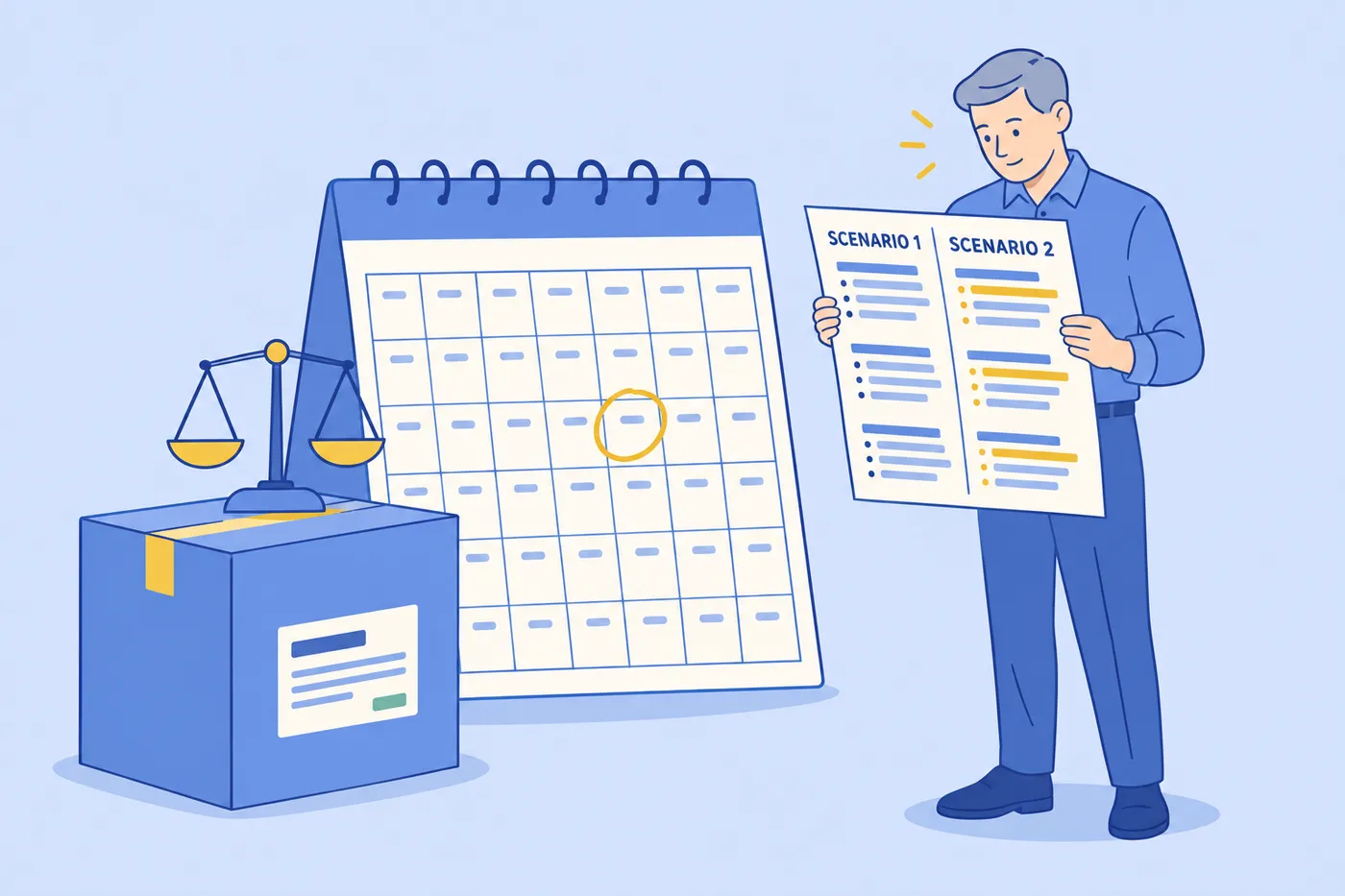
Scenario 1: deadline versus scope
Maya, a developer, is asked to deliver a five-week feature in three weeks because a client demo moved up. Her fallback, if no agreement is reached, is to escalate the priority call to her manager, which she would rather not spend on this.
She asks one diagnostic question first: "What does the demo actually need to show?" The answer is the core workflow, not the admin settings or edge-case handling. That is the interest behind the position. The position was "everything in three weeks"; the interest was "a convincing demo on the new date."
Her proposal trades on that gap: core workflow demo-ready in three weeks, remaining scope two weeks after, with one boundary stated plainly: the security review stays in, because a demo that later fails review costs more than it buys. The product lead can explain this deal upward ("demo is covered, full release slips two weeks, nothing skipped"), and Maya can explain it in a future interview. She closes with a recap message listing what ships when and who signs off.
Scenario 2: supplier terms
Dario, an office manager, is renewing a contract with Northfield Supply (fictional). Northfield opens with a 9% price increase. Dario's fallback is a quote he already collected from a second vendor, which is comparable on price but worse on delivery reliability. Knowing his alternative is what lets him stay calm; he does not need this deal at any price.
His diagnostic question: "What's driving the increase?" Answer: Northfield's costs are up, but their bigger worry is customers switching mid-year, which makes their planning volatile. Predictability is the interest behind the price position. So Dario trades across priorities: a 12-month commitment, which costs him little given their reliability, in exchange for holding the current price and moving to net-45 payment terms. His boundary is no auto-renewal clause. He anchors the ask to the standard of their own prior contract, then confirms everything in a written amendment before the old contract lapses.
Different rooms, identical skeleton: question before counter, interest behind position, a trade each side can explain, one stated boundary, a written record. That skeleton is what you are practicing, not scripts.
The five phases, so you know where you are
For this guide, use five practical phases to organize preparation and reflection: preparation (goals, information, interests, BATNA), discussion (exchanging perspectives and clarifying concerns), proposal (introducing possible terms), bargaining (counteroffers and concessions), and agreement (recording the mutually acceptable result). Real negotiations loop back when new information changes the picture, and that is fine.
The practical use of the model is diagnostic. Most workplace negotiations go wrong by skipping a phase: proposing before discussing (you anchor to the wrong problem) or agreeing without recording (the deal evaporates in two weeks). When a conversation feels stuck, name the phase you are in and ask whether you skipped the one before it.
A self-assessment: score your last real negotiation
Pick one recent negotiation, even a small one, such as a deadline discussion or a meeting-time standoff. Answer the five questions honestly. This is an informal reflection tool, not a validated instrument; its value is in showing you which behavior to practice next, and nothing more.
| Dimension | Ask yourself | What strong looks like |
|---|---|---|
| Preparation | Did I write down my interests and my fallback before the conversation? | A prep note existed before the meeting, even three lines on paper |
| Understanding the other side | Can I state their constraint in one sentence they would agree with? | You asked at least one "what's driving this?" question and restated the answer |
| Options | Did we consider more than one possible deal? | At least two structures were on the table before anyone said yes |
| Limits | Did I know my walk-away point, and did I state my boundary once, calmly? | The boundary was named before pressure arrived, not improvised under it |
| Follow-through | Does a written record of the agreement exist, with owners and dates? | A recap message went out within a day and both sides saw it |
Mark each row yes or no, then choose a missing behavior to practice. The count cannot explain the outcome on its own: power, available alternatives, authority and external constraints also affect what agreement is possible.
How to improve: a repeatable practice plan
Negotiation improves through small, frequent, low-stakes reps with a debrief, not through one high-stakes conversation a year. Three exercises carry most of the load.
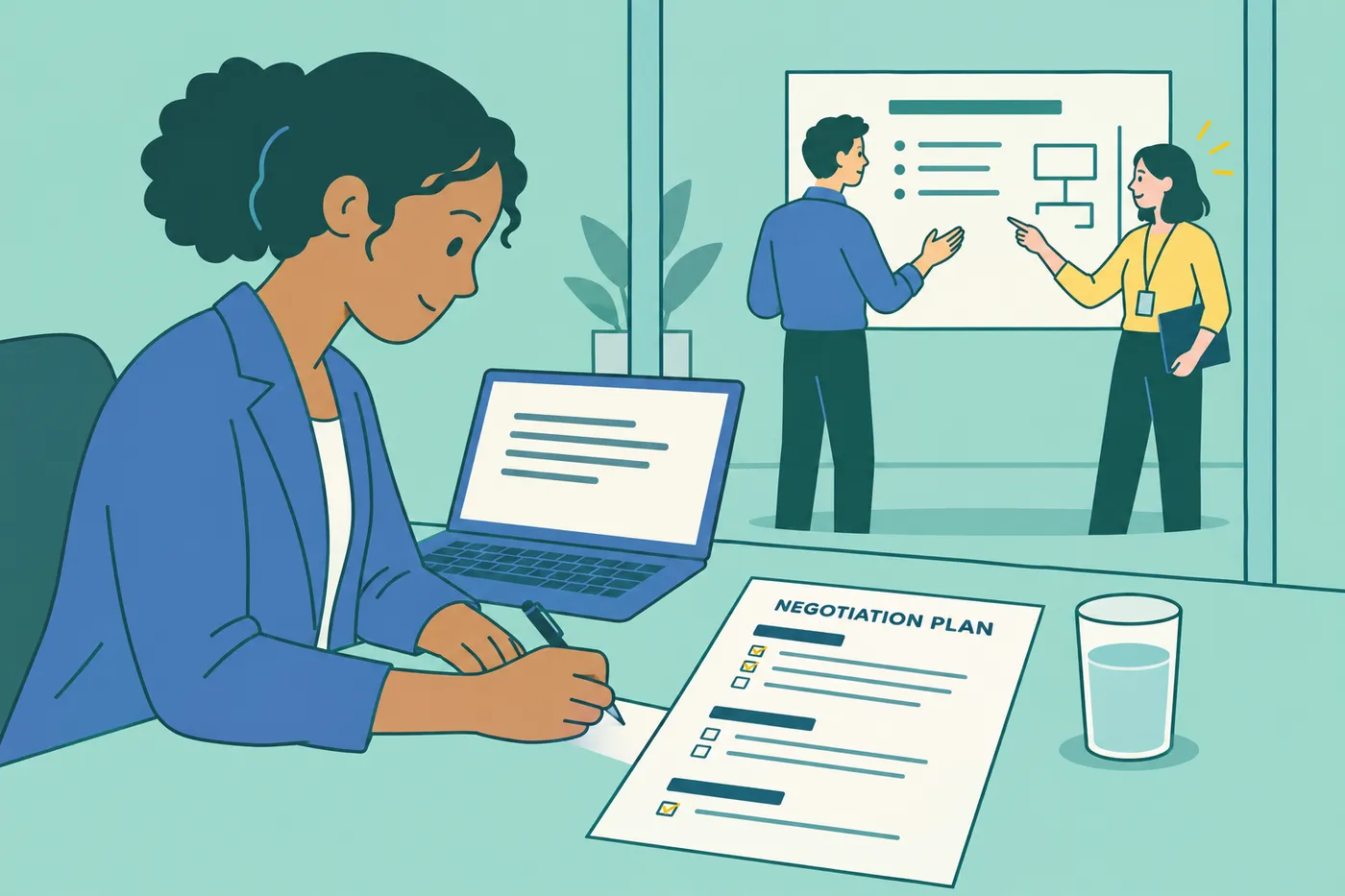
- Interests-behind-positions drill (10 minutes): take any request you received this week and write the position ("I need this Friday") and three plausible interests behind it ("a client meeting Monday," "their own boss's deadline," "fear it will slip further"). Then verify by asking. The gap between your guess and the real answer is the training signal.
- Fallback preparation: before your next contested conversation, write your BATNA, your best alternative if no deal happens, in one sentence, and one step you could take this week to make it stronger. A negotiator with a real alternative asks better questions because nothing is riding on any single answer.
- Role-play a scope discussion: ask a colleague or friend to play a stakeholder demanding a shorter timeline, run fifteen minutes, and debrief on one question only: is the agreement good, meaning both sides can explain it and it will survive two weeks? Reviewing who "won" trains the wrong instinct; most workplace counterparts are people you negotiate with again.
Make it a loop: one drill per week, one written prep note before every real negotiation, and a ten-minute debrief after, using the self-assessment table above. For feedback, ask your counterpart one question after the dust settles: "Was there a version of that deal that would have worked better for you?" The answer tells you what you failed to discover during the discussion phase, which is the most common and most fixable gap.
The same preparation can help with a job offer. Consider the full package and ask which terms are open to discussion. Pay, start date, working arrangements or development support may have different constraints. Confirm any agreement in writing; do not assume every employer can negotiate every term.
Negotiation skills for a resume: evidence, not the word
"Negotiation" sitting alone in a skills list carries almost no weight, because a recruiter cannot verify it there. The skill earns its place when an experience bullet shows a negotiation with a result. Build each bullet from three parts: the action (what you negotiated), the context (with whom, over what), and the evidence (the commercial or delivery result you can verify). Brackets below mark facts only you can supply; never ship a bracket, and never invent a number to fill one.
- Account manager: "Renegotiated [N] contract renewals with [client segment], trading multi-year commitments for pricing stability and retaining [$X / N%] of at-risk revenue."
- Project coordinator: "Negotiated a revised delivery plan with [stakeholder team], splitting scope into two releases and keeping the [launch/demo] date without added headcount."
- Office or operations manager: "Secured [net-45] payment terms and a [12-month] price hold from [supplier category] in exchange for an annual commitment, improving monthly cash flow by [$X]."
- Engineer or analyst: "Negotiated scope with product on [feature], shipping the core workflow for [the deadline] and deferring [non-critical items], with the full release delivered [N] weeks later as agreed."
The weak-to-strong rewrite makes the pattern obvious. Weak: "Strong negotiation and communication skills; experienced in vendor management." Strong: "Renegotiated [supplier] contract at renewal, holding price flat against a proposed [N%] increase in exchange for a [12-month] term, documented in an amendment before expiry." The first could describe anyone; the second names a counterpart, a trade, a boundary and a record, which is exactly the matrix from earlier in bullet form.
In Roleframe’s resume editor, live checks can flag wording to review while you edit. Signed-in accounts have a limited free allowance for AI features. If you ask Remi for a rewrite, supply the facts and review the proposed changes before applying them; keep only claims you can support.
Interview evidence: one answer, built properly
"Tell me about a time you negotiated" is a standard behavioral prompt, and the strong answer has the same three parts as the resume bullet: a real situation, your specific actions, and a verifiable result or an honest learning. The STAR method gives it structure. A skeleton worth adapting, in first person and clearly a template:
"Our main supplier proposed a price increase at renewal [situation]. Before the call, I wrote down what we needed, what I guessed they needed, and our alternative quote [preparation]. I asked what was driving the increase and learned mid-year churn was their bigger concern, so I proposed a longer commitment in exchange for holding the price, with no auto-renewal [action and trade]. We signed an amendment that week, and the terms held for the full year [result]."
Three boundaries keep the answer safe. First, never claim a win you cannot explain mechanically; the follow-up will be "why did they accept?" and "I pushed hard" is not an answer. Second, keep confidential figures out: "a mid-single-digit increase" works where the real number is protected. Third, if the negotiation partly failed, say what you would prepare differently; interviewers trust a specific learning more than a spotless record. The most common mistake is telling a persuasion story, where you talked someone into your position, instead of a negotiation story, where you discovered their interest and traded on it. The second is the skill being tested.
A last placement rule: evidence lives in the experience bullet and the interview story. The skills list is an index, not a proof. If the only place "negotiation" appears on your resume is the skills list, move the proof into a bullet first and the list entry becomes legitimate.
Frequently asked questions
- What are good negotiation strategies?
Prepare your priorities and your best alternative if no agreement is reached. Ask what drives the other side’s request, consider several workable options, and compare proposals using relevant standards. The Harvard Program on Negotiation guide explains these elements. Record the agreed terms, owners and dates.
- What are the 7 basic rules of negotiating?
A useful seven-part checklist is: prepare, identify interests, know your alternative, set limits, listen and ask questions, compare options against relevant standards, and record the agreement. This is a practice checklist rather than a universally recognized set of seven rules.
- What soft skills matter most for negotiating effectively?
Active listening, clear questioning, empathy, emotional self-control, assertive but respectful communication, perspective-taking, problem-solving, flexibility, patience, and trust-building. These are what let you uncover constraints, separate positions from interests, and make trades that create value rather than just divide it. Their relative weight shifts with the relationship, the stakes, and whether the negotiation is collaborative or adversarial. Most of them are communication skills with a specific job to do; our communication skills guide covers how to practice and prove them.
- What are the five phases of negotiation?
A commonly taught model: preparation, discussion, proposal, bargaining, and agreement. Preparation covers goals, information, interests and BATNA; discussion exchanges perspectives; proposal introduces terms; bargaining handles counteroffers and concessions; agreement records the result. Real negotiations loop back to earlier phases when new information changes interests or alternatives, so treat the model as a map of where you are, not a script.
- Is negotiation a hard skill or a soft skill?
It sits in between. The underlying behaviors, such as listening, questioning and perspective-taking, are soft skills, but negotiation also has teachable technique (BATNA analysis, trading across priorities, anchoring to standards) and, in roles like procurement, formal hard-skill components like cost and price analysis. On a resume, treat it the way you treat any claim covered in our hard vs. soft skills guide: the label matters less than the evidence bullet behind it.
- Can you negotiate things at work other than salary?
Yes. Depending on the role and the employer’s policies, discussions may cover deadlines, project scope, resources, supplier terms, a start date or working arrangements. Ask what is open to negotiation and confirm authority before committing. Some terms are fixed.

Turn your skills into proof.
A skills section helps most when your experience backs it up. In the editor, write each skill into a bullet about real work, then check the page against the posting before you send it.


