Cook Skills for a Resume: Line and Prep Cook Skills With Examples
The cook skills employers screen for: station work on the line, knife and prep, food safety, and ticket times, with a proof bullet for each skill.


On this page
Most of what ranks for "cook skills" is written for home cooks. Knife tutorials, recipe roundups, advice on boiling an egg. None of it helps when a kitchen manager is scanning your resume between lunch and dinner service, deciding in a few seconds whether you can hold a station on a Friday night.
This page is for line cooks and prep cooks applying to real kitchens. Here is the cook skills list hiring kitchens actually screen for:
- Station cooking on the line: grill, sauté, fry, garde manger, plating to spec
- Knife work and batch prep: standard cuts, mise en place, recipe scaling, portioning
- Reading tickets and timing courses off a kitchen display system (KDS) or printer
- Food safety and temperature control: temp logs, cooling procedures, allergen handling
- Recipe and portion consistency: standardized recipes, photo spec, remake discipline
- Inventory and receiving: deliveries, counts, par levels, first in first out rotation
- Communication with the expo and front of house
That list is the answer a searcher wants up front. The rest of this page earns it. Each section below covers the exact wording postings use, so your resume matches what the applicant tracking system (ATS) scans for, and the proof that convinces the human reading after it. Every section ends with a resume bullet you can adapt to your own numbers.
Line station skills
The first question a kitchen manager asks of a line cook resume is which stations you can hold and at what volume. Station cooking means running grill, sauté, fry or garde manger through a full service while reading tickets off a KDS or printer, firing courses in the right order, and calling back to the expo without losing your place on eight open tickets.
Postings phrase this as "line cook experience" or "ability to work multiple stations," often with "high-volume kitchen" attached. A resume that says "cooked food" matches none of that. Name your stations and name the volume. Covers per night is the single most convincing number a line cook can put on paper, because it tells the reader exactly what kind of pressure you have already survived.
Resume bullet: Held sauté and grill stations through 280-cover weekend dinner services at a 120-seat bistro, reading tickets off a KDS and plating 14 menu items to photo spec.
Knife and prep skills
Prep is where kitchens lose money, so prep skills are where a resume can show you save it. The skill set covers standard cuts (dice, julienne, brunoise, chiffonade), batch prep against a daily prep list, recipe scaling for volume, portioning proteins to spec, labeling and dating everything, and rotating walk-in stock first in first out (FIFO).
Postings phrase this as "prep cook duties," "food prep experience" or the catch-all "mise en place." Use those exact phrases somewhere on the resume, then prove them with volume and waste. A prep cook who completes a full list for a 400-cover night without the line running out mid-service is a different hire from one who chops vegetables, and the resume should make that difference visible.
Resume bullet: Completed daily prep lists supporting 400-cover services across two stations, portioning proteins to spec and rotating walk-in stock FIFO with dated labels; kept produce waste under 4% on weekly counts.
Food safety and sanitation skills
Food safety is the skill area kitchens cannot compromise on, because a failed inspection or an allergen incident can close the doors. On a resume it covers time and temperature logs, two-stage cooling procedures, cross-contamination controls between raw and ready-to-eat product, allergen handling, and keeping a station inspection-ready every shift rather than the night before the health department visits.
Postings phrase this as "food safety knowledge," "sanitation standards" or "ServSafe preferred." The proof that lands is an inspection result. If your kitchen passed with an A grade or zero critical violations while you ran temp logs, that belongs in a bullet. Your ServSafe or state food handler card belongs in a certifications line, covered further down this page.
Resume bullet: Maintained line temperature logs and two-stage cooling records through three consecutive health inspections with zero critical violations; ran a dedicated allergen protocol for a menu with eight declared allergens.
Consistency and speed under pressure
Any cook can produce one good plate. Kitchens hire the cook who produces the hundredth plate identical to the first, at 8:45 on a Saturday, with the printer still chattering. The skill set behind that is following standardized recipes without improvising, plating to photo spec, hitting ticket times, and staying level during a rush instead of going down in flames and taking the station with you.
Postings phrase this as "attention to detail" and "ability to work under pressure," sometimes as "thrives in a fast-paced kitchen." Those phrases prove nothing by themselves, and every applicant claims them. Ticket times and remake counts prove them. If you know your average entrée time during peak service, or how rarely your plates come back, put the number on the resume.
Resume bullet: Kept average entrée ticket times under 12 minutes through peak Friday services and held remakes below two per 100 covers by plating to photo spec on every check.
Kitchen operations skills
Operations skills separate a cook who works a station from a cook a manager can leave alone with the building. They cover receiving deliveries and checking them against invoices, running inventory counts, holding par levels, basic equipment care, opening and closing the line, and training new cooks to station-ready.
Modern kitchens add a layer here. High-volume operations increasingly run programmable combi ovens, automated fryers, digital inventory systems and KDS-integrated workflows, so naming the specific equipment and software you have operated is worth resume space. A cook who can troubleshoot a combi mid-service instead of calling for a manager is more valuable on paper and on the line.
Postings phrase this area as "kitchen operations," "opening and closing duties" or simply "teamwork." Shift lead responsibility is the proof, even without the title. Orders you placed, deliveries you received and cooks you trained all count.
Resume bullet: Opened and closed the line four shifts per week, received and reconciled three weekly broadline deliveries against invoices, and trained five new line cooks to station-ready in under three weeks each.
Credentials worth their own line
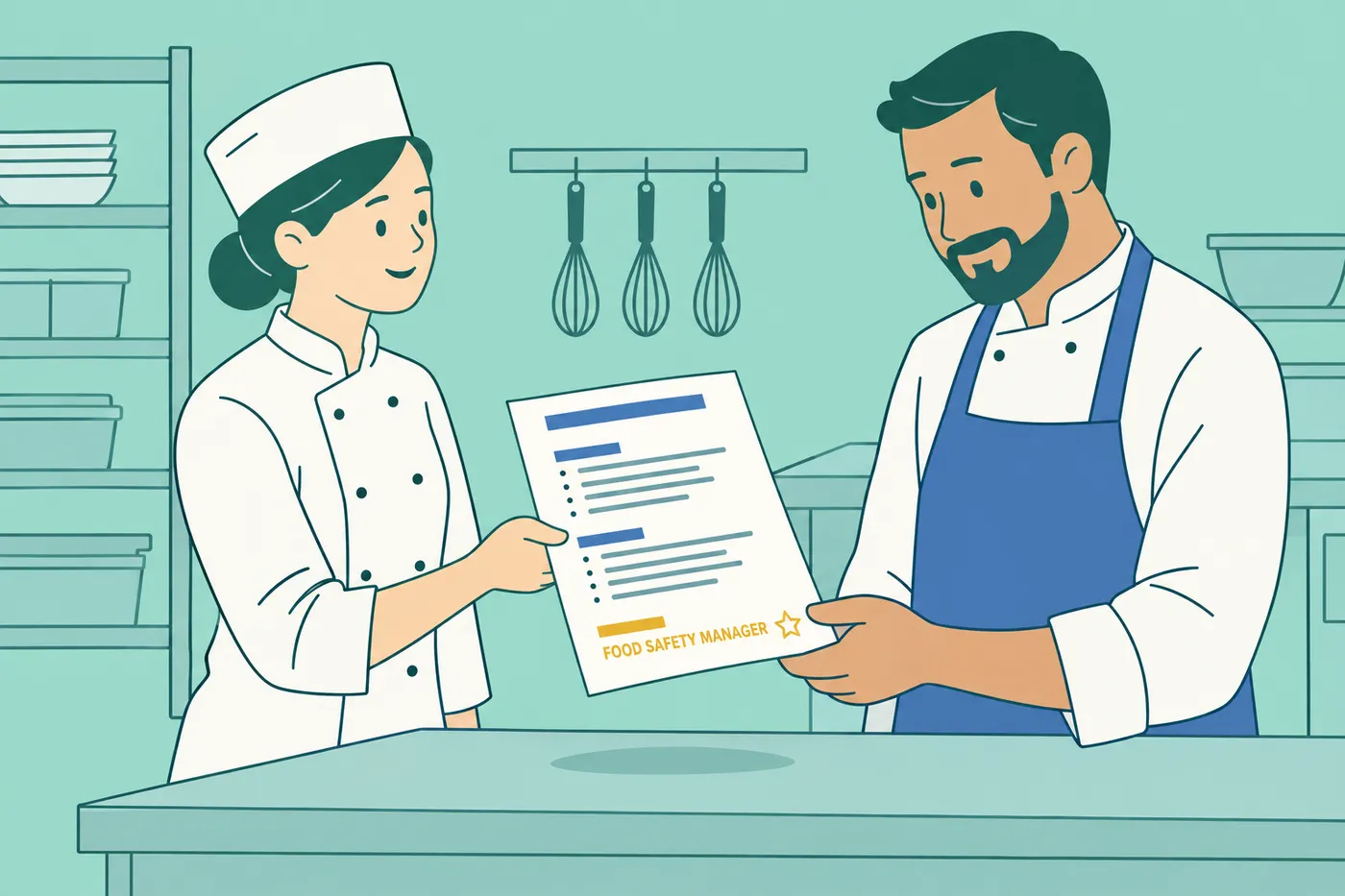
Two credentials matter for most cook postings. A state or county food handler card is required in many jurisdictions before you can legally work a shift, and requirements vary by state, so check what your area asks for and list the exact card you hold. ServSafe Food Handler is the widely recognized national training; ServSafe Manager is worth pursuing if you have run a line or led shifts, because it signals you can be the certified person on duty.
List the certification by its exact name with the expiration date if it has one. Where it sits on the page depends on whether the posting requires it; when it does, it should be visible in the top half. The guide on where to put certifications on a resume covers the placement decision in detail.
No culinary degree is required for almost any line or prep cook posting. Kitchens hire on experience and often on a trial shift, and they train the rest on the job. Do not let a missing diploma stop an application the posting never asked a diploma for.
Cook skills, posting language and proof at a glance
| Skill area | How postings phrase it | Proof that convinces |
|---|---|---|
| Line station cooking | Line cook experience, working multiple stations | Covers per night, stations held, seats served |
| Knife work and prep | Prep cook duties, mise en place, food prep experience | Prep list volume, waste percentage, portioning to spec |
| Ticket reading and timing | KDS experience, fast-paced kitchen | Average ticket times during peak service |
| Food safety and sanitation | Food safety knowledge, sanitation standards, ServSafe | Inspection results, temp log ownership, allergen protocol |
| Consistency and speed | Attention to detail, works under pressure | Ticket times, remake counts, photo-spec plating |
| Inventory and receiving | Kitchen operations, opening/closing duties | Deliveries reconciled, counts run, par levels held |
| Expo and FOH communication | Teamwork, communication skills | Callbacks, all-day counts, coursing with servers |
Where these skills go on your resume
Split the work between two sections. The skills section carries the scannable keywords in short form, things like the stations you run, KDS experience, and your food safety card, because that list is what an ATS keyword filter and a skimming manager both read first. The experience bullets carry the proof, meaning the covers, the waste numbers and the inspection results from the sections above. A skill that appears in the list with no bullet behind it reads as a claim, and kitchen managers have read thousands of unsupported claims.
Match the posting's wording before you submit. If the ad says "garde manger" and your resume says "cold station," a keyword filter can miss the match even though you have the skill. Pulling the exact phrases takes a few minutes; the walkthrough on pulling resume keywords from a job description shows how. For the layout of the section itself, these resume skills section examples show what to keep short and what to move into bullets.
Send the finished resume as a PDF. It holds its formatting on every device the kitchen manager might open it on, which is often a phone between services.
Run the resume skills check, then fix what it flags
This page carries a resume skills check. Upload your resume and each skill from the list above comes back in one of three states. Proven means a bullet already backs it with something concrete. Only listed means the word appears but nothing supports it. Missing means it is not on the page at all, and if the posting asks for it, a keyword filter will notice before a human does.
Work the results in that order. Turn every "only listed" skill into an experience bullet with a number a kitchen manager recognizes, whether that is covers per night, stations held or an inspection result. Then add the missing skills the tool flags, using the posting's own phrasing. When you are applying to a specific job, checking your resume against the job description goes a step further; in Roleframe you duplicate your base resume for the posting and get a fit report with an ATS score, the exact keywords you are missing and a prioritized plan, then you make each edit yourself with Remi suggesting rewrites you approve one at a time.
Frequently asked questions
- How do you list cooking skills on a resume?
Put the scannable keywords in a short skills section, meaning the stations you run, KDS experience and your food safety credential, then prove each one in an experience bullet with a real number. Covers per night, prep volume, ticket times and inspection results are the numbers kitchen managers trust. Mirror the posting's exact wording, because an ATS filter matching "garde manger" will not credit "cold station." A skill listed with no bullet behind it reads as an unsupported claim.
- What are the top 5 culinary skills?
For a professional kitchen resume, the five that matter most are station cooking at volume, knife and prep work, food safety and temperature control, consistency to spec under time pressure, and clear communication with the expo and front of house. Home-cooking lists put technique first; hiring kitchens put volume and safety first. If you can only prove one, prove station work with covers per night, because it implies most of the others.
- What are some basic cook skills?
For an entry-level kitchen job, the basics are standard knife cuts, following a standardized recipe exactly, labeling and dating product, FIFO stock rotation, basic temperature control, and cleaning as you go. A food handler card, where your state requires one, belongs on the resume from day one. Kitchens expect to train everything else on the job, so a resume that proves reliability and the basics is enough to get a trial shift.
- What are the 10 most common types of cooking techniques?
Grilling, sautéing, frying, roasting, braising, poaching, steaming, blanching, baking and searing cover most professional menus. On a resume, name the station rather than the technique, because postings screen for "sauté station" and "fry station," and the station name implies the techniques. Listing techniques alone reads like a home cook's resume.
- Do you need a culinary degree to be a line cook?
No. The overwhelming majority of line and prep cook postings ask for experience, a food handler card where required, and sometimes ServSafe, with no degree mentioned. Kitchens routinely hire on a trial shift, called a stage, and train station skills on the job. Culinary school can accelerate a path toward sous chef or chef roles, but it is not the entry requirement for the line.
- Should a prep cook and a line cook use the same resume?
Use one base resume, then adjust the emphasis per posting. A prep-heavy ad wants your cuts, batch volumes, labeling discipline and waste numbers near the top; a line posting wants stations, covers and ticket times first. The underlying experience is the same, so the change is order and wording rather than a rewrite. Keep the tailored version for each application so you know exactly what a given kitchen saw.


Turn your skills into proof.
A skills section helps most when your experience backs it up. In the editor, write each skill into a bullet about real work, then check the page against the posting before you send it.


