Attention to Detail: Work Examples and Ways to Demonstrate It
What attention to detail means at work, concrete examples with observable actions, a self-test, and how to prove it on your resume and in interviews.


On this page
Attention to detail means checking work for errors, missing information and inconsistencies before they cause a problem. Catching a billing discrepancy is a stronger example than describing yourself as meticulous.
This guide follows that idea from definition to practice: observable work examples, a fictional invoice discrepancy, an informal exercise, a checking routine, and resume bullets and interview answers built from your own evidence.
What attention to detail means at work
At work, attention to detail involves three questions: is the work accurate, is it complete, and is it consistent across the records or documents involved?
Match the depth of review to the task’s risk and required procedure. A routine message may need a brief read-through; a payment or safety-sensitive task may require approvals and formal checks. Follow the controls for your role rather than improvising your own substitute.
The aim is useful checking, not endless rechecking. Agree what must be verified, what would trigger escalation and when the work is ready to hand over. The practice exercise below helps you observe which errors your process catches; it is not a personality or diagnostic test.
Attention to detail examples: the behavior-to-evidence matrix
An adjective list ("thorough, precise, careful") proves nothing. What convinces a hiring manager is the chain from task to observable action to an artifact you could show, plus a ready answer for the follow-up question that action invites. The matrix below maps that chain for the most common detail-heavy tasks across office, technical, clinical and early-career work.
Use work records only with permission. Redact confidential details or describe the example instead of sharing the original artifact.
| Task | Observable action | Artifact you could share | Interview follow-up to expect |
|---|---|---|---|
| Account reconciliation | Match each ledger entry to a statement line and investigate every difference instead of writing small ones off | The reconciliation file with each resolved item noted | "Walk me through a discrepancy you found. How did you decide it was resolved?" |
| Proofreading a deliverable | Read in separate passes: facts and numbers first, then structure, then spelling and formatting | A style checklist and a tracked-changes file | "What do you check first, and why in that order?" |
| Data validation before import | Compare a sample of records to source documents, then run duplicate and range checks on the full set | The validation log with error counts by type | "What did your checks miss, and what did you change afterward?" |
| Specification or drawing check | Measure the output against each stated tolerance and log every deviation rather than judging by eye | A completed inspection sheet | "Which requirement was hardest to verify, and how did you do it?" |
| Version control on shared files | Name versions by date and status; confirm the file you send matches the final approved copy | A version history or change log | "How do you stop the wrong version going out?" |
| Safety or launch checklist | Work the list item by item, sign each step, and stop when a step fails instead of working around it | The signed checklist | "Tell me about a time a checklist step failed." |
| Verifying AI-assisted work | Check every fact, figure, date and citation against a known-good source before submitting | Your verification notes or source list | "How do you decide what needs verifying?" |
AI-assisted work needs the same verification as other work: compare facts, figures and citations with dependable sources before using them. Plausible wording does not establish accuracy.
Other examples include checking calculations, reviewing error logs, verifying links and recipients, and reconciling records between systems. The data entry resume example shows how checking actions can become resume evidence.
A worked example: finding and fixing a discrepancy
Everything in this example is fictional: the company, the people and the figures. It exists to show the checking method, which is real.
Dana works in accounts payable at Brightline Supplies, a fictional distributor. An invoice arrives from a regular vendor, Harwick Paper Co., for $1,482.00. The purchase record in Brightline's system says the order should cost $1,428.00. Two numbers, same digits, different order. Most people would pay whichever figure is on the invoice, because invoices feel authoritative.
Here is the chain Dana runs instead, and each step maps to one of the three questions from the definition above.
- Consistency check: the invoice and the internal record disagree, so one of them is wrong. A disagreement between systems is never resolved by picking the more official-looking one.
- Go to the source document: the signed purchase order says 420 units at $3.40 per unit. Recompute it: 420 × 3.40 = $1,428.00. The internal record is right; the invoice transposed two digits and overbills by $54.
- Proportionate response: a $54 transposition on a recurring vendor does not justify auditing a year of invoices, but it does justify a corrected invoice. Dana holds the payment, emails Harwick requesting a corrected invoice, and notes the discrepancy and resolution in the record.
- Corrected record: payment of $1,428.00 is made against the corrected invoice, with the note trail intact so the next person who looks at this account understands what happened.
Notice what made this work. The error was found by a consistency check, confirmed by going to the source document and recomputing, and resolved with a visible trail rather than a silent fix. That trail is the artifact. Six months later, "caught a vendor overbilling by reconciling invoices against signed purchase orders" is a resume bullet with an interview story behind it.
Test yourself: an informal self-assessment
This exercise is informal practice, not a validated assessment. Its purpose is to compare checking approaches on the same kind of task. Use fictional or safely anonymized documents.
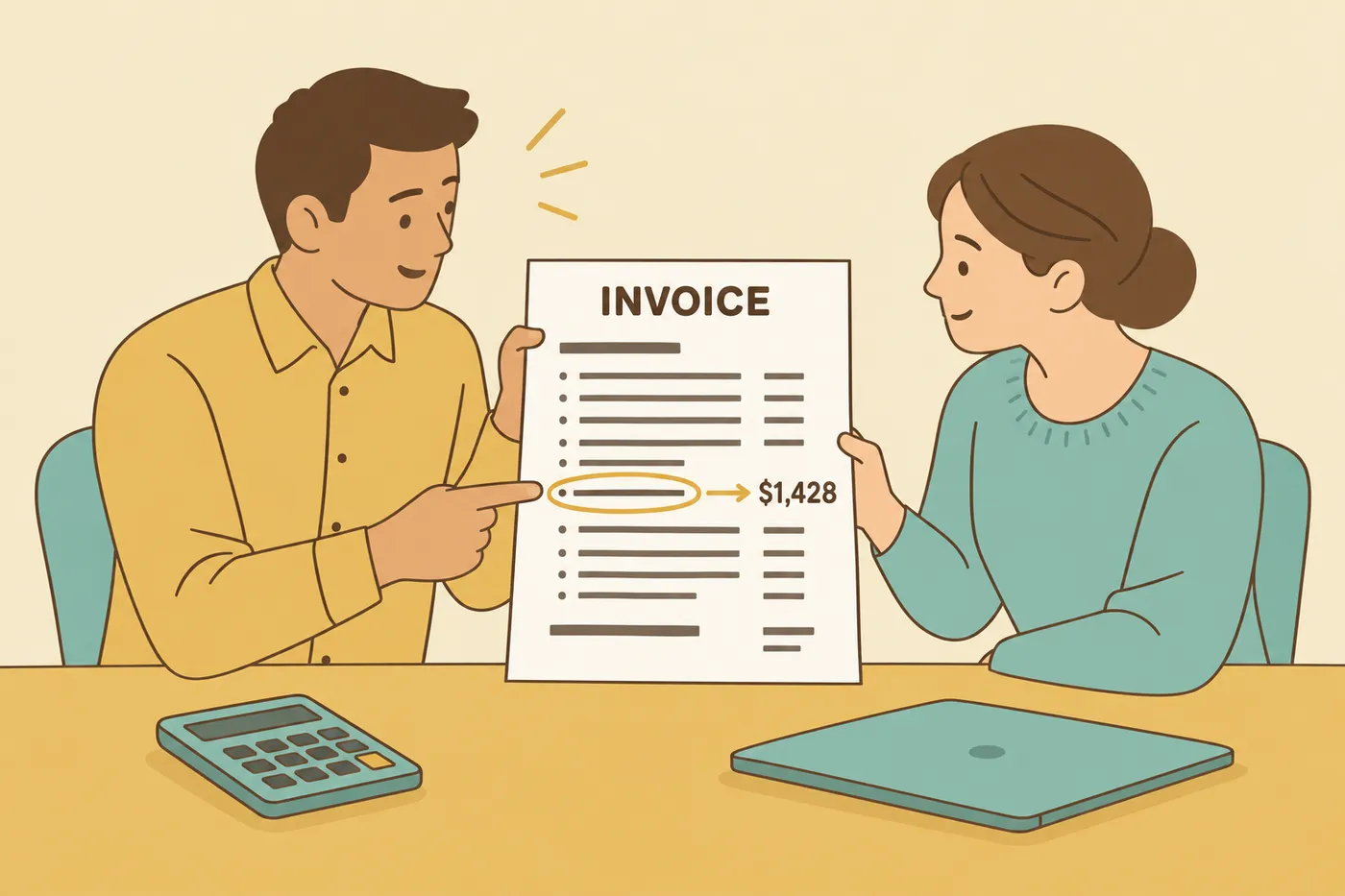
- Pick a one-page document with facts in it: an invoice, a staff roster, a schedule, a spec sheet from your field.
- Ask a friend to make a copy with 8 deliberate changes. Mix the types: a transposed number, a shifted date, a swapped name, a deleted line, an inconsistency between two sections.
- Give yourself 15 minutes to find them using your normal approach. Write down what you found.
- Now re-check the same document with a written checklist in a fixed order (numbers first, then names and dates, then completeness, then cross-references). Write down what the second pass added.
- Score both passes: errors found out of 8, and which error types each method caught.
Compare the errors caught in each pass and note their types. A second pass also benefits from familiarity with the document, so it is not a controlled test of the checklist. Repeat with fresh examples and alternate approaches if you want a more useful comparison.
How to improve attention to detail
Improve the checking process as well as your concentration. These five changes give you a repeatable way to review work and learn from errors:
- Build a short checklist for a repeated task, with items in the order you will check them. Adapt its length to the task and required controls.
- Review separately from drafting. Take a break if time allows, then check structure, facts and surface errors in distinct passes.
- Set a deliberate stopping point before you start. Decide what "checked enough" means for this task given its risk, then stop there. This is the control that keeps checking proportionate instead of sliding into perfectionism.
- Use a realistic verification task regularly and log which error types you catch. Compare fresh examples over time; no fixed practice period guarantees improvement.
- Collect feedback on what gets past you. Ask whoever reviews your work to tell you, for one month, every error they catch that you missed. Each one names a checklist item you did not have yet.
Purdue OWL’s proofreading guidance recommends a break before checking and a list of errors to look for. For AI-assisted material, add explicit checks of facts, numbers, dates and citations against the original sources.
How to show attention to detail on a resume
A skills label is useful only alongside evidence. Show attention to detail in experience bullets with a task, the checking action and an outcome. Include the phrase when relevant to the posting, and use your skills section for specific competencies you can demonstrate.
Build each bullet from an artifact in the matrix above: a quality checklist you created, a discrepancy you corrected, a review record you kept, or verified accuracy data if your team tracked it. Four role-specific patterns, with brackets around every fact you must supply yourself:

- Finance or operations: "Reconciled [number] vendor invoices per month against purchase orders, resolving every discrepancy before payment, including a [value] overbilling caught in [period]."
- Data or admin: "Entered and verified [number] records per week against source documents, running duplicate and range checks before import [add your error or accuracy figure only if your team measured one]."
- Editorial or client work: "Proofread [number]-page client reports against a house style checklist in three passes, logging errors by type to cut repeat issues."
- Technical or quality: "Inspected [output] against [number] specified tolerances per [drawing/spec], logging each deviation in [system] with photos and measurements."
Never fill a bracket with a number you cannot defend in an interview. A clear qualitative outcome is useful when no reliable metric exists.
Here is the weak-to-strong rewrite in full. Weak: "Detail-oriented professional with strong organizational skills." Strong: "Caught a [value] billing discrepancy by checking invoices against signed purchase orders, then added the check to the team's monthly close checklist." The first is a claim about personality. The second names a task, an observable action, an artifact and a lasting improvement, and it hands the interviewer their next question.
In Roleframe’s resume editor, live checks can flag wording to review while you edit. Signed-in accounts have a limited free allowance for AI features. If you ask Remi for a rewrite, supply the facts and review the proposed changes before applying them; keep only claims you can support.
Attention to detail in interviews: questions and evidence
An interviewer may ask for an example of an error you caught or give you a task that resembles the work. Prepare a genuine incident and practice checking documents relevant to the role.
Build your answer around one real situation using three beats: the task and what was at stake, the specific checking action you took, and a verifiable result or an honest learning. The STAR method gives you the full scaffolding. A fictional sample answer showing the structure; replace it with your own true experience:
"In my last role I processed vendor invoices, and our record and an invoice disagreed by about fifty dollars. Instead of paying the invoice figure, I pulled the signed purchase order, recomputed the line items, and found the vendor had transposed two digits. I held the payment, requested a corrected invoice, and documented it in the account notes. After that I added a recompute step to our payment checklist, and it caught two more errors that quarter."
Two boundaries keep an answer credible. First, never claim nothing ever gets past you; if asked about an error that slipped through, give the real one, how it was found, and the control you added afterward. A specific failure with a fix is stronger evidence than a claim of perfection. Second, keep the evidence where it belongs: the story lives in an experience bullet and in your interview answer, not as a phrase in the skills list. If the interviewer hears the bullet, asks the follow-up from the matrix, and your answer holds up, that is the skill demonstrated three times over.
Frequently asked questions
- How do you develop good attention to detail?
Define the task’s requirements, use a checklist appropriate to its risk, and review separately from creating. Purdue OWL suggests allowing a break before proofreading and keeping a list of errors to check. Track what gets past your process and revise the checklist accordingly.
- What is a word that means attention to detail?
Depending on context, meticulousness, thoroughness, precision or care can express a similar idea. On a resume, a specific example of a discrepancy you caught is usually more informative than replacing one adjective with another.
- How do you use "attention to detail" in a sentence?
Example: “Her attention to detail helped her identify and correct errors before the report was submitted.” For resume evidence, name the actual check: “Compared invoice totals with signed purchase orders and resolved discrepancies before payment.”
- What does it mean to be too detail-oriented?
Checking becomes unhelpful when time spent on minor points prevents you from meeting the task’s important requirements. Agree a stopping point based on risk, deadlines and required controls. Do not skip mandatory checks to meet that target; escalate a conflict between the deadline and the required process.
- Is "detail-oriented" the same as attention to detail?
They describe the same thing from different angles: "detail-oriented" is the adjective applied to a person, while "attention to detail" names the skill itself. On a resume both are unsupported claims until a bullet backs them up. Whichever phrasing the job posting uses, mirror it once if it fits naturally, then prove it with a task, a checking action and an outcome in your experience section.
- Does AI make attention to detail less important?
No. AI output can contain plausible errors, so facts, calculations and citations still need verification. Checking the generated material against the original source is a practical way to demonstrate attention to detail.
- Should I list "attention to detail" in my resume skills section?
You can list it if the posting asks for it and your experience supports it. Pair the label with an example of a reconciliation, corrected discrepancy or review process. Do not rely on the phrase alone to explain what you can do.
Turn your skills into proof.
A skills section helps most when your experience backs it up. In the editor, write each skill into a bullet about real work, then check the page against the posting before you send it.


