Sales Director Resume Example & Executive ATS Strategy
by Larbi SahliLast Updated
A full sales director resume example, plus the strategic GTM and forecasting keywords that executive ATS screens filter for at the director level.
Users have landed jobs at
- 1Password
- OpenAI
- Notion
- justworks
On this page
The resume that made you a sales manager will quietly disqualify you for a sales director role. Manager resumes prove you can close and coach. Director resumes have to prove you can build: a go-to-market (GTM) motion, a forecast the CFO trusts, a team that scales past the people you personally hired. Recruiters screening director candidates read for that shift in the first pass, and applicant tracking system (ATS) filters are configured for it too.
This page gives you a complete sales director resume example, then breaks down the part most guides skip: how the keyword profile changes between manager and director postings, how to structure a multi-region resume, and how to quantify revenue scaling without inflating numbers you would have to defend in a final-round interview.
What executive recruiters look for in a sales director
An executive recruiter reads a director resume with three questions in mind, in roughly this order.
First: what did you own? Not what you participated in. A director owns a number (revenue, ARR, bookings), a team, and usually a segment or region. If your resume says "contributed to" and "supported" where it should say "owned" and "built," the recruiter downgrades you to senior manager territory before finishing the summary.
Second: did the business grow under you, and can you prove causation? Every director resume claims growth. The ones that survive scrutiny show the mechanism: a new segment opened, a pricing motion changed, a hiring plan executed, a forecast process rebuilt. "Grew revenue 40%" is a claim. "Grew the mid-market segment 40% by moving from inbound-only to a paired AE/SDR pod model" is evidence.
Third: have you managed managers? This is the sharpest line between manager and director in most orgs. If you have led team leads or front-line managers, say so explicitly and early. If you led a flat team of individual contributors, be honest about it and show scale in other ways, such as the size of the number you carried or the complexity of the deals.
Recruiters give a resume seconds, not minutes, on the first pass. The summary and the top three bullets of your current role carry almost the entire decision. Everything below that is confirmation reading.
Full sales director resume example
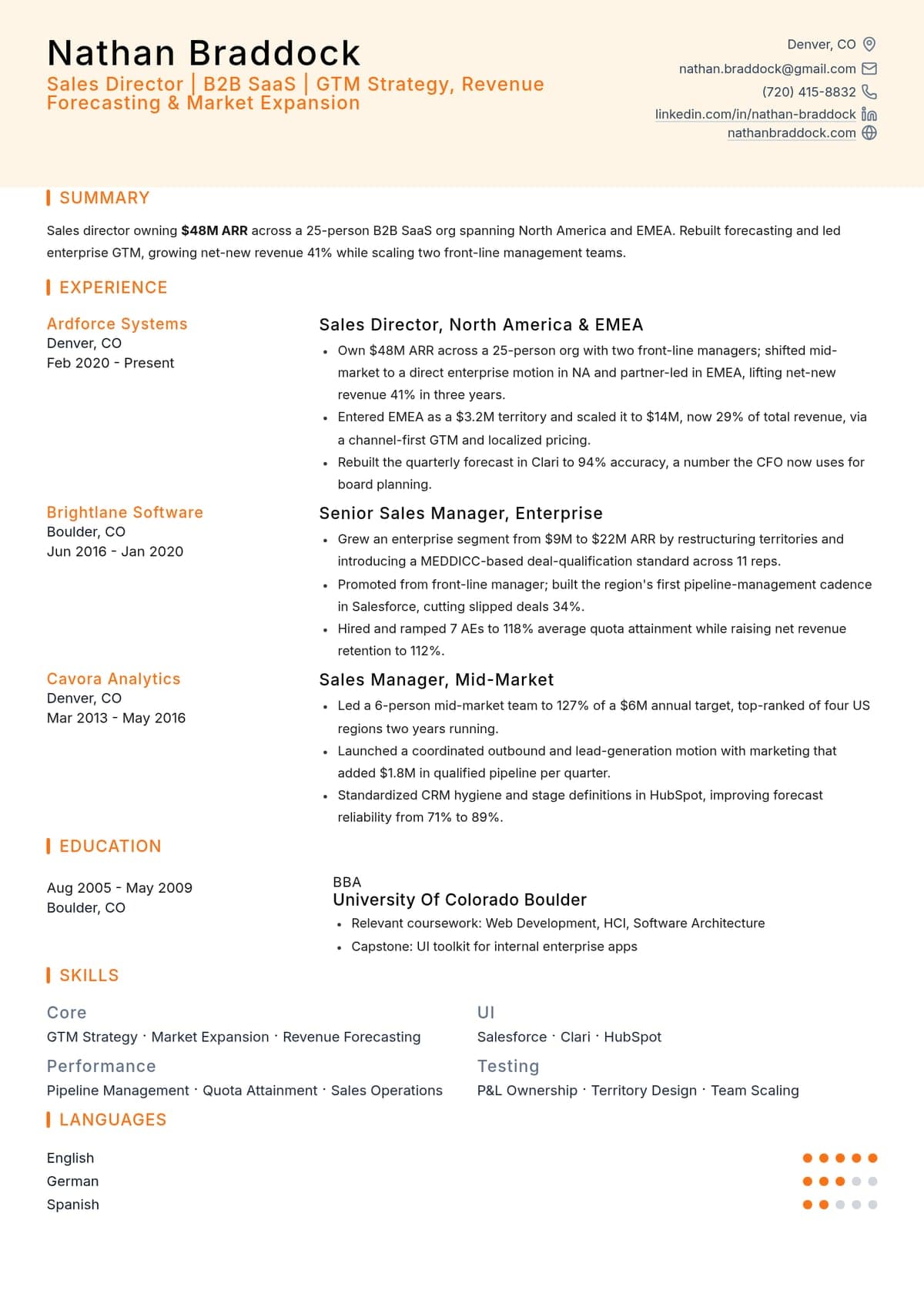
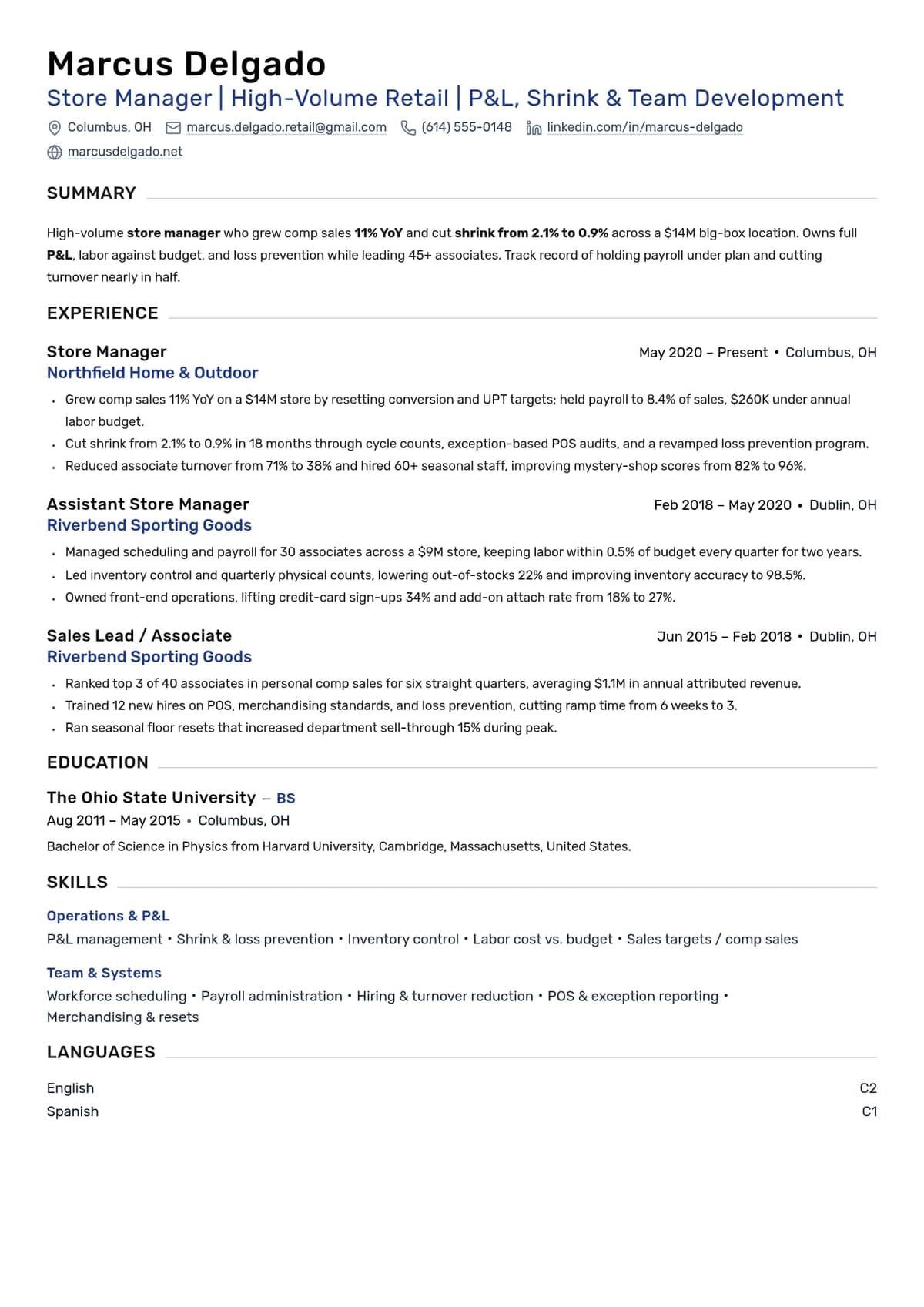
Here is a complete example. Notice how the summary leads with scope (revenue owned, team size, segment), how each role opens with a scale-setting line before the bullets, and how the bullets pair a business outcome with the decision that caused it. That pairing is what separates a director resume from a manager resume with a bigger title.
Two things worth stealing from this example even if your background looks different. The scope line under each title (revenue owned, team size, reporting line) does the recruiter's mental math for them, so they never have to guess your seniority. And the bullets never claim an outcome without naming the lever: a hire, a process, a segment, a pricing decision. That structure is copyable no matter what industry you sell in.
Executive ATS keywords: the shift from tactical to strategic
When Roleframe's job-analysis engine reads sales director postings against sales manager postings, the vocabulary splits cleanly. Manager postings ask for execution language: prospecting, quota attainment, CRM hygiene, deal coaching. Director postings largely drop those words and replace them with the language of systems: go-to-market strategy, revenue forecasting, market expansion, sales operations, pipeline governance, hiring and ramping.
This matters because most candidates promoted into director roles carry their manager-era resume upward. It is full of tactical keywords that director-level filters are not looking for, and thin on the strategic terms they are. The result is a strong candidate scoring poorly against a posting they are qualified for. The fix is not stuffing new words in; it is describing the strategic work you already did in the vocabulary the posting uses.
| Manager-level (tactical) language | Director-level (strategic) language |
|---|---|
| Quota attainment, hitting targets | Revenue forecasting, forecast accuracy, board reporting |
| Prospecting, cold outreach, lead generation | Go-to-market (GTM) strategy, demand model, segment strategy |
| Territory management | Market expansion, new market entry, regional P&L |
| Deal coaching, closing support | Pipeline governance, deal desk, win-rate improvement |
| CRM data entry and hygiene | Sales operations, RevOps alignment, tech stack ownership |
| Team motivation, one-on-ones | Org design, hiring plans, manager development, ramp time |
| Sales targets | Annual planning, capacity modeling, comp design input |
Read the right column against your last two years. Almost every experienced manager has done some of that work without labeling it. If you rebuilt how your team forecasted, that is forecast methodology, not "improved reporting." If you decided which accounts your team pursued, that is segment strategy. Rename the work you already did, truthfully, and your keyword coverage changes without a single invented claim. For the mechanics of matching a specific posting, see our guide to ATS resume keywords.
One caution: keep a handful of tactical proof points. A director resume with zero closing evidence reads as someone who has drifted too far from the deal. One or two bullets showing you still get into strategic deals personally, especially the largest ones, round out the picture.
Structuring a multi-region or global sales resume
Multi-region experience is a genuine differentiator at the director level, and most candidates bury it. The mistake is listing regions as a detail ("managed teams across NA and EMEA") instead of structuring the resume so the geographic scope is visible at a glance.
Three structural moves work well.
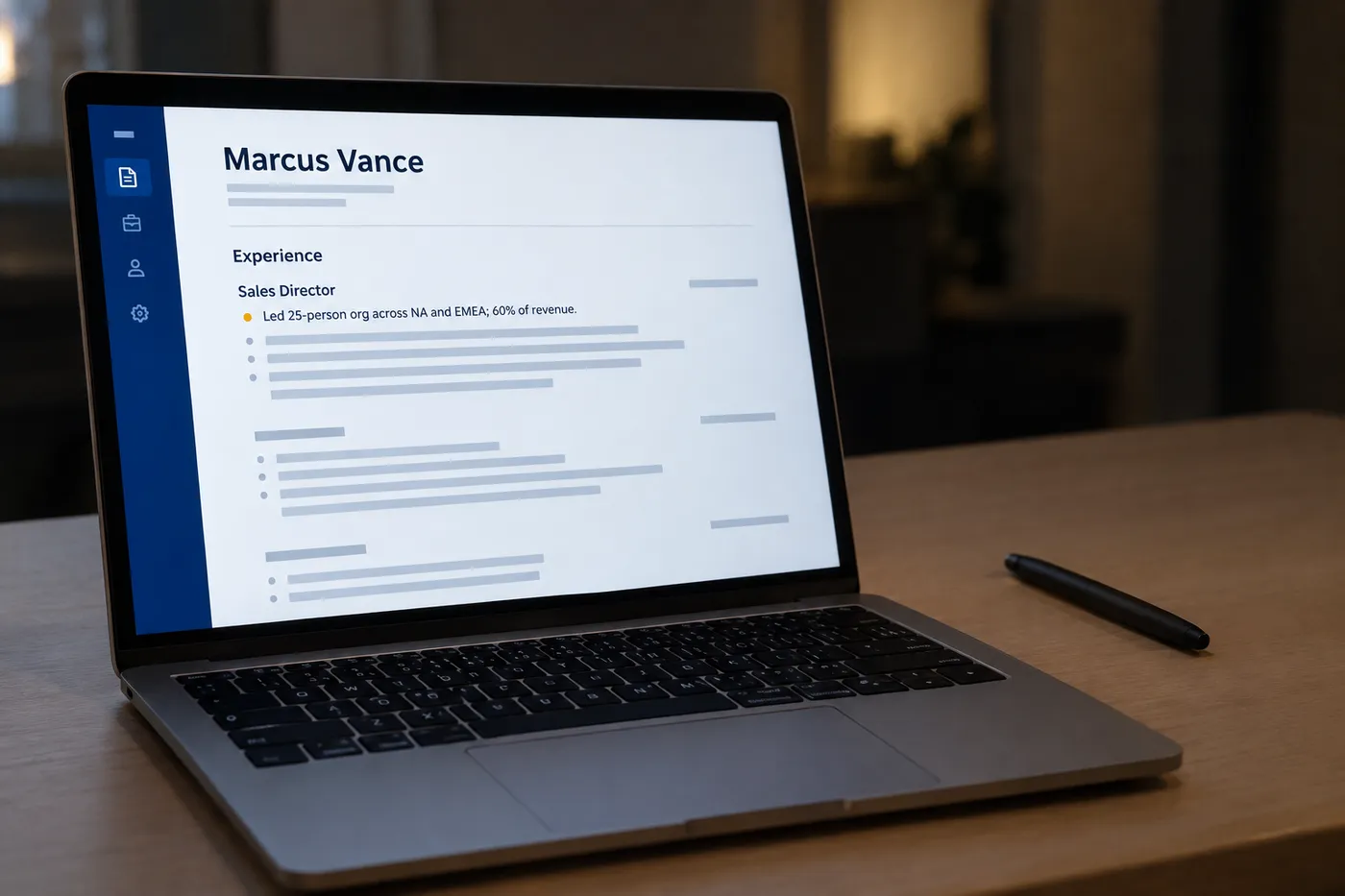
- Put geography in the scope line, with numbers attached: "Led 25-person org across North America and EMEA; 60% of revenue from outside the US." Revenue split by region is more convincing than a list of country names.
- Give each major expansion its own bullet with a before-and-after: what the region contributed when you took it on, what it contributed when you left, and the entry decision you made (local hires vs. relocation, channel vs. direct, pricing localization).
- If you ran meaningfully different GTM motions per region, say so explicitly. "Direct enterprise motion in NA, partner-led in APAC" tells a recruiter you have operated two playbooks, which is exactly what a global director role demands.
Resist the urge to create a separate "International Experience" section. It fragments your story and pushes revenue numbers away from the roles that produced them. Keep the reverse-chronological structure and let the scope lines carry the geography.
How to quantify team growth and revenue scaling
Director resumes live or die on numbers, and the interview is where inflated ones die. Every figure you write should survive the question "walk me through how you got that number." Here is how to quantify the two claims every sales director makes.
Revenue scaling
State the range, not just the percentage. "Scaled the segment from $8M to $21M ARR over three years" is more credible than "grew revenue 160%" because it shows the base. Small bases produce spectacular percentages, and recruiters know it. If you cannot disclose exact figures for confidentiality reasons, use honest approximations ("grew a ~$10M book to ~$25M") rather than a bare percentage.
Attach the mechanism to the number in the same bullet. The pattern is: result, lever, timeframe. "Grew enterprise ARR from $12M to $19M in 18 months by launching a named-accounts motion and hiring the company's first two enterprise AEs." One sentence, and the reader knows the outcome, the strategy, and the pace.
Team growth
Headcount alone is a weak metric; anyone can hire. The numbers that impress at the director level are the ones around hiring: ramp time, retention of top performers, and the share of the team hitting quota. "Grew the team from 8 to 22 while cutting average AE ramp from six months to four" proves you built a machine, not just a payroll. If you promoted individual contributors into management, count it. Producing managers is director-level evidence that no quota number replaces.
Avoid metrics you did not own. If marketing sourced most of the pipeline, do not imply you built demand. Claim the conversion, the expansion, the forecast accuracy, whatever was genuinely yours. A director who is precise about attribution reads as more senior, not less.
Should a sales director resume be two pages?
Yes, almost always. At ten-plus years of experience, forcing your record onto one page means cutting the scope lines and quantified outcomes that justify the title. Two pages is the norm for director resumes, and no recruiter working executive searches will blink at it. The general breakdown by experience level is covered in our guide on whether a resume should be one page or two.
The discipline is in what fills the second page. Your current and previous roles get the space: four to six bullets each, full scope lines, real numbers. Roles older than ten to twelve years compress to a title, company, and dates, or a single line of context. A two-page resume where 2009 gets the same detail as 2024 signals someone who has not edited in fifteen years. If you are unsure where to cut, our guide on how far back a resume should go gives you the rules.
Page one must be self-sufficient. Assume the reader never reaches page two: your summary, your current role, and your biggest numbers all belong above that fold.
Using a fit report for executive roles
Director-level postings vary more than junior ones. One company's "sales director" is a player-coach carrying a personal quota; another's runs a 40-person org and reports to the CRO. Sending the same resume to both wastes your strongest applications, and at this level you may only have a handful of live openings worth pursuing at once.
This is where a per-job check earns its time. Paste the posting into Roleframe and you get a fit report: an ATS score against that specific job, the exact keywords the posting uses that your resume is missing (this is where the tactical-to-strategic gap shows up in black and white), and a prioritized plan of what to rewrite and reorder. You make the edits yourself, with Remi, Roleframe's career copilot, proposing rewrites bullet by bullet that you approve or discard. Nothing is ghostwritten for you, which matters more at the executive level than anywhere else: a hiring committee will probe every line, and you need to be able to defend all of them. The full workflow is described in how to check your resume against a job description.
Import your existing executive resume as a PDF
You do not need to retype a fifteen-year career into a new tool. Roleframe imports an existing resume as a PDF and converts it into editable blocks, with roles, dates, and bullets landing in the right places. The import runs a full resume analysis on its own, so the first thing you see is your current resume scored, with the weak sections named. For a director resume that has grown by accretion since your first management job, that outside read is usually worth more than the editing that follows. Export whatever you use now to PDF, import it, and start from a graded document instead of a blank page.
Download your free, unwatermarked PDF
When you are done, save and send the resume as a PDF. It is the format that preserves your layout exactly on every screen the hiring committee opens it on, and modern ATS platforms parse a well-structured PDF cleanly. Roleframe's editor is free to use with no account, and the PDF download carries no watermark, no trial gate, and no signup wall at the last step, which is where most "free" builders spring the catch. If you have been burned by that pattern before, our breakdown of actually free resume builders explains what to watch for.
Frequently asked questions
- What are the most important skills for a sales director resume?
The skills that separate director resumes from manager resumes are strategic: go-to-market strategy, revenue forecasting, market expansion, sales operations, pipeline governance, and hiring and developing managers. Keep a small amount of tactical proof, such as involvement in the largest strategic deals, but the weight should sit on building systems and teams. List your CRM and sales tech stack too, since director postings still name specific tools.
- What is the 7-second rule for resumes?
It refers to the widely repeated idea that recruiters spend only a few seconds on the first pass of a resume before deciding whether to keep reading. Whatever the exact number, the practical lesson holds: your summary and the top bullets of your current role carry the decision. For a sales director, that means revenue owned, team size, and your biggest quantified win must all appear in the top third of page one.
- What should a resume look like for a director position?
Two pages, reverse-chronological, with a three-to-four line summary stating scope (revenue, team size, segment or region), a scope line under each title, and four to six quantified bullets for your two most recent roles. Older roles compress to a line or two. Skip photos, graphics, and multi-column layouts for the version you submit through an application portal; clean single-column formatting parses most reliably.
- How do I write a strong resume summary for a sales director role?
Lead with scope, then your single best proof point, then your specialty. Pattern: years of experience and segment, revenue and team owned, one quantified outcome with its mechanism. For example: "Sales director with 12 years in B2B SaaS, currently leading a 25-person, two-region org owning $30M ARR; grew enterprise revenue 60% by launching a named-accounts motion." Our guide to writing a professional summary covers the structure in depth.
- Can I write a sales director resume with no director experience?
Yes, if you have done director-level work under a manager title, which is common in smaller companies. Surface the strategic evidence: any forecast process you built, segment or territory strategy you set, hiring you drove, or managers you developed. State your scope in numbers so the reader can see the seniority the title hides. Do not inflate your title; recruiters verify titles, and the scope line does the persuading honestly.
- Should I send my sales director resume as a PDF or a Word file?
PDF, by default. It preserves your formatting exactly across every device and prints cleanly for interview panels, and modern ATS platforms parse well-structured PDFs without trouble. Send a different format only if a specific employer's portal explicitly demands it, and even then keep the PDF as your default everywhere else.
Ready when you are
Send the tailored resume, not the generic one.
Paste a job posting and Roleframe scores your resume against it, then helps you close the gaps one approved edit at a time, so you apply while the role is still fresh.