
Quality Engineer Resume Examples (With the ATS Keywords That Matter)
by Larbi SahliLast Updated
A complete quality engineer resume example, plus the ATS keywords that matter: CAPA, FMEA, 8D, and how to quantify defect reduction and audit wins.

On this page
Recruiters searching an applicant tracking system (ATS) for quality engineers type a short list of exact terms: CAPA, FMEA, root cause analysis, and the standard that governs their operation, which may be ISO 9001, IATF 16949, AS9100, or 21 CFR 820 depending on the industry. If those strings are not on your resume, the search never returns you. The work you did on the line does not count until the document proves it in the vocabulary the filter expects.
That should feel familiar. Quality engineering runs on evidence, traceability, and defined terminology, and a strong quality engineer resume reads the same way, with every claim tied to a metric and every methodology named the way an auditor would name it. This page walks through a complete quality engineer resume example, the keywords that show up again and again in real postings, how to quantify defect reduction and audit results, where ASQ certifications belong, and how a supplier quality engineer resume differs from an internal one.
Building a Flawless Quality Engineer Resume
Treat your resume like an audit record. A quality hiring manager reads it the way they read a supplier's PPAP package: is the evidence there, is it traceable, and does the terminology match the spec? "Responsible for quality on the production line" is the resume equivalent of a nonconformance report with no root cause. "Cut scrap from 4.1% to 1.6% by leading 8D investigations on the top three defect modes" closes the finding.
On the first skim, which lasts seconds, a recruiter or hiring manager is checking for five things:
- The governing standard for their industry, named exactly: ISO 9001, IATF 16949, AS9100, ISO 13485, or 21 CFR 820
- The core methodologies, spelled out and abbreviated: corrective and preventive action (CAPA), failure mode and effects analysis (FMEA), and eight disciplines (8D) problem solving
- A statistical tool they recognize, usually Minitab, and statistical process control (SPC) applied to a real process rather than listed as a buzzword
- At least one number that moved: parts per million (PPM) defects, scrap rate, first-pass yield, or audit findings closed
- An ASQ certification or Six Sigma belt in a section they can find in two seconds
Format matters less than quality engineers tend to fear, as long as you stay conventional. Reverse-chronological order, standard section headings (Summary, Skills, Experience, Certifications, Education), and no critical content trapped inside graphics or decorative tables. One page is right for most people under roughly ten years of experience. Save and submit as a PDF, which locks your formatting so the document the hiring manager opens is the document you built. For the parsing details, see the guide to an ATS-friendly resume format.
Here is what all of that looks like as a finished document.
Why This Manufacturing Quality Engineer Resume Example Works
The summary earns the read
Three lines do the job. Line one states the title, years of experience, industry, and governing standard. Line two names the methodologies you actually run, using both the full term and the acronym at least once somewhere on the page. Line three delivers one quantified win. A summary built this way answers the recruiter's filter questions before they scroll, which is the entire point of a summary.
What kills a quality engineer summary is adjectives. "Detail-oriented professional with a passion for continuous improvement" tells a hiring manager nothing they can verify. "Cut customer PPM by more than half across two product launches" is a claim they can probe in an interview, and probing it is exactly what they want to do.
The skills section is written for exact-match search
Recruiter searches and ATS keyword filters match strings, not meaning. "Failure analysis" does not match a search for "FMEA," and "corrective actions" does not reliably match "CAPA." The example groups skills into methodologies and standards on one side and tools on the other, and it lists both the spelled-out form and the acronym for the terms that recruiters abbreviate. That redundancy looks slightly inelegant to a human and is exactly right for the software.
Keep soft skills out of this section. Cross-functional facilitation and supplier communication belong in your bullets, where a result backs them up.
Every bullet follows verb, method, metric
Look at the pattern in the experience section above: an action verb, the quality method used, and the number that moved. That structure does two things at once. It plants the keyword in context, which reads far more credibly than a keyword list, and it converts your work into evidence. A bullet that names 8D without a defect mode and an outcome is a keyword. A bullet that ties the 8D to a customer complaint, a containment, and a permanent corrective action is a story you can defend for ten minutes in an interview.
Certifications sit where a skimmer looks
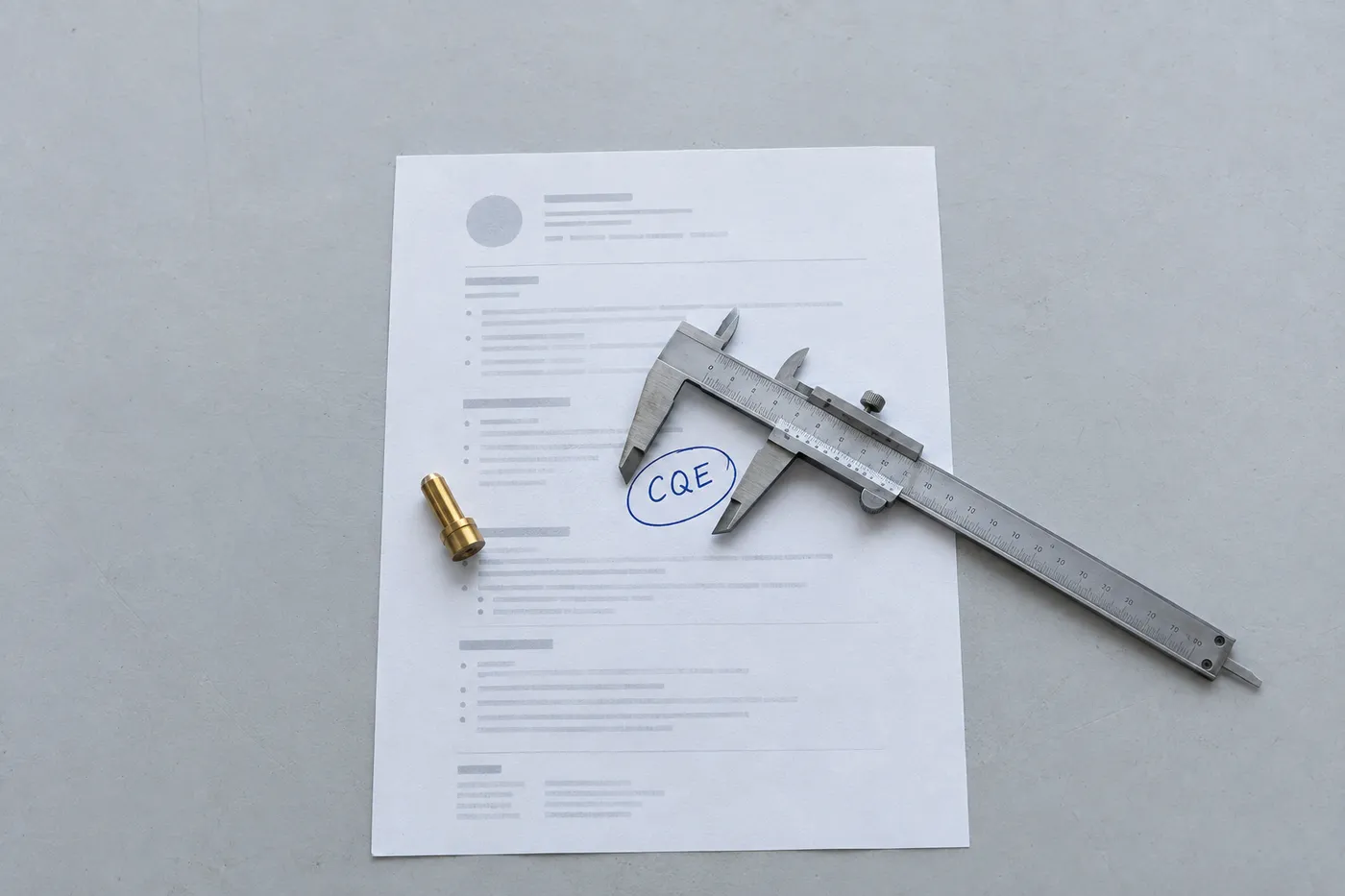
The CQE appears twice in the example: in a dedicated Certifications section and next to the name in the header. For a credential this central to the role, that repetition is deliberate. A recruiter scanning twenty resumes for "CQE" should not have to hunt for it.
Quality Engineer Resume Example: Software and QA Roles
Two different careers share this job title, and their keyword sets barely overlap. The example above is the manufacturing version. If you are a software quality engineer, often titled QA engineer or software development engineer in test (SDET), keep the same structure and swap the vocabulary entirely.
Most quality engineer resume samples online are written for the manufacturing version of the job, which is why software QA candidates who copy them get filtered out. Your posting will filter on a different list: test plans and test strategy, test automation frameworks (Selenium, Playwright, Cypress), API testing, regression suites, CI/CD integration, defect triage, and a tracking tool like Jira. The concepts that carry over are the mindset ones. Root cause analysis exists in both worlds, and hiring managers in both worlds respond to the same bullet structure of verb, method, metric.
The metrics change but the discipline does not. Escaped-defect rate, automation coverage of critical paths, and regression cycle time are your PPM and scrap rate. "Cut regression cycle from three days to four hours by building a Playwright suite covering the forty highest-risk user flows" is a software QA bullet doing exactly what the manufacturing bullets in the example do. If this is your side of the title, the guide to an ATS-friendly software engineer resume covers the technical-resume specifics in depth.
The Keywords That Matter: CAPA, FMEA, and Root Cause Analysis
Read fifty quality engineer postings back to back and a clear pattern emerges. A handful of terms recur constantly, a second tier depends on industry, and everything else is noise. The table below is that pattern, with the honest guidance on how each term earns its place on your resume rather than just occupying space.

| Keyword | Where it shows up | How to use it on your resume |
|---|---|---|
| Root cause analysis | Close to universal across quality engineer postings in every industry | Name the technique you actually used (5 Whys, fishbone, fault tree) and the defect it eliminated |
| CAPA (corrective and preventive action) | A staple in regulated industries such as medical device and pharma, and common across general manufacturing | Show ownership and cycle time: how many you led, how fast they closed, and whether the fix held |
| FMEA / PFMEA / DFMEA | Standard in automotive and aerospace, and expected anywhere APQP applies | State whether you facilitated or contributed, and what changed on the line as a result of the risk work |
| 8D | Concentrated in automotive and supplier-facing roles | Tie each 8D to a customer complaint or defect mode, from containment through permanent corrective action |
| SPC (statistical process control) | Broad across manufacturing postings | Name the charts, the tool (Minitab is the one employers recognize), and the capability result, such as a Cpk improvement |
| ISO 9001 / IATF 16949 / AS9100 / ISO 13485 / 21 CFR 820 | Postings almost always name one, and it is among the fastest recruiter filters | Put the exact standard from the posting in your summary and in at least one bullet |
| PPAP / APQP | Automotive and supplier quality postings | List the submission levels you have handled and the approval outcomes |
| Six Sigma / DMAIC | Broad, frequently listed as preferred rather than required | Pair the belt with a completed project and its defect or savings result |
Two rules govern how you deploy these. First, mirror the posting. If the job description says "corrective and preventive action (CAPA)," write it that way at least once; if it says PFMEA rather than FMEA, so do you. Second, do not stuff. A skills section with thirty acronyms and no supporting bullets reads as padding to the human who opens the file after the filter passes it. Every keyword should appear where it did work, attached to a process, a product, or a number. The broader logic of matching postings without stuffing is covered in our guide to ATS resume keywords.
How to Quantify Defect Reduction and Audit Success
You have an advantage most job seekers lack: your metrics already exist. The quality management system (QMS) has been recording them the whole time. Before you write a single bullet, pull your numbers for the metrics hiring managers recognize instantly:
- Customer PPM and internal PPM, with the before and after
- Scrap and rework rate, as a percentage or a cost
- First-pass yield on the lines or processes you owned
- CAPA closure time and recurrence rate on the issues you led
- Audit results: majors and minors found, findings closed, recertifications passed
- Process capability, such as Cpk moved from below to above target
- Cost of poor quality (COPQ) reductions you contributed to
- Supplier scorecard movement, if your role touched the supply base
Then write each bullet as baseline, action, result. Compare the difference it makes:
Weak: "Participated in internal and external quality audits."
Strong: "Closed all 12 findings from the IATF 16949 surveillance audit ahead of deadline; the site passed recertification with zero major nonconformances."
Weak: "Managed CAPA process for production issues."
Strong: "Cut average CAPA closure time from 45 to 21 days by rebuilding the containment-to-verification workflow in the QMS, with zero recurrence on closed issues over the following year."
Weak: "Worked to reduce scrap on assembly lines."
Strong: "Reduced scrap rate from 4.1% to 1.6% in nine months by leading 8D investigations on the top three defect modes and error-proofing two assembly stations."
One caution that matters more in this field than any other. Only publish numbers you can defend, because a quality interviewer will drill into them the way you drill into a supplier's data. If you cannot recall the exact figure, an honest approximation ("roughly a third") beats a precise number you invented. A fabricated metric on a quality engineer's resume is a self-disqualifying irony.
Listing ASQ Certifications (CQE, CQA) for Maximum Impact
For this title, the ASQ Certified Quality Engineer (CQE) is the strongest general-purpose signal, and postings that want it usually say so by acronym. The Certified Quality Auditor (CQA) carries similar weight for audit-heavy roles, the Certified Software Quality Engineer (CSQE) maps to the software side of the title, and the Certified Quality Improvement Associate (CQIA) or Certified Quality Process Analyst (CQPA) are credible early-career signals. Six Sigma belts sit alongside these rather than replacing them, and a belt lands hardest when the resume also shows the completed project behind it.
Format each entry with the full name, the acronym, the issuer, and the year: "Certified Quality Engineer (CQE), ASQ, 2023." The full-name-plus-acronym pairing exists for the same reason it does in your skills section, because you cannot know which string the recruiter will search.
Placement follows one rule: match prominence to how badly the posting wants it. Every quality engineer resume should have a dedicated Certifications section. When the posting lists the CQE as required or strongly preferred, also put the acronym after your name in the header and reference it in the summary. And keep it honest: if your recertification has lapsed, say when you held it rather than presenting it as current. The full decision tree is in our guide on where to put certifications on a resume.
Tailoring Your Resume for Supplier vs. Internal Quality Roles
A supplier quality engineer resume and a plant quality resume describe overlapping skill sets to audiences filtering on different terms. The supplier-facing role lives in PPAP submissions, supplier audits, and supplier corrective action requests (SCARs). The internal role lives in SPC, control plans, material review board (MRB) decisions, and line support. Send the internal version to a supplier quality posting and the keyword match collapses even though you could do the job.
| What to adjust | Supplier quality engineer resume | Internal / plant quality resume |
|---|---|---|
| Keywords to feature | PPAP, APQP, SCAR, supplier audits, supplier development, incoming inspection | CAPA, SPC, control plans, MRB, layered process audits, line support |
| Metrics that land | Supplier PPM reduction, SCAR closure rate, on-time PPAP approvals, scorecard gains | Scrap rate, first-pass yield, internal PPM, CAPA cycle time, audit findings closed |
| Experience framing | Cross-functional work with purchasing, on-site supplier audits, supplier development projects | Production support, launch support, operator training, containment leadership |
| Summary angle | Name the commodity or supply base you managed and a supplier-facing win | Name the process or product line you owned and a plant-level win |
The practical way to run this is one master resume that holds everything, then a version per application that shifts the emphasis. You are not rewriting your history for each posting, you are reordering and rewording it so the right evidence surfaces first. The mechanics of that system are laid out in our guide to base resumes and tailored versions.
Score Your Resume Against a Real Quality Engineering Job Posting
The keyword table above describes the pattern across postings. The posting in front of you is the spec that actually matters, and specs get verified, not assumed. This is what Roleframe is built for: keep a base quality engineer resume, duplicate it for the job you are applying to, paste the posting, and get a fit report showing your ATS score against that specific description, the exact keywords it asks for that your resume is missing, and a prioritized plan of what to change. If the posting says PFMEA and 21 CFR 820 and your resume says neither, the report names both gaps before a recruiter's filter does.
Roleframe deliberately does not rewrite the resume for you. Remi, its career copilot, proposes a rewrite for the bullet you are working on and you approve or discard every change, word by word. In a field where the interviewer will pressure-test every metric you claim, sending a document a machine wrote and you cannot defend is the one failure mode worse than a generic resume. When you are done, the export is a clean PDF that matches the editor exactly, ready to submit.
Frequently asked questions
- What is a good summary for a quality engineer resume?
Three lines. State your title, years of experience, industry, and the governing standard; name the methodologies you actually run (CAPA, FMEA, SPC, 8D); and close with one quantified win. For example: "Quality engineer with 6 years in medical device manufacturing (ISO 13485, 21 CFR 820). Own CAPA investigations end to end and lead process validation. Cut internal PPM 40% at my current site." Skip adjectives like "detail-oriented," which nobody can verify.
- What is the best resume format for a QA engineer?
Reverse-chronological, single column, with standard section headings, exactly like the manufacturing version. The difference is vocabulary: group your skills around automation frameworks (Selenium, Playwright, Cypress), API testing, and CI/CD, and quantify with escaped-defect rates, automation coverage, and regression cycle time instead of PPM and scrap.
- What skills should a quality engineer put on a resume?
Lead with the hard skills recruiters filter on: root cause analysis, CAPA, FMEA, SPC, Minitab, GD&T, and the standard for your industry (ISO 9001, IATF 16949, AS9100, ISO 13485, or 21 CFR 820). Show soft skills like cross-functional facilitation and supplier communication inside your bullets, attached to results, rather than listing them in the skills section.
- How do I write a quality engineer resume with no experience?
Lead with education and projects instead of experience. A senior design or capstone project with a measurable outcome, an internship on a production floor, and statistics or quality coursework all count as evidence. Add an early-career credential like ASQ's CQIA or CQPA, or a Six Sigma yellow or green belt, to prove you speak the methodology language before you have the job title.
- How long should a quality engineer resume be?
One page under roughly ten years of experience, and two pages once you have senior scope such as multiple sites, launches, or a supply base to describe. The breakdown by experience level is in our guide on whether a resume should be one page or two.
- Should I submit my quality engineer resume as a PDF?
Yes. A PDF locks your formatting, so the recruiter opens exactly the document you built, and modern ATS software parses a cleanly structured PDF without trouble. Only deviate if a specific employer's system explicitly demands another format, and treat PDF as the default everywhere else.


Ready when you are
Send the tailored resume, not the generic one.
Paste a job posting and Roleframe scores your resume against it, then helps you close the gaps one approved edit at a time, so you apply while the role is still fresh.