AI Engineer Resume Example: RAG, Evals, and Serving Cost
by Larbi SahliPublished
Explore a fictional AI engineer resume with RAG, evaluation, adaptation, and serving examples. Learn to explain your contribution and define metrics accurately.
Users have landed jobs at
- 1Password
- OpenAI
- Notion
- justworks
On this page
An AI engineer resume should make your contribution clear: what you built, how you assessed it, and which constraints you handled. Retrieval, evaluation, model adaptation, and serving are useful areas to describe when they match your work and the target role. They are not four requirements every candidate must satisfy.
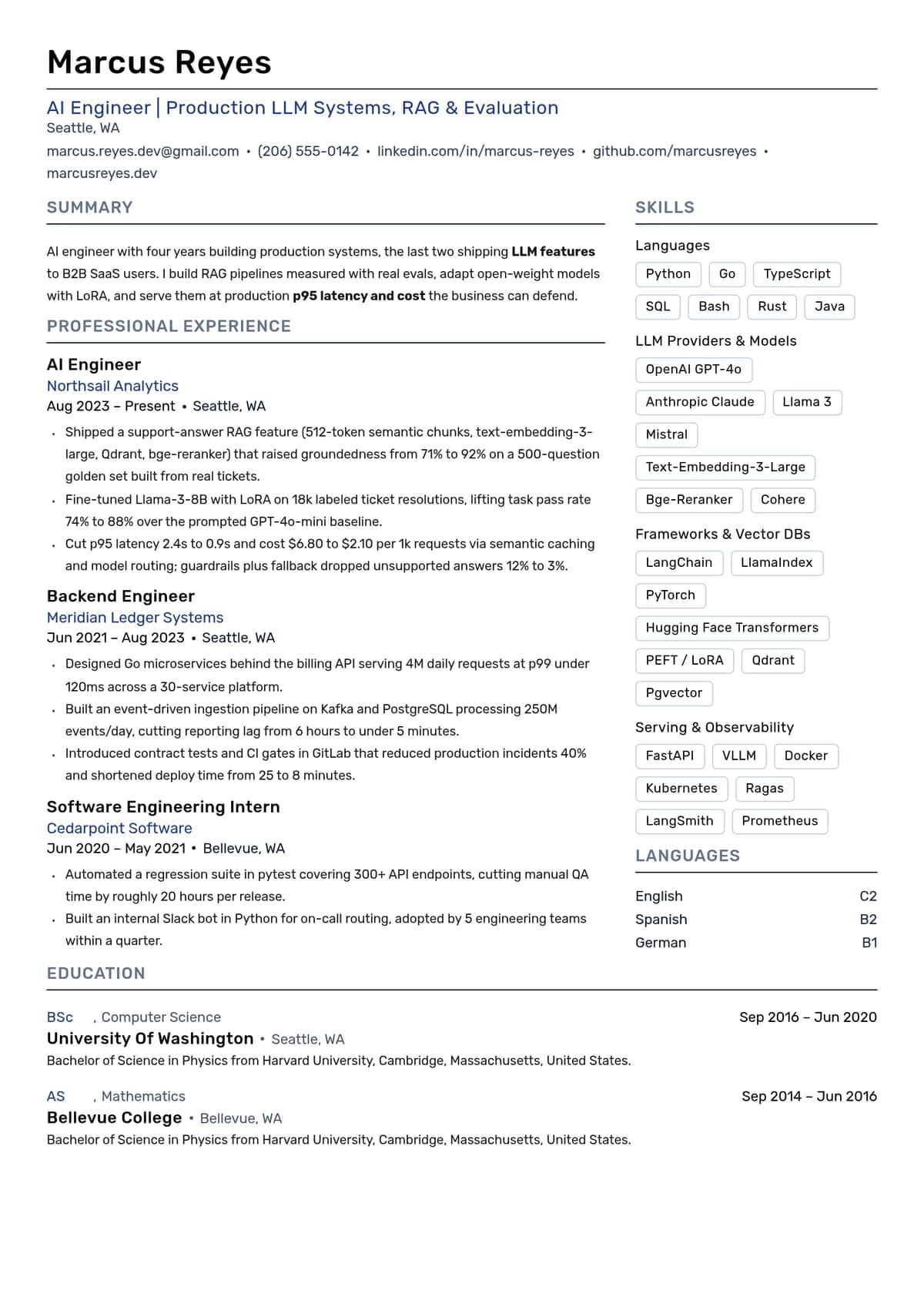
The resume below is a fictional teaching example. Its person, employers, credentials, projects, and numerical results are illustrative, not a verified candidate record or a report of tests we ran. The links use placeholder addresses. Do not copy its achievements into your own resume.
Use the example to see how technical detail can support a claim. The sections that follow explain how to choose relevant evidence, define metrics, and describe projects honestly when you have not yet worked on a production LLM system.
AI engineer, LLM engineer, ML engineer, or data scientist: which title goes in your headline
Read the responsibilities behind the job title. AI engineer, LLM engineer, ML engineer, and data scientist can overlap, and employers define them differently. A target headline can describe the work you are seeking, but keep employment titles and the context of your experience accurate.
| Title in the posting | Responsibilities to look for | How to adjust your resume |
|---|---|---|
| AI Engineer | Product integrations, model-backed features, retrieval, evaluation, or other AI systems | Lead with relevant systems and the contribution you made |
| LLM Engineer | Language-model applications, adaptation, retrieval, serving, or evaluation | Choose examples matching the specific model and application work |
| ML Engineer | Training pipelines, deployment, monitoring, ranking, forecasting, or other ML workloads | Show the relevant model-development and systems experience |
| Data Scientist | Analysis, experimentation, statistical modeling, or production model work | Match the actual responsibilities; do not infer scope from the title alone |
If your LLM experience comes from study or a personal project, label it that way. For example, “Backend engineer with an LLM evaluation project” communicates a different background from a job title implying professional AI deployment.
Use a base resume with tailored versions to change emphasis while keeping the facts consistent. One posting may prioritize retrieval; another may value inference performance or data preparation.
A useful bullet pattern: contribution, context, evaluation, and constraints
Choose the details that explain your work: what you built, who or what it served, how you measured it, and the relevant operating constraints. Split a long claim into two bullets instead of forcing every detail into one sentence.
A vague bullet:
- “Worked with LLMs to build a support chatbot using RAG.”
A fictional expanded example, assuming the candidate actually collected the additional evidence:
- “Added a cross-encoder reranker to a support-answer RAG pipeline; raised grounded-answer pass rate from 71% to 89% on 500 held-out questions using a fixed review rubric.”
The expansion explains the contribution, the comparison, and the evaluation. It does not follow automatically from the vague sentence: the writer must have evidence for each added fact. In this example the change is 18 percentage points, not an 18% relative improvement.
If you did not measure answer quality, describe what you did measure or built. A truthful account of integration, testing, adoption, or failure handling is useful without an invented score.
Name the technical decisions you actually made
A broad label such as “RAG” or “fine-tuning” does not identify your contribution. Add the parts you designed, implemented, or evaluated. Distinguish your work from the wider team’s system, and omit tools you did not use.
RAG: spell out the pipeline
Retrieval-augmented generation combines retrieved information with generation. In an application, relevant choices can include document preparation, chunking, retrieval, reranking, and how retrieved evidence enters the prompt. Not every pipeline uses every component.
For example: “Built hybrid BM25 and dense retrieval over an internal document collection; evaluated whether a cross-encoder reranker improved retrieval on held-out queries.” Add collection size and results when measured and permitted to share. Explain the comparison, such as top-k retrieval hit rate, instead of using “improved RAG” as the entire claim.
Fine-tuning: which kind, on how much data, against what baseline
Name the method you used: full fine-tuning, LoRA, or QLoRA. LoRA trains low-rank adapters; QLoRA combines adapter training with a quantized base model. These are technical methods, not automatic evidence of a better result.
A useful pattern is: “Trained LoRA adapters on [number and type of examples]; compared [metric] against [baseline] on a separate test set.” Include the outcome honestly. If a prompted baseline performed better, describing the experiment and the decision to keep that baseline can demonstrate engineering judgment.
Tool calling and agents: describe the loop, not the buzzword
For tool-using systems, describe the available tools, validation, loop limits, and failure handling. A fictional example is: “Added schema validation and a step limit to a six-tool workflow; task pass rate rose from 62% to 84% on the same 200-task test suite.”
That claim needs a definition of task completion and a record of the comparison. A prototype can still be worth describing; call it a prototype instead of implying it was a production deployment. See adding LLM experience to a software engineer resume for more phrasing examples.
Explain what your evaluation actually measured
An evaluation claim is useful when a reader can understand the task and comparison. Hugging Face’s evaluator documentation, for example, treats the model, dataset, and metric as distinct parts of an evaluation. A resume can summarize them briefly and leave the implementation detail for a portfolio or interview.
Include these details where relevant:

- Dataset and scope: what examples represent, how many were assessed, and how evaluation data was separated from training or tuning. A larger set is not automatically a better test.
- Metric and scoring: define exact match, retrieval hit rate, task pass rate, or the rubric behind a groundedness score. State whether scoring was automated or human-reviewed when relevant.
- Comparison: use the same task and comparable conditions for before-and-after claims. A single current score can describe performance, but it does not establish an improvement.
If you built release checks, describe what they tested and how regressions were handled. For example: “Added a fixed evaluation suite to CI and blocked deployment when task pass rate fell below the agreed threshold.” A gate checks the cases and criteria it contains; it does not establish that every future response will be correct.
If the team used manual reviews, user feedback, or escalation tracking, name those methods accurately. Do not relabel a thumbs-up rate as answer accuracy. For an independent project, keep a reproducible evaluation script and explain the scoring choices in the README.
Latency and cost: define the measurement before the improvement
Serving work becomes easier to assess when the metric has a clear boundary. NVIDIA’s GenAI-Perf documentation distinguishes time to first token, request latency, token throughput, and other metrics. Use the one you measured rather than the general claim “made it faster.”
Useful details include:
- p50 or p95 of a named metric. For complete-response latency, measure through completion; for time to first token, measure until the first generated content. Streaming does not by itself demonstrate a faster complete response.
- Workload and conditions: request mix, concurrency, input/output lengths, cache state, and measurement window can affect a comparison. Include the most relevant context and retain the rest in supporting notes.
- Token usage: describe input and output tokens separately when they matter. A shorter prompt can reduce input use, but total cost also depends on the model, output, caching, and infrastructure.
- Cost per request or per 1,000 requests: state what costs you counted. Use only figures you are authorized to disclose; relative percentages may be confidential too.
- Mechanism: name the change you implemented, such as caching, routing, batching, or quantization, and check the quality trade-off alongside performance.
A fictional serving bullet is: “Reduced p95 complete-response latency from 2.4s to 0.9s on the same replay workload by adding semantic caching and model routing.” To use a claim like this yourself, keep the workload definition and cache conditions with the measurement. Backend experience with caching, reliability, and observability can be relevant even when the earlier service did not use an LLM.
Reliability and safety work that earns a bullet
Describe reliability and data-handling work as concrete behavior: what could fail, what you changed, and how you assessed it. Model-generated errors add challenges, while provider timeouts and service outages are familiar distributed-systems problems.
Examples of details to include:
- Fallbacks: the timeout, rate-limit, or validation conditions that trigger a retry, another model, or a human handoff; report observed outcomes if measured.
- Input/output validation: what is checked, how invalid output is handled, and how false positives or rejected valid requests were assessed.
- Sensitive-data handling: the redaction or filtering you implemented, its scope, and what testing showed. Avoid turning a component-level check into a broad compliance guarantee.
- Unsupported-answer evaluation: define the review rubric and dataset. For a fictional 12% to 3% reduction, explain what counted as unsupported and whether the compared systems answered the same test questions.
The skills block: relevant tools you can explain
List tools you have used and can discuss accurately. Professional work, coursework, and independent projects can all support a skill when you represent the context honestly. You do not need production experience in every tool on the list.
Group the section for readability:

| Category | Examples of relevant content | What to be ready to explain |
|---|---|---|
| Languages | Languages used in the work or projects you describe | What you implemented and your level of familiarity |
| Models and providers | Model families or APIs you actually used | Their role in the system and any comparison you made |
| Frameworks and libraries | Orchestration, training, or evaluation libraries you used | Which parts you configured or built yourself |
| Retrieval and storage | Search stack, vector store, or embeddings used in your project | How retrieval was configured and assessed |
| Serving and observability | Inference server, caching, monitoring, or tracing tools | What you measured and how the information informed a decision |
Support the most relevant skills with examples in your work or projects. Every individual library does not need a separate bullet. Remove names added only because they appeared in a posting, and distinguish limited familiarity from substantial experience.
When your LLM work is under NDA, or you are coming from backend engineering
If your work is confidential, first identify which responsibilities or outcomes you are permitted to describe. If you have backend experience but no professional LLM project, select relevant systems work and add a clearly labeled independent project when it strengthens your application.
One useful project design is a small RAG application with an evaluation harness: document the corpus, keep a separate test set, define retrieval and answer-quality measures, and compare a few design changes. The goal is a reproducible explanation of your decisions, not a large dataset or impressive percentage for its own sake.
Make the project easy to assess:
- Label it as a personal, academic, open-source, or professional project and describe your own contribution.
- Add a README with setup instructions, the evaluation method, results, limitations, and one design decision.
- Link a repository or demonstration you are allowed to publish, and test the link in the exported resume. Use public, licensed, synthetic, or otherwise authorized data.
A personal project does not automatically remove confidentiality obligations. Use your own work and authorized data; do not copy an employer’s code, prompts, internal documents, or evaluation examples into a public repository. Check permission before sharing production metrics, including relative changes. When disclosure is restricted, describe permitted scope and responsibilities without inventing substitute results.
Match the resume to the role, then inspect the export
Read the posting against your resume and lead with the experience that addresses its responsibilities. The fictional example covers several technical areas to illustrate possible evidence; your resume should reflect your actual background.
In Roleframe, a base resume and tailored versions can help organize that work. Resume checks and job matching identify areas to review, and you can assess assistant suggestions before applying changes. A Roleframe score is a product assessment, not an employer’s ATS score or a hiring prediction. See how to check a resume against a job description for a manual method.
Follow the requested file format and open the downloaded file. Check page breaks, selectable text, links, and any application fields populated from it. Choose a readable length for the relevant content rather than squeezing this example’s sections into an arbitrary page count. Use a clear filename such as Aditya-Rao-Resume.pdf for your own appropriately named file.
Frequently asked questions
- How do I write an AI engineer resume with no professional AI experience?
Keep employment titles accurate and describe relevant backend, data, or testing work. Put independent LLM work in a clearly labeled projects section. Explain your contribution, evaluation method, and limitations without presenting a prototype as professional production experience.
- Is an LLM engineer resume different from an AI engineer resume?
The titles can overlap, but the responsibilities control what belongs on the resume. Read each posting and prioritize the relevant retrieval, adaptation, serving, evaluation, or integration work. Keep the underlying employment facts unchanged.
- Should I name specific models and providers on my resume?
Name models and providers you actually used when that detail helps explain your work. Include versions when relevant to a decision or timeline. Describe the contribution and measurement as well as the product name.
- Do I need a degree or PhD to get hired as an AI engineer?
Requirements depend on the employer and role. Check the posting for required and preferred qualifications, and list your education accurately. Research, applied engineering, and product roles can have different expectations; a resume example cannot establish a universal degree rule.
- What if all my LLM experience is prompt engineering?
Describe the task, prompt changes, testing, and outcomes you actually worked on. If you versioned prompts or built evaluation checks, explain those contributions. Do not relabel occasional chatbot use as production engineering or claim unmeasured improvements.
- How long should an AI engineer resume be?
Use the space needed to present relevant experience clearly. One page may suit a focused early-career resume; two can be appropriate when the additional material is useful. Follow any application-specific length limit and inspect the exported document.
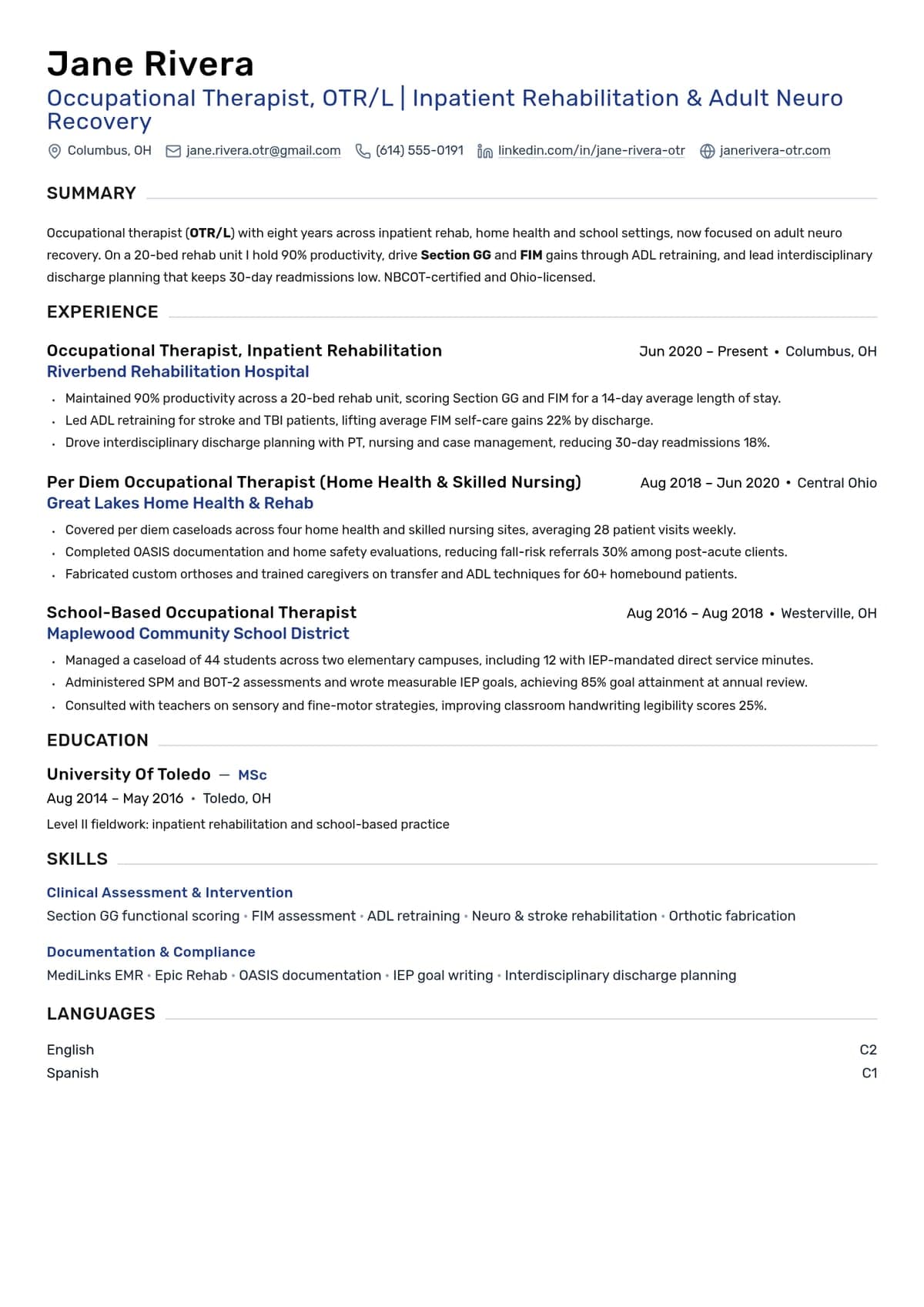
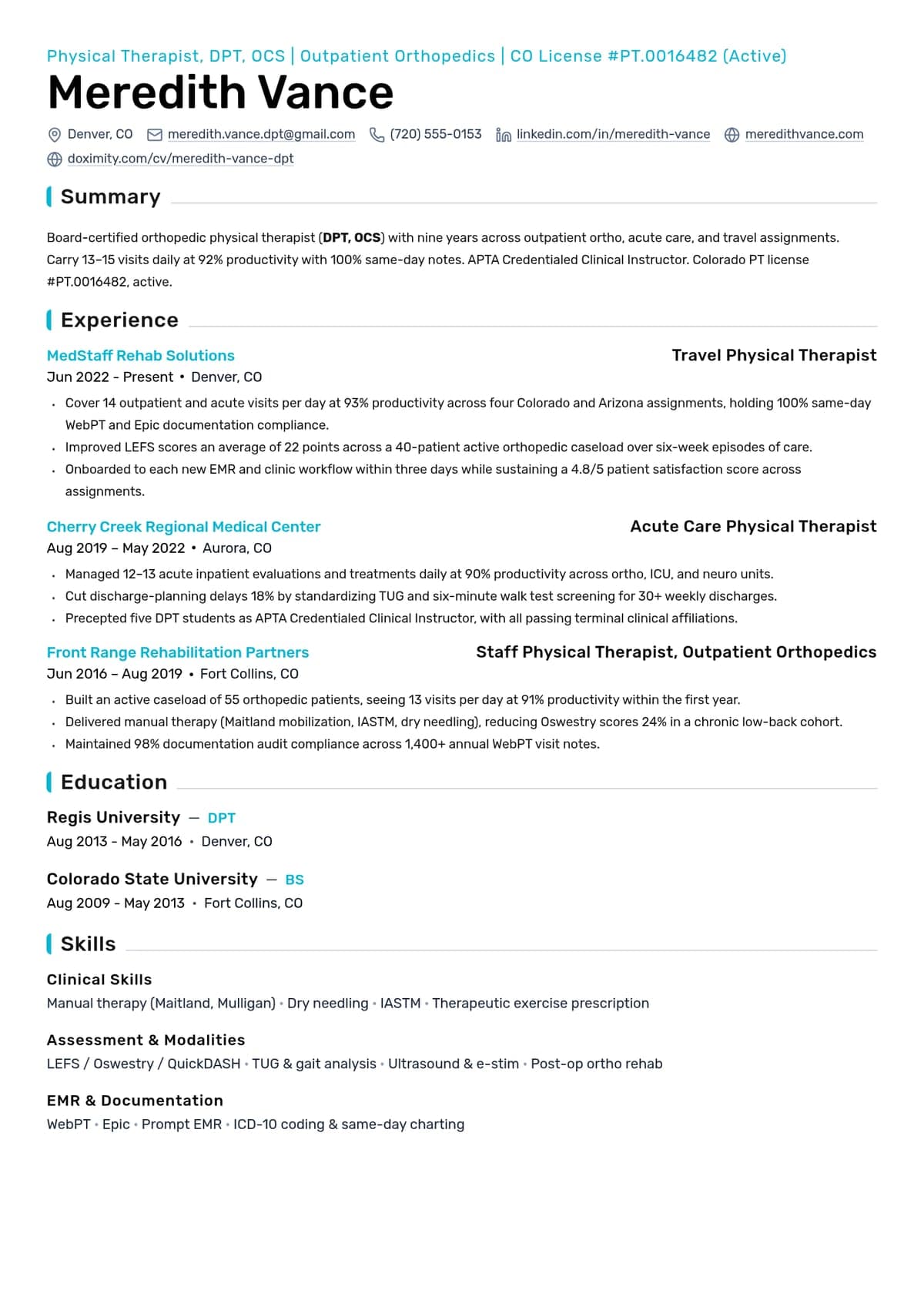

Build yours on the same template.
Every example here is built on a template you can open in the editor. Start from the same layout and write your own experience into it, then download the PDF free, with no watermark.


