Occupational Therapist Resume Example: One Resume, Three Settings
by Larbi SahliPublished
One occupational therapist resume example reordered for school, inpatient rehab and home health, plus the license lines and keywords each setting screens.
Users have landed jobs at
- 1Password
- OpenAI
- Notion
- justworks
On this page
Recruiters screening occupational therapist resumes verify two things before reading a single bullet: an active license they can check, and evidence you have worked the setting they are hiring for. That second check is where experienced OTs lose interviews. A career that runs through schools, inpatient rehab and home health reads as unfocused when the resume treats every setting equally.
You do not need three resumes. One document covers all of it, as long as the emphasis moves with each application. The example below belongs to a clinician with all three settings behind her, currently aimed at an inpatient rehab opening. Later sections show exactly which pieces move when the same document targets a school district or a home health agency, and which pieces never change.
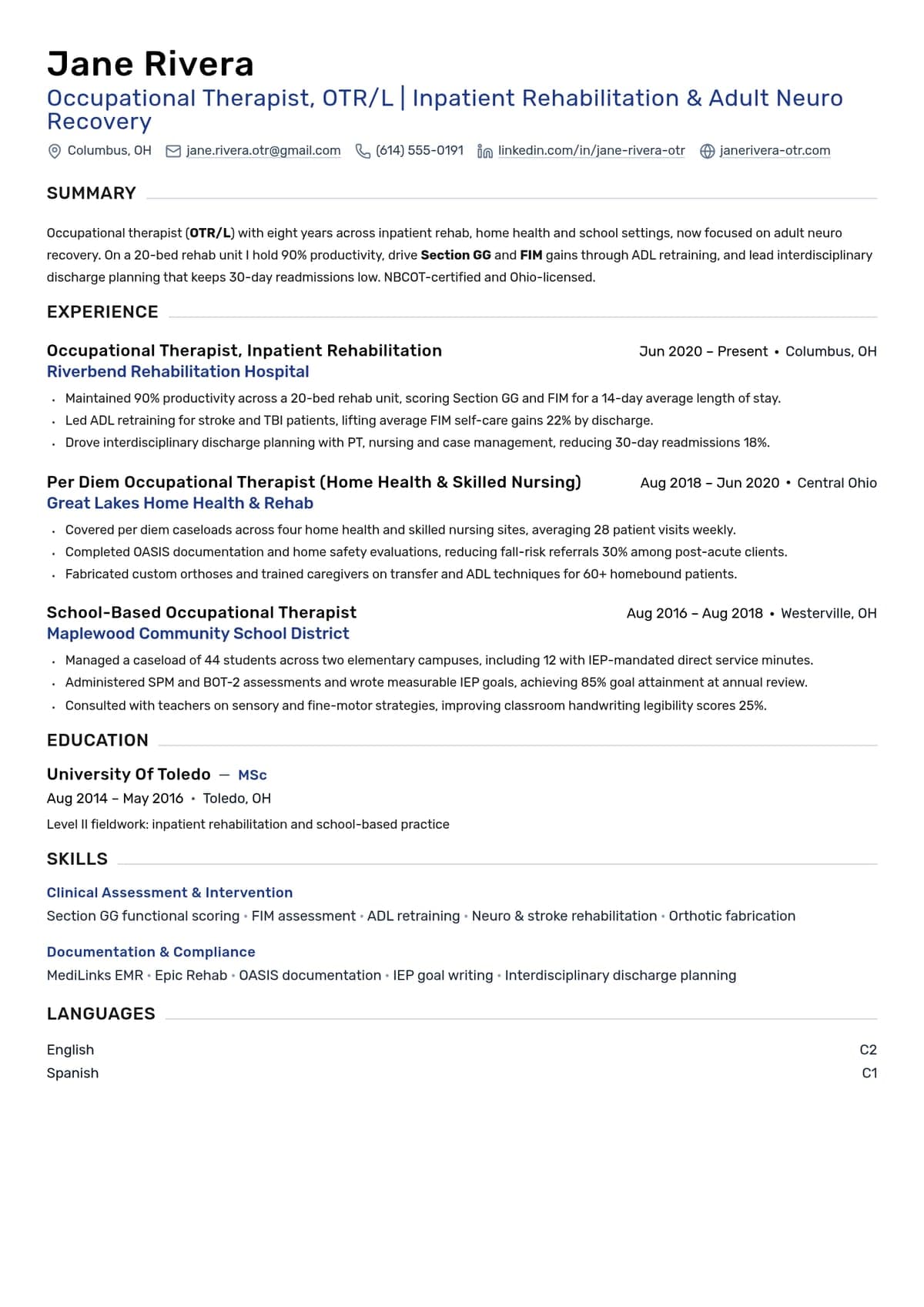
The occupational therapist resume example
This version leads with inpatient rehab. The summary names the setting and the top bullets in her hospital role carry outcome measures. Skills put acute documentation systems first. Read it as the inpatient variant of a base document, one of three orderings this page walks through.
Everything below refers back to this document. Each element is doing screening work, from the license block to the scope lines inside the bullets, and each is worth copying into your own draft with your own numbers.
NBCOT certification and state licensure, written to be verified
Healthcare recruiters and school district HR both verify credentials before a phone screen, and a credential they cannot verify slows you down or removes you. Write your NBCOT certification and state license so that verification takes one search. That means the exact credential name, the number, and the expiration date, formatted like this:
- Jane Rivera, OTR/L in the header, directly after your name
- NBCOT: Occupational Therapist Registered (OTR), Certification #1234567, current through 03/2027
- Occupational Therapy License, Ohio OT Board, #OT.004821, expires 06/30/2026
- Additional state licenses listed the same way if you hold them, active ones only
Put the credential letters in the header and the full detail in a Licenses and Certifications section directly under your summary. Recruiters filling clinical roles look for it there, and an applicant tracking system (ATS) parses a dedicated section more reliably than a line buried in education. For placement rules across other roles, see where to put certifications on a resume.
One warning from hiring pipelines: never round an expiration date in your favor, and never list a lapsed license as anything but lapsed. Credentialing teams check, and a mismatch there poisons an otherwise strong application.
Three settings, one readable career arc
Setting-hopping is normal in occupational therapy and rare on paper. Most multi-setting OT resumes either bury the older settings or present each job in its own vocabulary, which forces the reader to reconstruct the career themselves. Give them the arc in one summary sentence instead: a clinician who evaluates function and builds treatment plans across the lifespan, from pediatric IEP goals to geriatric home safety.
Then keep the body strictly reverse chronological. Chronology is what makes a varied career readable, because the reader can see when each setting happened and how long it lasted. What you control is the grammar. Write every bullet in the same shape, verb first with a scope number, ending in an outcome where you have one. When a school bullet and a hospital bullet share a structure, the reader stops seeing three careers and starts seeing one clinician.
Which setting leads when you apply back into an old one
Here is the move this page exists for. When you apply back into a setting you left, that setting leads the page, even though the job holding it is not your most recent. You cannot reorder jobs without breaking chronology, so you reorder everything else: the summary rewrites around the target setting, the relevant job gains bullets while the others compress, and the skills section resorts so the target's tools come first. The table shows the same resume from the example above, adjusted three ways.
| What moves | School application | Inpatient rehab application | Home health application |
|---|---|---|---|
| Summary lead | School-based OT, IEP evaluations and direct service minutes | Inpatient OT, functional outcomes and discharge planning | Home health OT, OASIS assessments and home safety |
| Bullets promoted | IEP goals written, teacher consultation, sensory strategies | Section GG gains, ADL retraining, co-treatment with PT and SLP | Start-of-care visits, caregiver training, equipment recommendations |
| Skills listed first | BOT-2, PDMS-2, EasyIEP | FIM, Section GG, Epic | OASIS-E, Homecare Homebase, home modification |
| What compresses | Hospital and home health roles drop to two or three bullets each | School and home health roles drop to two or three bullets each | School and hospital roles drop to two or three bullets each |
| Certification to surface | Ayres Sensory Integration, ATP | CBIS, physical agent modalities certification | CAPS, CLT |
Notice what never moved: the jobs, their dates, the license block and the education section. The document stays honest, and each reader still finds the version of you they were hoping for. If your editor makes reordering painful, that is a tooling problem; section order is an argument, and you should be able to change it per application in minutes. For the general logic behind ordering, see the best resume section order for your experience level.
Caseload, productivity and length of stay: your scope lines
Every OT job has a size, and hiring managers in each setting have a number they instinctively check yours against. Schools think in caseload and campuses. Rehab directors think in productivity percentage and average length of stay. Home health managers think in visits per week and territory. A resume without these numbers forces the reader to guess, and readers guess low. Scope lines look like this:
- Managed a caseload of 44 students across two elementary campuses, including 12 with IEP-mandated direct service minutes
- Maintained 90% productivity on a 20-bed inpatient rehab unit while completing same-day documentation in Epic
- Treated 6 to 8 patients daily with an average length of stay of 14 days, contributing to discharge planning from the initial evaluation
- Completed 25 to 30 home visits per week across a two-county territory, including OASIS-E start-of-care assessments
Two rules keep scope lines safe. First, only publish a number you can defend in the interview, because a rehab director will ask how you hit that productivity figure and what it cost your documentation. Second, give the number context. A caseload of 44 means one thing across two campuses and something else across five, so say which.
Evaluations, treatment plans and documentation systems worth naming
Named assessments prove setting fluency, and they double as ATS keywords because postings name them. List the ones you administer independently: standardized assessments in your skills section, and the setting-specific ones repeated inside the relevant job's bullets where they attach to real patients.

- School: BOT-2, PDMS-2, School Function Assessment, sensory profiles, plus IEP goal writing as its own line
- Inpatient rehab: FIM and Section GG scoring, MoCA, kitchen and ADL evaluations, splinting and orthotic fabrication
- Home health: OASIS-E start-of-care and recertification assessments, COPM, home safety and fall-risk evaluations
Documentation systems deserve the same treatment. Epic and Cerner cover most hospital work, PointClickCare and Net Health dominate skilled nursing, Homecare Homebase and WellSky run much of home health, and districts use IEP platforms such as EasyIEP or SEIS. Name the ones you have charted in, spelled exactly as the posting spells them. A recruiter filtering for Epic experience will not infer it from a phrase like "electronic medical records."
Specialty certifications, from hand therapy to assistive technology
Specialty certifications change which postings you clear. Some are filters in themselves; a Certified Hand Therapist posting will not interview without the credential. Others tip a decision between two otherwise similar clinicians. List each with its issuing body and year, in the same section as your license, ordered by relevance to the job in front of you.
- CHT (Certified Hand Therapist, HTCC): the hard requirement for hand therapy roles and a strong differentiator in outpatient ortho
- ATP (Assistive Technology Professional, RESNA): carries weight in schools and in wheelchair seating and mobility clinics
- CBIS (Certified Brain Injury Specialist): signals depth for inpatient rehab and neuro units
- LSVT BIG: valued in home health and outpatient neuro for Parkinson's caseloads
- Ayres Sensory Integration (ASI) certification: the pediatric and school-based differentiator
- CLT (Certified Lymphedema Therapist): opens oncology rehab and some home health roles
- CAPS (Certified Aging-in-Place Specialist): a home modification signal for home health
Cut anything expired unless you are actively renewing it, and never list a certification course you attended as a certification you hold. Continuing education belongs in a separate line, or nowhere.
Per diem and contract work, shown without looking unstable
Per diem and contract work is how many OTs keep skills current across settings, and it is also how resumes start looking like confetti. Six entries of two lines each, some overlapping, reads as instability even when the underlying story is sensible. Group instead.
Make one entry titled "Per Diem Occupational Therapist" with a single date range, name the facilities on one line, and write bullets about the clinical work rather than the logistics. "Covered inpatient and SNF caseloads at three facilities, meeting productivity standards with no orientation period" says more than three separate stubs ever could. If one contract was substantial, say a school-year contract with a district, break it out as its own entry and fold the rest into the grouped one.
State the reason for the pattern only if it is a strength. Flexibility during a relocation reads well in a summary line, and so does keeping acute skills sharp alongside a school position. Never apologize for it.
The keywords OT resumes are screened on, and where each goes
OT postings are screened on a predictable set of terms, some by ATS keyword filters and some by the recruiter's eye during the first skim. Pull the exact phrasing from each posting you apply to, since "IEP" and "Individualized Education Program" are matched differently by different systems. The method is covered in how to pull resume keywords from a job description; the table below covers where each OT term should live.
| Keyword | Who screens on it | Where it goes |
|---|---|---|
| OTR/L | Every clinical recruiter, often the first filter | Header after your name, plus the certifications section |
| NBCOT certification | Credentialing and HR | Certifications section, with number and expiration |
| ADLs / IADLs | All settings | Summary and at least one bullet per clinical role |
| IEP / 504 plan | School districts | School role bullets and skills |
| FIM / Section GG | Inpatient rehab and SNF | Inpatient bullets, tied to outcomes |
| OASIS | Home health agencies | Home health bullets and skills |
| Discharge planning | Inpatient and home health | One bullet naming your role in it |
| Caregiver education | Home health and pediatrics | Bullets, with who and what you trained |
| Splinting / orthotic fabrication | Inpatient, outpatient, hand therapy | Skills, plus a bullet if you fabricate |
| Named EMR (Epic, PointClickCare, Homecare Homebase) | Recruiters matching systems | Skills, spelled exactly as the posting spells it |
Place each term once where it carries proof, and once at most anywhere else. Recruiters recognize keyword stuffing instantly, and a skills section with thirty comma-separated terms convinces no one.
Scan your draft against a real posting
The last step is a check, and eyeballing is not a check. Put your draft next to the actual posting and confirm three things: the license block is verifiable in one search, the target setting leads the page, and every screened keyword from the posting sits where the table above says it should.
This is the part worth automating. Paste the posting into Roleframe and it produces a fit report for your resume against that specific job, including an ATS score, the screened keywords your draft is missing, and a prioritized plan of what to change. Remi, its career copilot, then helps you rewrite bullet by bullet with you approving every change, which matters in a field where a clinical claim you cannot defend is disqualifying. Prefer to run the comparison by hand? This guide to checking a resume against a job description walks through it. Either way, save and submit as PDF so the formatting the recruiter sees matches the one you built.
Frequently asked questions
- What should an occupational therapist's resume look like?
Reverse chronological, with your credentials (OTR/L) in the header and a licenses and certifications section directly under the summary. Each clinical role should carry a scope line, such as caseload size or productivity percentage, and name the assessments and documentation systems you used. One to two pages is standard, and an experienced multi-setting OT usually needs two.
- What is the 7 second rule on a resume?
It is the widely repeated idea that a recruiter's first pass over a resume lasts only a few seconds. Treat it as a design constraint rather than a statistic: your license, your target setting and your scope numbers should all be visible in the top third of page one, without scrolling or hunting.
- Is occupational therapy a low stress job?
It depends heavily on setting. Skilled nursing and inpatient roles carry productivity pressure, home health adds driving and solo decision-making, and schools trade acuity for large caseloads and IEP paperwork. Setting changes are common in OT careers for exactly this reason, which is why a resume built to reorder across settings pays off more than once.
- What are the 7 core values of occupational therapy?
AOTA's Code of Ethics names altruism, equality, freedom, justice, dignity, truth and prudence. Do not list them on a resume as values, because recruiters skip value statements. Show them through bullets instead, for example caregiver education for access, or accurate outcome documentation for truth.
- How does a new grad OT show experience on a resume?
List Level II fieldwork as experience entries, each with the setting, population and typical caseload, written with the same verb-first bullets a paid role would get. Once you have a year of paid practice, compress fieldwork to a line or two. Drop it entirely after your second job unless a placement matches the posting's setting.
- Should an OT resume be one page or two?
New grads should hold to one page. An OT with several settings behind them earns two, provided the second page is bullets with numbers rather than filler. The reasoning by experience level is covered in should a resume be one page or two.


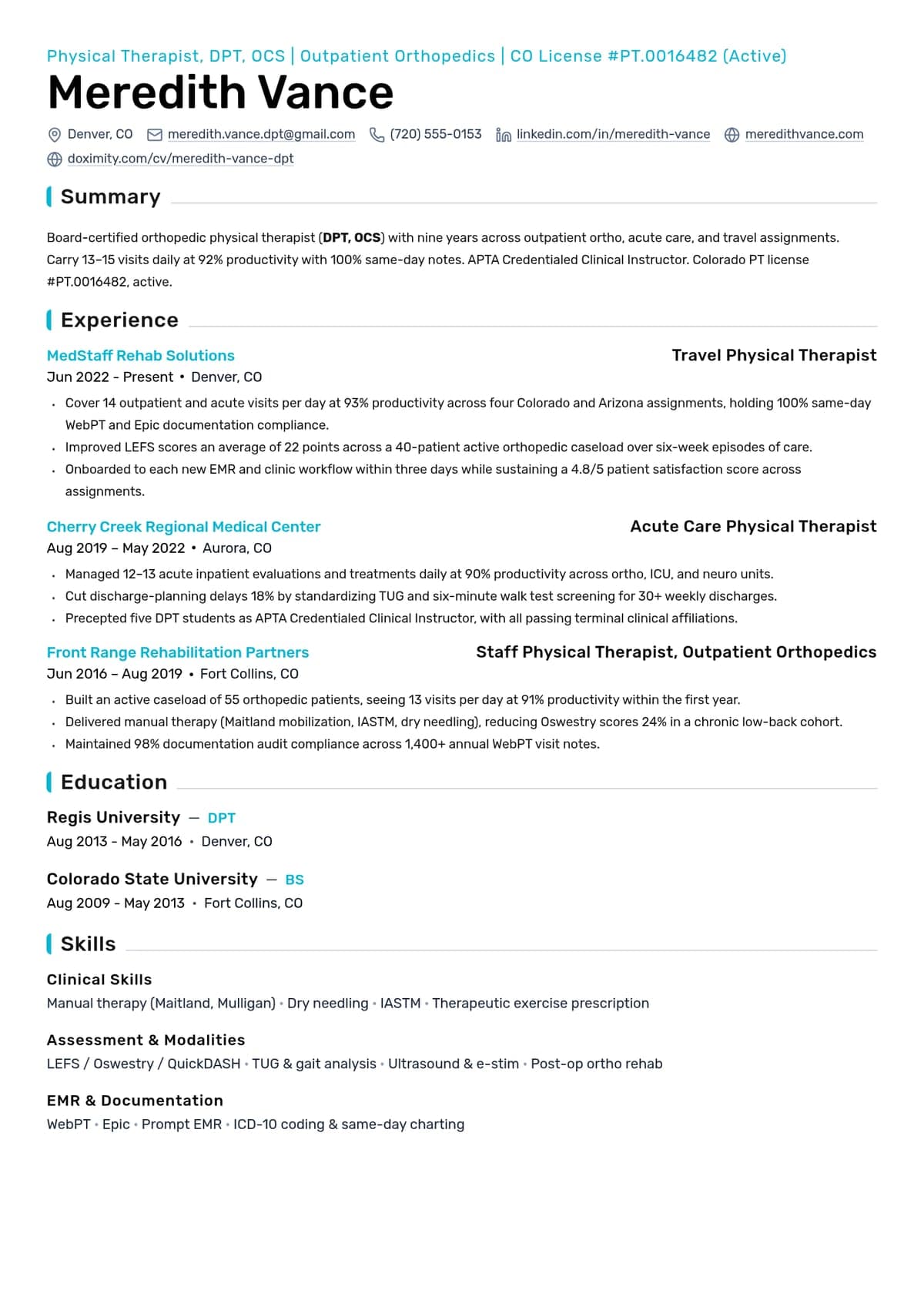
Build yours on the same template.
Every example here is built on a template you can open in the editor. Start from the same layout and write your own experience into it, then download the PDF free, with no watermark.


