Physical Therapist Resume Example With Caseload Numbers
by Larbi SahliPublished
A physical therapist resume example where every bullet carries a verifiable number, plus which caseload and productivity figures directors can check.
Users have landed jobs at
- 1Password
- OpenAI
- Notion
- justworks
On this page
A clinic director reading a physical therapist resume is doing quiet math. "Carried 13 visits a day at 92% productivity" reads as a therapist who covers her own salary. "Provided high-quality, patient-centered care" reads as a therapist the director has to interview just to find out what she did all day. That difference decides who gets the call.
The example below puts a defensible number on every clinical bullet. Daily visit volume, active caseload, productivity percentage, standardized outcome measures. This guide also covers something most PT resume pages skip, which is which of those numbers a former employer can actually confirm. Directors call references, and the numbers that survive that call are the ones worth leading with.
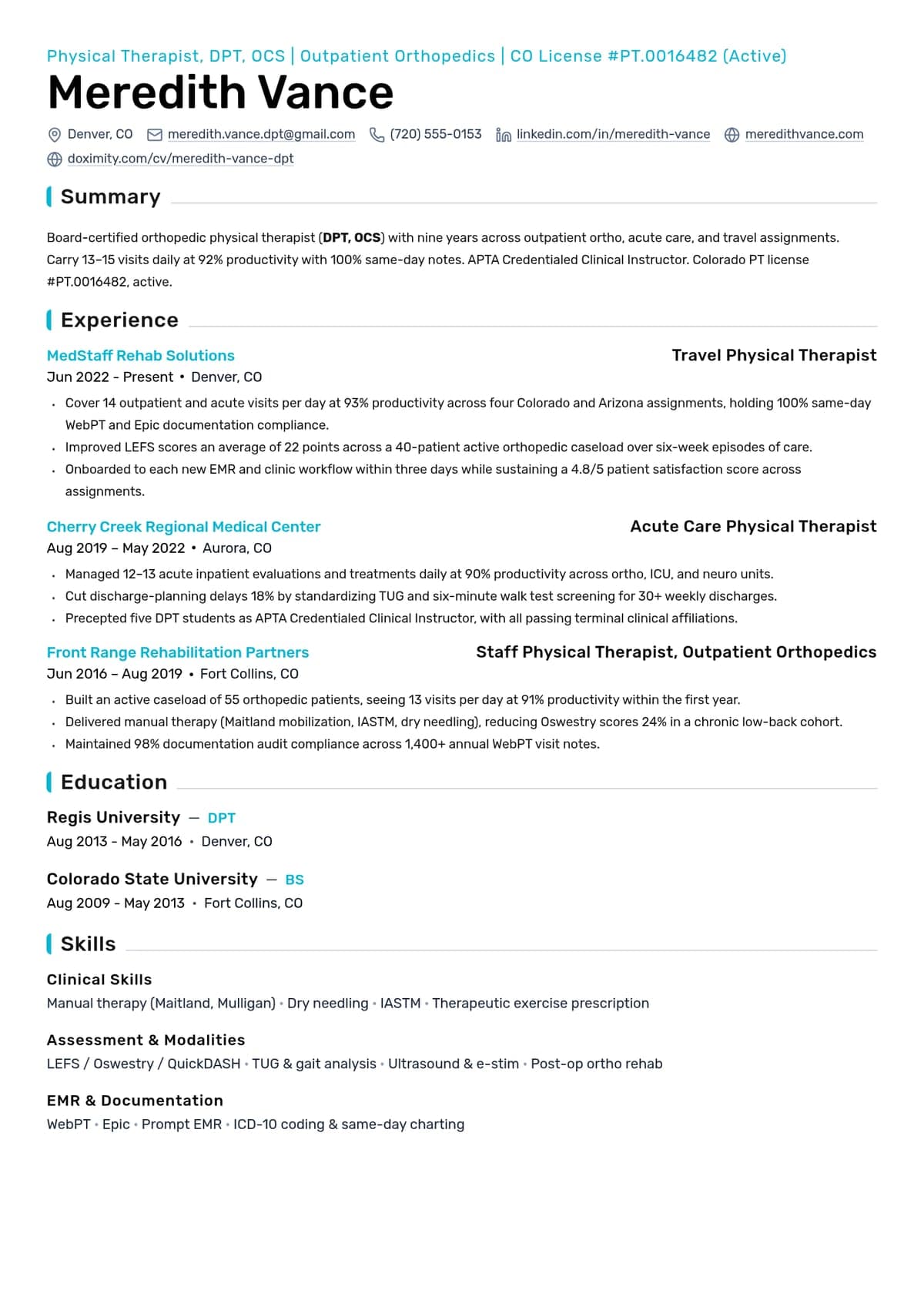
The physical therapist resume example
The resume below belongs to a mid-career PT with a board specialization and three settings behind her. As you read it, watch two things. First, no clinical bullet is number-free. Second, the credentials a recruiter screens for sit in the top third of the page, where a seven-second skim finds them.
Copy the structure, not the figures. Your own numbers live in your EMR's productivity reports and your old schedules, so pull them from there. A director who ran the same reports at her own clinic knows exactly what plausible looks like in each setting.
Which of these numbers a clinic director can verify
Reference calls in PT hiring are short and specific. A director does not ask your former manager whether you were passionate about patient care. She asks how many visits you carried, whether your documentation held up in an audit, and whether she would hire you back. Every number on your resume either survives that call or it doesn't.
Here is how the common PT resume metrics hold up.
| Number on the resume | Verifiable? | How a director checks it |
|---|---|---|
| Visits per day / active caseload | Yes, easily | Scheduling and billing reports show it month by month, and any former manager remembers who carried the heavy schedule |
| Productivity percentage | Yes | Most clinics track it per therapist, and a reference call confirms whether you ran at, above, or below target |
| Documentation compliance (same-day notes, audit results) | Yes | Compliance reports exist, and managers remember who they had to chase for late notes |
| Outcome measure gains (LEFS, Oswestry, QuickDASH) | Partly | Aggregate per-therapist outcomes are hard to pull in most EMRs, so keep claims modest and tied to a documented protocol |
| Patient satisfaction scores | Partly | Surveys are usually clinic-level, so claim them only if your clinic reported them per therapist |
| Students supervised / staff mentored | Yes | CI credentialing and school placement records name you directly |
| Program results (new service line, referral growth) | Yes, if you name the program | A director can ask your old clinic about the program by name; a vague "grew referrals" claim cannot be checked and gets discounted |
The practical rule falls out of the table. Lead your bullets with the fully verifiable numbers, use outcome measures as supporting evidence tied to a named protocol, and cut anything you could not calmly repeat with your former manager on the phone. A single inflated figure taints every honest one around it.
License, DPT and board specialization go at the top
Nothing on a PT resume gets checked faster than the license. Put your credentials after your name in the order the profession reads them, "PT, DPT," then the board certification, so the header reads "Jordan Reyes, PT, DPT, OCS." Recruiters search the short form, so keep "OCS" even though the American Board of Physical Therapy Specialties now styles it "Board-Certified Clinical Specialist in Orthopaedic Physical Therapy." Use both, short form in the header and the long form in your certifications section, and the resume matches either search.
Give the license its own line directly under your summary. State, number, status. The number is public record, and listing it saves the credentialing coordinator a lookup, a small courtesy that reads as someone who has been through onboarding before. If you hold PT Compact privileges, say so on the same line; for travel and multi-state work that is a screening criterion, not a nice-to-have.
Where your remaining certifications go depends on what the posting requires. Anything the ad names as required belongs in the top half of page one. The full reasoning is in our guide to where to put certifications on a resume.
Outpatient ortho to acute care to travel PT, written as one story
Setting changes only look like drift if each job reads like a different career. Written well, this path is a single argument. Outpatient orthopedics proves volume and manual skills. Acute care proves you can handle medically complex patients and make discharge recommendations that hold up in rounds. Travel proves you get productive in a new EMR and a new team within days, not months.
Make the summary carry that argument in one sentence, something like "Orthopedic-trained DPT with acute care and travel experience across eight facilities, returning to a permanent outpatient role." The last clause matters. The quiet worry about any candidate coming off travel contracts is that they will leave in six months, and a summary that names permanence as the goal answers it before the interview does.
Group short travel contracts under one heading, with the agency as the employer and each facility as a sub-line. Seven separate three-month entries read as churn. One travel block with per-facility numbers reads as range.
Which roles keep four bullets at ten years in
At ten years in, you cannot give every job six bullets and stay under two pages. Weight by relevance to the posting, not by how fond you are of the job. The role in the same setting as the one you are applying for keeps four to six bullets even if it is not your most recent. Your current role keeps at least four regardless. Everything else shrinks.
A staff PT job from nine years ago earns two lines, enough to show the setting and one number. Per-diem work earns a single line unless it covers a setting the posting asks for. If a role would force a third page, cut it entirely. How far back a resume should go is a judgment call, but for licensed clinicians the license history already covers continuity, so old roles do less work than people think. The math on bullets per role is worked through in how many bullet points per job.
Caseload, visits per day and productivity are scope, not bragging
In most fields, resume numbers prove impact. In clinical work they mostly prove scope, and scope is what a director is hiring. Fourteen visits a day in outpatient ortho and six evaluations a shift on a med-surg floor describe two different jobs, and a bullet without the number leaves the reader guessing which one you did.
Here is what the upgrade looks like in practice.
- Instead of "Managed a full caseload of orthopedic patients," write "Carried an active caseload of 40 patients, averaging 13 visits per day at 92% productivity in a three-therapist clinic."
- Instead of "Used outcome measures to track patient progress," write "Progressed post-op ACL and TKA patients through criterion-based protocols, with an average 22-point LEFS gain at discharge."
- Instead of "Completed documentation in a timely manner," write "Closed 100% of notes same-day in WebPT, with zero deficiencies across two Medicare documentation audits."
- Instead of "Provided care in an acute setting," write "Evaluated 6 to 8 new patients per shift on a 32-bed med-surg floor, with discharge recommendations that held up in interdisciplinary rounds."
Pick outcome measures that match the setting. LEFS, QuickDASH and Oswestry read as outpatient ortho. The Berg Balance Scale and the timed up-and-go (TUG) read as inpatient and geriatric work. Naming the measure signals you actually administered it, because nobody bluffs an Oswestry.
Name manual therapy, modalities and EMRs the way postings do
Applicant tracking systems (ATS) match phrases, not intentions. A posting that says "manual therapy" will not match "hands-on treatment techniques," and a filter set to "WebPT" will not find "clinic documentation software." Use the words the posting uses, then prove them in a bullet.
For manual skills, name the specific approach where you have real training. Joint mobilization, thrust manipulation where your state allows it, dry needling with the certification your state requires, instrument-assisted soft tissue mobilization, McKenzie (MDT) if you hold the credential. A named technique with a certification behind it is screenable. "Skilled manual therapist" is not.
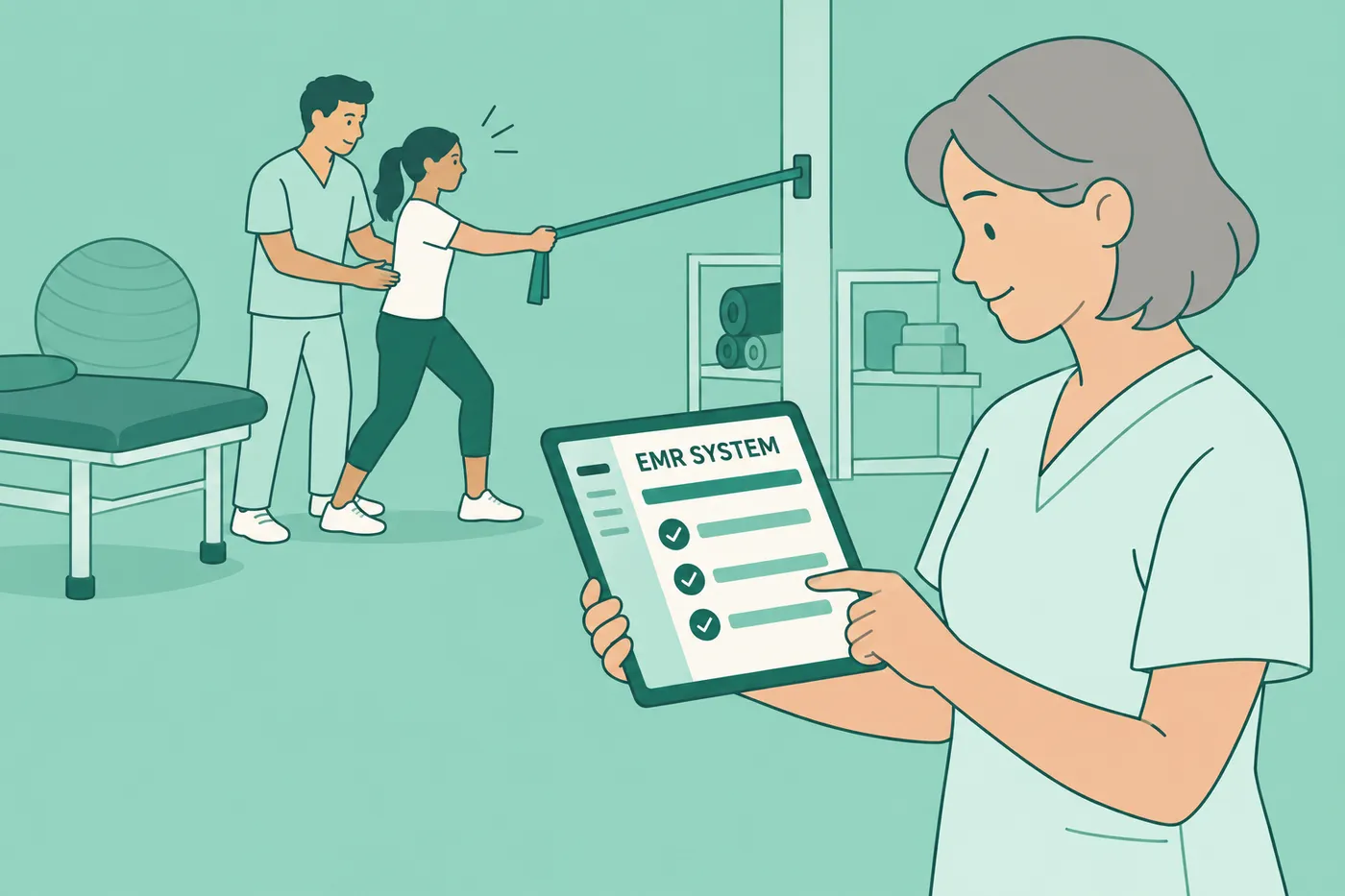
List EMRs by product name, whichever ones you can actually drive on day one. WebPT, Epic, Cerner, Net Health, Raintree, Clinicient. For a clinic replacing a therapist mid-caseload, "charting in our system from week one" is a genuine hiring factor, and travel PTs should make that breadth explicit. Classic modalities like e-stim and ultrasound earn a line only if the posting mentions them; leading your skills section with modalities dates the resume.
Clinical instructor, mentoring and program development are your leadership section
Most staff PTs have leadership experience and file it under "other." Wrong drawer. Supervising DPT students as a credentialed clinical instructor, mentoring new-grad hires through their first months, and building a program the clinic still runs are exactly the evidence a director wants when hiring for the next level up.
Give these bullets numbers like everything else. "APTA Credentialed Clinical Instructor; supervised two DPT students per year for five years" is verifiable through school placement records. "Built a direct-access injury screening program that brought in 15 new evaluations a month within a quarter" is a claim a director can check with one phone call, which is exactly why it gets believed. In-services count too, provided you name the topic and the audience instead of writing "presented in-services."
Pointing the same resume toward clinic director or rehab manager
A staff PT resume becomes a director candidate's resume by changing the weighting, not the history. Patient-level numbers prove you can treat. Team-level numbers prove you can run a clinic. If management is the goal, promote the operational bullets that are probably sitting at the bottom of each job entry.
That means the scheduling template you built that lifted the clinic's schedule fill rate. The hiring panels you sat on and the hires you helped make. The coverage you coordinated across a satellite location, and the monthly visits to referring physician practices that kept the evaluation pipeline full. None of these require a title to be true, and all of them can be confirmed by the manager you did them for.
Change the summary to match. "Senior outpatient PT and credentialed clinical instructor seeking a clinic director role, with experience in scheduling, hiring and referral development" tells the reader which job this page is applying for. The clinical numbers stay, one tier down, as proof the future director still understands the treating therapist's day.
The keywords PT screens run on, and where each one goes
Healthcare recruiters screen PT resumes on a short, predictable list. Most of it is credential and setting language rather than exotic skills, which means placement matters as much as presence. The same keyword does different work in the header, in the summary and in a bullet.
| Keyword or phrase | Where it belongs |
|---|---|
| Physical Therapist, PT, DPT | After your name and in the resume title line, in exactly those short forms |
| State license, number and status | Its own line directly under the summary |
| OCS (and the long ABPTS title) | Short form in the header, long form in certifications |
| Setting names (outpatient orthopedics, acute care, SNF) | Summary, plus a setting sub-line under each job |
| Manual therapy, plus named techniques | Skills section, backed by at least one bullet showing it in use |
| Home exercise program (HEP) | An experience bullet, tied to adherence or outcomes |
| EMR by product name (WebPT, Epic, Net Health) | Skills section, and the job entry where you used each one |
| Medicare / defensible documentation | A bullet in the setting where you carried a Medicare caseload |
| Direct access | Summary or a bullet, only if you have screened direct-access patients |
| CPR/BLS and other required certs | One line in certifications; required means findable, not prominent |
Scan your draft against the real posting before you send it
Every clinic writes its posting differently. One asks for "orthopedic manual therapy," another for "OMPT," a third just says "manual skills," and the recruiter's filter only matches what the recruiter typed. Before you send anything, pull the exact phrases from the job description and check your draft against them line by line.
This is the part worth automating. In Roleframe, you duplicate your base resume for the specific job, paste the posting, and get a fit report with your ATS score, the keywords the posting asks for that your resume is missing, and a prioritized plan. Then you make the edits yourself, with Remi suggesting rewrites bullet by bullet and you approving each one. On a clinical resume that approval step is the whole point, because a productivity percentage you cannot defend in the interview is worse than no number at all. Export the finished version as a PDF so the layout you built is the layout the clinic sees.
Frequently asked questions
- What should a physical therapist's resume look like?
One to two pages, reverse chronological, with credentials after your name and the license on its own line under the summary. Each role names the setting and carries numbers for caseload, daily visits and productivity. The skills section lists named techniques and EMR systems rather than personality traits. A new grad fits on one page; ten years of experience justifies two.
- How do I write a good resume for a physical therapy job with no experience?
Treat clinical rotations as experience. List each one with the setting, the length, and the volume you carried by the end, for example "final caseload of 10 patients per day under supervision." Name the outcome measures and the EMR you used. Directors hiring new grads are buying trajectory, and rotation numbers are the only trajectory data you have.
- What is a brief description of a physical therapist for a resume summary?
One or two sentences carrying your credential, your primary setting, one scope number and your target. "DPT with six years in outpatient orthopedics, carrying 13 visits a day at 90%+ productivity; board-certified OCS seeking a senior clinician role" does more work than any paragraph about passion for patient care.
- What skills should a physical therapist include on a resume?
Named manual therapy techniques you are trained in, the outcome measures you administer, the EMR systems you can use on day one, and documentation compliance. Soft skills like communication belong inside bullets as evidence, such as discharge recommendations accepted in rounds, rather than as items in a skills list.
- Should I put my license number on my resume?
Yes. It is public record, verifiable through your state board in seconds, and listing it saves the credentialing coordinator a step. Put state, number and status on one line under your summary. If you hold PT Compact privileges, add that to the same line.
- Do productivity percentages belong on a resume, and can employers check them?
They belong, and yes, a reference call to a former manager can confirm whether you ran at target. That verifiability is what makes the number persuasive. Use your real figure from clinic reports, and skip the metric entirely for any job where you never saw those reports rather than estimating high.
- Do short travel PT contracts hurt my resume?
Not if you group them. One travel block with the agency as the employer and each facility as a sub-line reads as range; seven separate three-month entries read as churn. Add a summary line naming a permanent role as your goal, since that is the unspoken question about every candidate coming off contracts.
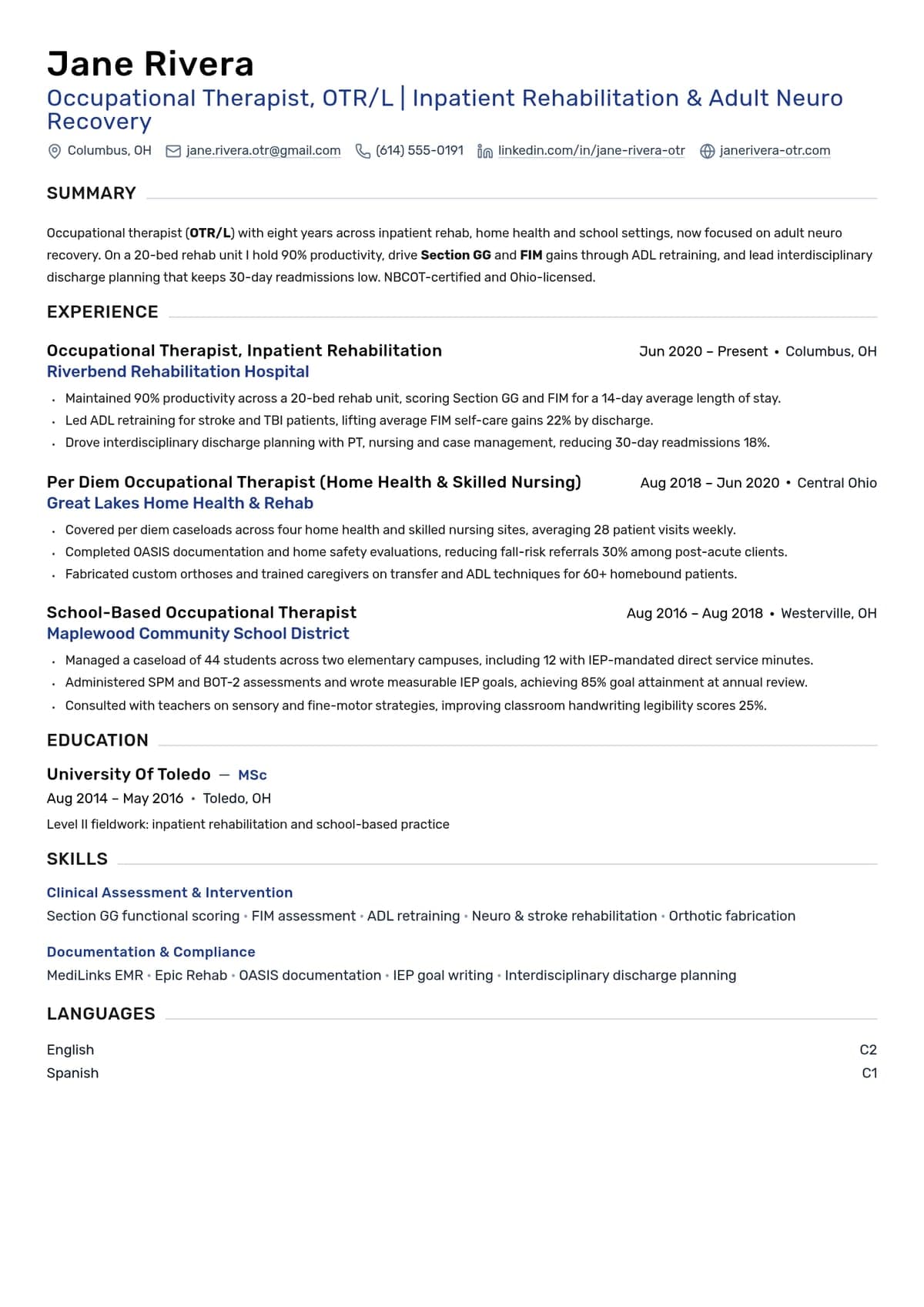


Build yours on the same template.
Every example here is built on a template you can open in the editor. Start from the same layout and write your own experience into it, then download the PDF free, with no watermark.


