
Junior Software Developer Resume Example & Writing Guide
by Larbi SahliLast Updated
A full junior software developer resume example, plus how keyword expectations shift between entry-level and junior postings, and what to write for each section.

On this page
A junior software developer resume has one job: prove you can ship code in a real codebase, with other people, under real constraints. That is the line between "junior" and "entry-level" in a recruiter's head. Entry-level postings ask whether you learned to program. Junior postings, the ones asking for one to two years of experience, ask whether you have already worked like a developer: pull requests reviewed and merged, tickets closed, bugs found in production and fixed.
Most candidates with a year or two of experience write their resume like a graduate: education first, a long list of languages, project descriptions that read like assignment briefs. That resume loses to people with less experience who framed theirs correctly. This guide shows you a complete example, walks through every section, and covers something the other example pages skip: how the keywords recruiters filter on actually change between entry-level and junior postings, based on the job descriptions Roleframe's job-analysis engine reads every day.
What Makes a Junior Software Developer Resume Effective
Three things separate the junior resumes that get callbacks from the ones that don't.
Evidence of production work, not just code. "Built a REST API in Flask" could describe a weekend tutorial. "Built and deployed a REST API that handles internal reporting requests for a 40-person sales team" describes a job. Every bullet on a junior resume should carry a signal that real users, real teammates, or a real deployment pipeline were involved.
Experience before education. Once you have professional experience, even a year of it, it goes above your degree. A hiring manager scanning your resume wants to know what you did last, and a resume that leads with a 2024 graduation date reads as more junior than you are. Recent graduates with only internships are the exception; more on that below.
A tech stack that matches how postings are written. Junior postings name specific tools: a framework, a cloud platform, a testing library, a workflow. A skills section that lists twelve languages you touched in school signals breadth without depth. Six to ten technologies you have genuinely used, grouped so a recruiter can scan them in two seconds, signals a developer who knows what they work with.
The example below shows all three in practice. Read it first, then use the section-by-section breakdown to build yours.
Junior Software Developer Resume Example
Devin Alvarez
Junior Software Developer | Python & JavaScript | Backend & Full-Stack | github.com/devinalvarez

Summary
Junior developer with about 18 months building production software in Python, Django, JavaScript, and PostgreSQL. Shipped a notifications service to 40,000 users and cut a key endpoint's response time by 84%. Comfortable working through pull requests, code review, and agile sprints, and looking to grow on a backend or full-stack team.
EXPERIENCE
Junior Software Developer
Shipped a Django notifications service to 40,000 users, cutting missed-alert support tickets by 32%.
Opened and reviewed 15+ pull requests monthly, keeping code review turnaround under 6 hours.
Cut a reporting endpoint from 2.1s to 340ms with query indexing and caching.
Software Engineering Intern
Built REST endpoints in Node.js and Express for an inventory tool used by 12 staff.
Added Jest unit tests raising coverage on the billing module from 44% to 78%.
Paired with two senior engineers in weekly sprints, closing 30+ Jira tickets.
Freelance Web Developer
Built responsive React sites for three local businesses, deployed on AWS Amplify.
Raised Lighthouse performance scores from the 60s to 90+ via image and lazy-load fixes.
Delivered every project on schedule, managing scope directly with each client.
EDUCATION
University of Texas at Austin
BSc
Bachelor of Science in Physics from Harvard University, Cambridge, Massachusetts, United States.
SKILLS
Languages & Databases
Frameworks, Tools & Cloud
LANGUAGES
PROJECTS
TaskFlow
Creator
github.com/devinalvarez/taskflow
Full-stack task board in React and Django REST, deployed on Render with 300+ signups and a public demo handling live drag-and-drop updates.
CERTIFICATIONS
AWS Certified Cloud Practitioner
Validated foundational knowledge of AWS cloud concepts, security, and billing.
Covered core services including EC2, S3, RDS, Lambda, and CloudFront.
Demonstrated understanding of shared responsibility model and basic architectural best practices.
AWARDS
Dean's List (four consecutive semesters)
University of Texas at Austin
Recognized for building a cloud-native AI productivity tool.
Notice what this resume does not do. It does not open with an objective statement about "seeking opportunities to grow." It does not list coursework. It does not pad the skills section with every tool mentioned once in a lecture. Every line answers the question a hiring manager is actually asking: can this person contribute to our codebase in their first month?
Formatting Your Resume for ATS Parsers
An applicant tracking system (ATS) is the software that stores and parses your resume before a human sees it. The horror stories are mostly wrong: an ATS does not auto-reject resumes for using the wrong font. What it does is parse your document into structured fields, and a resume that parses badly shows up as a garbled mess when the recruiter opens your profile.
For a junior developer resume, the formatting rules are short:
- One page. With one to two years of experience, a second page reads as padding, and recruiters agree on this more than on almost anything else.
- Standard section headings: Experience, Projects, Skills, Education. Parsers key on these words. "Where I've Made an Impact" confuses both the software and the human.
- Reverse-chronological order within Experience: current or most recent role first.
- No tables for layout, no text boxes, no columns for critical content like job titles and dates. A simple single-column body parses cleanly everywhere.
- Save and submit as PDF. A well-structured PDF preserves your formatting exactly and parses reliably in modern systems. Only send another format if a specific employer explicitly asks for one.
- Dates in a consistent format ("Jun 2024 – Present") aligned with each role, because parsers extract employment duration from them.
If you want the deeper treatment, including which design elements are safe and which break parsers, read our guide to building an ATS-friendly software engineer resume. The short version: clean beats clever, and clean can still look sharp.
Writing a Summary That Shows Growth Potential
A summary earns its three lines only if it says something the rest of the resume can't say as fast. For a junior developer, that something is trajectory: what you shipped, what stack you did it in, and where you are heading.
Here is the difference in practice.
Weak: "Motivated junior software developer with a passion for coding and problem-solving, seeking to grow my skills in a dynamic team environment."
Strong: "Software developer with 18 months of experience building and maintaining Python/Django services for an e-commerce platform. Shipped features used by 12,000 monthly customers, cut a key checkout query from 3s to 400ms, and now looking to go deeper on backend architecture."
The weak version contains zero facts. The strong version contains four: tenure, stack, a shipped outcome, and a direction. Note that the numbers in the strong version come from the candidate's own work, which is the only place your numbers should ever come from.
Skip the objective statement entirely unless you are changing careers into development, in which case a one-line objective explaining the pivot earns its place. We break down when each works in resume summary vs. objective, and there are 16 worked summaries in our professional summary guide if you want more patterns to steal from.
Detailing Your Tech Stack Without Keyword Stuffing
Keyword stuffing is listing every technology you have ever installed. It backfires twice. Recruiters discount a skills section with twenty entries because they know no junior developer is proficient in twenty things. And the first interview question about the tenth item on your list will expose the gap.
The fix is grouping and honesty. Structure your skills section in three or four labeled groups:
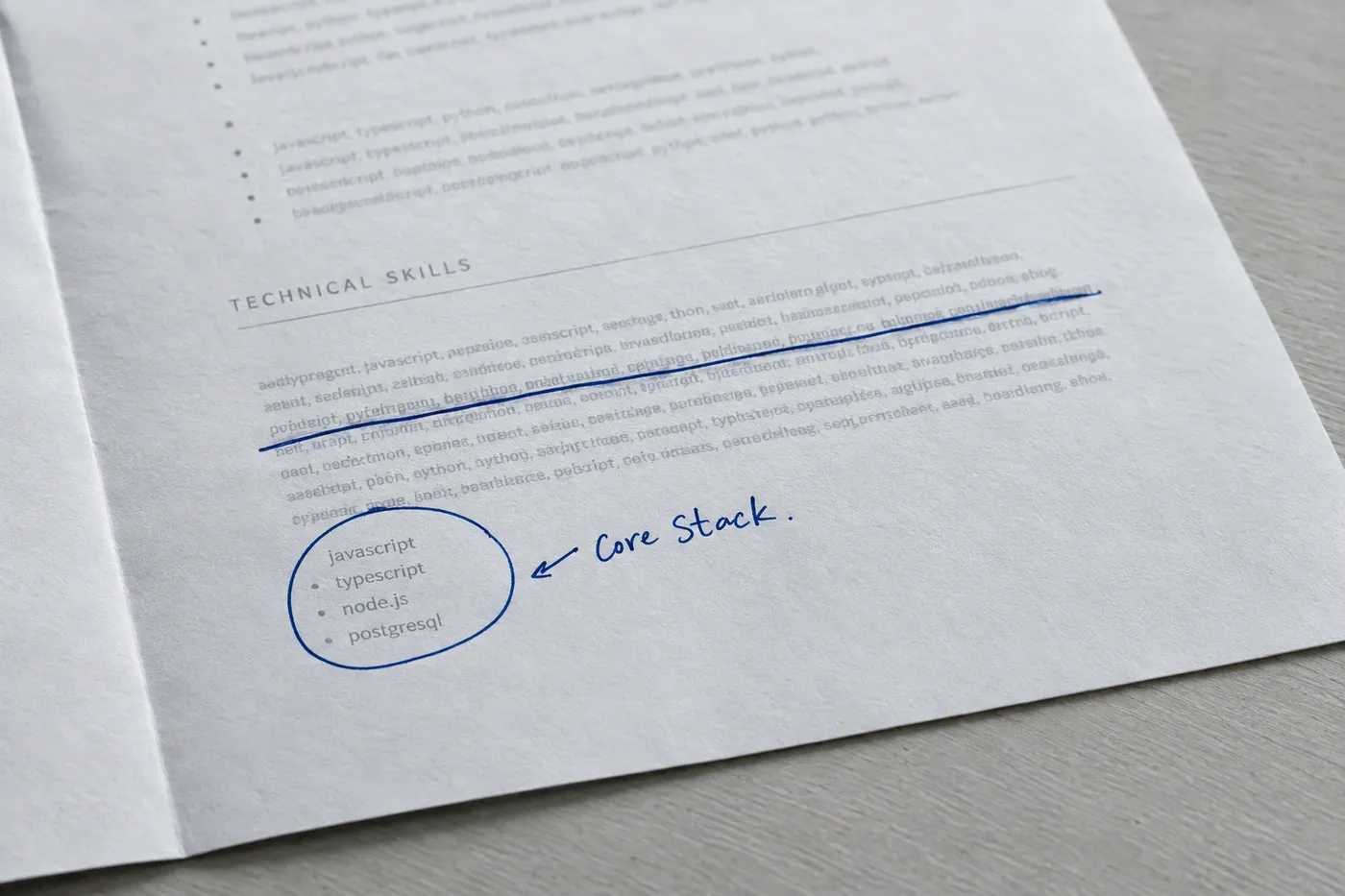
- Languages: the two to four you can be interviewed in today (e.g., Python, JavaScript, SQL)
- Frameworks & libraries: what you have built real things with (e.g., Django, React, pytest)
- Tools & platforms: your actual daily workflow (e.g., Git, Docker, AWS, PostgreSQL, Jira)
Then tailor the emphasis per application. If the posting is a React role and you have React experience, React belongs first in its group and in your summary, not buried mid-list. This is where a per-job check pays off: Roleframe's fit report reads the posting and shows which of its keywords your resume already covers and which are missing, so you are matching against the actual job instead of guessing. The judgment call, whether you can honestly claim a missing keyword, stays yours.
One more rule: never add a technology you cannot discuss for five minutes. A keyword gets you past a filter; the interview is where an inflated skills section goes to die. Our skills section examples show what to keep and what to cut for a dozen situations.
Showcasing Projects That Prove You Can Code
With one to two years of experience, projects are no longer the core of your resume, but a strong one still earns a section, especially if it demonstrates a skill your day job doesn't. A backend developer with a deployed side project in React tells a full-stack story their work experience can't.
What separates a project bullet that helps from one that hurts:
- It's deployed, or at least runnable, with a link. A GitHub repo with a clear README beats a paragraph of description. Put the link right on the project entry.
- It solves a problem someone actually had, even if that someone was you. "Built a CLI tool that automates my team's release notes, now used by 4 teammates" beats any tutorial-clone.
- The bullet names the stack and one technical decision. "Chose PostgreSQL over MongoDB for relational integrity across order data" shows engineering judgment, which is the thing junior interviews probe hardest.
- It's recent. A project untouched since your sophomore year signals the opposite of what you want.
Two or three projects maximum, one is fine if it's strong. For formatting details and more worked bullets, see how to list coding projects on a resume, and if you're deciding where your GitHub belongs, we cover placement in where to include your GitHub link.
Framing Internships and Co-ops
An internship is professional experience. Put it in your Experience section, titled exactly as it was ("Software Engineering Intern"), and write the bullets the same way you would for a full-time role: what you shipped, who used it, what changed because of it.
The mistake interns make is describing the program instead of the work. "Participated in a 12-week internship program at a fintech company" says nothing. "Fixed 14 bugs in the payments dashboard and shipped a CSV export feature that account managers requested for two quarters" says everything. If you were assigned tickets, reviewed in pull requests, or sat in sprint planning, those are production signals; make them visible.
Order matters here too. If your only experience is internships and co-ops, they still lead the resume, above education, as long as they are substantial. A three-month internship with real shipped work is a stronger opener than a degree. If you came through a bootcamp instead of a degree program, that has its own placement rules, covered in how to put a coding bootcamp on your resume.
Co-ops deserve special mention because they often run longer and carry more responsibility than internships. Don't compress a two-term co-op into one line. Give it the same bullet count you would give a job, because to the reader, it was one.
Entry-Level vs. Junior: How the Keywords Actually Change
This is the distinction most resume guides miss, and it changes what you should write. Roleframe's job-analysis engine reads real postings the way a recruiter does, mapping every requirement, and a consistent pattern shows up when you compare postings aimed at zero-experience candidates against postings asking for one to two years.
Entry-level postings screen for fundamentals. They emphasize languages, computer science concepts like data structures and algorithms, degree requirements, and a general "willingness to learn." The keyword profile is academic: the posting is asking whether you were trained.
Junior postings screen for workflow. The language requirements are still there, but the weight shifts to the machinery of professional development: version control and code review, continuous integration and delivery (CI/CD), automated testing, agile ceremonies, debugging in production, and collaboration terms like "cross-functional" and "stakeholders." The posting is asking whether you have already worked.

| Keyword category | Entry-level postings (0 years) | Junior postings (1–2 years) |
|---|---|---|
| Core languages (Python, Java, JavaScript) | Central requirement, often the whole ask | Assumed baseline; framework depth matters more |
| Data structures & algorithms | Frequently named, tied to interviews | Rarely emphasized in the posting itself |
| Git / version control | Sometimes listed as a plus | Expected; "code review" appears alongside it |
| CI/CD and deployment | Rare | Common, often with a named tool |
| Automated testing (unit, integration) | Coursework-level mention | Expected as a working practice |
| Agile / Scrum / sprints | Occasional | Standard, treated as lived experience |
| Production support / debugging | Almost never | Regular, a defining junior signal |
| Degree requirement | Often strict | Frequently softened to "or equivalent experience" |
The practical consequence: if you have a year or two of experience and your resume still reads like an entry-level one, heavy on coursework and language lists, light on workflow, you are underselling yourself on exactly the keywords junior postings filter for. Get "code review," "CI/CD," your testing framework, and your agile experience onto the page, in bullets that show you doing them, not in a bare list.
And it cuts the other way. If you are applying up from zero experience to junior roles, this table is your gap list. You can build several of these signals outside a job: run CI on your personal projects, write tests, review a friend's pull requests. Then the keywords on your resume are true. For the broader method of matching a resume to what filters scan for, see ATS resume keywords: stop guessing and start matching.
Hard Skills vs. Soft Skills on a Junior Resume
Hard skills belong in your skills section. Soft skills belong in your bullets, demonstrated, never listed. "Team player" in a skills section is a wasted line that recruiters have learned to skip. "Paired with a senior engineer to refactor the auth module, cutting review cycles on that codebase from days to hours" proves collaboration without naming it.
For junior developers specifically, three soft skills carry the most weight with hiring managers, and each has a bullet-level way to show it:
- Communication: bullets that mention writing documentation, presenting work in demos, or translating requirements from non-technical stakeholders.
- Receiving feedback: bullets about code review, iterating on a design after input, or shipping a v2 based on user complaints. Juniors who can absorb review comments without friction are the ones teams fight to keep.
- Ownership: bullets where you noticed a problem nobody assigned you and fixed it. "Identified and patched a memory leak that had caused three weekend pages" is the single most senior-sounding thing a junior resume can say.
The split matters because the two skill types are screened differently: hard skills by software and recruiter filters, soft skills by the hiring manager reading your bullets. We go deeper on that mechanic in hard skills vs. soft skills on your resume.
Start From the Resume You Already Have
You don't need to rebuild from a blank page. Export your current resume as a PDF and import it into Roleframe: it comes back as editable blocks, with your roles, dates, and bullets in place, and the analysis runs on its own, so the first thing you see is a scored resume with its weak sections named. From there, duplicate it for each junior posting you apply to, read the fit report to see which keywords the job asks for that you're missing, and make the edits yourself with Remi, Roleframe's career copilot, suggesting rewrites bullet by bullet. You approve every change, which means you can defend every line of it in the interview.
If you'd rather start fresh, the same document-grade editor is free to use with no account, and the PDF download has no watermark.
Frequently asked questions
- Should a junior software developer resume be one page?
Yes. With one to two years of experience, everything worth saying fits on one page, and a second page signals padding. Cut coursework, trim older projects, and keep three to five bullets for your main role. If you're on the fence about length by experience level, we break down when a resume should be one page or two.
- Can I apply to junior developer roles with no professional experience?
Yes, and people get hired this way, but your resume has to supply the signals junior postings screen for: version control with code review, automated testing, CI/CD, and shipped projects with real users. You can build every one of those into personal projects. A posting's years-of-experience line is a preference, not a law; a resume that demonstrates the workflow often beats one that merely has the tenure.
- Should I put my GPA on a junior developer resume?
Once you have professional experience, drop it unless it's exceptional and you graduated recently. Your shipped work is stronger evidence than any grade. The full decision tree is in should I put my GPA on my resume.
- What's the difference between a junior developer resume and an entry-level one?
Emphasis and keywords. An entry-level resume proves you learned to program: education leads, fundamentals and languages dominate. A junior resume proves you've worked as a programmer: experience leads, and bullets show code review, testing, deployment, and agile collaboration. Postings for the two screen on different keyword sets, so the same person should write the two resumes differently.
- How many projects should I include with 1–2 years of experience?
One to three, and only ones that add something your work experience doesn't: a different part of the stack, a deployed product with users, or evidence of initiative. Once your Experience section carries the resume, a weak project costs more space than it earns. Each project gets a link, a stack, and one or two outcome-focused bullets.
- Should I send my resume as a PDF or a Word document?
PDF, always, unless a specific employer explicitly requests otherwise. A PDF preserves your formatting exactly on every screen, and modern applicant tracking systems parse well-structured PDFs reliably. Roleframe's editor exports a PDF that matches the editor view exactly, so what you proofread is what the recruiter opens.
- How do I write a junior software developer resume summary?
Three lines, four facts: your tenure, your stack, one concrete shipped outcome with a number from your own work, and the direction you're growing in. Skip adjectives like "motivated" and "passionate"; they carry no information. If every sentence in your summary would survive a skeptical hiring manager asking "prove it," it's done.


Ready when you are
Send the tailored resume, not the generic one.
Paste a job posting and Roleframe scores your resume against it, then helps you close the gaps one approved edit at a time, so you apply while the role is still fresh.