
Paralegal Cover Letter Example & Writing Guide
by Larbi SahliLast Updated
A paralegal cover letter example that names real tools like Clio and Relativity, plus how to adapt it for litigation, corporate, and entry-level roles.

On this page
A paralegal cover letter is graded as a writing sample before anyone reads a word of its content. Legal hiring managers read briefs, contracts, and discovery responses for a living, and they apply the same eye to your letter: one typo, one vague claim, one paragraph of filler, and the application is done. That is the bad news. The good news is that most paralegal cover letters are generic enough that a specific one stands out fast.
This guide gives you a complete paralegal cover letter example built around a litigation role, then shows you how to rework it for corporate law and for an entry-level application. Along the way we cover the part almost every template skips: naming the case management and e-filing software the posting actually asks for, because that is what firms filter on before they ever evaluate your prose.
Why your paralegal cover letter needs to prove precision
Every paralegal cover letter claims attention to detail. Almost none of them demonstrate it. "I am a detail-oriented professional with strong organizational skills" tells a hiring manager nothing, because the candidate who missed three filing deadlines last year writes the same sentence as the one who never missed one.
Precision gets proven three ways in a legal cover letter. First, the letter itself is flawless: correct firm name, correct addressee, correct practice area, zero typos. Second, the claims are specific: a caseload number, a filing volume, a named court system, a named tool. Third, the letter shows you read the posting, by responding to what this firm asked for rather than what law firms want in general.
Compare two sentences. "I have experience with e-discovery and document review" could come from anyone. "I managed document review across a 40,000-document production in Relativity, tagging for privilege under a two-week deadline" could only come from someone who has done the work. The second sentence is what a litigation support manager stops on. Everything in this guide is in service of writing more sentences like it.
One more reason specificity matters: many firms and legal staffing agencies run applications through an applicant tracking system (ATS), software that screens documents for the terms in the job description. If the posting names Clio, Westlaw, or CM/ECF and your materials never do, you may be filtered before a human reads your carefully polished paragraphs. The tools belong in your resume first, and your cover letter is where you turn those keywords into a story.
Paralegal cover letter example: litigation focus
The example below is written for a mid-level litigation paralegal applying to a mid-size firm. Read it once for tone, then again for structure. Notice that it never uses the phrase "detail-oriented," yet every paragraph is evidence of exactly that. It opens with a concrete case-support win, names the tools the role requires, and quantifies the workload instead of describing it with adjectives.
Marcus Delacroix
Litigation Paralegal | Discovery, E-Filing & Trial Preparation
Dear Hiring Manager,
On a 14-defendant construction defect case last year, I ran document review in Relativity across 240,000 records, coded privilege, and built the trial exhibit binders that carried our team through a three-week jury trial. Your posting for a litigation paralegal describes exactly that work, and I would bring it to your firm.
Over five years supporting civil litigators, I have managed CM/ECF e-filing on more than 600 filings without a single rejection, drafted discovery responses, and maintained privilege logs under a defined two-review protocol so no confidential or privileged material ever left our control. I run Westlaw research daily and keep 40-plus active matters moving in Clio.
I would welcome the chance to discuss how my discovery and trial-prep experience fits your caseload. Thank you for your time and consideration.
Sincerely,
Marcus Delacroix

What this letter gets right, paragraph by paragraph
The opening: a result, not an announcement
Weak paralegal cover letters open with "I am writing to express my interest in the paralegal position I saw on Indeed." The hiring manager knows why you are writing. The example above opens with the strongest fact the candidate has, which does two things at once: it proves competence in the first sentence, and it signals that the rest of the letter will not waste the reader's time.
Your version of that opening should carry a number where you have one. Caseload size, document volumes, number of depositions summarized, filings per month, trials supported. Legal work generates measurable output constantly, and a letter with zero numbers reads like the candidate never tracked their own work.
The body: tools and practice area, matched to the posting
The middle paragraphs do the matching work. The posting asked for e-discovery experience, so the letter names Relativity and describes a real production. The posting asked for federal court filing, so the letter names CM/ECF rather than saying "court filing systems." Named tools survive both the ATS filter and the skim read; generic descriptions survive neither.
The body is also where the letter mirrors the firm's practice area. A litigation letter talks about discovery, depositions, motion practice, and trial prep. It does not spend a paragraph on contract management, because that paragraph would tell the reader the letter is recycled.
The close: confident and short
The close restates the fit in one line and asks for the conversation. No "I hope to hear from you at your earliest convenience," no paragraph re-summarizing the letter. Legal readers respect economy. A three-sentence close that ends on a specific reason you want this firm beats a six-sentence close that ends on gratitude.
Adapting the example for corporate law
A corporate paralegal letter keeps the same skeleton and swaps the evidence. The precision argument does not change; what changes is the vocabulary of the work and the tools that carry it.
Where the litigation letter talks about discovery and trial prep, the corporate version talks about entity management, closing checklists, due diligence, board minutes, and regulatory filings. Where the litigation letter names Relativity and CM/ECF, the corporate version names document management systems like iManage or NetDocuments, entity management platforms, and state filing portals for formations and annual reports.
The quantification changes shape too. Corporate paralegals count entities maintained, closings supported, diligence data rooms organized, and filing deadlines hit across jurisdictions. "Maintained corporate records for a portfolio of subsidiaries across multiple states, with no missed annual report deadlines" is the corporate equivalent of the litigation letter's document-production line. If you support M&A work, a sentence about running a closing checklist under deal pressure is worth more than any adjective in the language.
Tone shifts slightly as well. Corporate legal departments and transactional groups tend to read for reliability and process; litigation groups read for speed under deadline. Both want precision, but the corporate letter should feel steady where the litigation letter feels fast.
The entry-level paralegal cover letter: no experience, real evidence
An entry level paralegal cover letter has a different job: it has to substitute credentials and adjacent experience for a work history it does not have. The mistake most new grads make is apologizing for that, with openers like "Although I have no professional paralegal experience..." Never open with your gap. Open with what you do have.
You have more evidence than you think. In rough order of weight:
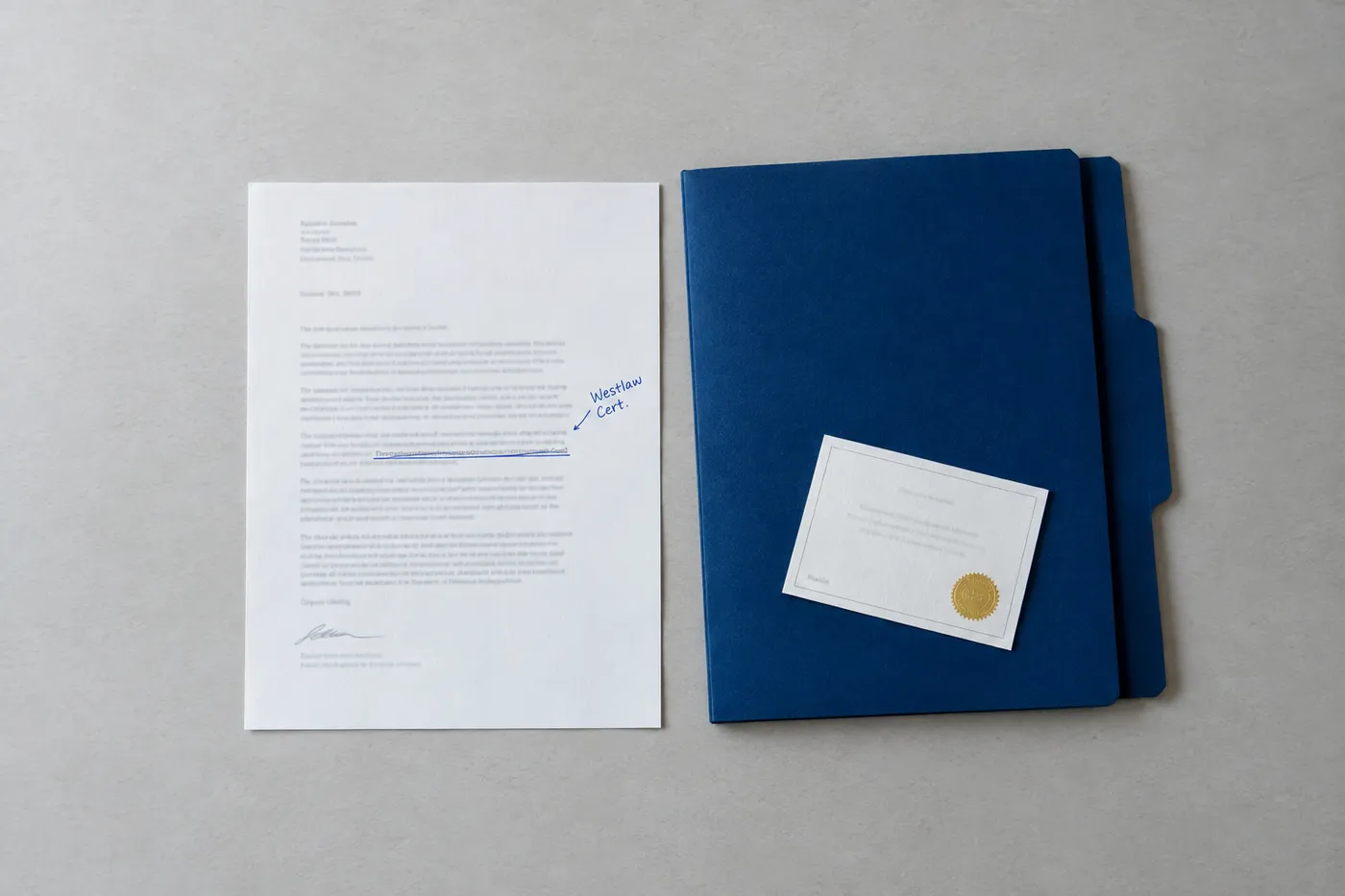
- Your paralegal certificate or degree, especially from an ABA-approved program, named specifically with any legal research or litigation coursework that matches the posting.
- Westlaw or LexisNexis training from your program. Most paralegal programs include certified research training, and it is a real, named tool you can put in the letter honestly.
- Internships, clinic work, or volunteer work at legal aid organizations. Even a semester of intake interviews and file organization is legal work product you can describe concretely.
- Precision-heavy work from other fields. Banking, insurance claims, medical records, executive support: any role where an error had consequences and you kept the error rate at zero is directly relevant, and you should say so in those terms.
- Confidentiality experience from any prior role, since handling sensitive information responsibly transfers directly to legal work.
The structure of the entry-level letter mirrors the example above: open with your strongest concrete fact (the certificate plus a specific internship result works well), spend the body matching the posting's requirements to your coursework and adjacent experience, and close short. One honest sentence about why you chose this practice area does more for a junior letter than three sentences of enthusiasm, because it shows you know what the work actually is.
If your path to paralegal work includes a gap or a career change, address it in one forward-looking sentence rather than an explanation. There is a full breakdown of that technique in our guide on explaining an employment gap in a cover letter.
How to highlight case management and e-filing software
Software is where paralegal postings get specific, and where most cover letters go vague. Firms do not hire "proficiency with legal technology." They hire someone who can be productive in their stack in week one, and the posting usually names that stack. Your job is to name it back, attached to real work.
The tools cluster by practice setting. Small and mid-size firms run practice management platforms like Clio, MyCase, or Filevine. Litigation shops add e-discovery platforms, with Relativity and Everlaw the names that come up most, plus federal e-filing through CM/ECF and docket research through PACER. Corporate and in-house teams lean on document management systems like iManage and NetDocuments. Nearly everyone expects research competence in Westlaw or LexisNexis.
| Practice setting | Tools postings commonly name | How to reference them in the letter |
|---|---|---|
| Small / mid-size firm | Clio, MyCase, Filevine, PracticePanther | Tie the tool to intake, calendaring, or billing work: what you managed in it and at what volume |
| Litigation | Relativity, Everlaw, CM/ECF, PACER, Westlaw | Attach it to a production, a review, or a filing deadline with numbers |
| Corporate / transactional | iManage, NetDocuments, entity management platforms | Attach it to closings, diligence, or entity maintenance across jurisdictions |
| Any setting | Westlaw, LexisNexis, Microsoft Office / Adobe Acrobat | Mention research tools with the task: cite-checking, memo research, Bluebook work |
Two rules keep this honest and effective. First, only name tools you can discuss in an interview; a claimed Relativity certification you cannot back up will surface in the first ten minutes. Second, never list tools bare. "Proficient in Clio, Westlaw, and CM/ECF" is a resume line, and a weak one. In the letter, each tool gets a verb and a result: filed in it, reviewed in it, managed a deadline calendar in it. If the posting names a tool you have not used but you have used a direct equivalent, say that plainly: "I ran document review in Everlaw and expect a fast ramp on Relativity" is credible in a way silence is not.
If you want to see exactly which terms a specific posting is weighting before you write, our guide to ATS resume keywords covers how keyword matching actually works and how to check your coverage against a real job description.
Confidentiality and attention to detail: show, don't claim
These are the two traits every legal employer screens for, and they are the two traits you cannot claim with adjectives. The fix is the same for both: describe the process, not the trait.
For confidentiality, one sentence about how you handled privileged material does the work. Tagging for privilege during review, maintaining separation between matters, handling medical or financial records under a defined protocol. You are not revealing anything confidential by describing the safeguard itself, and the sentence signals that you understand privilege as a practice rather than a vocabulary word.
For attention to detail, the letter is the demonstration. Get the addressee's name and title exactly right. Get the firm name exactly right, including any ampersand or comma the firm uses. Match the practice area terminology the firm uses on its own site. Then proofread the way you would proofread a filing: print it or change the font, read it once out loud, and read it once bottom to top. A paralegal letter with a typo is not a letter with a typo, it is a work sample with an error, and legal readers treat it that way.
Matching the firm's practice area
A recycled letter is easiest to spot in its middle paragraphs, where the candidate describes work the firm does not do. Ten minutes of research prevents it. Read the firm's practice area pages, note the terms they use for their own work, and check the specific attorneys or group the role supports if the posting says.
Then make one deliberate match in the letter. A personal injury firm cares about medical records management and lien resolution. An immigration practice cares about form preparation volume and USCIS deadlines. A family law office cares about client communication under emotional pressure. An insurance defense shop cares about reporting requirements and billing guidelines. One sentence that speaks the firm's specific language outweighs a paragraph of general litigation experience, because it answers the question every hiring manager is silently asking: does this person understand what our days look like?
For big law specifically, tighten everything. Large firms expect a conservative, one-page letter with zero flourish: firm name, practice group, your strongest credentials and matter experience, and a clean close. The Yale and Columbia career offices frame the cover letter as your first writing sample precisely because that is how large-firm recruiting reads it. Save the personality for the interview.

Drafting your letter with Remi: from resume to finished draft
The hard part of everything above is not knowing what to do. It is doing it for the fourth posting this week, when each firm names a different stack and a different practice area and the deadline pressure pushes you back toward the generic letter you swore off.
This is the workflow Roleframe was built for. You keep a base resume, duplicate it for the specific paralegal posting, and paste the job description. The fit report reads the posting the way a recruiter does: it scores your resume against it, lists the exact keywords the firm is filtering for, and flags which ones your materials are missing, including the software names. From there, Roleframe drafts a job-specific cover letter grounded in your actual resume and that posting, so the draft names your real tools and your real matters instead of inventing generic enthusiasm. Then you edit it with Remi, your career copilot, which proposes changes one at a time and applies nothing until you approve it. The letter that goes out is one you wrote and can defend line by line, which matters more in legal hiring than anywhere else.
That grounding step is the difference between a usable draft and the interchangeable output most generators produce. We wrote up why most tools get this wrong in our piece on AI cover letter generators that work from your resume, and if you just need a clean, free place to write and export the letter, see the best free cover letter builder without sign-up. Either way, send the finished letter as a PDF so the formatting the firm sees is the formatting you approved.
Common mistakes that sink legal cover letters
- Opening with "I am writing to express my interest in the paralegal position." The reader knows. Open with your strongest fact instead.
- Claiming "attention to detail" as an adjective while the letter contains a typo, a wrong firm name, or the previous firm's name left in from the last application. This single mistake ends more legal applications than any other.
- Listing software without context. "Proficient in Clio and Westlaw" is filler; "managed intake and deadline calendaring for 60 active matters in Clio" is evidence.
- Repeating the resume paragraph by paragraph. The letter's job is to connect your experience to this firm's practice, not to restate the document sitting next to it.
- Ignoring the practice area. Sending a letter about trial support to a transactional group signals you did not read the posting, let alone the firm's site.
- Going past one page. Legal readers are trained to value economy. Three to four tight paragraphs is the ceiling.
- Overexplaining a gap or a career change. One forward-looking sentence, then back to the evidence.
- Begging in the close. "I would be grateful for any opportunity to discuss" reads as weak. "I would welcome the chance to discuss how my discovery experience fits your litigation group" reads as ready.
- Sending anything other than a PDF unless the firm explicitly asks for another format. A PDF locks your formatting; other formats can reflow on the reader's screen.
Frequently asked questions
- How long should a paralegal cover letter be?
One page, and closer to three-quarters of a page in practice: three to four paragraphs, roughly 250 to 350 words. Legal hiring managers read economically written documents all day and notice when yours is not one. If a sentence does not add evidence of fit, cut it.
- Do I really need a cover letter for a paralegal job?
In legal hiring, more than almost anywhere else, yes. The cover letter doubles as your first writing sample, and firms use it to screen for the exact skills the job requires: precision, clarity, and judgment. Skipping it when the posting requests one is read as a red flag, and a strong one can carry a resume that is a near-miss on paper.
- How do I write a paralegal cover letter with no experience?
Lead with your credential, not your gap: your paralegal certificate or degree, ideally from an ABA-approved program, plus any Westlaw or LexisNexis training it included. Then convert adjacent experience into legal-relevant evidence, such as internships, legal aid volunteering, or precision-heavy work in banking, insurance, or records management. Never open by apologizing for what you lack; open with the strongest concrete fact you have.
- How do I address a paralegal cover letter when I don't know the hiring manager's name?
Try to find one first: the firm's website, the posting itself, or LinkedIn will often surface the office manager, paralegal manager, or hiring partner. If you genuinely cannot find a name, "Dear Hiring Manager" or "Dear [Firm Name] Hiring Committee" is fine. Never guess a name, and never use "To Whom It May Concern," which reads as dated in legal settings.
- Should I mention my paralegal certification in the cover letter?
Yes, and specifically. Name the credential, such as a certificate from an ABA-approved program or a NALA Certified Paralegal designation, in the first or second paragraph if the posting asks for it. Certifications are a screening criterion at many firms, so the letter should confirm the match early rather than leaving the reader to hunt for it on the resume.
- Should my cover letter mention specific software like Clio or Relativity?
If the posting names a tool you have used, name it back, attached to real work: what you did in it and at what volume. Software names are among the terms applicant tracking systems and skimming recruiters check first. If you have used a close equivalent instead, say so honestly rather than staying silent or overstating.
- Can I use the same cover letter for litigation and corporate paralegal jobs?
No, and this is the fastest way to sound generic. The structure can stay the same, but the evidence must change: discovery, depositions, and e-filing for litigation; entity management, closings, and diligence for corporate. A letter describing trial support sent to a transactional group tells the reader you did not research the firm.


Ready when you are
Send the tailored resume, not the generic one.
Paste a job posting and Roleframe scores your resume against it, then helps you close the gaps one approved edit at a time, so you apply while the role is still fresh.